
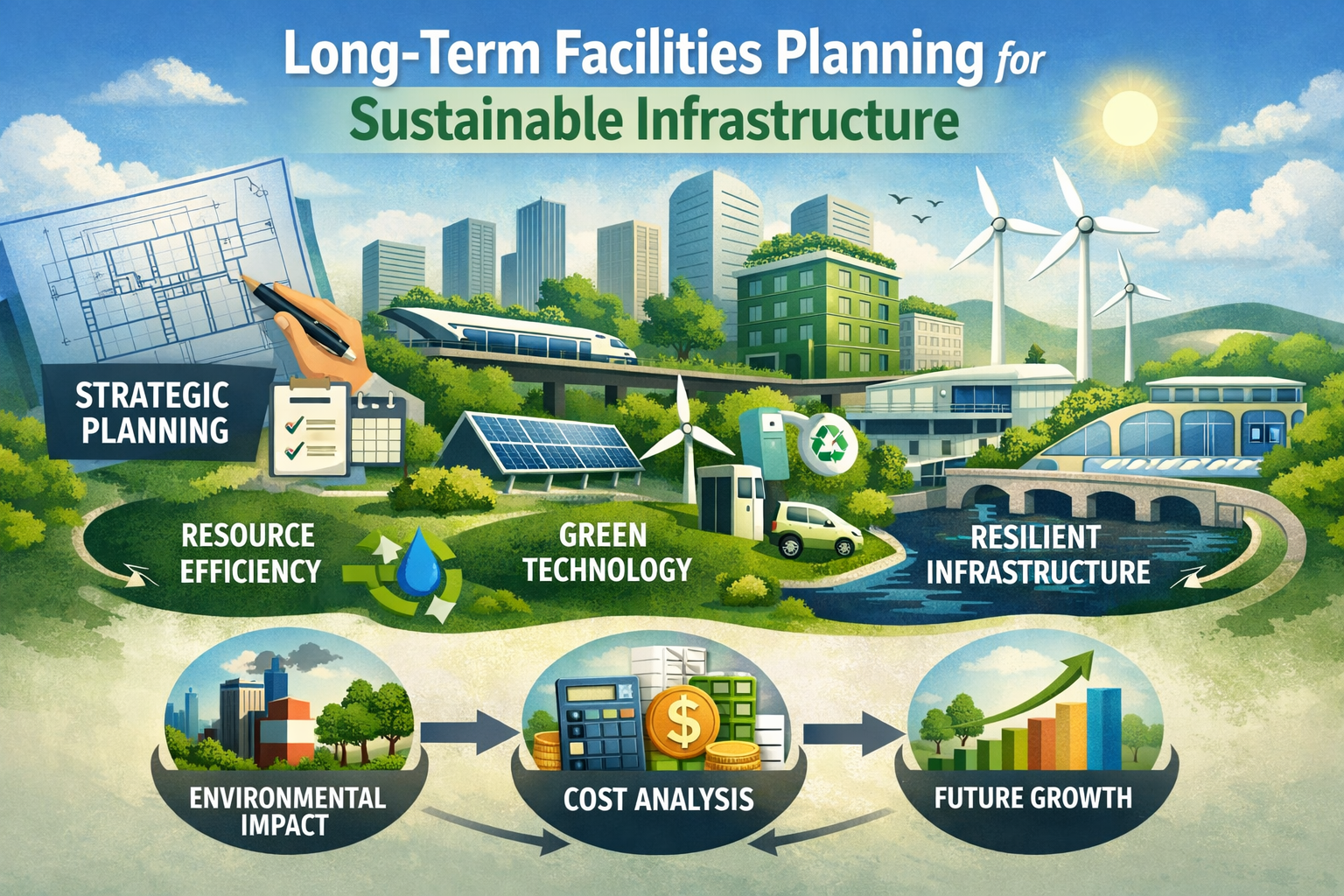
Long-term facilities planning is a critical component of effective infrastructure planning. It ensures that organizations, cities, and institutions can meet future operational needs while optimizing costs, performance, and sustainability. Whether for corporate campuses, manufacturing plants, hospitals, schools, or public infrastructure, long-term facilities planning provides a structured approach to aligning physical assets with long-term strategic goals.
In an era of rapid technological change, population growth, and increasing environmental constraints, infrastructure planning can no longer focus only on short-term capacity. Instead, decision-makers must adopt a forward-looking framework that considers lifecycle costs, adaptability, resilience, and stakeholder needs.
This article explores the principles, processes, and best practices of long-term facilities planning, offering practical insights for organizations seeking to build infrastructure that remains valuable for decades.
What Is Long-Term Facilities Planning?
Long-term facilities planning is the systematic process of analyzing, forecasting, and designing physical infrastructure to support organizational or community needs over a long time horizon, typically 10 to 30 years or more.
It goes beyond simple construction planning. Instead, it integrates strategic objectives, operational requirements, financial constraints, regulatory standards, and future growth scenarios into a cohesive infrastructure roadmap.
At its core, long-term facilities planning answers three fundamental questions:
- What facilities are needed in the future?
- Where should they be located and how should they be designed?
- How can they be delivered and maintained sustainably and cost-effectively?
By addressing these questions early, organizations can avoid costly reactive investments and instead develop infrastructure that evolves with their mission.
Why Long-Term Facilities Planning Matters?
Effective infrastructure planning depends heavily on long-term facilities planning. Without it, organizations often face issues such as space shortages, inefficient layouts, outdated systems, and escalating maintenance costs.
Some of the key benefits include:
1. Cost Control and Lifecycle Optimization
Long-term facilities planning shifts focus from upfront capital costs to total lifecycle costs. This includes construction, operations, maintenance, upgrades, and eventual replacement. Planning for these factors early enables better financial forecasting and more sustainable budget allocation.
2. Strategic Alignment
Facilities should directly support organizational strategy. For example, a hospital planning to expand specialized care services must ensure that its physical infrastructure can accommodate new technologies, workflows, and patient volumes.
3. Risk Reduction
Poor infrastructure decisions can lock organizations into inefficient systems for decades. Long-term facilities planning reduces this risk by testing multiple future scenarios and building flexibility into designs.
4. Sustainability and Compliance
Environmental regulations and sustainability standards are becoming more stringent. Proactive infrastructure planning allows organizations to integrate energy efficiency, carbon reduction, and resilience from the start.
Key Components of Long-Term Facilities Planning
A comprehensive long-term facilities planning framework typically includes the following elements:
1. Needs Assessment
This step involves analyzing current facilities, utilization rates, performance issues, and future demand. Data sources may include occupancy metrics, asset condition assessments, operational bottlenecks, and stakeholder interviews.
The goal is to understand not just what exists today, but what will be required in the future.
2. Demand Forecasting
Forecasting future demand is central to infrastructure planning. This may involve:
- Workforce growth projections
- Population trends
- Market expansion plans
- Technology adoption scenarios
Accurate forecasting prevents both underbuilding (leading to shortages) and overbuilding (leading to wasted capital).
3. Space and Functional Planning
This phase translates demand into physical space requirements. It considers how spaces will be used, how workflows will operate, and how departments or functions should be co-located.
For example, in manufacturing, this may include production flows and material handling. In education, it may include classroom utilization and student movement.
4. Financial Modeling
Long-term facilities planning requires robust financial analysis. This includes:
- Capital expenditure planning
- Operating cost projections
- Funding sources and financing strategies
- Cost-benefit analysis of alternative scenarios
Financial modeling ensures that infrastructure planning remains economically viable over time.
5. Risk and Scenario Analysis
Future conditions are uncertain. Effective infrastructure planning tests multiple scenarios, such as:
- High-growth vs low-growth outcomes
- Technology disruptions
- Regulatory changes
- Environmental risks
This allows planners to design facilities that are adaptable rather than rigid.
Best Practices in Long-Term Facilities Planning
Organizations that excel in infrastructure planning tend to follow a set of proven best practices.
1. Integrate Planning with Business Strategy
Facilities planning should not exist in isolation. It must be directly linked to corporate, institutional, or public-sector strategy. Every major infrastructure investment should clearly support long-term goals.
2. Prioritize Flexibility and Modularity
Rigid infrastructure becomes obsolete quickly. Modern long-term facilities planning emphasizes flexible layouts, modular construction, and scalable systems that can evolve as needs change.
3. Use Data-Driven Decision Making
Asset data, performance metrics, and predictive analytics improve planning accuracy. Digital tools such as Building Information Modeling (BIM) and facility management systems enable better long-term forecasting.
4. Engage Stakeholders Early
End users, operations teams, financial leaders, and external partners should all be involved early in the planning process. This reduces resistance, improves design quality, and ensures that facilities truly meet operational needs.
5. Plan for Sustainability and Resilience
Climate risks, energy costs, and regulatory pressures make sustainability a core part of infrastructure planning. Long-term facilities planning should incorporate:
- Energy-efficient systems
- Renewable energy integration
- Water conservation
- Disaster resilience
These factors protect both financial and operational performance over time.
Common Challenges and How to Overcome Them
Despite its importance, long-term facilities planning often faces practical challenges.
1. Uncertain Future Conditions
No forecast is perfect. The solution is not to seek certainty, but to design for adaptability. Scenario planning and flexible design principles help mitigate uncertainty.
2. Budget Constraints
Capital limitations often lead to short-term thinking. However, long-term facilities planning demonstrates that strategic investments typically reduce total cost of ownership over time.
3. Organizational Silos
Facilities planning may be disconnected from operations or strategy. Strong governance structures and cross-functional teams help integrate infrastructure planning into overall decision-making.
4. Resistance to Change
Stakeholders may prefer familiar systems. Transparent communication, clear business cases, and early engagement reduce resistance and increase adoption.
The Role of Technology in Infrastructure Planning
Digital transformation is reshaping long-term facilities planning. Advanced tools enable better analysis, visualization, and decision-making.
Key technologies include:
- Building Information Modeling (BIM): Enables lifecycle modeling of facilities.
- Digital Twins: Provide real-time performance data and predictive insights.
- AI and Analytics: Support demand forecasting and scenario testing.
- Facility Management Systems: Improve asset tracking and maintenance planning.
These tools allow infrastructure planning to move from reactive problem-solving to proactive strategic management.
Long-Term Facilities Planning in Different Sectors
The principles of infrastructure planning apply across industries, but each sector has unique priorities.
Healthcare
Focus on patient flows, regulatory compliance, medical technology integration, and resilience.
Manufacturing
Emphasis on production capacity, automation readiness, logistics efficiency, and scalability.
Education
Driven by enrollment trends, learning models, campus experience, and technology integration.
Public Sector
Centered on population growth, service accessibility, budget transparency, and community impact.
Regardless of sector, the core objective remains the same: align physical infrastructure with long-term mission and performance goals.
Conclusion: Building Infrastructure for the Future
Long-term facilities planning is not simply a technical exercise. It is a strategic discipline at the heart of effective infrastructure planning. Organizations that invest in structured, data-driven, and forward-looking planning frameworks consistently outperform those that rely on short-term fixes.
By integrating strategic objectives, financial modeling, risk analysis, and sustainability principles, long-term facilities planning enables decision-makers to create infrastructure that remains relevant, efficient, and resilient for decades.
In a world defined by rapid change and increasing complexity, the true value of infrastructure planning lies not in building more, but in building smarter, with a clear vision of the future.