
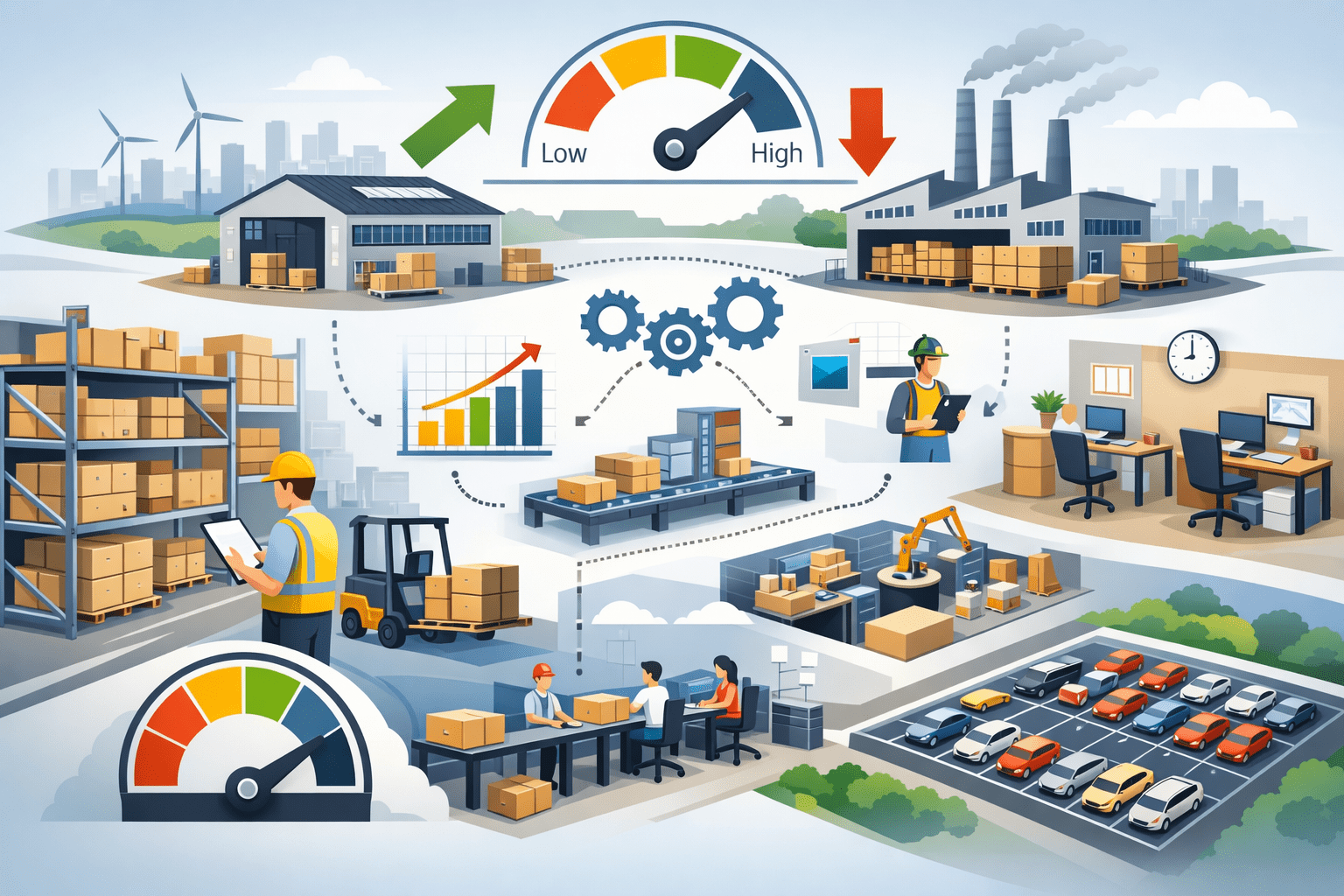
Capacity and utilization considerations play a central role in modern infrastructure planning. As organizations invest in long-term facilities planning, they must not only determine how much space or output is required, but also how effectively that capacity will be used over time. Therefore, successful infrastructure planning depends on balancing demand, efficiency, flexibility, and long-term strategic goals.
Without a structured approach, organizations often face two costly outcomes. On one hand, they may overbuild and carry unnecessary capital and maintenance costs. On the other hand, they may underbuild and suffer from congestion, operational delays, and limited growth. Consequently, capacity and utilization must remain core decision factors throughout the planning process.
This article examines how capacity and utilization considerations influence long-term facilities planning and explains how organizations can apply data-driven frameworks to create sustainable infrastructure strategies.
Understanding Capacity in Infrastructure Planning
In infrastructure planning, capacity refers to the maximum level of activity that a facility can support under normal operating conditions. However, capacity varies significantly by industry and operational model.
For example, in manufacturing, capacity usually refers to production output per hour or shift. In healthcare, it typically involves patient beds, treatment rooms, or diagnostic volumes. Meanwhile, in education, capacity relates to classroom seats and enrollment levels. In corporate environments, it often refers to workstations or occupancy limits.
Importantly, long-term facilities planning treats capacity as a dynamic variable rather than a fixed constraint. As organizations grow, adopt new technologies, or change workflows, capacity requirements will evolve. Therefore, infrastructure planning must anticipate future conditions instead of reacting to immediate pressures.
The Role of Utilization in Long-Term Facilities Planning
While capacity shows what a facility can handle, utilization shows how much of that capacity is actually being used. In other words, utilization measures real performance.
For instance, a facility may be designed for 1,000 users but consistently operates at only 600. As a result, utilization stands at 60 percent, which may indicate inefficiencies or shifts in operational behavior.
Utilization is commonly calculated using the following formula:
Utilization = (Actual Usage ÷ Maximum Capacity) × 100
However, high utilization does not always indicate success. In fact, extremely high utilization often leads to congestion, system stress, and reduced service quality. Conversely, very low utilization suggests wasted resources and poor capital efficiency. Therefore, long-term facilities planning seeks to achieve optimal, not maximum, utilization.
Why Capacity and Utilization Matter in Infrastructure Planning?
Capacity and utilization considerations directly shape strategic infrastructure decisions. As a result, they influence financial performance, operational efficiency, and long-term risk exposure.
1. Capital Efficiency
First, infrastructure requires significant capital investment. Overestimating demand leads to unused assets and higher operating costs. Meanwhile, underestimating demand forces organizations to make emergency expansions, which are usually more expensive.
Therefore, long-term facilities planning ensures that capital spending aligns with realistic demand forecasts and strategic priorities.
2. Operational Performance
Second, infrastructure directly affects productivity, safety, and service quality. When facilities operate beyond designed capacity, equipment failures increase and employees experience higher stress levels. Consequently, performance and morale decline.
By contrast, balanced capacity supports smoother workflows and consistent service delivery.
3. Risk Management
Finally, facilities operating at near-maximum utilization have little room to absorb disruptions. For example, unexpected demand spikes or equipment breakdowns can quickly overwhelm systems.
Thus, infrastructure planning must include buffer capacity to manage operational risk and maintain resilience.
Key Factors in Capacity Planning
Effective long-term facilities planning requires systematic evaluation of several critical factors.
1. Demand Forecasting
To begin with, demand forecasting provides the foundation for all capacity decisions. Organizations must analyze historical data, market trends, growth projections, and strategic initiatives.
Moreover, planners should develop multiple scenarios rather than relying on a single forecast. By doing so, they can prepare for both optimistic and conservative outcomes.
2. Process Efficiency
Next, capacity depends not only on physical space but also on how processes are designed. Workflow optimization, automation, and layout improvements often increase effective capacity without expanding facilities.
Therefore, infrastructure planning must integrate operational design with physical design.
3. Technology Impact
Additionally, technology significantly affects capacity requirements. For example, automation may reduce labor space needs but increase energy and data infrastructure demands.
As a result, long-term facilities planning must anticipate how emerging technologies will reshape capacity profiles.
4. Regulatory and Safety Constraints
Finally, legal occupancy limits, environmental regulations, and safety standards impose fixed capacity boundaries. Consequently, planners must integrate regulatory compliance into early infrastructure decisions.
Utilization Analysis in Long-Term Facilities Planning
Utilization analysis helps organizations identify inefficiencies and improvement opportunities. Furthermore, it provides objective data to support infrastructure investments.
Common Utilization Metrics
Different sectors use different indicators, including:
- Space utilization (occupied versus available space)
- Equipment utilization (runtime versus idle time)
- Throughput utilization (actual output versus design output)
- Time utilization (hours in use versus total available hours)
By combining these metrics, long-term facilities planning creates a comprehensive utilization profile that supports informed decision-making.
Balancing Overcapacity and Overutilization
One of the most difficult challenges in infrastructure planning involves balancing excess capacity with operational intensity.
Risks of Overcapacity
Overcapacity leads to higher capital costs, increased maintenance, and lower return on investment. Additionally, unused space often becomes difficult to repurpose effectively.
Risks of Overutilization
Overutilization causes congestion, equipment fatigue, and declining service quality. Furthermore, it increases the likelihood of system failures and employee burnout.
Therefore, most organizations aim for a utilization range between 70 and 85 percent. This range provides efficiency while still maintaining operational flexibility.
Scenario Planning for Capacity and Utilization
Because future conditions remain uncertain, scenario planning plays a critical role in long-term facilities planning.
Organizations typically evaluate scenarios such as:
- High growth demand
- Low growth or decline
- Technology disruption
- Regulatory change
By analyzing capacity and utilization under each scenario, planners can design infrastructure that remains effective across multiple futures.
Best Practices for Capacity and Utilization Planning
Organizations that succeed in infrastructure planning consistently apply proven best practices.
1. Design for Flexibility
First, flexible layouts and modular systems allow facilities to adapt to changing needs. Consequently, organizations avoid costly redesigns.
2. Use Data and Analytics
Second, real-time data improves forecasting accuracy and utilization monitoring. Therefore, digital tools enable continuous optimization.
3. Align with Strategic Planning
Third, capacity planning must integrate with business strategy, workforce planning, and financial forecasts.
4. Plan for Lifecycle Performance
Finally, planners should evaluate facilities based on long-term performance rather than short-term occupancy.
The Role of Technology in Modern Capacity Planning
Technology has transformed infrastructure planning from reactive management to proactive optimization.
Key tools include:
- Building Information Modeling (BIM)
- Digital twins
- Predictive analytics
- Facility management platforms
Together, these systems allow organizations to simulate capacity changes, track utilization trends, and optimize infrastructure investments.
Sector Applications of Capacity and Utilization Planning
Capacity and utilization considerations apply across industries.
In healthcare, planners manage patient volumes and emergency preparedness. In manufacturing, they align production with market demand. In education, they forecast enrollment trends. Meanwhile, in corporate real estate, organizations optimize space for hybrid work models.
Despite these differences, the underlying objective remains consistent: align infrastructure with long-term operational needs.
Conclusion: Strategic Value of Capacity and Utilization in Infrastructure Planning
Capacity and utilization considerations form the foundation of effective long-term facilities planning. By applying structured forecasting, utilization analysis, scenario planning, and digital tools, organizations create infrastructure that delivers sustained value.
Ultimately, successful infrastructure planning does not focus on building more space. Instead, it focuses on building the right space, used efficiently, and aligned with future growth.