
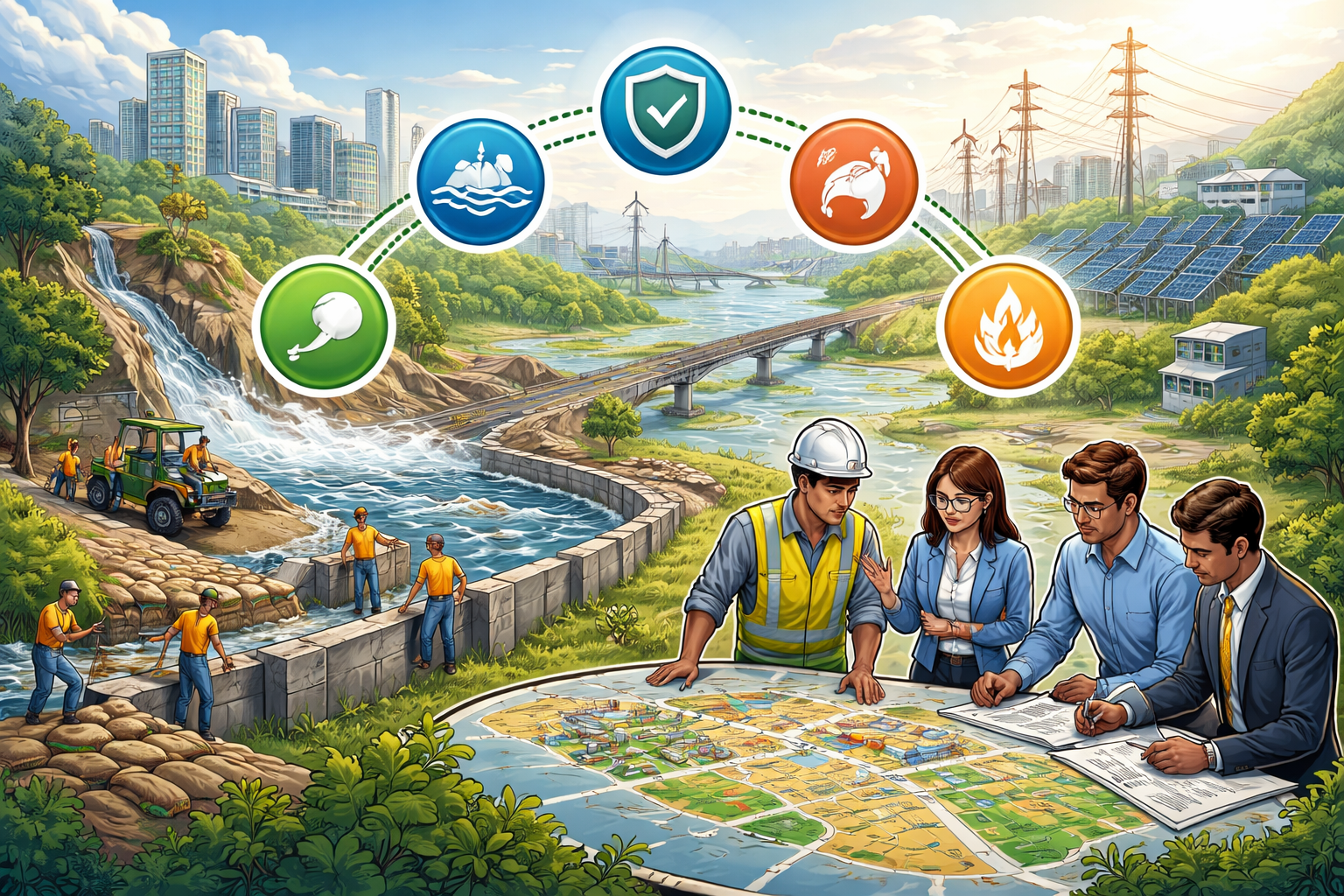
Risk and resilience planning has become a central pillar of modern infrastructure planning. As organizations and communities face increasing uncertainty from climate change, cyber threats, supply chain disruptions, and aging systems, long-term facilities planning must move beyond efficiency and cost optimization to focus on continuity, adaptability, and recovery.
Without a structured approach to risk and resilience planning, infrastructure systems remain vulnerable to disruptions that can lead to financial losses, safety incidents, and prolonged service outages. Therefore, effective infrastructure planning integrates risk assessment and resilience strategies to ensure that critical assets can withstand, respond to, and recover from adverse events.
This article explores the role of risk and resilience planning in infrastructure planning and outlines best practices for building robust, future-ready infrastructure systems.
Understanding Risk and Resilience in Infrastructure
In infrastructure planning, risk refers to the probability and impact of events that could disrupt operations, damage assets, or compromise safety. These risks may originate from natural hazards, technical failures, human error, or external threats.
Resilience, on the other hand, refers to the ability of infrastructure systems to absorb shocks, adapt to changing conditions, and recover quickly from disruptions. While risk focuses on what could go wrong, resilience focuses on how systems perform under stress.
Together, risk and resilience planning ensures that infrastructure systems are not only designed for optimal performance, but also for survival under adverse conditions.
Why Risk and Resilience Planning Matters?
Risk and resilience planning plays a strategic role in infrastructure planning because it directly affects operational stability, financial performance, and public trust.
1. Operational Continuity
First, critical infrastructure supports essential services such as healthcare, energy, transportation, and communication. Disruptions in these systems can have cascading effects across entire organizations or communities.
By integrating resilience into infrastructure planning, organizations improve their ability to maintain operations during crises.
2. Financial Protection
Second, infrastructure failures often lead to significant financial losses, including repair costs, regulatory penalties, and reputational damage. Proactive planning reduces the likelihood and severity of these impacts.
Therefore, risk and resilience planning protects long-term financial sustainability.
3. Regulatory and Compliance Requirements
Third, many industries now face regulatory mandates related to risk management, disaster preparedness, and system reliability. Infrastructure planning must align with these requirements to avoid legal and operational consequences.
Key Risk Categories in Infrastructure Planning
Effective risk and resilience planning begins with identifying and categorizing major risk types.
Natural and Environmental Risks
These include floods, earthquakes, storms, heatwaves, and sea-level rise. Climate change has increased both the frequency and severity of these events, making environmental risk a primary concern in infrastructure planning.
Technical and Operational Risks
System failures, equipment degradation, power outages, and software errors fall under this category. Aging infrastructure significantly increases technical risk.
Cyber and Security Risks
Digital infrastructure faces threats from cyberattacks, data breaches, and system sabotage. As infrastructure becomes more connected, cyber risk becomes inseparable from physical risk.
Financial and Supply Chain Risks
Budget constraints, vendor failures, and material shortages can delay projects and compromise system reliability.
Risk Assessment Frameworks
Structured risk assessment provides the foundation for resilience planning.
1. Risk Identification
The first step involves identifying critical assets and potential threat scenarios.
2. Risk Analysis
Next, planners evaluate the likelihood and impact of each risk. This may involve qualitative scoring or quantitative modeling.
3. Risk Prioritization
Risks are ranked based on severity and urgency. This ensures that resources focus on the most critical vulnerabilities.
4. Risk Mitigation
Finally, mitigation strategies are developed to reduce exposure and improve system robustness.
Building Resilience into Infrastructure Planning
Resilience requires more than redundancy. It demands integrated design, governance, and operational strategies.
1. Design for Adaptability
Flexible infrastructure can adjust to changing conditions without major reconstruction. Modular systems, scalable networks, and open standards improve long-term resilience.
2. Build Redundancy and Diversity
Critical systems should include backup components and alternative pathways. Redundancy prevents single points of failure.
3. Enhance Monitoring and Intelligence
Real-time monitoring enables early detection of anomalies and rapid response to emerging risks.
4. Develop Emergency Response Plans
Resilience depends on human preparedness. Clear response protocols, training programs, and communication plans reduce recovery time.
Role of Technology in Risk and Resilience Planning
Digital tools significantly enhance risk and resilience planning.
Key technologies include:
- Predictive analytics
- Digital twins
- Sensor networks
- Geographic information systems (GIS)
- Cybersecurity platforms
These systems enable scenario modeling, performance simulation, and proactive risk management.
As a result, infrastructure planning becomes more anticipatory and less reactive.
Sector Applications of Risk and Resilience Planning
Risk and resilience planning applies across sectors.
Healthcare
Hospitals focus on disaster readiness, backup power, and cyber protection.
Manufacturing
Factories manage supply chain resilience and automation reliability.
Transportation
Airports and rail systems plan for weather disruptions and system failures.
Public Sector
Cities integrate climate resilience and emergency response into infrastructure strategies.
Despite sector differences, the objective remains consistent: ensure continuity under stress.
Common Challenges in Risk and Resilience Planning
Organizations face several obstacles.
Limited Data
Incomplete risk data reduces assessment accuracy. Investing in monitoring systems improves visibility.
Budget Constraints
Resilience investments often compete with growth initiatives. However, ignoring risk increases long-term costs.
Organizational Silos
Risk management may operate separately from infrastructure planning. Integrated governance structures improve coordination.
Cultural Resistance
Organizations may underestimate risk due to optimism bias. Leadership commitment is essential for cultural change.
Measuring Resilience Performance
Resilience must be measurable.
Common indicators include:
- Recovery time after disruptions
- Frequency of system failures
- Financial losses avoided
- Compliance performance
- Stakeholder confidence
These metrics demonstrate the effectiveness of resilience investments.
Conclusion: Risk and Resilience as Strategic Imperatives
Risk and resilience planning is no longer optional. It is a strategic necessity within modern infrastructure planning.
By applying structured risk assessments, integrating adaptive design principles, and leveraging digital technologies, organizations can transform infrastructure from vulnerable assets into resilient systems.
Ultimately, successful infrastructure planning does not focus solely on efficiency. Instead, it prioritizes survival, adaptability, and long-term value in an increasingly uncertain world.