
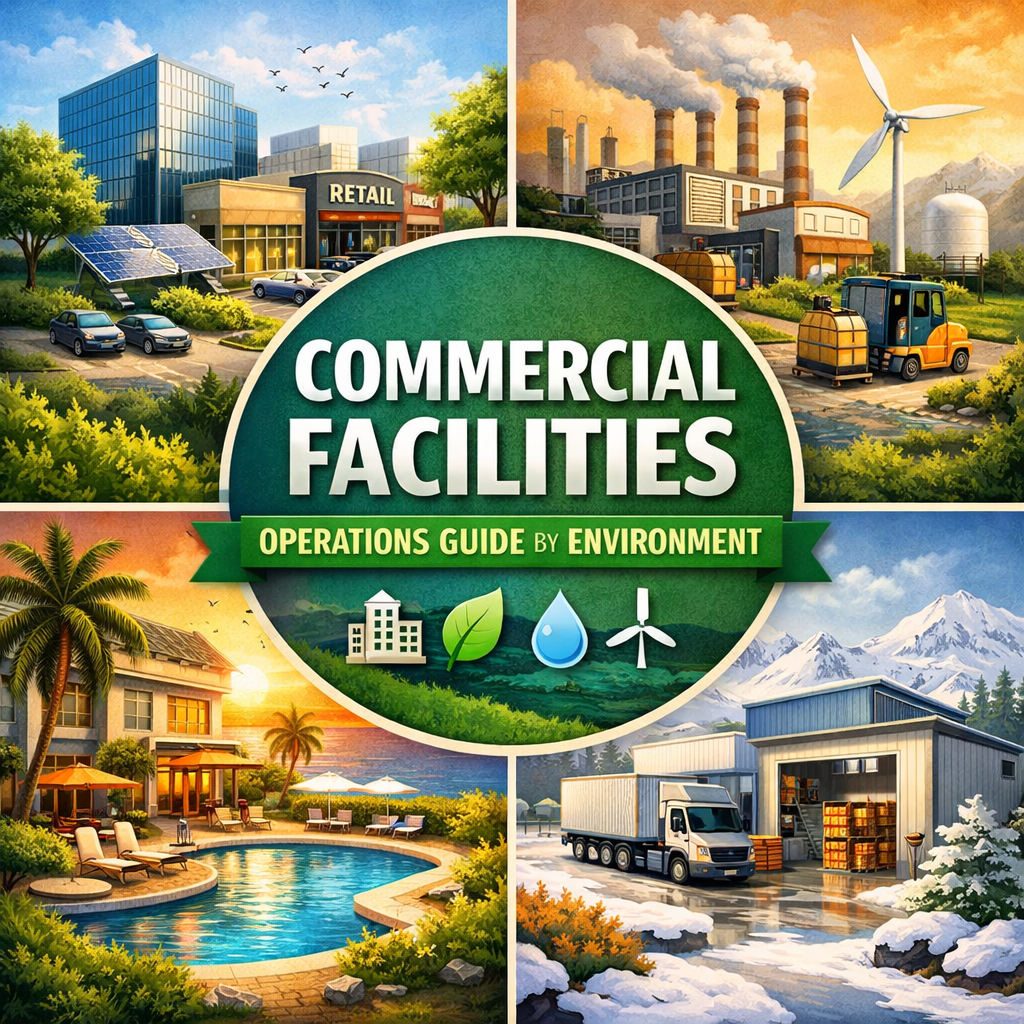
Commercial facilities operations play a critical role in ensuring that buildings function efficiently, safely, and sustainably across different environments. From corporate offices and retail centers to healthcare institutions and industrial complexes, effective facilities management directly impacts productivity, compliance, cost control, and user satisfaction.
This article explores commercial facilities operations through the lens of Facilities by Environment, providing a structured, professional guide for facility managers, operations leaders, and business owners seeking to optimize performance across diverse commercial settings.
What Are Commercial Facilities Operations?
Commercial facilities operations refer to the coordinated management of physical assets, infrastructure, and support services within commercial buildings. This includes maintenance, energy management, safety, security, space utilization, cleaning, and compliance with regulatory standards.
According to the International Facility Management Association (IFMA), facility management integrates people, place, process, and technology to ensure the functionality of the built environment.
The primary objective of commercial facilities operations is to maintain a functional environment that supports business activities while minimizing operational risks and costs.
Core functions typically include:
- Preventive and corrective maintenance
- Building systems management (HVAC, electrical, plumbing)
- Environmental health and safety
- Asset lifecycle management
- Space planning and utilization
- Sustainability and energy efficiency
- Vendor and contract management
When managed effectively, facilities operations improve reliability, reduce downtime, and enhance overall organizational performance.
Facilities by Environment: Why Context Matters
Facilities do not operate in isolation. Each commercial environment presents unique operational requirements, risks, and performance expectations. Facilities by environment is a strategic framework that aligns operational practices with the specific needs of different building types.
Understanding environmental context allows facilities managers to implement tailored systems, policies, and technologies rather than using generic approaches.
Key environmental categories include:
- Office and corporate environments
- Retail and hospitality environments
- Healthcare facilities
- Industrial and manufacturing sites
- Educational institutions
- Data centers and technology hubs
Each environment requires specialized operational strategies to ensure compliance, safety, and efficiency.
Office and Corporate Facilities Operations
Office environments focus on productivity, comfort, and employee well-being. Commercial facilities operations in this context emphasize climate control, ergonomic design, energy efficiency, and digital infrastructure.
Critical operational priorities include:
- HVAC optimization for indoor air quality
- Lighting systems for productivity and energy savings
- Workspace utilization and hybrid office planning
- Smart building technologies and automation
- Cleaning and sanitation protocols
Modern corporate facilities increasingly adopt smart sensors, building management systems (BMS), and workplace analytics to monitor occupancy, energy consumption, and environmental conditions in real time.
Retail and Hospitality Environments
Retail malls, hotels, and entertainment venues require facilities operations that prioritize customer experience, aesthetics, and safety.
Key operational considerations include:
- Escalator and elevator maintenance
- Lighting and visual merchandising support
- Restroom sanitation and hygiene standards
- Security and crowd control systems
- Waste management and pest control
In hospitality, facilities operations also integrate guest comfort technologies such as automated climate controls, digital room management, and energy-saving systems to balance service quality with cost efficiency.
Healthcare Facilities Operations
Healthcare environments demand the highest levels of compliance, reliability, and risk control. Commercial facilities operations in hospitals and clinics directly affect patient safety and regulatory outcomes.
Operational priorities include:
- Infection control systems
- Medical gas and power backup systems
- Environmental monitoring
- Equipment calibration and compliance audits
- Emergency response readiness
Facilities managers in healthcare must align with standards such as ISO, Joint Commission requirements, and national healthcare regulations.
Industrial and Manufacturing Facilities
Industrial environments present complex operational challenges involving heavy machinery, hazardous materials, and strict safety protocols.
Facilities operations focus on:
- Equipment reliability and uptime
- Occupational health and safety compliance
- Energy-intensive system optimization
- Environmental impact management
- Fire prevention and emergency preparedness
Predictive maintenance and industrial IoT systems are increasingly used to monitor machinery health and prevent costly downtime.
Data Centers and Technology Facilities
Data centers represent one of the most critical commercial environments due to their dependence on continuous power, cooling, and security.
Facilities operations in this environment prioritize:
- Redundant power infrastructure
- Precision cooling systems
- Environmental monitoring sensors
- Physical and cybersecurity integration
- Disaster recovery systems
Any failure in facilities operations can result in massive financial and reputational losses.
Sustainability in Commercial Facilities Operations
Sustainability is now a core objective across all commercial environments. Facilities by environment strategies increasingly integrate environmental responsibility into daily operations.
Key sustainability initiatives include:
- Energy management systems
- Water conservation programs
- Green building certifications (LEED, BREEAM)
- Waste reduction and recycling
- Carbon footprint monitoring
Facilities operations teams are now measured not only on performance and cost but also on environmental impact and regulatory compliance.
Technology and Automation in Facilities Operations
Digital transformation is reshaping commercial facilities operations across every environment.
Common technologies include:
- Computerized Maintenance Management Systems (CMMS)
- Building Information Modeling (BIM)
- Smart sensors and IoT platforms
- AI-based predictive analytics
- Digital twin simulations
These tools enable real-time monitoring, automated reporting, and data-driven decision-making, improving both operational efficiency and long-term asset performance.
Risk Management and Compliance
Facilities operations are directly responsible for managing operational risks and regulatory compliance.
Key risk areas include:
- Fire safety and evacuation systems
- Electrical and structural inspections
- Environmental health and safety standards
- Emergency preparedness planning
- Insurance and legal compliance
Facilities by environment frameworks ensure that compliance requirements are aligned with specific industry regulations.
Best Practices for Commercial Facilities Operations
To optimize facilities performance across environments, organizations should adopt the following best practices:
- Implement preventive and predictive maintenance strategies.
- Use environment-specific operational frameworks.
- Invest in digital facilities management platforms.
- Establish clear KPIs and performance metrics.
- Train staff in safety, compliance, and sustainability.
- Conduct regular audits and environmental assessments.
- Integrate sustainability into operational planning.
These practices ensure that facilities operations remain resilient, cost-effective, and future-ready.
The Strategic Role of Facilities by Environment
Facilities by environment is no longer a theoretical concept—it is a strategic imperative. As commercial buildings become more complex, facilities operations must adapt to environmental demands with precision and expertise.
Organizations that align facilities operations with environmental context gain measurable advantages in:
- Operational efficiency
- Risk reduction
- Regulatory compliance
- Employee and customer satisfaction
- Sustainability performance
Commercial facilities operations are evolving from a support function into a core business enabler.
Conclusion
Commercial facilities operations form the backbone of modern business infrastructure. By applying the facilities by environment framework, organizations can develop tailored operational strategies that enhance performance, safety, and sustainability across diverse commercial settings.
Whether managing office buildings, hospitals, retail centers, or industrial complexes, effective facilities operations ensure that environments remain functional, compliant, and aligned with organizational goals. In an increasingly complex and regulated world, facilities by environment is the key to achieving long-term operational excellence.