
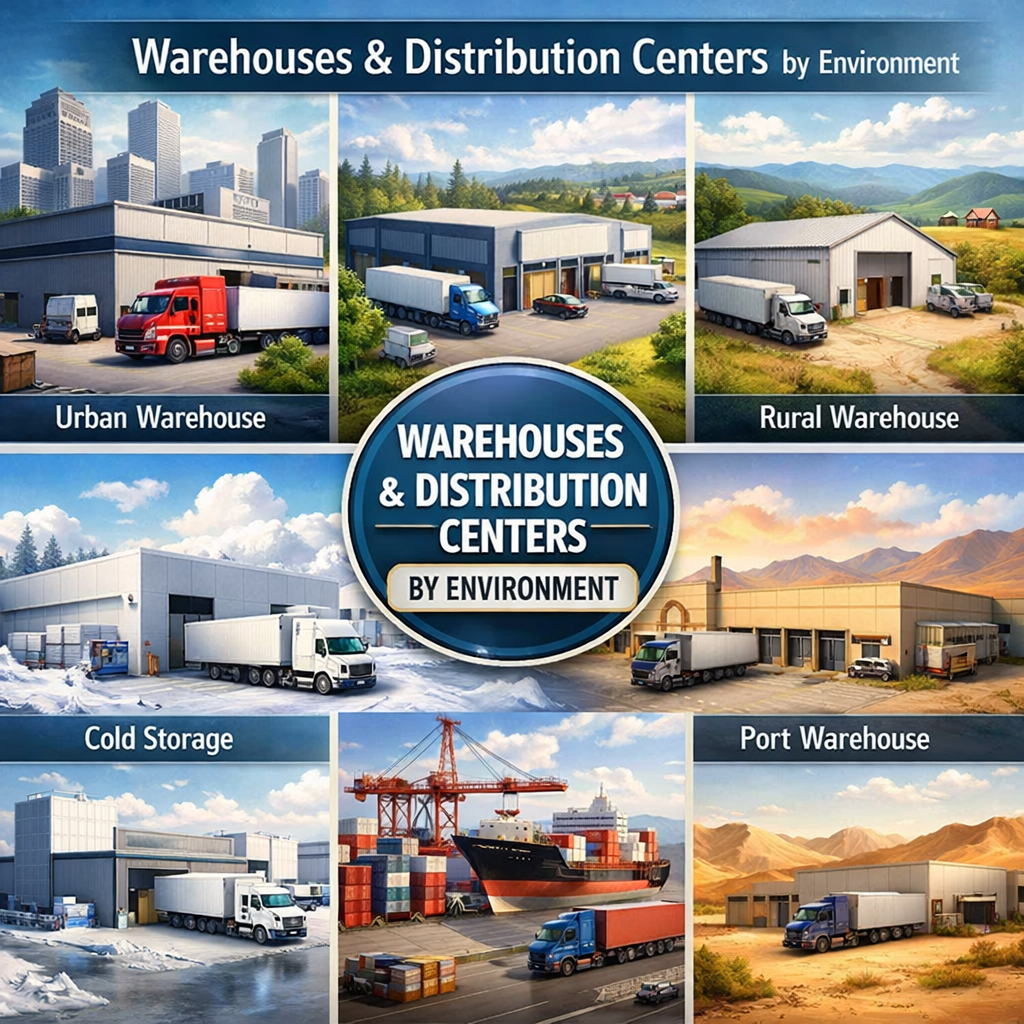
Warehouses and distribution centers are essential components of modern supply chains, supporting the storage, processing, and movement of goods across regional and global markets. Within the Facilities by Environment framework, these facilities require specialized management approaches that reflect their operational intensity, safety risks, and technological complexity.
As logistics operations become faster and more data-driven, facilities management must evolve accordingly. Therefore, organizations that invest in environment-specific strategies gain a significant advantage in efficiency, resilience, and scalability.
Understanding Warehouses and Distribution Centers
Warehouses and distribution centers are purpose-built logistics facilities designed to handle inventory in various forms. While warehouses traditionally focus on storage, distribution centers emphasize speed, accuracy, and outbound fulfillment.
Distribution centers are specialized logistics hubs designed for rapid movement of goods, optimized for efficient handling, sorting, and outbound fulfillment, as explained in industry references such as Wikipedia.
In practical terms, warehouses manage bulk inventory, whereas distribution centers process high volumes of customer orders. Consequently, facilities management strategies must align with each facility’s functional role.
Key characteristics of these environments include:
- Large floor areas and vertical storage systems
- Continuous material handling activity
- Integration with transport networks
- Technology-driven inventory control
- High workforce density
As a result, these facilities operate more like dynamic systems than static buildings.
Facilities by Environment in Logistics Operations
Facilities by environment is a strategic concept that tailors facilities management practices to the operational demands of specific building types. In logistics, this approach is particularly critical because operations are time-sensitive and highly interdependent.
Moreover, logistics facilities face constant pressure to scale, adapt, and perform without disruption. For this reason, facilities management must focus on operational continuity, system reliability, and real-time visibility.
Key environmental challenges include:
- High throughput requirements
- Equipment-intensive workflows
- Safety risks from mobile machinery
- Continuous system dependencies
- Seasonal demand fluctuations
Therefore, a generic facilities model is insufficient for logistics environments.
Infrastructure and Building Systems
Reliable infrastructure forms the foundation of warehouse and distribution center performance. Without stable building systems, even the most advanced logistics technologies fail to deliver results.
Key infrastructure components include:
- Structural systems and floor load capacity
- Lighting systems for visibility and safety
- HVAC systems for temperature-sensitive goods
- Fire detection and suppression systems
- Electrical distribution and backup power
Additionally, facilities managers must plan for future expansion, ensuring that infrastructure remains flexible and scalable.
Equipment and Material Handling Systems
Material handling systems represent the operational core of logistics facilities. Consequently, their performance directly affects productivity, safety, and service levels.
Common systems include:
- Conveyors and sortation lines
- Forklifts and pallet handling equipment
- Automated storage and retrieval systems (AS/RS)
- Loading dock equipment
- Robotics and automated guided vehicles
Therefore, facilities management must implement preventive and predictive maintenance programs to minimize downtime and extend equipment lifespan.
Safety and Compliance Management
Safety remains one of the most critical priorities in warehouses and distribution centers. Due to the presence of heavy machinery and high traffic volumes, these environments carry elevated risk profiles.
Facilities management responsibilities include:
- Traffic flow design and signage
- Emergency exits and evacuation systems
- Fire safety compliance
- Ergonomic workstation design
- Routine safety audits
Furthermore, facilities by environment frameworks ensure that safety measures are customized to logistics-specific risks.
Technology and Automation in Logistics Facilities
Technology plays a transformative role in modern logistics environments. As automation increases, facilities management must integrate physical infrastructure with digital systems.
Key technologies include:
- Warehouse Management Systems (WMS)
- IoT sensors for environmental monitoring
- RFID and barcode tracking
- Robotics and automation platforms
- Digital twin modeling
In addition, facilities managers increasingly collaborate with IT teams to ensure seamless system integration.
Energy Management and Sustainability
Energy efficiency has become a strategic priority for logistics facilities. Since warehouses operate large lighting and equipment systems, energy costs significantly impact operational budgets.
Sustainability initiatives include:
- LED lighting systems
- Solar energy installations
- Smart energy monitoring platforms
- Waste reduction programs
- Water efficiency systems
Therefore, facilities by environment strategies align sustainability goals with regulatory and financial objectives.
Space Planning and Layout Optimization
Space utilization strongly influences logistics performance. Consequently, facilities management must design layouts that support efficient workflows and safe movement.
Key space planning considerations include:
- Storage density optimization
- Zoning for inbound and outbound operations
- High-bay racking systems
- Flexible layouts for seasonal demand
- Material flow optimization
As a result, well-designed layouts reduce handling time and improve throughput.
Workforce Support and Operational Continuity
Facilities management directly affects workforce performance and retention. Therefore, logistics facilities must provide environments that support employee well-being.
Key support elements include:
- Climate and air quality control
- Break rooms and sanitation facilities
- Noise reduction systems
- Lighting quality
- Shift-based operational planning
Moreover, improved working conditions contribute to higher productivity and lower turnover rates.
Risk Management and Business Continuity
Warehouses and distribution centers represent critical supply chain nodes. Consequently, operational disruptions can have far-reaching financial and reputational impacts.
Major risk areas include:
- Equipment failures
- Power outages
- Fire incidents
- System integration failures
- Natural disasters
Therefore, facilities management teams must develop robust business continuity plans and emergency response protocols.
Regulatory and Industry Compliance
Logistics facilities operate under strict regulatory oversight. As a result, compliance management is a core facilities responsibility.
Common regulatory areas include:
- Occupational safety standards
- Fire and building codes
- Environmental protection regulations
- Transportation compliance requirements
Accordingly, facilities by environment frameworks ensure consistent regulatory alignment across operations.
Best Practices for Managing Logistics Facilities
To achieve operational excellence, organizations should implement the following best practices:
- Adopt preventive and predictive maintenance programs.
- Use real-time monitoring and analytics.
- Integrate automation and robotics.
- Optimize space and layout design.
- Conduct regular safety and compliance audits.
- Invest in workforce-friendly facilities.
- Align sustainability initiatives with operations.
Ultimately, these practices enhance resilience, efficiency, and scalability.
The Strategic Value of Facilities by Environment
Facilities by environment is not merely an operational concept; it is a strategic enabler. Organizations that tailor facilities management to logistics environments achieve measurable performance improvements.
Specifically, they benefit from:
- Faster order fulfillment
- Lower operating costs
- Reduced safety incidents
- Improved asset utilization
- Stronger supply chain resilience
Therefore, warehouses and distribution centers evolve from cost centers into strategic assets.
Conclusion
Warehouses and distribution centers form the backbone of modern supply chains. By applying facilities by environment principles, organizations develop management strategies that reflect the complexity and criticality of logistics operations.
From infrastructure and safety to automation and sustainability, effective facilities management ensures that logistics environments remain efficient, compliant, and future-ready. Ultimately, environment-specific facilities strategies position organizations for long-term operational success.