
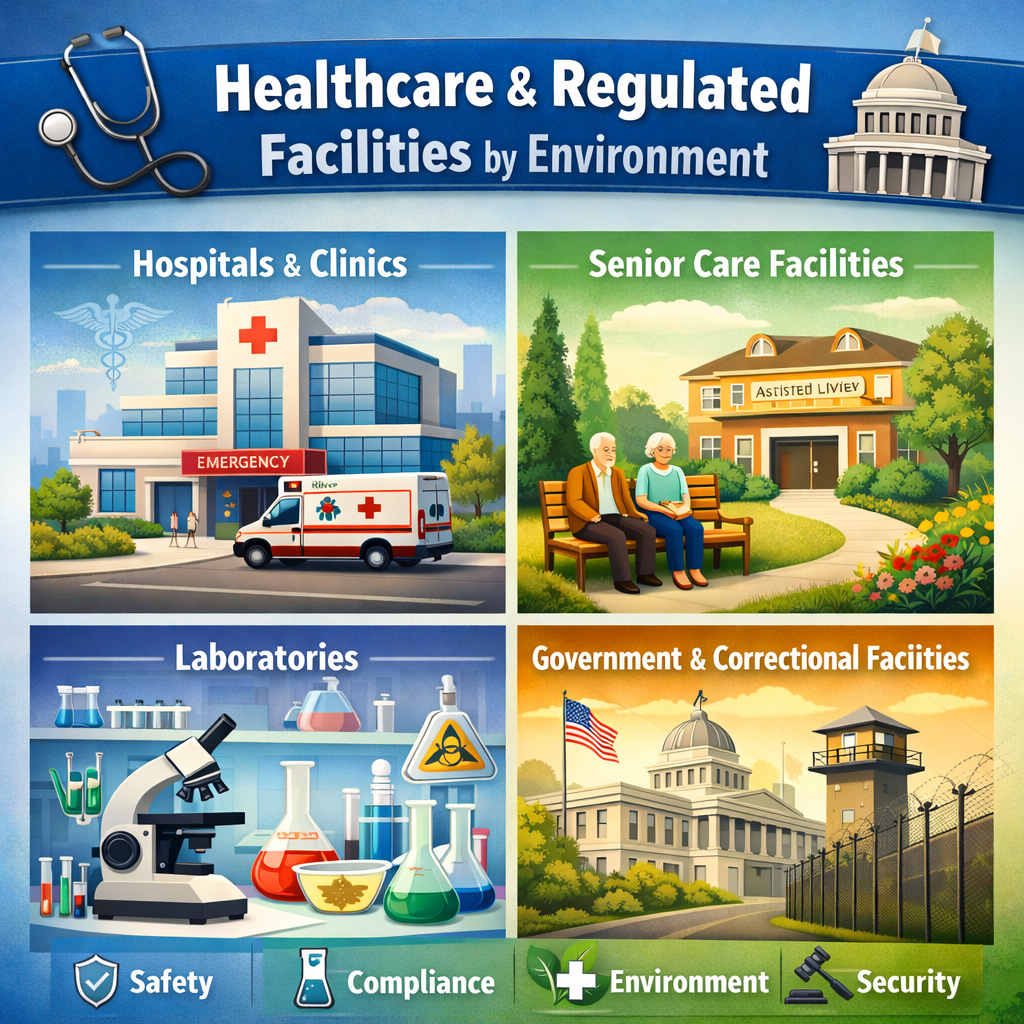
Healthcare and regulated facilities represent some of the most complex and critical environments within modern infrastructure. Under the Facilities by Environment framework, these facilities require specialized management strategies that prioritize patient safety, regulatory compliance, operational reliability, and risk mitigation.
From hospitals and clinics to laboratories and pharmaceutical plants, healthcare and regulated facilities must operate under strict standards. Therefore, facilities management in these environments plays a direct role in protecting human life, ensuring compliance, and maintaining organizational credibility.
Understanding Healthcare and Regulated Facilities
Healthcare and regulated facilities include a wide range of environments where operational failure can result in serious health, legal, or financial consequences. These facilities are governed by extensive regulatory frameworks that dictate how infrastructure, systems, and workflows must be managed.
Common facility types include:
- Hospitals and medical centers
- Outpatient clinics and diagnostic labs
- Pharmaceutical manufacturing sites
- Research laboratories
- Long-term care and rehabilitation facilities
As a result, facilities by environment strategies must be far more rigorous than those used in standard commercial settings.
Facilities by Environment in Regulated Settings
Facilities by environment is a strategic approach that aligns facilities management practices with the operational realities of specific building types. In healthcare and regulated environments, this approach is essential due to:
- High safety and hygiene requirements
- Continuous operational demands
- Regulatory inspections and audits
- Critical system dependencies
- Zero tolerance for downtime
Therefore, facilities management becomes a mission-critical function rather than a support service.
Core Functions of Healthcare Facilities Management
Effective facilities management in regulated environments is built on several foundational functions.
1. Infrastructure and Critical Systems
Healthcare facilities depend on highly reliable infrastructure systems to maintain patient safety and service continuity.
Key systems include:
- Electrical power and emergency backup systems
- Medical gas distribution systems
- HVAC systems for infection control
- Water and wastewater systems
- Structural and building envelope systems
Additionally, facilities managers must ensure that redundancy and fail-safe mechanisms are in place for all critical systems.
2. Environmental Health and Safety
Environmental health is one of the most critical aspects of healthcare facilities management. Facilities by environment frameworks prioritize risk prevention and compliance.
Key responsibilities include:
- Infection control protocols
- Indoor air quality management
- Hazardous waste handling
- Radiation and chemical safety
- Emergency preparedness planning
As a result, facilities teams work closely with clinical staff to ensure that physical environments support medical outcomes.
Regulatory Compliance and Accreditation
Healthcare and regulated facilities operate under extensive regulatory oversight. Compliance is not optional—it is a legal and ethical obligation.
International design and operational standards such as the International Health Facility Guidelines (IHF Guidelines) help ensure that healthcare and regulated facilities achieve appropriate safety, quality, and compliance outcomes in their built environments.
Common regulatory frameworks include:
- Health and safety authorities
- Fire and building codes
- Environmental protection agencies
- Healthcare accreditation bodies
- Pharmaceutical and laboratory standards
Facilities management ensures that infrastructure, processes, and documentation meet all regulatory requirements.
Technology in Healthcare Facilities Management
Technology plays a central role in maintaining operational reliability in regulated environments. Facilities managers increasingly rely on digital tools to monitor and control complex systems.
Key technologies include:
- Computerized Maintenance Management Systems (CMMS)
- Building Management Systems (BMS)
- Real-time environmental monitoring
- Asset tracking systems
- Predictive maintenance analytics
Therefore, digital transformation enables proactive facilities management rather than reactive problem-solving.
Infection Control and Hygiene Systems
Infection control is a defining characteristic of healthcare facilities management. Facilities by environment strategies integrate hygiene systems into every operational layer.
Critical infection control systems include:
- Air filtration and ventilation systems
- Isolation room controls
- Surface cleaning protocols
- Waste segregation systems
- Sterilization support systems
Consequently, facilities management directly contributes to patient safety and public health outcomes.
Energy Management and Sustainability
Healthcare facilities are among the most energy-intensive building types. Facilities management plays a key role in balancing sustainability with operational reliability.
Sustainability initiatives include:
- Energy-efficient HVAC systems
- Smart lighting controls
- Water conservation technologies
- Waste reduction programs
- Renewable energy integration
Therefore, facilities by environment frameworks align environmental goals with healthcare performance metrics.
Space Planning and Patient Flow
Space utilization in healthcare environments directly affects patient experience and clinical efficiency. Facilities management supports workflow optimization through strategic space planning.
Key considerations include:
- Zoning for clinical and non-clinical areas
- Patient and staff circulation paths
- Equipment accessibility
- Emergency response routes
- Flexible space design
As a result, well-planned facilities reduce congestion, improve service delivery, and enhance safety.
Workforce Support and Operational Continuity
Facilities management significantly impacts staff performance and morale in regulated environments. Therefore, workforce support is a core operational priority.
Key support functions include:
- Climate and air quality control
- Rest and recovery spaces
- Noise management systems
- Lighting optimization
- Shift-based operational planning
Moreover, supportive environments contribute to lower burnout and higher staff retention.
Risk Management and Business Continuity
Healthcare and regulated facilities face a wide range of operational risks. Facilities management is responsible for identifying, mitigating, and managing these risks.
Major risk categories include:
- Power failures
- System outages
- Fire and natural disasters
- Cyber-physical security breaches
- Supply chain disruptions
Therefore, facilities teams develop comprehensive business continuity and disaster recovery plans.
Best Practices for Healthcare Facilities Management
To achieve operational excellence, organizations should adopt the following best practices:
- Implement preventive and predictive maintenance programs.
- Maintain strict regulatory documentation.
- Use real-time monitoring systems.
- Integrate infection control into all facilities processes.
- Conduct regular safety and compliance audits.
- Invest in staff training and certification.
- Align sustainability initiatives with healthcare goals.
These practices ensure resilience, compliance, and high-quality care environments.
The Strategic Role of Facilities by Environment
Facilities by environment is not merely an operational model—it is a strategic framework that enables healthcare organizations to deliver safe, compliant, and efficient services.
Organizations that tailor facilities management to regulated environments benefit from:
- Improved patient safety
- Reduced compliance risk
- Lower operational costs
- Enhanced system reliability
- Stronger institutional credibility
Therefore, healthcare facilities management becomes a key driver of organizational success.
Conclusion
Healthcare and regulated facilities operate at the intersection of human safety, regulatory compliance, and operational complexity. By applying facilities by environment principles, organizations develop management strategies that reflect the critical nature of these environments.
From infrastructure and infection control to sustainability and risk management, effective facilities management ensures that healthcare environments remain safe, compliant, and future-ready. In an increasingly regulated and technology-driven world, environment-specific facilities strategies are essential for long-term healthcare performance.