
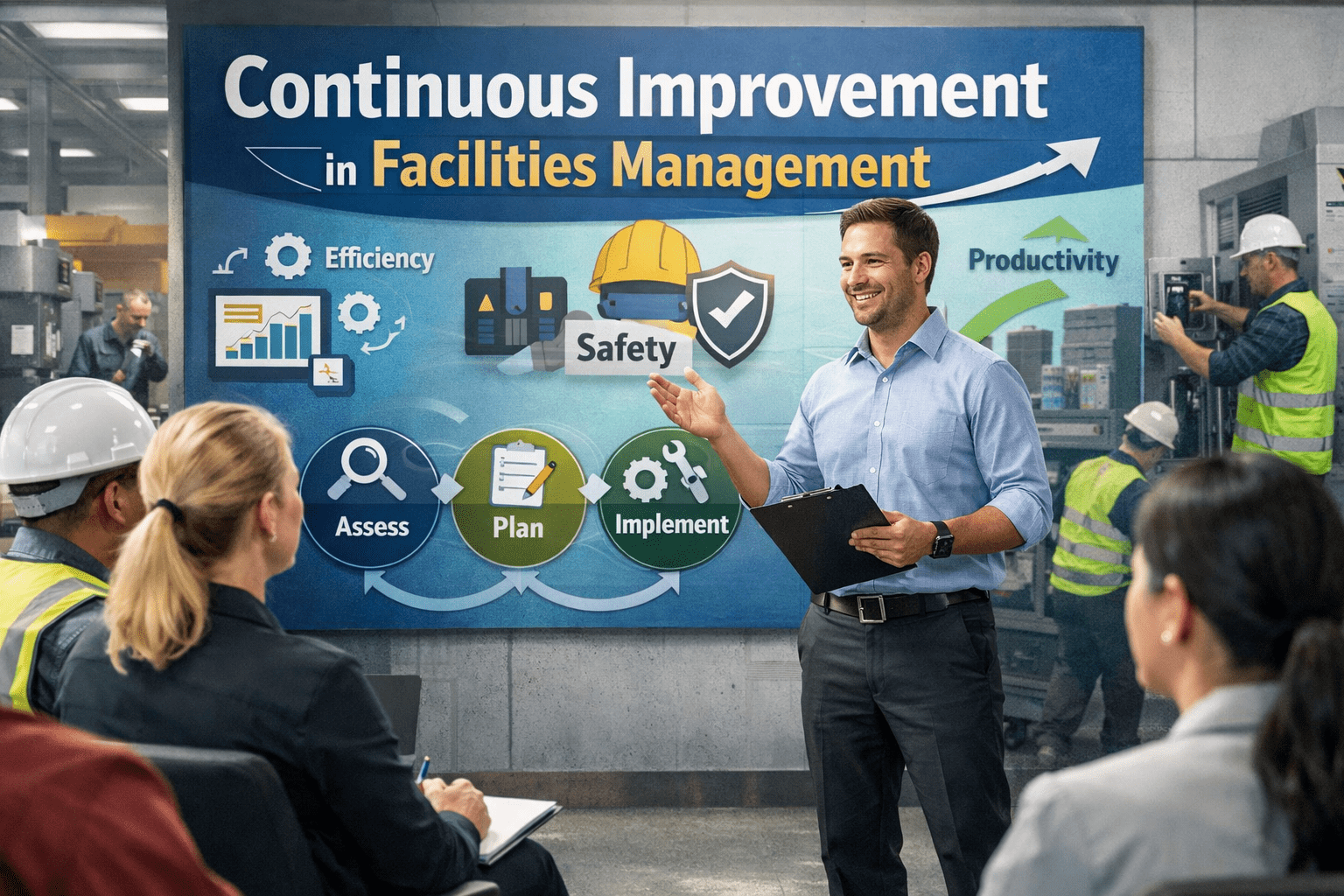
Continuous improvement in facilities is a core principle of modern performance measurement. As organizations face rising operational costs, stricter compliance requirements, and increasing expectations around sustainability and user experience, facilities management can no longer operate as a static support function. Instead, it must evolve into a dynamic, data-driven discipline focused on ongoing optimization.
This article provides a comprehensive and professional overview of continuous improvement in facilities, explaining its role in performance measurement, key frameworks, practical strategies, and long-term business impact.
What Is Continuous Improvement in Facilities?
Continuous improvement in facilities refers to the structured and ongoing process of evaluating, refining, and optimizing facility operations to achieve higher efficiency, reliability, and value over time. Rather than relying on periodic upgrades or reactive fixes, continuous improvement promotes a culture of regular assessment and incremental enhancement.
Facilities management best practices emphasize continuous improvement strategies to reduce waste, improve efficiency, and cut operational costs.
In practice, this approach focuses on improving areas such as:
- Maintenance effectiveness
- Energy performance
- Space utilization
- Safety and compliance
- Service quality
- Asset lifecycle management
As a result, facilities become more resilient, cost-effective, and aligned with organizational goals.
Why Continuous Improvement Matters in Facilities Management?
Facilities represent a significant portion of an organization’s operational expenses and risk exposure. Poorly managed facilities often result in:
- Excessive maintenance costs
- Energy waste
- Downtime and service disruptions
- Safety incidents
- Low occupant satisfaction
However, when continuous improvement principles are applied, organizations gain the ability to:
- Identify inefficiencies early
- Reduce long-term costs
- Improve service delivery
- Enhance sustainability outcomes
- Support strategic planning
Therefore, continuous improvement transforms facilities from a cost center into a strategic performance driver.
Continuous Improvement and Performance Measurement
Performance measurement is the foundation of continuous improvement. Without reliable data, improvement efforts are based on assumptions rather than evidence.
Facilities performance measurement typically focuses on:
- Cost efficiency
- Reliability and availability
- Energy consumption
- Space utilization
- Service response times
- Compliance and safety indicators
Through consistent measurement, organizations establish baselines, identify gaps, and track progress over time. Consequently, performance metrics guide improvement priorities and validate results.
Key Frameworks for Continuous Improvement in Facilities
Several established management frameworks support continuous improvement in facilities.
1. Plan-Do-Check-Act (PDCA)
PDCA is a widely used improvement cycle.
- Plan: Identify improvement opportunities and define objectives.
- Do: Implement changes on a small scale.
- Check: Measure results and compare with expectations.
- Act: Standardize successful changes or adjust strategies.
This cycle encourages experimentation and learning while minimizing risk.
2. Lean Facilities Management
Lean principles focus on eliminating waste and maximizing value.
In facilities, waste often appears as:
- Excess energy consumption
- Unnecessary maintenance tasks
- Underutilized space
- Inefficient workflows
By applying lean thinking, organizations streamline processes and improve resource efficiency.
3. Total Productive Maintenance (TPM)
TPM emphasizes proactive asset care and shared responsibility.
It promotes:
- Preventive maintenance
- Operator involvement
- Continuous skill development
- Equipment reliability improvement
As a result, asset performance becomes more predictable and sustainable.
Core Areas for Continuous Improvement in Facilities
Although improvement opportunities vary by organization, several core areas consistently deliver high impact.
1. Maintenance Optimization
Maintenance is often the largest controllable cost in facilities.
Continuous improvement focuses on:
- Increasing preventive maintenance ratios
- Reducing reactive repairs
- Improving mean time to repair (MTTR)
- Enhancing spare parts management
Over time, optimized maintenance improves reliability while lowering total cost of ownership.
2. Energy and Sustainability
Energy efficiency is a major driver of continuous improvement.
Facilities teams monitor:
- Energy intensity metrics
- Peak demand patterns
- Carbon emissions
- Equipment performance
Through regular measurement and adjustment, organizations reduce costs and environmental impact simultaneously.
3. Space Utilization
Underutilized or poorly planned space represents hidden inefficiency.
Continuous improvement in space management includes:
- Occupancy analysis
- Workplace redesign
- Flexible space strategies
- Remote work integration
As a result, facilities align more closely with evolving work patterns.
4. Safety and Compliance
Safety incidents and compliance failures carry significant operational risk.
Continuous improvement strengthens:
- Incident reporting systems
- Safety inspections
- Regulatory audits
- Training programs
This approach reduces risk while supporting organizational resilience.
Using Performance Metrics to Drive Improvement
Facilities improvement efforts must be guided by measurable indicators.
Common facilities performance metrics include:
- Cost per square meter
- Preventive maintenance compliance
- Energy consumption per unit
- Service response time
- Downtime frequency
- Customer satisfaction scores
However, metrics alone are not sufficient. They must be reviewed regularly, discussed openly, and linked to improvement actions.
Therefore, performance dashboards become central tools for continuous improvement governance.
Role of Technology in Continuous Improvement
Digital technologies significantly enhance continuous improvement capabilities.
Modern facilities increasingly rely on:
- Computerized maintenance management systems (CMMS)
- Integrated workplace management systems (IWMS)
- IoT sensors and smart meters
- Data analytics platforms
These tools enable:
- Real-time performance monitoring
- Automated reporting
- Predictive maintenance
- Scenario modeling
As a result, improvement efforts shift from reactive corrections to proactive optimization.
Building a Culture of Continuous Improvement
Technology alone does not guarantee improvement. Organizational culture plays a decisive role.
A strong improvement culture includes:
- Leadership commitment
- Employee engagement
- Open communication
- Knowledge sharing
- Accountability for performance
When staff understand the purpose of performance measurement and see tangible benefits, continuous improvement becomes part of daily operations rather than a one-time initiative.
Common Challenges in Continuous Improvement Programs
Despite its benefits, continuous improvement in facilities often faces obstacles.
Lack of Data Quality
Inaccurate or inconsistent data undermines trust and decision-making.
Resistance to Change
Employees may perceive improvement initiatives as additional workload or risk.
Too Many Metrics
Excessive indicators create complexity without adding insight.
No Clear Ownership
Without defined responsibility, improvement actions fail to materialize.
To overcome these challenges, organizations must simplify metrics, invest in training, and maintain leadership support.
Integrating Continuous Improvement with Business Strategy
High-performing organizations align facilities improvement with broader business objectives.
Continuous improvement supports:
- Cost reduction strategies
- Sustainability commitments
- Risk management frameworks
- Employee experience initiatives
- Digital transformation programs
Through this integration, facilities management contributes directly to organizational competitiveness and long-term success.
Continuous Improvement and Outsourced Facilities Services
For organizations using external service providers, continuous improvement remains essential.
Service contracts should include:
- Performance-based KPIs
- Service level agreements (SLAs)
- Regular performance reviews
- Continuous improvement clauses
This structure ensures that outsourced services evolve in line with organizational needs rather than remaining static.
Future Trends in Continuous Improvement in Facilities
Continuous improvement in facilities is evolving alongside technological and organizational change.
Key trends include:
- AI-driven performance analytics
- Predictive maintenance models
- Digital twins for scenario testing
- ESG-focused performance frameworks
- Experience-based facilities metrics
These trends reflect a shift from operational efficiency toward strategic value creation.
Conclusion: Why Continuous Improvement in Facilities Is Essential
Continuous improvement in facilities is not a temporary initiative—it is a long-term management philosophy. Through structured performance measurement, regular evaluation, and data-driven decision-making, organizations gain the ability to:
- Reduce operational costs
- Improve service quality
- Enhance sustainability
- Strengthen risk management
- Support organizational growth
Ultimately, continuous improvement transforms facilities from static infrastructure into a living system of performance optimization. In an increasingly competitive and resource-constrained environment, organizations that embrace continuous improvement in facilities achieve not only better buildings—but better business outcomes.