
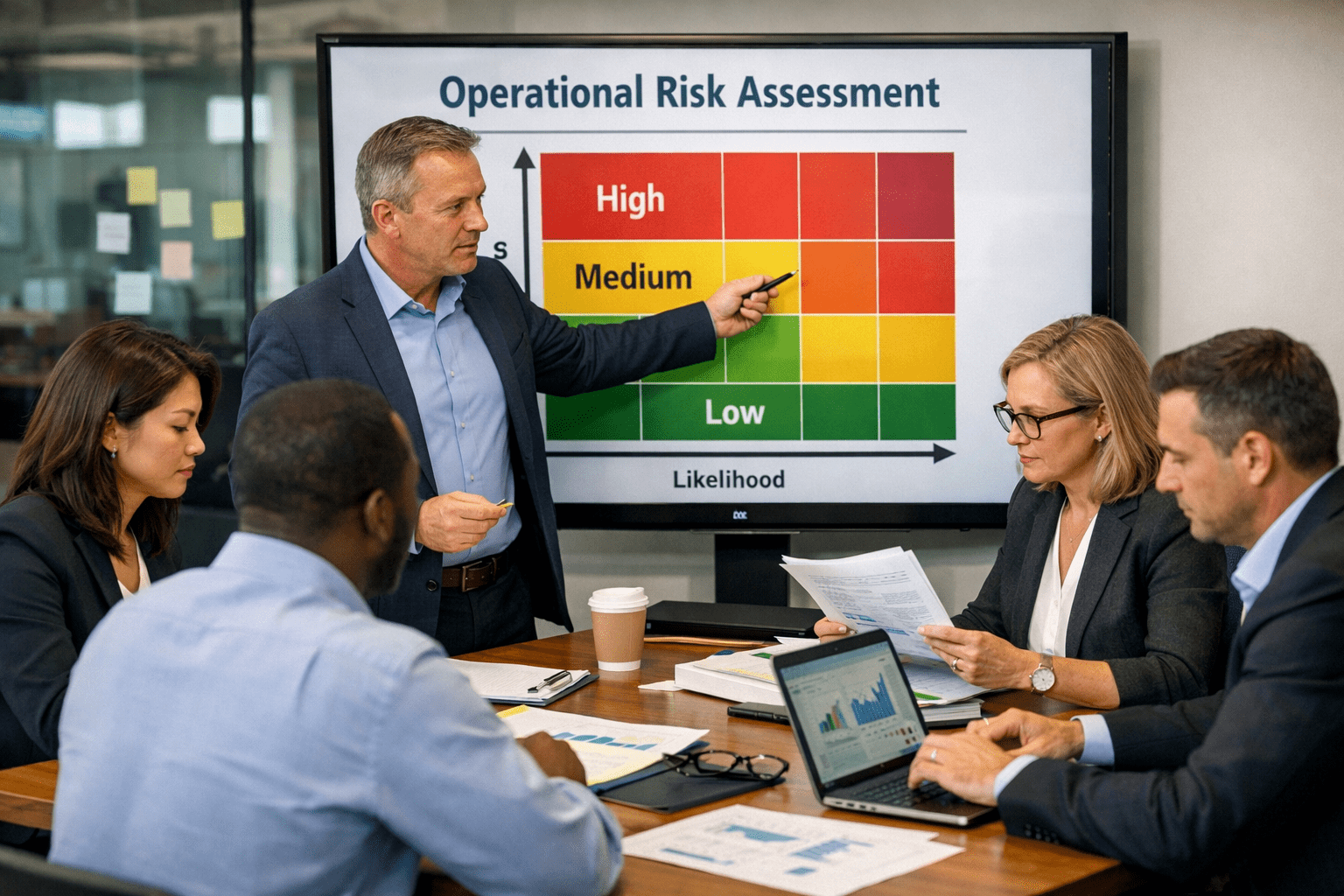
Operational decision making determines how organizations function on a daily basis. Every process, system, and workflow depends on decisions made at the operational level. Among these decisions, evaluating operational risk stands out as one of the most critical. Because operational risks directly affect continuity, cost, compliance, and performance, organizations must assess them carefully and consistently.
Rather than reacting to failures after they occur, effective operational decision making emphasizes proactive risk evaluation. As a result, organizations improve resilience, reduce disruption, and maintain control over day-to-day operations. This article explains how evaluating operational risk fits into operational decision making, using a structured and practical approach suitable for both beginners and experienced professionals.
Understanding Operational Decision Making
Operational decision making focuses on execution, efficiency, and consistency. While strategic decisions define long-term goals, operational decisions govern how work gets done every day. Managers, team leaders, and operations professionals make these decisions continuously.
Because operational decisions repeat frequently, small mistakes can compound over time. Therefore, organizations benefit from structured frameworks that guide decisions reliably. Evaluating operational risk plays a central role in this process because risk influences cost, performance, and service continuity.
In short, operational decision making works best when leaders identify and manage risk before it disrupts operations.
What Is Operational Risk?
Operational risk refers to the possibility of loss or disruption caused by failed processes, systems, people, or external events. Unlike financial or strategic risk, operational risk arises from everyday activities.
A clear definition of operational risk helps organizations understand how process failures, system issues, and human error affect daily operations.
Common sources of operational risk include:
- Process inefficiencies or breakdowns
- Human error or skill gaps
- Technology failures or cyber incidents
- Supplier and vendor disruptions
- Regulatory and compliance failures
Because these risks emerge from daily operations, organizations must evaluate them continuously rather than occasionally.
Why Evaluating Operational Risk Matters?
Evaluating operational risk enables organizations to make better decisions under uncertainty. Without risk evaluation, teams often prioritize speed or cost while overlooking vulnerabilities.
For example, a low-cost supplier may appear attractive initially. However, if that supplier lacks reliability, the organization may experience delays, rework, or customer dissatisfaction. As a result, short-term savings can lead to long-term losses.
Moreover, operational risk often hides within routine activities. Therefore, systematic evaluation helps organizations uncover weaknesses that are not immediately visible.
Identifying Operational Risks
The first step in evaluating operational risk is risk identification. Organizations must understand where risks originate before they can assess or manage them.
Typically, teams identify operational risks by reviewing core processes. They examine workflows, dependencies, and handoffs. In addition, teams analyze historical incidents, near misses, and performance failures.
Common risk identification techniques include:
- Process mapping
- Incident and error analysis
- Employee interviews and workshops
- Audit findings and compliance reviews
By combining multiple methods, organizations gain a more complete picture of operational risk exposure.
Categorizing Operational Risk
After identifying risks, organizations should categorize them. This step improves clarity and helps prioritize evaluation efforts.
Operational risks generally fall into several categories:
Process Risk
Process risk arises from poorly designed or undocumented workflows. Inefficient processes increase error rates and delay execution.
People Risk
People risk includes skill gaps, fatigue, turnover, and insufficient training. Human error remains one of the most common operational risk sources.
Technology Risk
Technology risk involves system outages, integration failures, cybersecurity incidents, and data integrity issues.
Third-Party Risk
Third-party risk results from reliance on suppliers, vendors, or service providers. Operational decision making must account for dependency and continuity risks.
Compliance and Regulatory Risk
Compliance failures can lead to fines, legal exposure, and operational shutdowns. Therefore, regulated industries must evaluate these risks carefully.
Categorization helps teams assign ownership and apply appropriate evaluation methods.
Assessing Risk Likelihood and Impact
Once risks are identified and categorized, organizations must evaluate likelihood and impact. This step transforms raw risk lists into actionable insights.
Likelihood measures how often a risk may occur. Impact measures the severity of consequences if the risk materializes. Together, these dimensions define risk exposure.
Many organizations use a risk matrix to support this evaluation. For example:
- High likelihood and high impact risks require immediate attention.
- Low likelihood and low impact risks may require monitoring only.
By applying consistent scoring scales, teams ensure objective comparisons across risks.
Using Data in Operational Risk Evaluation
Data-driven evaluation strengthens operational decision making. Instead of relying on assumptions, organizations use historical data and performance metrics to support risk assessments.
Relevant data sources include:
- Incident frequency and downtime records
- Error rates and rework metrics
- Customer complaints and service disruptions
- Audit findings and compliance reports
When teams analyze trends over time, they can detect emerging risks early. Consequently, organizations move from reactive problem-solving to proactive risk management.
Integrating Risk Evaluation Into Daily Operations
Evaluating operational risk should not remain a one-time exercise. Instead, it must integrate into daily operational decision making.
For example, teams can:
- Review risks during operational planning meetings
- Include risk checkpoints in process design
- Link risk metrics to performance dashboards
By embedding risk evaluation into routine activities, organizations maintain visibility and responsiveness. As a result, risk awareness becomes part of the operational culture.
Prioritizing Risks for Action
Not all operational risks require the same level of response. Therefore, prioritization is essential.
After assessing likelihood and impact, teams should rank risks based on overall exposure. High-priority risks demand immediate mitigation plans. Medium-priority risks require monitoring and contingency planning. Low-priority risks may remain under observation.
This prioritization enables efficient allocation of resources. Without it, teams may waste effort on low-impact issues while ignoring critical vulnerabilities.
Designing Risk Mitigation Strategies
Once teams prioritize risks, they must design mitigation strategies. Effective mitigation reduces either likelihood, impact, or both.
Common mitigation approaches include:
- Process redesign and standardization
- Automation to reduce human error
- Training and skill development
- System redundancy and backup planning
- Supplier diversification
Operational decision making improves when mitigation strategies align with business constraints such as cost, time, and complexity.
Monitoring and Reviewing Operational Risk
Operational risk evolves as processes, systems, and environments change. Therefore, continuous monitoring is essential.
Organizations should track risk indicators and review them regularly. Additionally, teams should reassess risks after major changes, such as system upgrades, organizational restructuring, or supplier transitions.
By maintaining an ongoing review cycle, organizations ensure that risk evaluations remain relevant and accurate.
Common Mistakes in Evaluating Operational Risk
Despite best intentions, organizations often make avoidable mistakes. For instance, some teams treat risk evaluation as a compliance exercise rather than a decision-support tool. Others rely solely on qualitative judgment without data.
Additionally, ignoring frontline employee input can limit risk visibility. Employees often understand operational weaknesses better than leadership teams.
Avoiding these mistakes strengthens the effectiveness of operational decision making.
Conclusion
Evaluating operational risk is a fundamental component of operational decision making. Because operational risks arise from everyday activities, organizations must identify, assess, and manage them continuously.
By applying structured risk evaluation methods, using data to support decisions, and integrating risk awareness into daily operations, organizations improve resilience and performance. Moreover, proactive risk evaluation enables leaders to make informed decisions even under uncertainty.
Ultimately, strong operational decision making turns risk evaluation from a defensive task into a strategic operational advantage.