
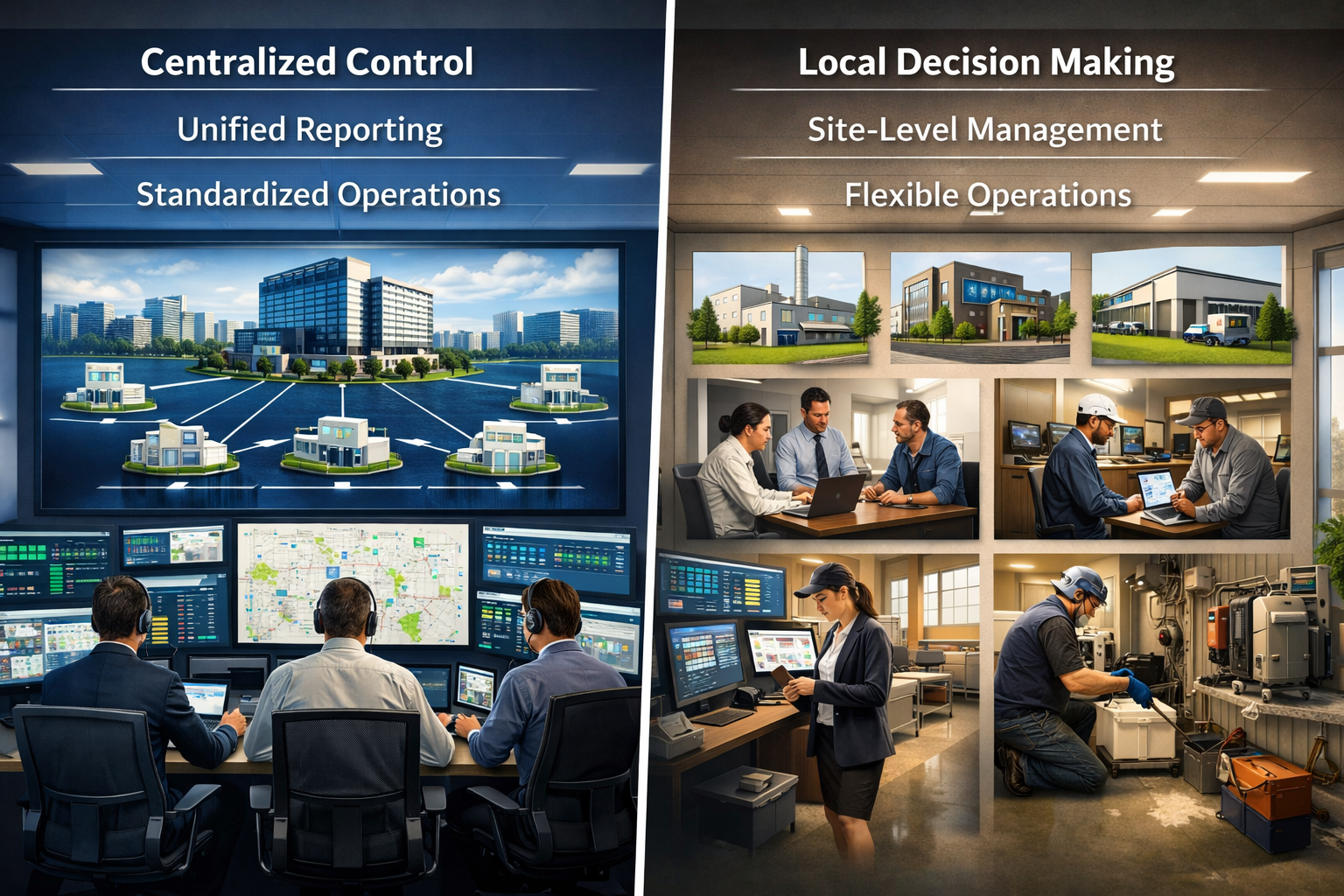
In the world of operations, infrastructure, and asset management, choosing the right facility structure can define long-term success. One of the most strategic decisions organizations face is Centralized vs decentralized facility management. Before evaluating a Centralized vs decentralized facility model, it is important to understand basic common facilities terminology used in operations and infrastructure management.
Choosing between a Centralized vs decentralized facility model directly impacts cost control, operational efficiency, scalability, and risk management.This guide explains the fundamentals of both models, their advantages and challenges, and how to determine which approach fits your organization best.
What Is a Centralized Facility Model?
A centralized facility model places authority, decision-making, budgeting, procurement, and maintenance control under a single management structure or headquarters. When evaluating a Centralized vs decentralized facility model, it’s helpful to consider how facility management experts compare the effectiveness and efficiency of each structure in practice; facilities professionals have long debated which model works best for different organizational needs. For an in-depth look at this debate, see the FacilitiesNet discussion on centralized vs decentralized facility models.
In this model:
- Policies are standardized across all locations
- Procurement is consolidated
- Maintenance scheduling follows uniform procedures
- Strategic planning flows from one leadership team
Key Characteristics of a Centralized Facility
- One central facilities management department
- Standardized vendor contracts
- Uniform compliance protocols
- Centralized reporting and analytics
- Consolidated budgeting and forecasting
Advantages of a Centralized Facility Model
1. Cost Efficiency Through Scale
Bulk purchasing, unified vendor negotiations, and standardized systems reduce overall operational costs.
2. Strong Governance and Compliance
A centralized facility structure ensures regulatory requirements are consistently implemented across locations.
3. Data-Driven Decision Making
Centralized data collection enables better forecasting, benchmarking, and asset lifecycle planning.
4. Brand and Quality Consistency
Uniform facility standards ensure the same experience across branches or properties.
Challenges of a Centralized Facility Model
- Slower response to local issues
- Reduced flexibility for regional needs
- Possible communication bottlenecks
- Overburdened central leadership
What Is a Decentralized Facility Model?
A decentralized facility model distributes authority across regional or site-level teams. Each location operates semi-independently while aligning with broader organizational goals.
In this structure:
- Local teams manage daily operations
- Budgets may be allocated per region
- Vendors can be selected locally
- Maintenance decisions happen on-site
Key Characteristics of a Decentralized Facility
- Regional facility managers
- Localized procurement
- Customized maintenance strategies
- Faster site-level decision making
Advantages of a Decentralized Facility Model
1. Faster Operational Response
Local teams can immediately address maintenance issues or emergencies.
2. Greater Flexibility
Facilities can adapt to climate, culture, regulations, and operational differences.
3. Higher Ownership and Accountability
Regional teams feel direct responsibility for facility performance.
4. Improved Local Vendor Relationships
On-site managers often build stronger service provider partnerships.
Challenges of a Decentralized Facility Model
- Inconsistent standards across sites
- Duplication of resources
- Limited purchasing leverage
- Harder enterprise-wide reporting
Centralized vs Decentralized Facility: Direct Comparison
| Factor | Centralized Facility | Decentralized Facility |
|---|---|---|
| Decision Authority | Central leadership | Regional/site teams |
| Cost Control | High through consolidation | Variable per site |
| Flexibility | Moderate | High |
| Standardization | Strong | Limited |
| Emergency Response | Slower | Faster |
| Data Visibility | Unified reporting | Fragmented data |
| Vendor Management | Consolidated contracts | Local contracts |
Understanding Centralized vs decentralized facility differences helps organizations align structure with strategic goals.
When to Choose a Centralized Facility Model?
A centralized facility model works best when:
- The organization operates in highly regulated industries
- Brand consistency is critical
- Cost reduction through scale is a priority
- The organization has multiple similar locations
- Executive oversight is a top concern
Ideal Industries
- Healthcare networks
- Banking institutions
- Corporate office portfolios
- Large retail chains
When to Choose a Decentralized Facility Model?
A decentralized facility model is more suitable when:
- Locations vary significantly in operations
- Rapid response time is essential
- Geographic differences require customization
- Local regulations differ widely
Ideal Industries
- Manufacturing plants with unique production lines
- Hospitality properties with varied guest experiences
- Universities with independent campuses
- Field operations and logistics hubs
Hybrid Approach: The Balanced Model
Many modern organizations adopt a hybrid structure that blends centralized and decentralized elements.
In a hybrid model:
- Strategic planning and procurement remain centralized
- Day-to-day operations are decentralized
- Technology platforms are unified
- Reporting remains centralized
This balanced solution often resolves the debate of Centralized vs decentralized facility management by combining control with agility.
Technology’s Role in Facility Structure
Digital transformation has changed the Centralized vs decentralized facility discussion.
Tools like:
- Computerized Maintenance Management Systems (CMMS)
- Integrated Workplace Management Systems (IWMS)
- IoT-enabled asset monitoring
- Cloud-based reporting dashboards
allow centralized oversight while enabling decentralized execution.
Technology reduces the trade-offs traditionally associated with both models.
Risk Management Considerations
When evaluating Centralized vs decentralized facility models, risk exposure must be assessed.
Centralized Risks
- Single point of failure in decision making
- Central leadership overload
- Delays in crisis response
Decentralized Risks
- Compliance gaps
- Inconsistent safety standards
- Budget inefficiencies
A strong governance framework and performance metrics help mitigate these risks.
Financial Implications
Cost modeling is a major factor in Centralized vs decentralized facility decisions.
Centralized Financial Benefits
- Bulk purchasing discounts
- Unified maintenance contracts
- Predictable budgeting
Decentralized Financial Benefits
- Better local cost optimization
- Reduced downtime due to quick action
- Customized capital planning
A thorough cost-benefit analysis should include:
- Total cost of ownership
- Downtime impact
- Vendor negotiation leverage
- Administrative overhead
Organizational Culture Impact
Structure affects people.
In a centralized facility model:
- Employees follow strict protocols
- Authority flows top-down
- Change management is structured
In a decentralized facility model:
- Teams operate autonomously
- Decision-making is distributed
- Innovation may happen faster
Leadership style and corporate culture often determine which model performs better.
Scalability and Growth Strategy
If your organization plans rapid expansion, the Centralized vs decentralized facility decision becomes even more critical.
- Centralized models simplify onboarding new sites
- Decentralized models allow rapid local adaptation
- Hybrid models scale efficiently with proper digital infrastructure
Growth plans should align with the chosen facility framework.
Key Questions Before Deciding
To determine the best structure, ask:
- How many locations do we operate?
- How different are our facilities from each other?
- What level of compliance risk do we face?
- How critical is cost standardization?
- Do we have strong regional leadership talent?
- What technology systems support our operations?
These questions clarify the Centralized vs decentralized facility strategy.
Final Thoughts
There is no universal winner in the Centralized vs decentralized facility debate. The right choice depends on operational complexity, regulatory environment, financial priorities, and organizational culture.
A centralized facility model provides efficiency, control, and standardization.
A decentralized facility model offers flexibility, responsiveness, and local ownership.
Many organizations succeed by combining the strengths of both.
Ultimately, the best facility structure is the one aligned with long-term strategy, risk tolerance, and growth objectives. When thoughtfully implemented, either approach can deliver strong performance, operational resilience, and sustainable value.