
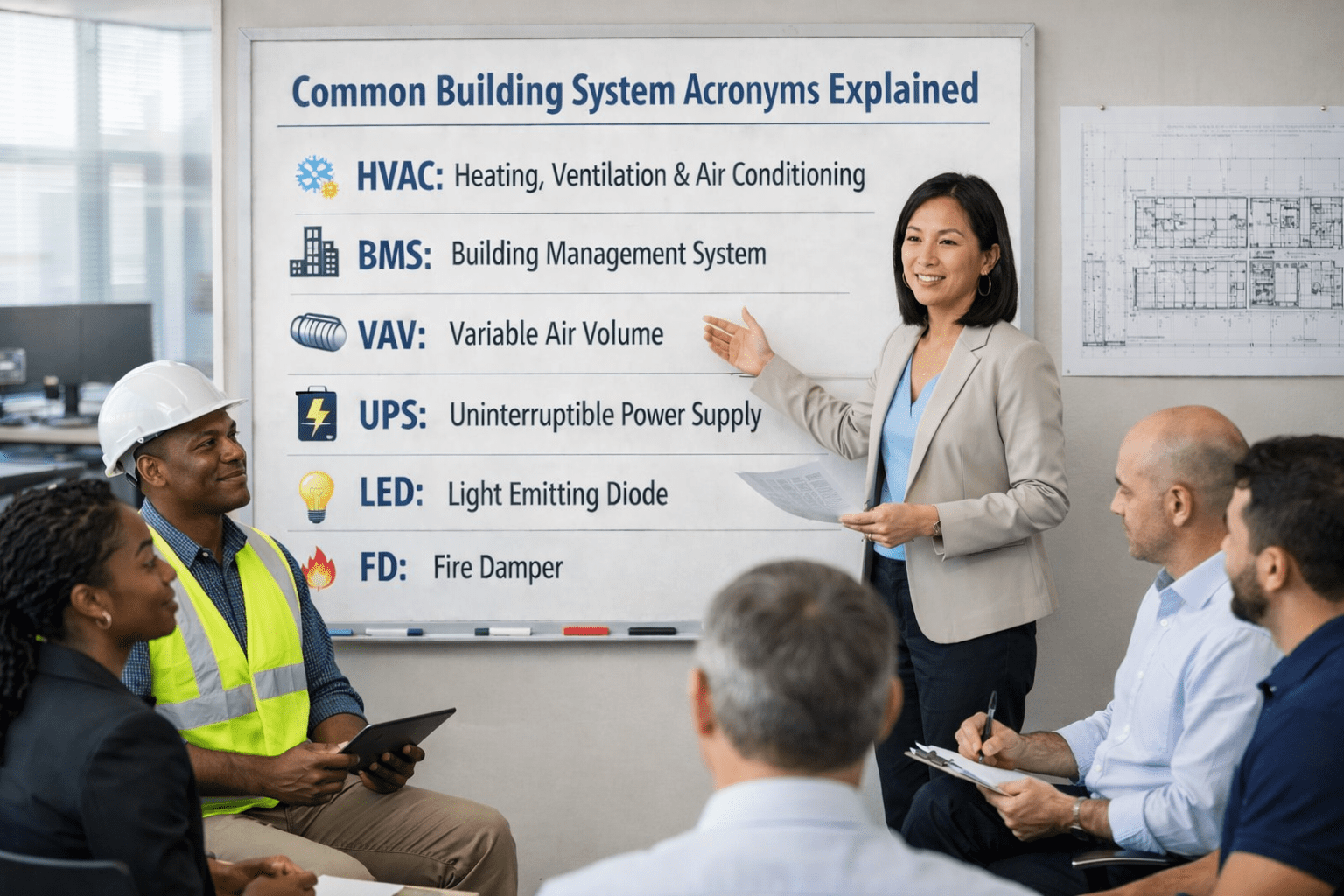
Understanding common building system acronyms is essential for professionals working in facilities management, construction, engineering, and property operations. Modern buildings rely on complex technical systems, and these systems are almost always referred to by abbreviations. From HVAC and BMS to UPS and CCTV, acronyms form the everyday language of building operations.
This article provides a comprehensive and professional guide to common building system acronyms, explaining what they mean, how they are used, and why they matter. It is designed to help facility managers, engineers, contractors, and business leaders communicate more effectively and operate buildings with greater confidence.
What Are Building System Acronyms?
Building system acronyms are standardized abbreviations used to describe mechanical, electrical, plumbing, safety, and digital systems within a facility. These acronyms simplify communication, reduce documentation complexity, and ensure consistency across technical teams. Systems like building automation are essential components of modern facilities and are widely used to control HVAC, lighting, security, and more, as outlined in building automation systems overview by Wikipedia.
Instead of writing long technical terms repeatedly, professionals use acronyms such as HVAC (Heating, Ventilation, and Air Conditioning) or BMS (Building Management System). Over time, these abbreviations become the industry’s shared language.
Without a clear understanding of common building system acronyms, even experienced professionals may struggle to interpret maintenance reports, engineering drawings, or system manuals.
Mechanical System Acronyms
Mechanical systems control climate, air movement, and thermal comfort. These acronyms are among the most frequently used in building operations.
HVAC – Heating, Ventilation, and Air Conditioning
The primary system responsible for indoor temperature, air quality, and occupant comfort. HVAC includes chillers, boilers, air handling units, ductwork, and control systems.
AHU – Air Handling Unit
A central component of HVAC systems that circulates and conditions air within a building.
FCU – Fan Coil Unit
A localized air conditioning device used in offices, hotels, and residential buildings.
VRF – Variable Refrigerant Flow
An advanced HVAC technology that adjusts refrigerant flow based on demand, improving energy efficiency.
CHW – Chilled Water System
A cooling system that uses water instead of refrigerant to distribute cooling across large facilities.
Electrical System Acronyms
Electrical systems power all building operations, from lighting to IT infrastructure.
UPS – Uninterruptible Power Supply
A backup power system that provides temporary electricity during outages to protect critical equipment.
ATS – Automatic Transfer Switch
A device that automatically switches power from the main supply to a backup generator.
LV – Low Voltage
Electrical systems operating at lower voltages, typically for lighting, data, and controls.
MV – Medium Voltage
Electrical systems used for larger power distribution in commercial and industrial facilities.
GFCI – Ground Fault Circuit Interrupter
A safety device that protects against electrical shock by shutting off power during faults.
Plumbing and Water System Acronyms
Plumbing systems manage water supply, drainage, and sanitation.
PWS – Potable Water System
The system that supplies clean drinking water to a building.
DHW – Domestic Hot Water
Hot water used for sinks, showers, kitchens, and restrooms.
STP – Sewage Treatment Plant
On-site or centralized systems that treat wastewater before discharge.
RWH – Rainwater Harvesting
A system that collects and reuses rainwater for irrigation or non-potable uses.
Fire Protection and Life Safety Acronyms
Safety systems are critical to building compliance and occupant protection.
FAS – Fire Alarm System
Detects smoke, heat, or fire and triggers alarms and evacuation protocols.
FPS – Fire Protection System
Includes sprinklers, fire pumps, hydrants, and suppression systems.
PA – Public Address System
Used for emergency announcements and evacuation instructions.
EM – Emergency Lighting
Lighting that activates during power failure to guide occupants to exits.
Building Automation and Smart System Acronyms
Automation systems optimize performance and enable real-time monitoring.
BMS – Building Management System
A centralized system that monitors and controls HVAC, lighting, power, and security.
BAS – Building Automation System
Often used interchangeably with BMS, focusing on automated building controls.
EMS – Energy Management System
Tracks energy consumption and identifies efficiency opportunities.
IoT – Internet of Things
Network of connected devices that collect data from building systems.
SCADA – Supervisory Control and Data Acquisition
Industrial control system used in large or critical facilities.
Security and Surveillance System Acronyms
Security systems protect assets, data, and occupants.
CCTV – Closed-Circuit Television
Video surveillance system used for monitoring and investigation.
ACS – Access Control System
Manages entry and exit using key cards, biometrics, or mobile credentials.
IDS – Intrusion Detection System
Detects unauthorized access or security breaches.
VMS – Video Management System
Software used to manage and analyze video surveillance footage.
Data and Communication System Acronyms
Digital infrastructure supports modern building operations.
LAN – Local Area Network
Internal network connecting computers and devices within a building.
WAN – Wide Area Network
External network connecting multiple buildings or locations.
PoE – Power over Ethernet
Technology that delivers power and data through a single network cable.
MDF – Main Distribution Frame
Central connection point for communication systems.
IDF – Intermediate Distribution Frame
Secondary distribution points throughout the facility.
Energy and Sustainability Acronyms
Sustainability is now a core priority in building management.
EUI – Energy Use Intensity
A metric that measures energy consumption per unit area.
PV – Photovoltaic
Solar panels that convert sunlight into electricity.
LEED – Leadership in Energy and Environmental Design
A global green building certification system.
ESG – Environmental, Social, and Governance
Framework for measuring sustainability and ethical impact.
Why Understanding Building System Acronyms Matters?
Understanding common building system acronyms is more than technical knowledge—it is a professional necessity. These acronyms appear in:
- Engineering drawings
- Maintenance reports
- System manuals
- Compliance documents
- Vendor contracts
- Emergency procedures
Misinterpreting an acronym can lead to operational errors, safety risks, and costly downtime.
For facility managers, fluency in building system acronyms improves communication with engineers, contractors, IT teams, and executives. It also enhances decision-making, troubleshooting, and long-term planning.
Best Practices for Using Building System Acronyms
To use acronyms effectively, professionals should follow several best practices.
Standardize Terminology
Use industry-recognized acronyms consistently across all documentation.
Define Acronyms Clearly
Always define acronyms in reports and manuals, especially for new stakeholders.
Maintain a System Glossary
Keep an internal glossary of building system acronyms for training and onboarding.
Avoid Overuse
Do not assume all audiences understand technical abbreviations.
The Role of Acronyms in Modern Building Operations
As buildings become smarter and more complex, the number of acronyms continues to grow. Technologies such as AI-driven automation, predictive maintenance, and digital twins introduce new terminology every year.
In this environment, professionals who understand common building system acronyms gain a competitive advantage. They communicate faster, reduce errors, and manage systems with greater confidence.
Acronyms are no longer just shorthand—they are the language of modern building management.
Conclusion
Common building system acronyms form the foundation of communication in facilities management, engineering, and property operations. From HVAC and BMS to UPS and IoT, these abbreviations define how professionals interact with technical systems every day.
This guide to common building system acronyms provides a practical and professional reference for understanding key terminology and concepts. By mastering these acronyms, building professionals improve operational efficiency, enhance safety, and strengthen collaboration across teams.
In a world where buildings are becoming more intelligent and interconnected, knowing the language of building systems is not optional—it is essential.