
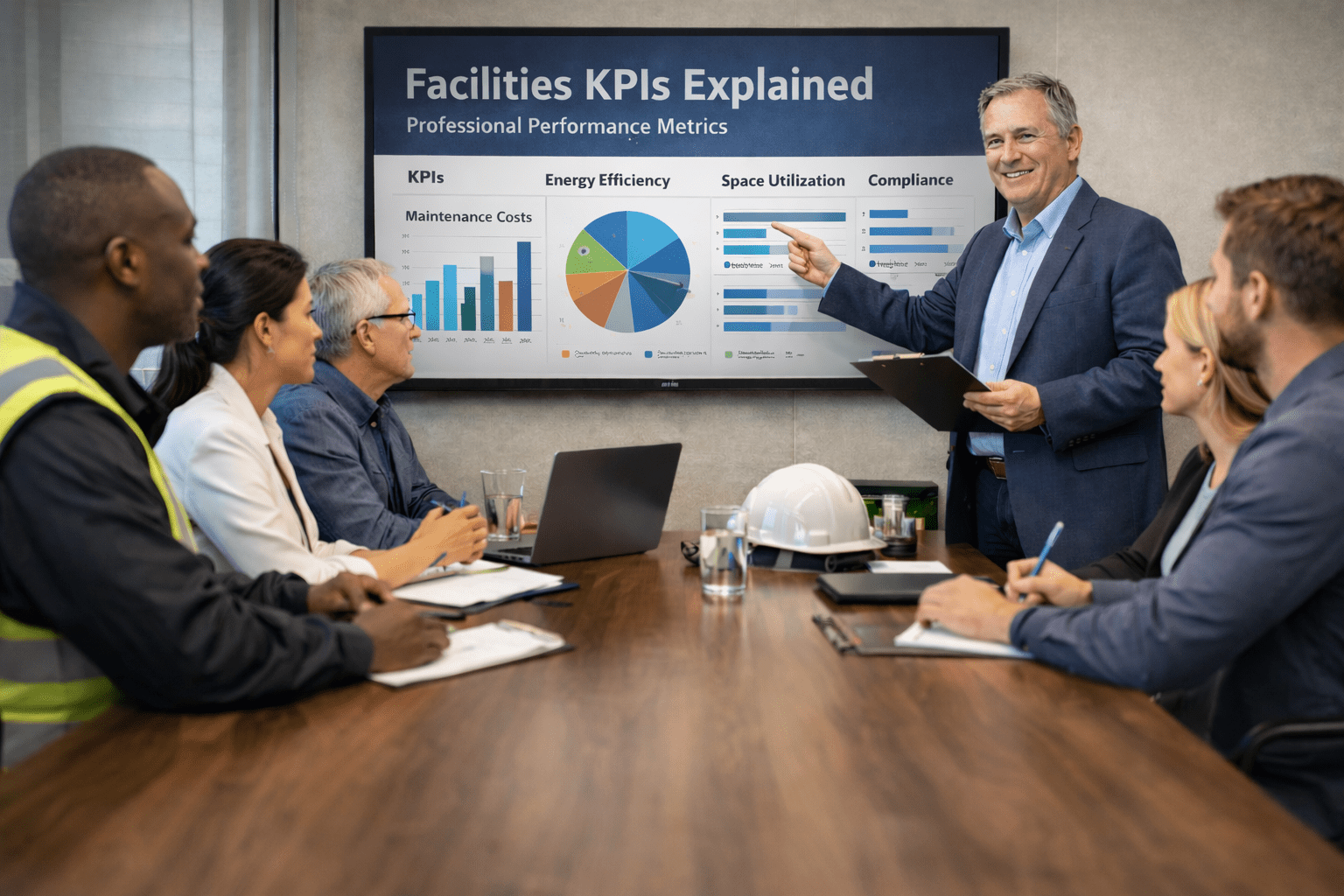
In today’s competitive and efficiency-driven business environment, performance measurement is no longer optional—especially in facilities management. Organizations increasingly rely on data to ensure their physical assets, infrastructure, and services are aligned with business objectives. This is where Facilities Key Performance Indicators (KPIs) come in.
This article provides a comprehensive and professional explanation of facilities KPIs, why they matter, and how organizations can use them to drive smarter decisions, reduce costs, and improve operational excellence.
What Are Facilities KPIs?
Facilities KPIs are quantifiable metrics used to evaluate how effectively facilities services are being delivered. They measure performance across areas such as maintenance, energy, space utilization, safety, compliance, and customer satisfaction.
In simple terms answers questions like:
- Are our buildings operating efficiently?
- Are maintenance costs under control?
- Is space being used effectively?
- Are occupants satisfied with facilities services?
These indicators allow facility managers and executives to move from reactive management to strategic oversight.
Why Facilities KPIs Matter?
Facilities represent one of the largest operational expenses for most organizations. Poorly managed facilities lead to:
- Increased downtime
- Higher energy consumption
- Safety risks
- Employee dissatisfaction
- Compliance failures
Well-designed KPIs provide:
- Visibility into performance trends
- Accountability for service providers
- Early warning signals for risks
- Data-driven justification for budgets and investments
Ultimately, bridges the gap between operational activity and business strategy.
Core Categories of Facilities KPIs
Industry frameworks such as those outlined in leading facility management KPI guides emphasize the importance of tracking financial, maintenance, and sustainability metrics.
Typically fall into five major categories:
1. Financial Performance KPIs
These focus on cost control and financial efficiency.
Common examples:
- Cost per square meter (or square foot)
- Maintenance cost as a percentage of asset value
- Facilities cost per employee
- Budget variance
Purpose:
To ensure facilities spending delivers maximum value for money.
2. Maintenance and Asset KPIs
These measure how well physical assets are maintained.
Key indicators include:
- Preventive Maintenance (PM) compliance rate
- Mean Time Between Failures (MTBF)
- Mean Time to Repair (MTTR)
- Reactive vs planned maintenance ratio
Purpose:
To shift from breakdown maintenance to proactive asset management.
3. Space and Utilization KPIs
These evaluate how efficiently physical space is used.
Examples:
- Occupancy rate
- Space utilization ratio
- Cost per workstation
- Desk sharing ratio
Purpose:
To optimize space planning, especially in hybrid and flexible work environments.
4. Energy and Sustainability KPIs
These track environmental and energy performance.
Common metrics:
- Energy consumption per square meter
- Carbon emissions per building
- Water usage per occupant
- Waste diversion rate
Purpose:
To support sustainability goals, regulatory compliance, and cost reduction.
5. Service Quality and User Experience KPIs
These reflect occupant satisfaction and service effectiveness.
Examples:
- Customer satisfaction score (CSAT)
- Work order response time
- Service request closure rate
- Complaint frequency
Purpose:
To ensure facilities contribute to employee productivity and wellbeing.
How to Design Effective Facilities KPIs?
Not all KPIs are equally valuable. The most effective follows the SMART principle:
- Specific – Clearly defined
- Measurable – Based on real data
- Achievable – Realistic targets
- Relevant – Linked to business goals
- Time-bound – Tracked over time
Step 1: Align KPIs with Business Strategy
Should support broader organizational goals such as:
- Cost optimization
- ESG (Environmental, Social, Governance) compliance
- Employee experience
- Risk reduction
Facilities should never measure performance in isolation.
Step 2: Focus on Leading and Lagging Indicators
- Lagging indicators show past results (e.g., total maintenance cost).
- Leading indicators predict future performance (e.g., PM compliance).
High-performing organizations balance both to manage today while preparing for tomorrow.
Step 3: Limit the Number of KPIs
Too many KPIs create noise and confusion. Best practice suggests:
- 10–15 core KPIs at executive level
- 20–30 operational KPIs for facilities teams
Quality always beats quantity.
Using Facilities KPIs for Decision-Making
Facilities KPIs are not just for reporting—they are powerful decision tools.
They help answer critical questions such as:
- Should we outsource maintenance services?
- Do we need to upgrade HVAC systems?
- Are we underutilizing office space?
- Is energy investment paying off?
When integrated into dashboards and CAFM/IWMS systems, KPIs enable real-time performance management.
Common Mistakes in Facilities KPI Implementation
Even mature organizations struggle with KPI adoption. The most common mistakes include:
1. Measuring What Is Easy, Not What Matters
Tracking available data instead of meaningful insights.
2. Lack of Data Quality
Poor asset records lead to unreliable KPIs.
3. No Ownership
KPIs without accountability never drive improvement.
4. No Action Plan
KPIs must trigger corrective actions, not just reports.
Facilities KPIs should always be tied to performance reviews, contracts, and improvement initiatives.
Facilities KPIs in the Era of Digital Transformation
Modern facilities management is increasingly supported by:
- IoT sensors
- Smart building systems
- AI-driven analytics
- Integrated workplace management systems (IWMS)
These technologies allow KPIs to move from static reports to predictive performance intelligence.
Examples:
- Predictive maintenance using sensor data
- Energy optimization through machine learning
- Space utilization tracked via occupancy sensors
Facilities KPIs are becoming not just measurement tools—but strategic forecasting systems.
Facilities KPIs and Outsourced Service Providers
For organizations using third-party facilities services, KPIs are critical for:
- Service Level Agreements (SLAs)
- Contract performance reviews
- Penalty and incentive structures
Typical SLA KPIs include:
- Response time compliance
- First-time fix rate
- Preventive maintenance completion
- Safety incident frequency
Clear KPI frameworks ensure transparency, accountability, and value realization from outsourcing partners.
Building a Facilities KPI Dashboard
A professional KPI dashboard should include:
- Financial overview
- Maintenance performance
- Energy metrics
- Space utilization
- User satisfaction
Best dashboards are:
- Visual
- Real-time or near real-time
- Role-based (executive vs operational views)
- Integrated with CMMS or IWMS platforms
Dashboards turn data into actionable intelligence.
Future Trends in Facilities Performance Measurement
Facilities KPIs are evolving rapidly. Key future trends include:
- AI-powered predictive KPIs
- ESG-driven performance frameworks
- Experience-based metrics (employee wellbeing, productivity)
- Digital twin modeling for scenario analysis
Facilities management is shifting from cost center to strategic business enabler—and KPIs are at the heart of this transformation.
Conclusion: Why Facilities KPIs Are Essential
Facilities KPIs are not just operational metrics—they are strategic performance tools. They enable organizations to:
- Control costs
- Improve service quality
- Enhance sustainability
- Optimize assets
- Support business growth
When properly designed and consistently applied, facilities KPIs transform facilities management from reactive support function into a data-driven leadership discipline.
In short, facilities KPIs are the language through which organizations understand, manage, and continuously improve their physical environment. And in a world where efficiency, sustainability, and employee experience define success, mastering facilities KPIs is no longer optional—it is essential.