
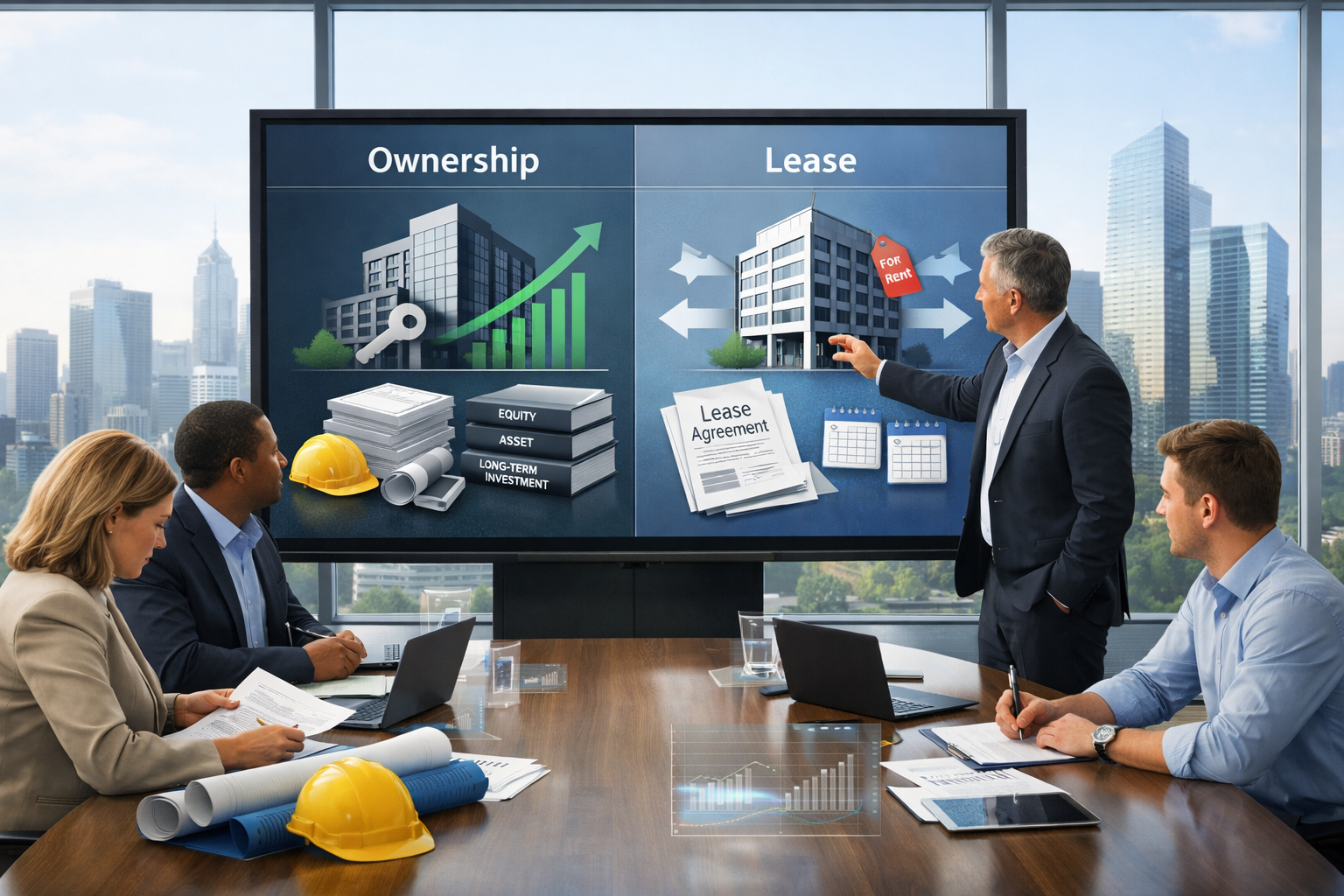
When planning a new site for operations, expansion, or investment, one of the most strategic decisions leaders face is Facility ownership vs lease. This decision impacts capital allocation, risk exposure, operational flexibility, tax positioning, and long-term scalability.
Before evaluating Facility ownership vs lease, decision-makers should understand key concepts and definitions used in facilities management. Reviewing common facilities terminology helps clarify financial and operational discussions.
Choosing between Facility ownership vs lease depends on your capital strategy, risk tolerance, growth timeline, and operational flexibility needs.
This guide explains and compares financial and operational implications, and helps decision-makers evaluate the right model for their business.
What Does Facility Ownership Mean?
Facility ownership means your company purchases and holds legal title to the property where operations occur. This includes land, buildings, and often major structural systems.
Ownership can be:
- Direct (the business owns the property outright)
- Through a holding entity (LLC or subsidiary)
- Via financing (mortgage-backed ownership)
Key Characteristics of Ownership
- Large upfront capital investment
- Full control of modifications and improvements
- Responsibility for maintenance and structural repairs
- Long-term asset appreciation potential
- Property tax obligations
Ownership converts facility costs into a capital asset rather than a recurring rent expense.
What Does Leasing a Facility Mean?
Leasing means your company rents the property from a landlord under a contractual agreement. Lease terms vary widely, from short-term flexible contracts to long-term triple-net leases.
Common lease types include:
- Gross lease
- Modified gross lease
- Triple-net (NNN) lease
- Build-to-suit lease
Under a lease model, the landlord retains ownership while the tenant pays rent and possibly operating expenses.
Financial Comparison: Facility ownership vs lease
Understanding the financial impact of Facility ownership vs lease requires analyzing capital structure, cash flow, and return on investment. For a closer look at the operational and cost implications of each option in industrial contexts, see leasing vs buying industrial property.
1. Upfront Capital Requirements
Ownership
- Down payment (typically 10–30%)
- Closing costs
- Due diligence and inspection costs
- Renovation or fit-out costs
Lease
- Security deposit
- First and last month’s rent
- Tenant improvements (depending on lease agreement)
Leasing preserves liquidity, while ownership requires significant capital commitment.
2. Monthly Cash Flow Impact
Ownership involves:
- Mortgage payments
- Property taxes
- Insurance
- Maintenance and capital repairs
Leasing involves:
- Fixed monthly rent
- Operating expenses (if applicable)
- Escalation clauses
With Facility ownership vs lease, ownership may initially cost more monthly, but it builds equity over time. Leasing often provides predictable short-term budgeting.
3. Asset Appreciation and Equity
Ownership allows the company to:
- Build property equity
- Benefit from market appreciation
- Use the property as collateral
Leasing does not create equity. Payments are operating expenses without long-term asset accumulation.
If real estate values rise significantly, ownership can generate substantial long-term value.
Operational Considerations in Facility ownership vs lease
Financial factors are important, but operational flexibility is equally critical.
Control and Customization
Ownership provides:
- Full control over structural modifications
- Freedom to expand or redesign
- No landlord approval process
Leasing may limit:
- Major renovations
- Exterior branding changes
- Structural alterations
For specialized industries like manufacturing, logistics, or healthcare, ownership may provide greater long-term operational freedom.
Maintenance Responsibilities
With ownership:
- All repairs and capital replacements are your responsibility
- Roof, HVAC, structural systems are company liabilities
With leasing:
- Responsibilities depend on lease type
- Triple-net leases shift many costs to tenants
- Gross leases may include maintenance in rent
Understanding cost allocation is essential when comparing Facility ownership vs lease.
Scalability and Flexibility
Leasing provides:
- Easier relocation
- Shorter commitment periods
- Faster geographic expansion
Ownership:
- Locks capital into one location
- May limit agility
- Requires property sale or refinancing to exit
For high-growth or uncertain businesses, leasing often reduces strategic risk.
Tax Implications of Facility ownership vs lease
Tax strategy significantly influences the decision.
Ownership Tax Benefits
- Depreciation deductions
- Mortgage interest deductions
- Property tax deductions
- Potential capital gains advantages
Lease Tax Benefits
- Rent payments typically deductible as operating expenses
- No depreciation management required
- Simpler accounting treatment
Tax positioning depends on jurisdiction and corporate structure, so consultation with financial professionals is essential.
Risk Profile Comparison
Risk tolerance is central to evaluating Facility ownership vs lease.
Market Risk
Ownership exposes businesses to:
- Property value fluctuations
- Local economic shifts
- Liquidity challenges during downturns
Leasing reduces:
- Real estate market exposure
- Capital risk concentration
Operational Risk
Ownership increases:
- Repair liabilities
- Unexpected capital expenditure risk
Leasing shifts:
- Some structural risks to landlords
- Long-term asset responsibility away from tenant
However, lease contracts can include rent escalation clauses that increase costs over time.
Industry-Specific Considerations
Different industries approach Facility ownership vs lease differently.
Manufacturing and Industrial Operations
Often favor ownership due to:
- Specialized infrastructure needs
- Long equipment lifecycles
- Stable location requirements
Retail and Hospitality
Often prefer leasing due to:
- Market volatility
- Location flexibility
- Brand repositioning needs
Technology and Startups
Frequently choose leasing because:
- Growth uncertainty
- Rapid team expansion
- Capital preservation priorities
Understanding operational horizon is critical before committing.
Strategic Growth Perspective
Facility decisions should align with long-term corporate strategy.
Ask these questions:
- Is real estate a core asset or support function?
- Will location remain stable for 10–20 years?
- Is capital better deployed into operations or property?
- How important is exit flexibility?
Facility ownership vs lease is not purely financial. It reflects the company’s growth philosophy.
Hybrid Approaches
Many organizations adopt blended strategies:
- Own headquarters, lease satellite offices
- Sale-leaseback transactions
- Ground leases
- Build-to-suit agreements
A sale-leaseback allows a company to:
- Sell owned property
- Free capital
- Lease the property back
This creates liquidity while maintaining operational continuity.
Hybrid models offer balance between control and flexibility.
Long-Term Cost Analysis
When comparing Facility ownership vs lease, decision-makers should conduct:
- Net present value (NPV) analysis
- Internal rate of return (IRR) modeling
- Total occupancy cost calculations
- Sensitivity analysis on appreciation rates
- Scenario modeling for exit strategies
Ownership may outperform leasing over 15–20 years in stable markets. Leasing may outperform ownership in volatile or fast-growth environments.
When Ownership Makes Sense?
Facility ownership may be ideal when:
- The business has strong capital reserves
- Long-term location stability is expected
- Customization needs are extensive
- Real estate appreciation is likely
- The company seeks balance sheet asset growth
Ownership supports long-term institutional stability.
When Leasing Makes Sense?
Leasing may be optimal when:
- Growth trajectory is uncertain
- Capital must remain liquid
- Market conditions are volatile
- Geographic flexibility is required
- The company prefers asset-light models
Leasing enhances adaptability and reduces capital lock-in.
Final Thoughts on Facility ownership vs lease
The debate around Facility ownership vs lease is not about right or wrong. It is about alignment. Ownership builds equity and long-term control. Leasing enhances flexibility and protects capital.
Leaders must evaluate:
- Financial health
- Market outlook
- Strategic timeline
- Risk appetite
- Operational requirements
In the end, Facility ownership vs lease should support business sustainability, not constrain it.
Organizations that approach this decision analytically — considering financial modeling, operational needs, and strategic direction — are better positioned to optimize facility performance and long-term value creation.By understanding the full scope of Facility ownership vs lease, companies can transform real estate decisions from simple occupancy choices into strategic growth drivers.