
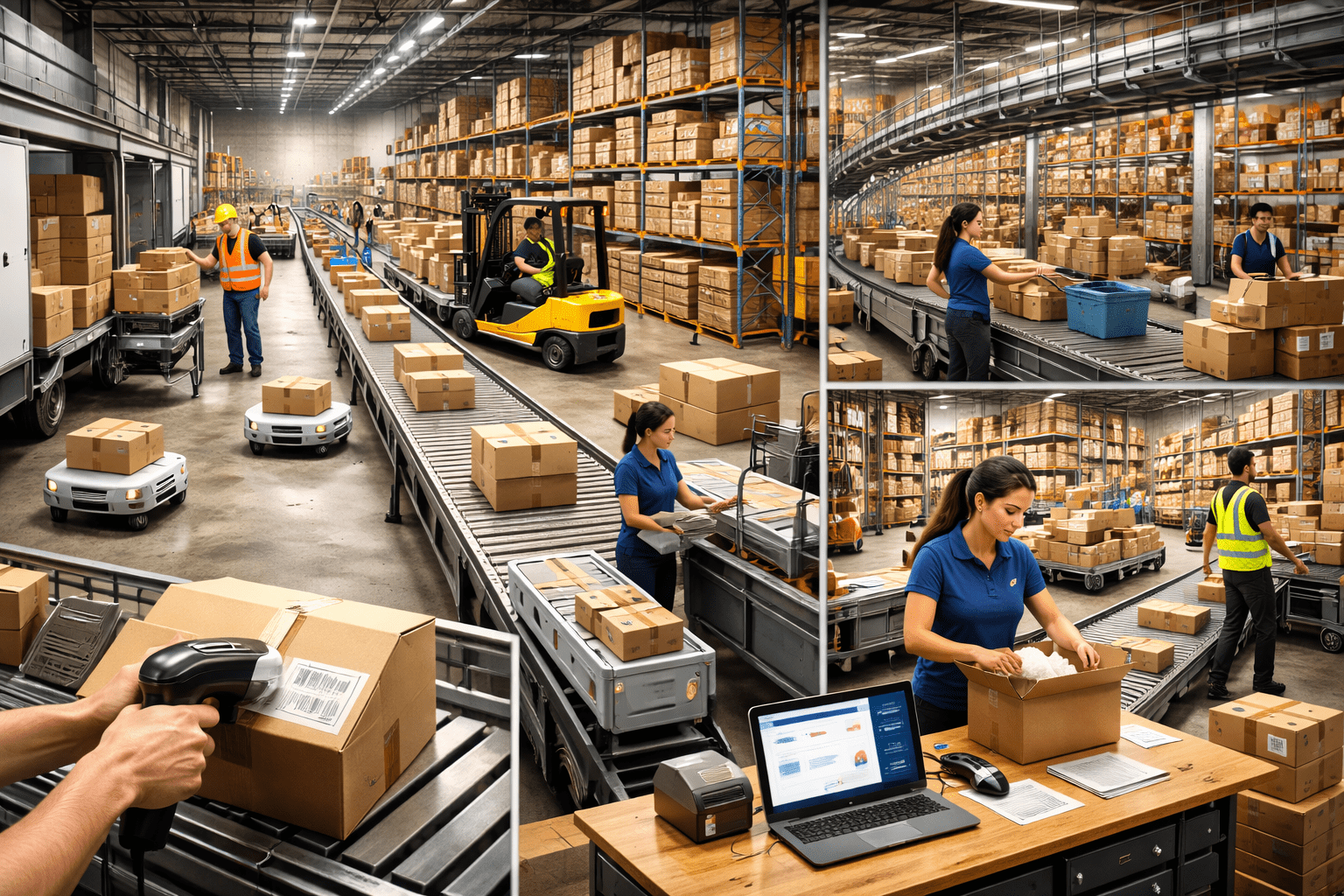
E-commerce continues to grow at an unprecedented rate. Behind every “Buy Now” click is a complex system of physical operations working to move products from suppliers to warehouses and ultimately to customers. At the heart of these physical operations lies one essential discipline: material handling basics.
For beginners entering the world of logistics, warehouse management, or online retail operations, understanding and It is crucial. It determines how efficiently products flow, how safely employees work, and how satisfied customers remain.
In this comprehensive guide, we’ll break down material handling fundamentals in a beginner-friendly yet technical way to help you build a strong operational foundation.
What Are Material Handling Basics in E-Commerce?
It refer to the systematic movement, storage, protection, and control of goods throughout the e-commerce fulfillment process.
In simple terms, material handling is how products:
- Move from receiving docks to storage areas
- Get picked and packed
- Travel through sorting systems
- Ship to customers
Efficient material handling reduces costs, prevents product damage, improves order accuracy, and enhances overall operational performance.
Why Material Handling Basics Matter in Physical Operations?
Efficient order fulfillment depends on proper materials handling in e-commerce operations, ensuring goods move safely from receiving to shipping without delays or damage. Physical operations in e-commerce include:
- Receiving inventory
- Warehousing
- Inventory management
- Order picking
- Packing
- Shipping
- Returns processing
Every one of these processes depends on proper material handling practices.
When ignored, businesses experience:
- Slow order fulfillment
- Increased labor costs
- Higher return rates due to damage
- Workplace injuries
- Inventory inaccuracies
On the other hand, mastering leads to scalable, efficient, and profitable operations.
Core Principles of Material Handling Basics
Understanding the principles behind material handling basics helps create systems that are safe and cost-effective.
1. Planning Principle
All material movement should be planned. Random workflows cause congestion and delays. Warehouse layout, equipment selection, and storage systems must align with order volume and SKU variety.
2. Standardization Principle
Standard processes reduce errors. For example:
- Standard bin sizes
- Standard pallet configurations
- Standard labeling procedures
Standardization improves efficiency and simplifies training.
3. Work Minimization Principle
The fewer times a product is touched, the lower the cost. Reducing unnecessary movement is one of the most important material handling basics.
4. Ergonomic Principle
Safety matters. Equipment and workflows should reduce strain on workers. Proper lifting techniques and ergonomic workstations prevent injuries.
5. Automation Principle
As order volume grows, automation becomes essential. Conveyor systems, barcode scanners, and robotics improve speed and accuracy.
Types of Material Handling Systems in E-Commerce
Material handling systems fall into three main categories.
1. Manual Material Handling
Manual handling involves human labor using tools like:
- Hand trucks
- Pallet jacks
- Shelving systems
- Picking carts
This approach works for small or startup e-commerce businesses. However, it may not scale efficiently for high-volume operations.
2. Semi-Automated Systems
These systems combine human labor with equipment such as:
- Conveyor belts
- Sortation systems
- Barcode scanners
- Warehouse Management Systems (WMS)
Semi-automation improves productivity while maintaining flexibility.
3. Fully Automated Systems
Large e-commerce fulfillment centers use advanced solutions like:
- Automated Storage and Retrieval Systems (AS/RS)
- Robotics-assisted picking
- Automated guided vehicles (AGVs)
- High-speed sorters
These systems maximize efficiency but require significant capital investment.
Key Equipment in Material Handling Basics
Choosing the right equipment is essential for efficient physical operations.
Storage Equipment
- Pallet racks
- Shelving systems
- Mezzanine floors
- Bin storage
These systems maximize vertical space and improve organization.
Transport Equipment
- Forklifts
- Conveyor belts
- AGVs
- Pallet jacks
Transport equipment moves goods between zones quickly and safely.
Unit Load Formation Equipment
- Pallets
- Containers
- Totes
- Shrink wrapping machines
Unit loads reduce the number of trips needed to move goods.
The Role of Warehouse Layout in Material Handling Basics
Warehouse layout directly impacts material flow.
Common layout types include:
U-Shaped Layout
Receiving and shipping are located close together. This design minimizes travel distance and improves efficiency.
I-Shaped Layout
Goods move in a straight line from receiving to shipping. Ideal for high-volume operations.
L-Shaped Layout
Suitable for buildings with space constraints.
An optimized layout supports material handling basics by reducing congestion and improving product flow.
Material Handling in the Order Fulfillment Process
Understanding where material handling basics apply in daily operations is important.
1. Receiving
When inventory arrives:
- Products are unloaded
- Inspected
- Scanned into inventory
- Stored
Proper material handling prevents damage during unloading.
2. Storage
Products are placed in designated locations using optimized slotting strategies. High-demand items are stored closer to picking areas.
3. Picking
Order picking is labor-intensive. Methods include:
- Single-order picking
- Batch picking
- Zone picking
- Wave picking
Efficient material handling reduces travel time and improves picking speed.
4. Packing
Items are securely packed using:
- Protective materials
- Right-sized boxes
- Automated packing stations
Good material handling minimizes product damage during shipment.
5. Shipping
Orders are sorted and staged for carrier pickup. Conveyor systems and scanning stations improve accuracy.
Safety Considerations in Material Handling Basics
Safety is a critical component of physical operations.
Common risks include:
- Back injuries from improper lifting
- Collisions with forklifts
- Slips and falls
- Falling objects from racks
Best practices include:
- Regular safety training
- Clear aisle markings
- Equipment maintenance
- Personal protective equipment (PPE)
Safe material handling reduces downtime and compensation claims.
Cost Impact of Material Handling Basics
Material handling accounts for a significant portion of warehouse operating costs.
Costs include:
- Labor
- Equipment
- Maintenance
- Energy consumption
- Space utilization
Improving material handling basics can:
- Reduce labor hours
- Lower damage rates
- Increase throughput
- Improve customer satisfaction
Even small workflow improvements can result in major cost savings over time.
Technology Supporting Material Handling Basics
Modern e-commerce relies heavily on technology.
Warehouse Management Systems (WMS)
A WMS tracks inventory movement and optimizes picking routes.
Barcode and RFID Systems
These technologies improve inventory accuracy and reduce human error.
Robotics and Automation
Robotic picking systems and AGVs streamline repetitive tasks.
Technology enhances material handling basics by improving visibility and efficiency.
Scalability and Future Growth
As e-commerce businesses grow, material handling systems must scale.
Scalability strategies include:
- Modular racking systems
- Expandable conveyor networks
- Cloud-based WMS platforms
- Flexible labor planning
Planning for growth ensures that physical operations can handle seasonal peaks and increased order volume.
Common Mistakes in Material Handling Basics
Beginners often make these mistakes:
- Overcrowded storage areas
- Poor SKU organization
- Ignoring data analysis
- Delaying automation too long
- Underestimating safety requirements
Avoiding these mistakes improves operational stability.
Final Thoughts on Material Handling Basics
Material handling basics are the backbone of physical operations in e-commerce. From receiving inventory to shipping orders, every step depends on efficient movement and storage of goods.
For beginners, focusing on:
- Smart warehouse layout
- Proper equipment selection
- Standardized processes
- Safety measures
- Scalable technology
will create a strong operational foundation.
As your e-commerce business grows, refining material handling basics will help reduce costs, improve speed, and enhance customer satisfaction.
In today’s competitive market, physical operations are not just about moving boxes — they are about building systems that deliver accuracy, efficiency, and long-term success.
Master the material handling basics, and you master the engine that powers e-commerce fulfillment.