
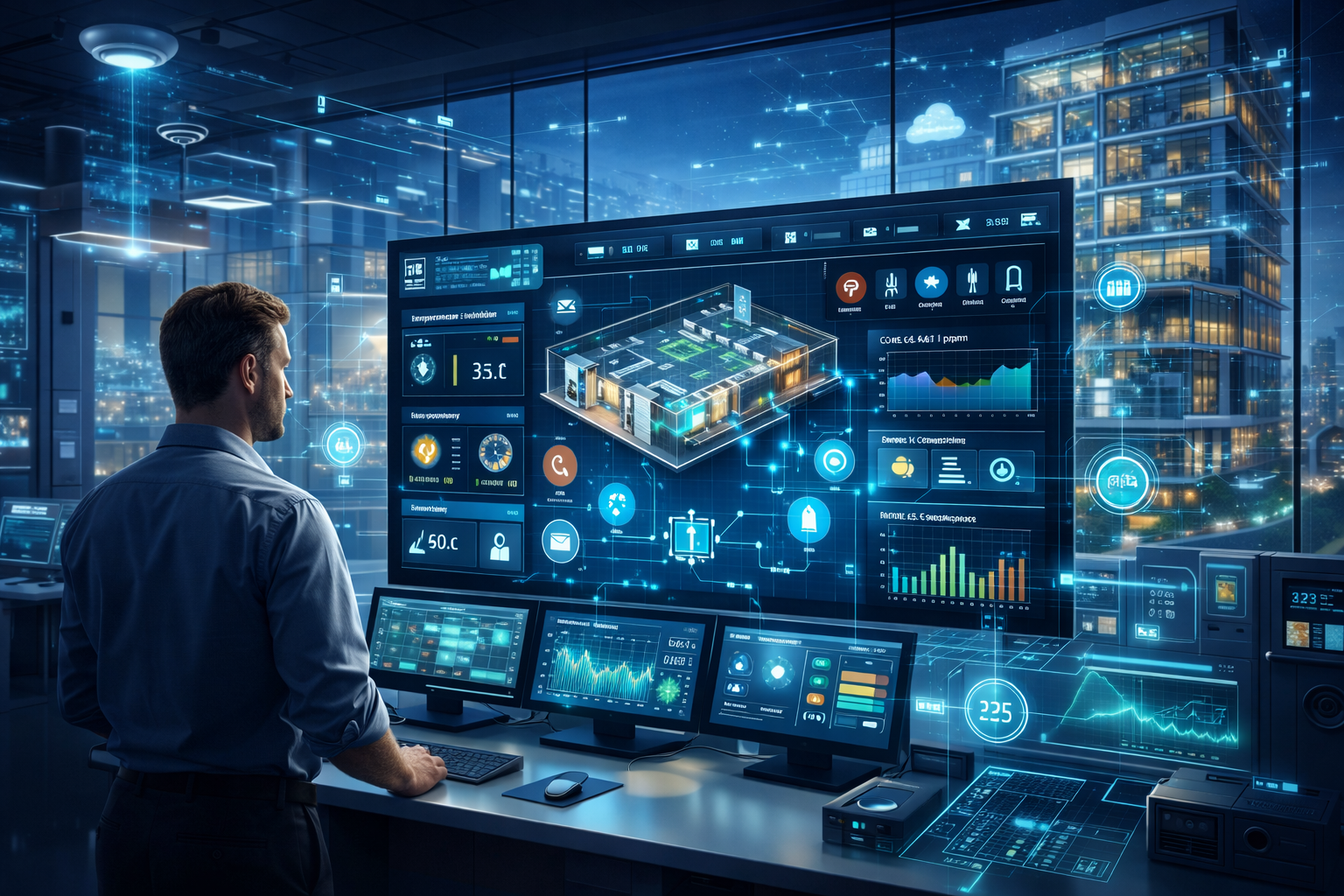
Modern buildings are evolving into intelligent environments that can sense, analyze, and respond to changing conditions in real time. Sensors serve as the foundation of modern smart building infrastructure, collecting real-time environmental and operational data. This data is then used by building automation systems (BAS) to automatically manage HVAC, lighting, security, and other building operations.
At the center of this transformation are sensors and monitoring technologies, which serve as the foundation of smart building infrastructure. These technologies enable building systems to collect operational data, monitor environmental conditions, and automate responses that improve energy efficiency, safety, and occupant comfort.
Within the broader framework of building systems engineering, sensors and monitoring technologies play a critical role in enabling automation, predictive maintenance, and data-driven facility management. As buildings become more connected and integrated, the demand for advanced monitoring technologies continues to grow across commercial, industrial, and residential environments.
Understanding Sensors and Monitoring Technologies
Sensors and monitoring technologies refer to electronic devices and digital systems that detect physical conditions and convert them into data signals. These signals are transmitted to building management platforms, where they can be analyzed and used to automate building operations.
In modern smart buildings, sensors continuously track key operational variables such as temperature, humidity, lighting levels, air quality, occupancy, and equipment performance. The data generated by these sensors is then processed by automation systems to optimize building performance.
Sensors essentially act as the sensory network of intelligent buildings, allowing systems to detect changes in the environment and respond automatically.
The Role of Sensors in Smart Building Infrastructure
In traditional buildings, facility managers relied on manual monitoring and periodic inspections to assess system performance. Today, sensors provide continuous real-time monitoring, allowing building systems to react instantly to environmental changes.
Sensors support a wide range of building operations, including:
- Heating, ventilation, and air conditioning (HVAC) management
- Energy consumption monitoring
- Lighting automation
- Occupancy detection and space utilization
- Air quality monitoring
- Security and access control
- Equipment performance diagnostics
By providing continuous data streams, sensors allow building management systems to maintain optimal conditions while minimizing energy waste and operational inefficiencies.
Key Types of Sensors Used in Building Systems
Modern buildings rely on a wide variety of sensors to monitor different environmental and operational parameters. Each sensor type provides specific insights that help automation systems maintain efficient building performance.
Temperature Sensors
Temperature sensors are among the most widely used monitoring technologies in building systems. They measure ambient air temperature and provide critical data for HVAC control systems.
These sensors help ensure that indoor spaces remain within comfortable temperature ranges while optimizing heating and cooling energy consumption.
Advanced temperature sensors can also monitor equipment temperatures, helping detect overheating or mechanical faults in building systems.
Humidity Sensors
Humidity sensors measure moisture levels in the air. Maintaining proper humidity levels is essential for occupant comfort, indoor air quality, and building material preservation.
High humidity levels can encourage mold growth and structural damage, while extremely low humidity can cause discomfort and affect sensitive equipment.
By integrating humidity sensors into HVAC systems, building automation platforms can regulate humidity levels automatically.
Occupancy and Motion Sensors
Occupancy sensors detect the presence of people in a specific area. These sensors are commonly used in lighting control and energy management systems. Modern smart buildings rely on connected sensor networks to monitor environmental conditions, occupancy patterns, and equipment performance. Advanced IoT sensor solutions, such as those developed by Minew, help facilities deploy scalable monitoring infrastructure for smart building environments.
When a room becomes occupied, the building system can automatically activate lighting, adjust temperature settings, and increase ventilation. When the space becomes vacant, the system can reduce energy usage by lowering lighting and HVAC activity.
Motion detection technologies commonly used in occupancy sensing include:
- Passive infrared (PIR) sensors
- Ultrasonic sensors
- Microwave sensors
- Camera-based analytics
These technologies help buildings operate more efficiently by aligning system activity with actual usage patterns.
Air Quality Sensors
Indoor air quality has become a major focus in building design, especially in commercial offices, hospitals, and educational facilities.
Air quality sensors monitor environmental factors such as:
- Carbon dioxide (CO₂) levels
- Volatile organic compounds (VOCs)
- Particulate matter (PM2.5 and PM10)
- Oxygen levels
These sensors help ensure healthy indoor environments by adjusting ventilation systems when pollutant levels rise.
Advanced air quality monitoring systems can also provide alerts to facility managers if air quality conditions fall outside safe thresholds.
Light Sensors
Light sensors measure illumination levels within a space. These sensors enable daylight harvesting systems, which automatically adjust artificial lighting based on available natural light.
For example, if sunlight enters a building through windows or skylights, light sensors can reduce the intensity of indoor lighting fixtures to maintain consistent brightness while reducing electricity consumption.
This technology improves energy efficiency and enhances occupant comfort.
Pressure Sensors
Pressure sensors are commonly used in HVAC systems to monitor airflow and system performance.
These sensors measure:
- Air pressure in ventilation ducts
- Water pressure in piping systems
- Differential pressure across filters
Monitoring pressure levels helps detect system blockages, clogged filters, or pump failures before they escalate into major operational problems.
Monitoring Technologies and Data Collection
While sensors gather environmental and operational data, monitoring technologies handle the aggregation, transmission, and analysis of that data.
Modern building monitoring platforms typically include:
- Data acquisition systems
- Communication networks
- Cloud-based monitoring dashboards
- Analytics and reporting tools
These systems convert raw sensor signals into meaningful insights that help facility managers make informed decisions.
Data collected from building sensors can also be stored for long-term analysis, allowing organizations to identify trends, optimize performance, and improve energy management strategies.
Integration with Building Automation Systems
Sensors and monitoring technologies are closely integrated with Building Automation Systems (BAS). BAS platforms rely on sensor data to execute automated control strategies across multiple building systems.
For example:
- Temperature sensors inform HVAC controllers when heating or cooling adjustments are required.
- Occupancy sensors trigger lighting and ventilation changes based on room usage.
- Air quality sensors increase ventilation rates when pollutant levels rise.
This continuous feedback loop allows building automation systems to maintain ideal conditions while reducing energy waste.
Without reliable sensors and monitoring technologies, BAS platforms would not be able to function effectively.
Predictive Maintenance and Equipment Monitoring
One of the most valuable applications of sensor technology is predictive maintenance. Instead of waiting for equipment to fail, monitoring technologies detect early warning signs of potential problems.
Sensors can monitor equipment variables such as:
- vibration levels
- temperature fluctuations
- electrical current consumption
- pressure changes
By analyzing these metrics, building systems can identify abnormalities that indicate equipment wear or failure.
Predictive maintenance helps organizations:
- reduce downtime
- extend equipment lifespan
- prevent costly repairs
- improve operational reliability
This proactive maintenance approach is becoming increasingly important in large commercial and industrial facilities.
IoT and Smart Sensor Networks
The rise of the Internet of Things (IoT) has significantly expanded the capabilities of building sensors. IoT-enabled sensors can communicate wirelessly and transmit data to cloud platforms for advanced analytics.
Smart sensor networks offer several advantages:
- scalable monitoring infrastructure
- wireless installation flexibility
- real-time data access
- remote monitoring capabilities
- integration with artificial intelligence systems
IoT sensors also support edge computing, where data processing occurs near the source of the sensor. This reduces latency and enables faster system responses.
As IoT technologies mature, buildings are becoming increasingly interconnected ecosystems where sensors continuously collaborate to optimize performance.
Cybersecurity Considerations
While sensor networks offer powerful monitoring capabilities, they also introduce potential cybersecurity risks. Connected sensors can become entry points for cyber threats if not properly secured.
To protect building infrastructure, organizations must implement strong security measures such as:
- encrypted communication protocols
- network segmentation
- secure device authentication
- regular software updates
Cybersecurity strategies are essential to ensure that building monitoring systems remain reliable and protected from unauthorized access.
The Future of Sensors and Monitoring Technologies
The next generation of building sensors will be driven by advancements in artificial intelligence, machine learning, and advanced analytics.
Future innovations may include:
- AI-powered sensor analytics
- self-calibrating sensors
- energy harvesting sensor devices
- ultra-low-power wireless sensors
- digital twin integration
These technologies will allow buildings to become self-optimizing environments capable of adapting automatically to changing conditions.
In smart cities, sensors will not only monitor individual buildings but also contribute to urban infrastructure networks that manage energy distribution, traffic flow, and environmental conditions.
Conclusion
Sensors and monitoring technologies are fundamental to the evolution of intelligent buildings. By collecting real-time data on environmental conditions and system performance, sensors enable building automation platforms to optimize operations, improve energy efficiency, and enhance occupant comfort.
As buildings continue to integrate advanced digital infrastructure, the importance of reliable monitoring technologies will only increase. Sensors serve as the eyes and ears of modern building systems, providing the information needed to maintain safe, efficient, and responsive environments.
In the broader Building Systems Deep Dive framework, sensors represent the starting point for intelligent building operations. Without accurate data collection and monitoring, automation systems would lack the insights required to make informed decisions.
For engineers, facility managers, and technology professionals, understanding sensors and monitoring technologies is essential for designing the next generation of smart, sustainable buildings.