
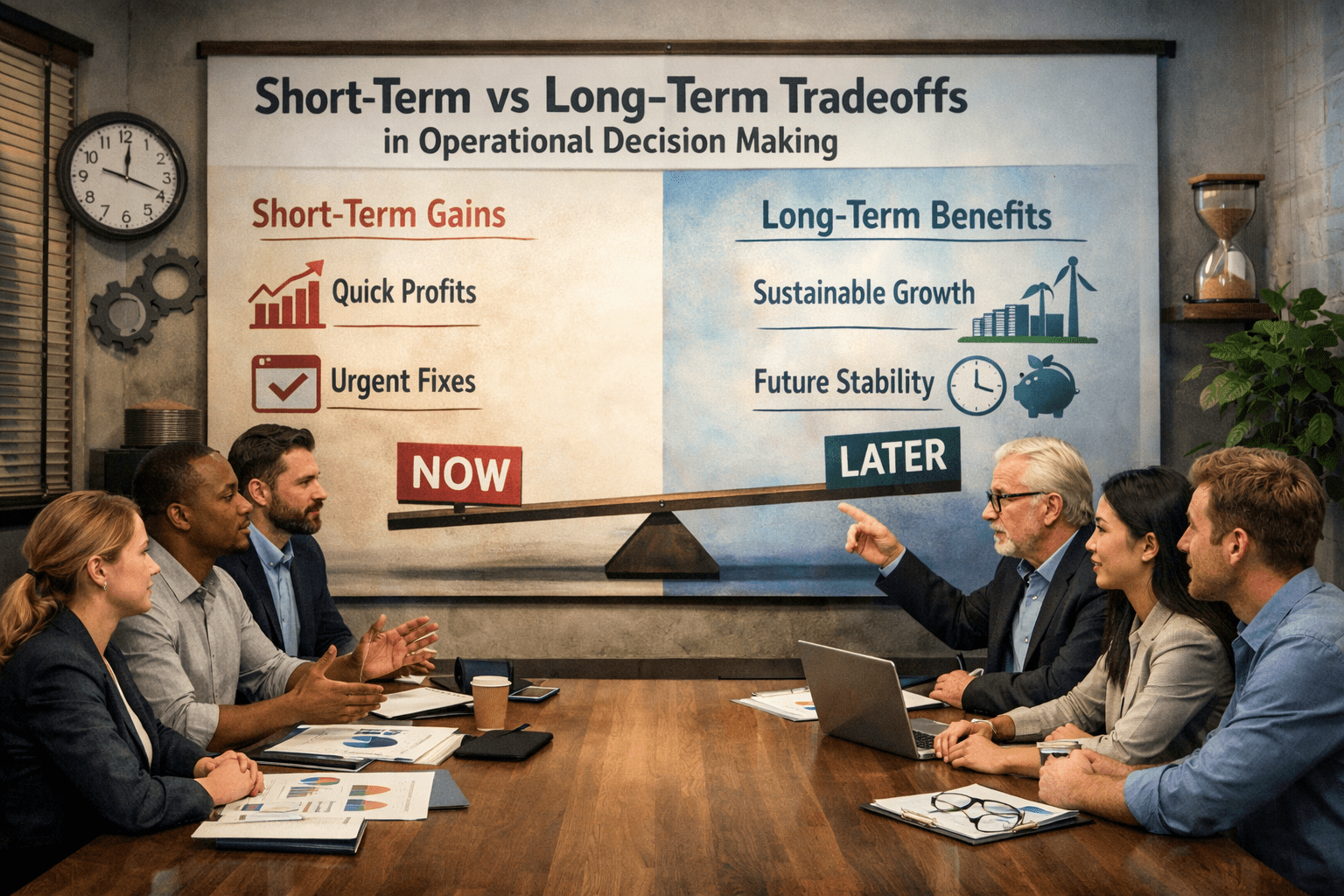
Operational decision making shapes how organizations perform every day. Managers constantly decide how to allocate time, money, and resources. Among these decisions, short-term vs long-term tradeoffs create some of the most challenging operational dilemmas. Because daily actions influence future performance, operational leaders must balance immediate results with sustainable outcomes.
Rather than favoring speed or cost alone, effective operational decision making evaluates both horizons simultaneously. As a result, organizations avoid short-sighted choices while still meeting near-term demands. This article explains how short-term and long-term tradeoffs affect operational decision making, using practical frameworks that support both beginners and experienced professionals.
Understanding Operational Decision Making
Operational decision making focuses on execution and consistency. While strategic decisions set direction, operational decisions determine how work happens daily. These decisions occur frequently and often under pressure.
Because operational decisions repeat over time, small tradeoffs accumulate quickly. Therefore, organizations must evaluate decisions carefully, especially when short-term gains conflict with long-term stability. When leaders understand these tradeoffs, they improve performance across the entire operation.
What Are Short-Term vs Long-Term Tradeoffs?
Short-term tradeoffs prioritize immediate outcomes such as cost reduction, speed, or quick problem resolution. Long-term tradeoffs emphasize sustainability, resilience, and future value.
For example, delaying maintenance saves money in the short term. However, over time, it increases failure risk and repair costs. Similarly, cutting training budgets may boost short-term margins but weaken long-term capability.
Because both perspectives matter, operational decision making must balance urgency with foresight.
Why These Tradeoffs Matter in Operations?
Operational environments demand quick action. Customers expect fast service, and managers face constant performance pressure. As a result, short-term thinking often dominates.
However, repeated short-term decisions can erode long-term performance. Deferred investments, overworked staff, and neglected systems gradually weaken operations. Therefore, understanding tradeoffs helps leaders avoid hidden costs.
Moreover, organizations that manage these tradeoffs well achieve greater operational resilience and adaptability.
Common Short-Term Focus Areas
Short-term tradeoffs typically appear in several operational areas:
Cost Reduction
Teams may cut expenses quickly by reducing staffing, maintenance, or quality controls. While this improves immediate financial results, it often increases risk.
Speed and Throughput
Accelerating production or service delivery may boost short-term output. However, rushed processes can increase errors and rework.
Resource Utilization
Maximizing asset or labor utilization improves short-term efficiency. Over time, though, it can cause burnout or equipment wear.
Understanding these patterns helps leaders recognize when short-term gains create long-term consequences.
Long-Term Operational Considerations
Long-term tradeoffs focus on building stable and scalable operations. Although these investments may not produce immediate returns, they strengthen future performance.
Key long-term considerations include:
- Asset reliability and lifecycle management
- Workforce capability and retention
- Process standardization and automation
- Risk reduction and compliance
- Customer trust and service consistency
By prioritizing these areas, organizations protect operational continuity.
Evaluating Tradeoffs Using a Time-Horizon Lens
Effective operational decision making uses a time-horizon lens. Instead of asking only “What solves today’s problem?”, leaders also ask “What does this decision create or destroy over time?”
Decision frameworks often distinguish differences between short-run and long-run decisions to clarify how immediate actions align with future goals.
One useful approach involves evaluating decisions across three horizons:
- Immediate impact
- Medium-term consequences
- Long-term outcomes
By comparing these effects, teams gain a clearer picture of total impact. Consequently, they avoid decisions that look efficient today but costly tomorrow.
Quantifying Short- and Long-Term Impacts
To make expert-level decisions, organizations must quantify tradeoffs whenever possible. Although some impacts remain qualitative, data strengthens evaluation.
For example, teams can compare:
- Short-term cost savings versus long-term maintenance costs
- Immediate productivity gains versus future turnover rates
- Faster delivery times versus warranty or rework expenses
By translating tradeoffs into measurable terms, operational leaders improve decision quality and accountability.
Risk as a Key Factor in Tradeoffs
Risk connects short-term and long-term decisions. Short-term choices often increase risk exposure, even if they reduce immediate cost.
For instance, skipping safety checks may save time today. However, it raises the probability of incidents and regulatory penalties later. Therefore, operational decision making must include risk evaluation alongside cost and speed.
When leaders account for risk, they balance efficiency with resilience.
Aligning Tradeoffs With Operational Goals
Tradeoffs make sense only when aligned with operational goals. A decision that supports one goal may undermine another.
For example, a company focused on rapid expansion may accept higher short-term costs to build scalable systems. In contrast, a cost-constrained organization may prioritize immediate efficiency.
Therefore, leaders must align tradeoffs with the organization’s operating model, maturity, and constraints. Without alignment, decisions create internal conflict and inefficiency.
Embedding Tradeoff Thinking Into Daily Decisions
Organizations should not treat tradeoff analysis as a one-time exercise. Instead, they should embed it into daily operational decision making.
Teams can do this by:
- Including long-term impact questions in decision reviews
- Tracking metrics that reflect future performance
- Encouraging cross-functional input
- Reviewing outcomes of past decisions
By normalizing tradeoff discussions, organizations build better decision habits.
Avoiding Common Tradeoff Mistakes
Operational leaders often make predictable mistakes when managing tradeoffs. For instance, some teams over-optimize short-term metrics while ignoring future costs. Others delay necessary investments indefinitely.
Additionally, relying solely on intuition without data weakens decisions. Avoiding these mistakes requires discipline, transparency, and consistent evaluation frameworks.
Creating Balance Through Continuous Review
Balance between short-term and long-term decisions is not static. As conditions change, tradeoffs must be revisited.
Organizations should review operational decisions regularly to assess whether short-term gains support long-term goals. When misalignment appears, leaders must adjust quickly.
Continuous review ensures that operations remain efficient today and sustainable tomorrow.
Conclusion
Short-term vs long-term tradeoffs lie at the heart of operational decision making. Every operational choice carries immediate benefits and future consequences.
By applying time-horizon thinking, quantifying impacts, managing risk, and aligning decisions with operational goals, organizations make stronger choices. Moreover, embedding tradeoff analysis into daily operations creates consistency and resilience.
Ultimately, effective operational decision making balances urgency with foresight, enabling organizations to perform well today while building for the future.