
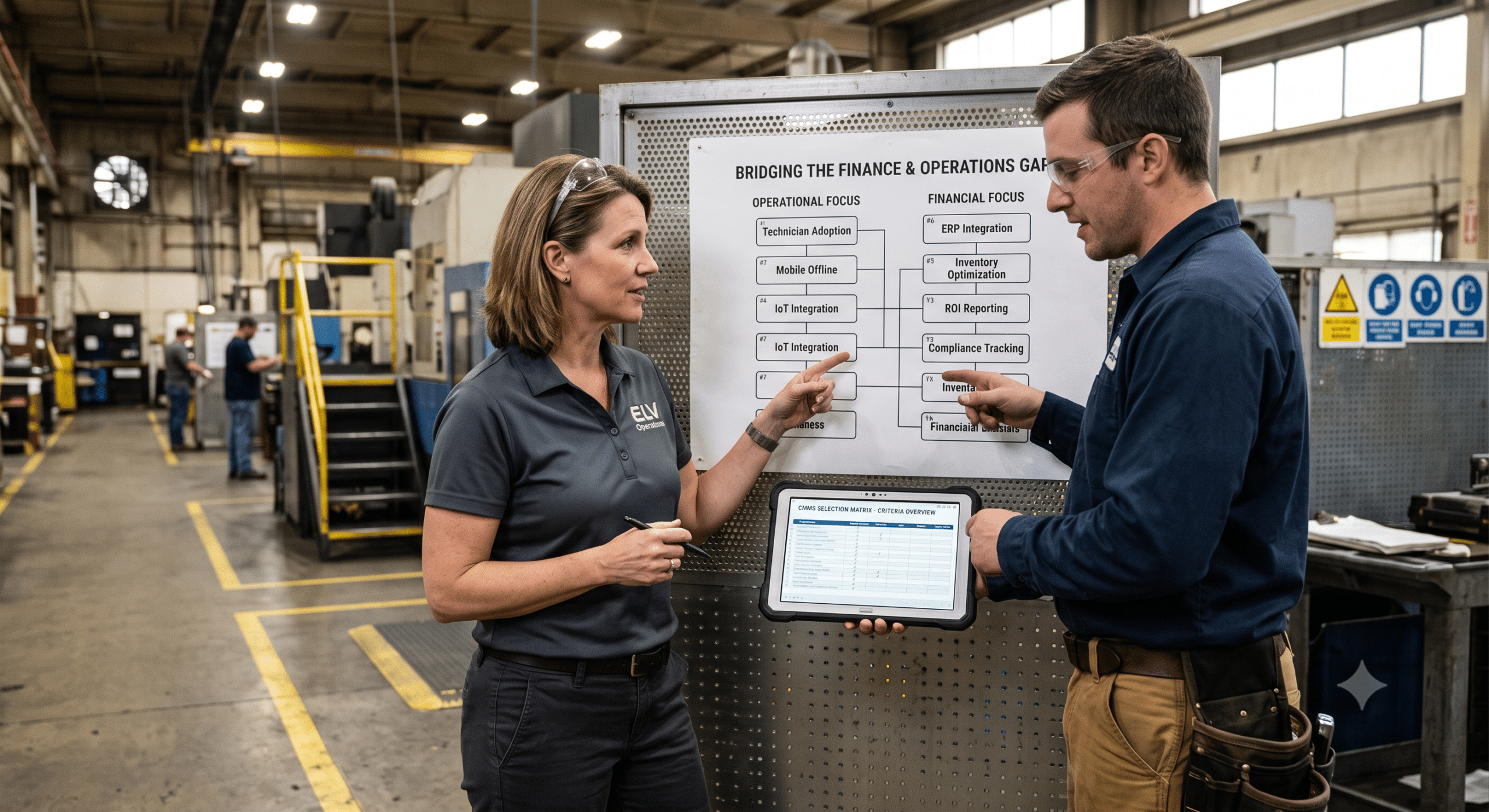
When evaluating modern enterprise software, defining the right CMMS system selection criteria must be the first step for any operations leader. Asset management is no longer just a back-room maintenance function. Consequently, fixing broken machines is no longer the only goal. Today, it sits directly at the intersection of corporate finance and floor operations. Therefore, when an industrial production line stops unexpectedly, the consequences ripple quickly. Those lost minutes translate directly into damaged operating margins. In addition, they cause expensive emergency shipping costs, missed delivery deadlines, and wasted raw materials. Ultimately, for any modern enterprise, managing industrial equipment requires a sophisticated strategy. You must balance engineering reality with financial performance.
True asset and equipment governance means viewing every machine as a vital economic engine. For this reason, the primary tool designed to orchestrate this strategy is the Computerized Maintenance Management System. This software is commonly known as a CMMS. However, many organizations select a CMMS based solely on software price tags. Others get distracted by flashy dashboard designs. As a result, these approaches completely miss the deeper operational alignment required to drive true financial returns.
To bridge the gap between finance and operations, companies must evaluate a CMMS through a highly specific framework. Specifically, this means analyzing software capabilities based on three core performance metrics. We must look at maximizing production throughput, reducing process cycle times, and minimizing raw material scrap rates. Indeed, when you evaluate software through this specific lens, the selection process transforms. It changes from a generic IT purchase into a high-impact strategic investment.
The Financial and Operational Connection in Asset Governance
Accountants see assets as items on a balance sheet. Thus, they depreciate these assets over a set timeline. Reliability engineers, conversely, view assets as dynamic systems. Furthermore, they know these systems require precise care to maintain peak production levels. When these two perspectives do not align, companies suffer. Specifically, they experience hidden operational drains that erode overall profitability.
Maximizing production throughput requires keeping your critical machinery running reliably. In particular, it must run at its optimal engineered speed. Every unexpected breakdown directly cuts into total production volume. Consequently, this forces facilities into a reactive mode that drives up labor costs through overtime.
Simultaneously, long process cycle times often point to poorly maintained machinery. Therefore, operators must run these machines at slower speeds to avoid overheating or breaking down completely. As a normal consequence, this slowness delays the entire supply chain and keeps cash tied up in unfinished inventory.
Furthermore, old or poorly calibrated equipment frequently causes a high raw material scrap rate. For instance, these machines produce defective products during startup or mid-run disruptions. By focusing your asset governance strategy on these three metrics, you protect the bottom line. In this manner, you ensure that every maintenance activity directly boosts the company’s financial health.
15 Essential CMMS System Selection Criteria
1. Intuitive User Interface and High Floor Adoption Rates
The most advanced maintenance software is completely useless if your frontline technicians refuse to use it. In fact, user adoption is the single most common reason software implementations fail in industrial environments. Frontline technicians need a clear, straightforward interface. For example, it must let them log completed tasks and document equipment issues with minimal clicks.
When software is easy to navigate, technicians enter high-quality data right from the production floor. Subsequently, this steady stream of clean operational data gives reliability engineers vital visibility. Thus, they can spot early failure trends before they turn into costly production shutdowns.
2. Device-Agnostic Mobile Accessibility with True Offline Functionality
Maintenance work rarely happens while sitting comfortably at a desk in a quiet office. Instead, technicians spend their days moving between production lines and navigating tight utility spaces. In addition, they work in remote outdoor storage areas where internet access is often spotty or non-existent.
The software you select must offer a robust, device-agnostic mobile application. Moreover, it needs to run seamlessly on both iOS and Android smartphones or tablets. Crucially, the app must include a dependable offline mode. This means that workers can view asset histories, log spare parts, and close out work orders without a signal. Afterward, the system can automatically sync all updates back to the central database later.
3. Advanced Meter-Based and Dynamic Preventive Maintenance Triggers
Simple calendar-based maintenance schedules are no longer sufficient for sophisticated industrial environments. For context, servicing a machine every thirty days can create issues. If a machine runs continuously across three shifts for two weeks, it needs more care. Conversely, if it sits idle for the next two weeks, it needs less. Therefore, calendar schedules will either under-service or over-service the asset.
Your chosen software must support advanced meter-based and dynamic triggers. To achieve this, these features schedule maintenance based on actual usage metrics. You can track operating hours, production stroke counts, or real-time temperature changes. In the long run, this precise approach ensures you perform maintenance exactly when the equipment needs it. thereby, this prevents unexpected breakdowns while avoiding the unnecessary costs of over-servicing perfectly good machinery.
4. Granular Failure Mode and Root Cause Analysis Tracking
To permanently eliminate recurring equipment failures, reliability teams must track exactly why a machine broke down. Accordingly, the platform should force users to categorize failures using structured data fields. These fields should include specific problem codes, failure causes, and corrective action histories.
This structured approach allows engineers to move away from vague written notes. Instead, they can work with clear, trend-based data. Over time, this accurate historical tracking makes it easy to spot systemic equipment flaws. As a result, engineers can update preventive maintenance protocols and lower scrap rates caused by sudden machine malfunctions.
5. Automated Multi-Variable Work Order Routing
In a busy production facility, manual work order assignment creates a bottleneck. Consequently, this delay slows down cycle times and leaves critical machinery sitting idle. The software should feature an intelligent, automated routing engine. Then, this engine instantly sends incoming work requests to the right team or individual.
This routing should be based on multiple customizable variables. Specifically, you can include the technician’s specific certifications, current shift availability, and physical location within the plant. Additionally, you can factor in the priority level of the broken asset. Automating this assignment process shaves valuable minutes off your total response times. Ultimately, this ensures that your most critical production lines get back up and running quickly.
6. Seamless Integration with Native Enterprise Resource Planning Systems
A maintenance platform that operates in isolation from the rest of the business creates data silos. Likewise, it leads to operational friction. To achieve true asset governance, the software must integrate seamlessly with your core Enterprise Resource Planning system. For instance, it should connect directly to tools like SAP or Oracle via modern, secure application programming interfaces.
This deep integration allows maintenance work orders to automatically sync with corporate accounting ledgers. Furthermore, it connects them to purchase orders and capital budgets. Thanks to this real-time financial connection, executive leadership can easily see the direct impact of maintenance spending on the company’s overall operational profitability.
7. Real-Time Operational Technology and Industrial IoT Connectivity
The modern industrial landscape relies heavily on smart machinery. For example, facilities use programmable logic controllers and supervisory control and data acquisition networks. Therefore, a forward-thinking maintenance system should connect directly to these operational technology layers. To do so, it must use standard industrial communication protocols.
By pulling real-time data directly from machinery sensors, the software can automatically flag anomalies. As a result, it will catch things like an unexpected spike in vibration or a sudden drop in pressure. Instantly, this visibility allows your maintenance team to intervene early. Consequently, they can fix minor issues before they cause a major breakdown that stops production throughput.
8. Comprehensive Asset Hierarchy and Parent-Child Relationship Mapping
Industrial production lines are complex systems. Clearly, they are made up of interconnected sub-assemblies, individual machines, and replaceable components. Hence, the software must allow you to build an incredibly detailed, multi-level asset hierarchy. This hierarchy needs to mirror real-world complexity.
By mapping out these clear parent-child relationships, engineers can easily trace asset health. Thus, they can see how a component failure on a small pump might affect a larger sub-assembly. Eventually, they can predict how it might disrupt the throughput of the entire production line. In short, this structural clarity is essential for making smart capital investments, helping teams decide exactly when to repair or replace older equipment.
9. Dynamic Spare Parts Inventory Optimization and Automated Reorder Workflows
Keeping too many spare parts in stock ties up valuable working capital. On the other hand, running out of a critical component can leave an essential machine broken down for days. To avoid this, the platform must feature an intelligent inventory management module. This module should track exact stock levels across multiple storage locations in real time.
The system should automatically calculate optimal minimum and maximum stock levels based on past usage patterns. Next, it should automatically trigger purchase requisitions when parts drop below those thresholds. In this way, this automated control keeps your maintenance teams equipped with the right parts. Consequently, they get them exactly when they need them, which minimizes extended downtime without inflating warehouse inventory costs.
10. Robust Interactive Visual Mapping and Digital Floor Plan Layouts
When a critical asset fails in a massive manufacturing plant, technicians can get lost. Similarly, they can face delays across a sprawling multi-facility campus. Therefore, workers should not waste valuable time searching for the physical location of a machine. The software should include interactive, high-resolution visual mapping features. Specifically, these tools lay out your equipment directly onto digital floor plans.
Technicians can look at their mobile devices to see exactly where the broken machine is located. In addition, they can easily find the closest isolation valves and spot nearby safety hazards. Undoubtedly, this visual clarity streamlines your response efforts. As a result, it helps teams resolve issues faster and significantly reduces overall process cycle times.
11. Custom Key Performance Indicator Dashboards and Tailored Executive Reporting
Different stakeholders across the organization need to look at maintenance data through very different lenses. For example, a plant floor supervisor needs to see daily preventative maintenance compliance. In contrast, a corporate chief financial officer needs to monitor total capital asset depreciation and return on investment.
The system must offer highly flexible, customizable dashboards and reporting tools. Moreover, these tools must let users build tailored reports without needing help from the IT department. As a consequence, having access to these personalized, data-driven insights ensures a stronger company culture. Ultimately, it guarantees that every level of management can make fast, well-informed business decisions.
12. Enterprise-Grade Scalability and Multi-Site Data Standardization
An organization that plans to grow cannot afford to buy limited software. In other words, you should not buy a platform that you will quickly outgrow in a few years. The software must be built on a secure, highly scalable cloud infrastructure. Indeed, this foundation can effortlessly handle adding new production lines, more users, and entirely new physical locations.
Furthermore, the platform must allow corporate teams to standardize data fields. Likewise, it should align asset naming rules and safety workflows across multiple facilities. Then, this corporate-wide standardization makes it easy for leadership to act. Consequently, they can accurately compare performance metrics between different plants and share best practices across the entire enterprise.
13. Comprehensive Regulatory Compliance Tracking and Automated Audit Trails
Modern industrial operations must navigate a complex web of strict safety, environmental, and quality regulations. Specifically, companies must comply with OSHA, EPA, and ISO standards regularly. Therefore, the maintenance software must serve as a secure system of record. It needs to automatically log every single maintenance action, employee signature, and safety calibration. Furthermore, the system should secure this data with an unalterable timestamp.
This automated tracking simplifies your regulatory audit preparation. At the same time, it protects the company from expensive compliance fines. Ultimately, it also proves that your machinery is operated safely and responsibly every day.
14. Flexible Total Cost of Ownership Structures and Clear Return on Investment Portals
Every major software investment must justify its cost. Namely, it needs to deliver clear, measurable financial value back to the business. When evaluating software options, you must look beyond the initial subscription cost. Instead, consider the entire total cost of ownership. This includes implementation fees, onboarding support, and future system upgrades.
The software vendor should provide a transparent pricing structure. In addition, they must also provide clear data portals that help you track ongoing financial returns. Thus, you should easily see reduced maintenance costs per asset and minimized production downtime losses.
15. Vendor Industry Expertise and Dedicated Long-Term Training Support
Implementing a new maintenance system requires shifting your organizational culture. In addition, it changes how people work every day. Therefore, the vendor you choose should be more than just a software company. Instead, they must act as a true long-term strategic partner.
Ensure the vendor has deep, proven experience working within your specific industrial sector. To support you, they should offer robust onboarding programs, continuous user training, and reliable technical support. In conclusion, this hands-on guidance ensures your team adopts the system quickly, helping you continue to get the maximum possible value out of the software for years to come.
Strategic Deep Dive: The Core CMMS System Selection Criteria
When you sit down with leadership to finalize your software requirements, you must evaluate vendors using a rigid framework. Your chosen platform should not just log tickets; it must optimize asset life cycles. Therefore, your engineering team must look closely at how each platform fulfills the core CMMS system selection criteria necessary to drive industrial efficiency.
First, consider how user adoption shapes data quality. The primary CMMS system selection criteria must prioritize a clean, intuitive user experience on the plant floor. Second, mobile accessibility with offline synchronization represents non-negotiable CMMS system selection criteria for modern remote operations. Without true offline functionality, data accuracy drops as technicians log details long after completing their tasks.
Furthermore, moving past outdated schedules requires advanced technical workflows. Your engineers should establish CMMS system selection criteria that favor real-time IoT integrations and meter-based maintenance triggers over simple calendar lookups. When you shape your CMMS system selection criteria around live sensor inputs, you prevent minor mechanical misalignments from escalating into major catastrophic line failures. Finally, enterprise scalability and native ERP system integrations round out the top CMMS system selection criteria required to unlock transparent cost tracking and data standardization across multiple facilities.
Strategy Matrix: From Selection to Bottom-Line Results
To show how these fifteen selection criteria directly impact your core metrics, look at the strategy matrix below. Specifically, this table connects specific software capabilities directly to improvements in throughput, cycle time, and scrap rates.
| CMMS Selection Criteria | Core Operational Metric Focus | Concrete Impact on Financial Performance |
| Meter-Based PM Triggers | Maximizing Throughput | Eliminates unexpected breakdowns, keeping production lines running smoothly at their engineered speeds. |
| Automated Work Order Routing | Reducing Cycle Time | Cuts down on response delays by instantly assigning urgent repairs to the closest qualified technician. |
| Failure Mode Tracking | Minimizing Scrap Rate | Stops recurring machine misalignments that produce defective products and waste raw materials. |
| Inventory Optimization | Reducing Cycle Time | Ensures critical spare parts are always in stock, eliminating long production delays while waiting for shipments. |
| Industrial IoT Connectivity | Maximizing Throughput | Uses real-time sensor data to flag minor mechanical issues before they turn into major failures. |
Moving Your Organization from Reactive to Strategic Governance
Successfully deploying a maintenance system is not an all-at-once technical event. Rather, it is a step-by-step journey toward operational excellence. The transition requires a clear, phased approach. Therefore, you must match your team’s current capabilities with your long-term business goals by establishing clear CMMS system selection criteria from the outset.
During the first thirty days, focus entirely on building a clean asset inventory. Then, establish a standard naming system across your facility that matches your predefined CMMS system selection criteria. Involve your frontline technicians early in this phase. For example, let them test the user interface and mobile application. As a result, this approach ensures they feel a sense of ownership over the new system from day one.
Over the following sixty to ninety days, start moving away from reactive firefighting. Instead, transition toward organized preventive maintenance schedules. Use meter-based and usage-based triggers on your most critical production machinery first, fulfilling your core operational CMMS system selection criteria.
As clean operational data begins to fill your system, your reliability engineers can start analyzing failure trends. Consequently, they can quickly fine-tune your spare parts stock levels. By continually connecting these engineering metrics back to corporate financial reports, your maintenance program transforms. Ultimately, it changes from a traditional cost center into a powerful driver of corporate growth and profitability.
Frequently Asked Questions
Why do so many software implementations fail on the production floor?
Most software implementations fail because organizations focus too much on complex backend features. Consequently, they ignore daily usability for their workers. If a mobile application is confusing or slow, workers will avoid using it. For instance, technicians will not use apps that force them to navigate through too many menus just to close out a task. Naturally, this lack of adoption leads to incomplete information. It leaves management with poor data that cannot be used to make smart operational decisions.
How does a maintenance system help reduce raw material scrap rates?
When manufacturing equipment begins to wear out, it loses its precise calibration. As a result, it then often produces products that fail quality inspections, creating immediate material waste. A robust maintenance platform tracks these specific failure patterns. Furthermore, it uses real-time sensor data to trigger quick adjustments. Catching these calibrations early ensures your machinery runs within its exact design specifications. Thus, this prevents product defects and keeps your scrap rates low.
What is the difference between calendar-based and meter-based maintenance?
Calendar-based maintenance triggers service automatically after a set period, such as every ninety days. Crucially, it does this regardless of how much the machine was actually used. In contrast, meter-based maintenance relies on real-time operating data, such as actual runtime hours or production cycle counts. Therefore, it triggers service only when the machine has completed a specific amount of work. This usage-based approach prevents over-servicing idle machinery and protects heavily used assets from breaking down unexpectedly.
Why is an offline mode so critical for mobile maintenance apps?
Many heavy industrial facilities have weak cellular and Wi-Fi coverage. Specifically, this is common in underground utility rooms and remote outdoor storage yards. If a mobile app requires a constant internet connection to work, technicians will stop using it on the floor. Instead, they will revert to writing notes on paper. However, an offline mode allows workers to view asset histories and log their work anywhere. Then, it automatically updates the central database as soon as they walk back into a connected area.
How does integrating a maintenance platform with an ERP save money?
Connecting your maintenance platform with your corporate ERP system eliminates manual data entry. At the same time, it keeps your maintenance activities aligned with financial budgets. When a technician uses a spare part, the system instantly alerts the corporate procurement team to handle reordering. In addition, it also updates the financial ledger automatically. Ultimately, this real-time connection gives executive leadership clear, automated visibility into how operational maintenance spending directly impacts corporate profitability.
Further Reading and Strategic Resources
For organizations looking to dive deeper into asset governance strategies and software evaluation metrics, the following domain resources offer valuable industry insights, research papers, and technical frameworks:
-
Accruent Maintenance Connection: 5 Key CMMS Selection Criteria Guide — A detailed industry breakdown evaluating user experience, mobile architecture configurations, and data reporting scalability for corporate assets.
-
Society for Maintenance & Reliability Professionals (SMRP): SMRP Best Practices and Operational Roadmaps — A globally recognized organization dedicated to setting the standard for maintenance, reliability, and physical asset management excellence.
-
Reliabilityweb: Asset Management Insights and Frameworks — A comprehensive hub offering technical articles, case studies, and expert analysis on predictive maintenance technologies and culture change.
-
Association of Asset Management Professionals (AMP): Uptime Elements Digital Clean Energy Architecture — Provides detailed frameworks for integrating industrial internet-of-things data with corporate asset governance models.