
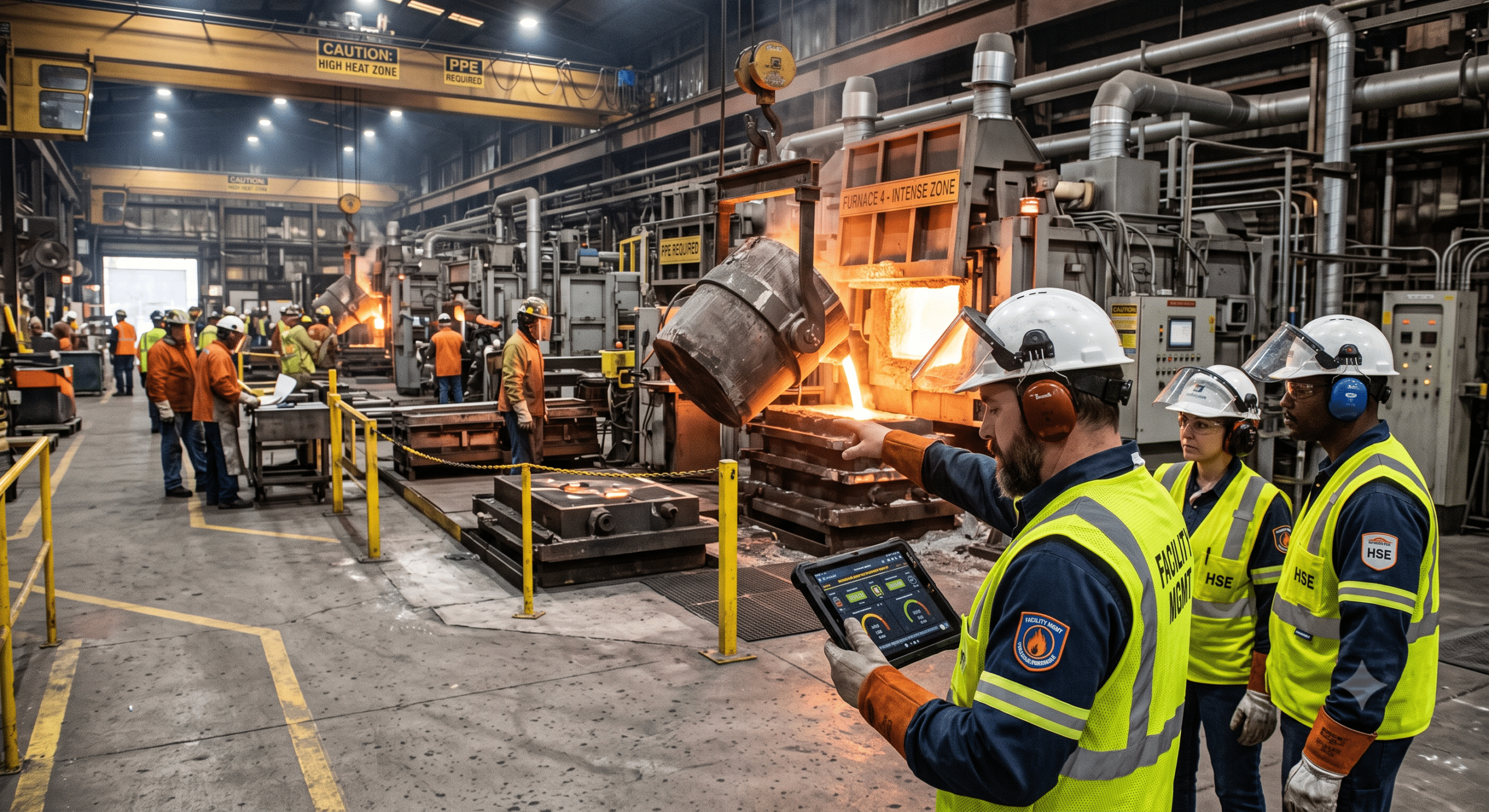
Managing high-heat environments requires a complete shift in strategy compared to standard building operations. If you ask ten different plant managers or real estate directors how they classify their buildings, nine of them will talk about square footage, location, or lease terms. However, if you sit down with a facilities management consultant or an operations management consultant who has spent years troubleshooting plant floors and boiler rooms, they will tell you that those metrics miss the bigger picture.
Ultimately, what really dictates how a facility runs—how much maintenance it needs, how high its energy bills climb, and how safe its crew stays—is operational intensity.
Operational intensity measures the mechanical, thermal, physical, and human strain put on a building’s infrastructure over time. For instance, on one end of the spectrum, you have low-intensity spaces like corporate offices, where the biggest daily emergency might be a tripped breaker in the breakroom or a faulty thermostat on the second floor. On the other hand, you have high-heat environments—facilities where furnaces run around the clock, heavy machinery generates massive thermal loads, and outdoor temperatures combine with indoor heat to create extreme operating conditions.
Consequently, when you manage a facility defined by extreme thermal strain, the standard playbook for facilities management (FM) breaks down. Therefore, you cannot treat a commercial foundry, an industrial bakery, a glass plant, or a high-density data center like an office building with a few extra fans.
This guide breaks down how facilities operate across different levels of operational intensity, with a primary focus on how to master high-heat environments. To achieve this, we will look at practical engineering controls, human safety protocols, maintenance strategies, and 7 core operational pillars that keep these challenging facilities running smoothly without burning out your equipment or your people.
Understanding Facilities by Operational Intensity
To begin with, building an efficient maintenance and operations plan requires you to first categorize your facilities by their operational strain. After all, facility management isn’t a one-size-fits-all discipline. Equipment wear, staffing models, and safety requirements change dramatically as a result of increasing operational stress.
+-----------------------------------------------------------------------------------+
|                        FACILITY OPERATIONAL INTENSITY SPECTRUM                    |
+--------------------------+--------------------------+-----------------------------+
|    LOW INTENSITY         |    MODERATE INTENSITY    |       HIGH INTENSITY        |
|  - Corporate Offices     |  - Logistics Warehouses  |  - High-Heat Environments   |
|  - Retail Outlets        |  - Light Assembly        |  - Foundries & Steel Plants |
|  - Bank Branches         |  - Commercial Laundry    |  - Industrial Bakeries      |
|  - Standard Classrooms   |  - Distribution Centers  |  - High-Density Data Centers|
+--------------------------+--------------------------+-----------------------------+
1. Low-Intensity Facilities
These buildings host light human activity and minimal heavy equipment. Specifically, HVAC systems run on standard commercial cycles, power draws remain predictable, and indoor air quality stays fairly stable.
-
Examples: Corporate headquarters, branch banks, retail stores, standard educational buildings.
-
Primary Focus: Energy efficiency, occupant comfort, aesthetic upkeep, basic preventive maintenance (PM).
2. Moderate-Intensity Facilities
These spaces experience continuous foot traffic, light material handling, or moderate mechanical use. Because of this, HVAC systems work harder to manage ambient conditions, and equipment requires regular, structured upkeep.
-
Examples: Logistics hubs, e-commerce fulfillment centers, light electronics assembly, commercial laundries.
-
Primary Focus: Fleet maintenance, conveyor system uptime, indoor air quality, shift scheduling, basic thermal management.
3. High-Intensity Facilities (Focus: High-Heat Environments)
These are facilities where process heat, continuous production cycles, heavy machinery, or high electrical loads push physical infrastructure to its absolute limit. In particular, in high-heat environments, ambient room temperatures often spike far above comfortable human ranges. As a direct result, this creates severe risks for both equipment failure and thermal stress among workers.
-
Examples: Metal foundries, glass manufacturing facilities, commercial bakeries, chemical processing plants, plastic extrusion lines, power generation stations, and server farms/data centers.
-
Primary Focus: Heat dissipation, continuous HVAC/exhaust engineering, emergency cooling redundancy, worker safety, heat stress compliance, and condition-based predictive maintenance.
Operational Intensity Comparison Matrix
| Facility Category | Primary Thermal Driver | Equipment Wear Rate | HVAC & Exhaust Requirements | Worker Risk Factors | Maintenance Strategy |
| Low-Intensity | Solar gain, human occupancy | Low | Standard commercial air handlers | Ergonomics, slip/fall | Time-based (Quarterly/Annual) |
| Moderate-Intensity | Dock doors, light machinery | Moderate | Enhanced ventilation, spot heating | Fatigue, repetitive strain | Hybrid PM & reactive |
| High-Heat Environments | Process equipment, radiant heat, steam | High to Extreme | Heavy industrial exhaust, makeup air units, spot coolers | Heat exhaustion, heat stroke, dehydration | Condition-based predictive (PdM) & daily checks |
The Hidden Dynamics of High-Heat Environments
When working with operations teams in high-heat environments, one common oversight stands out: treating heat as a mere comfort issue rather than a structural risk factor.
In reality, heat affects every single element inside a facility. For example, it breaks down mechanical lubricants, causes metal components to expand beyond tight tolerances, degrades electrical insulation, and rapidly saps human energy.
Therefore, to manage these facilities successfully, you need to understand the two ways thermal stress attacks your operations: Radiant vs. Ambient Heat, and Mechanical vs. Human Limits.
                           +---------------------------------+
                           |      THERMAL STRESS TRIANGLE    |
                           +---------------------------------+
                                           / \
                                          /   \
                                         /     \
                                        /  HEAT \
                                       /   LOAD  \
                                      /-----------\
                                     /             \
                                    / HUMAN   EQUIP.\
                                   / IMPACT   IMPACT \
                                  +-------------------+
Radiant Heat vs. Ambient Heat
-
Ambient Heat: First, ambient heat represents the temperature of the air surrounding equipment and workers. This is what a standard thermometer measures.
-
Radiant Heat: In contrast, radiant heat consists of electromagnetic heat waves emitted by hot surfaces like kilns, molten metals, steam pipes, or massive ovens. Crucially, radiant heat does not warm the air directly; instead, it warms objects and bodies in its direct line of sight.
In many high-heat environments, air temperatures might read $88^\circ\text{F}$ ($31^\circ\text{C}$). However, radiant heat from uninsulated piping or open furnaces can make the perceived thermal load feel like $115^\circ\text{F}$ ($46^\circ\text{C}$) or higher. Consequently, facilities teams that only measure ambient air temperature miss the real strain on both crew and equipment.
The Double Impact: Human Limits and Machine Limits
-
Human Physiological Limits: When body temperatures rise faster than sweating can cool them down, workers experience reduced fine motor skills, slow reaction times, thermal fatigue, and severe conditions like heat exhaustion or heat stroke. Furthermore, in industrial settings, a fatigued worker in a high-heat zone is far more likely to make a costly error or suffer a safety incident.
-
Machine Thermal Throttling & Breakdown: Similarly, motors operating in extreme temperatures face rapid insulation breakdown. In fact, every $10^\circ\text{C}$ ($18^\circ\text{F}$) increase in operating temperature above a motor’s rated limit cuts its insulation life in half. Meanwhile, hydraulic oil thins out, leading to internal pump wear, while air compressors pull in hot ambient air, forcing them to work harder and cycle constantly.
7 Core Operational Pillars for Managing High-Heat Environments
In order to keep high-intensity facilities running without surprise shutdowns, you need a system built specifically for heavy thermal loads. Below, we outline 7 core operational pillars designed to protect your workforce, extend equipment life, and keep utility bills in check.
+-----------------------------------------------------------------------------------+
|               7 PILLARS FOR HIGH-HEAT FACILITY MANAGEMENT                         |
+-----------------------------------------------------------------------------------+
|  1. Source Mitigation    |  2. Industrial Airflow  |  3. Workforce Protection     |
|  4. Predictive Upkeep    |  5. Emergency Redundancy|  6. Real-Time BMS Logging    |
|  7. FM-Ops Alignment     |                         |                              |
+-----------------------------------------------------------------------------------+
Pillar 1: Thermal Mitigation at the Source
Undoubtedly, the most efficient way to manage heat is to stop it from escaping into the broader work area in the first place.
-
Insulation & Thermal Blankets: Wrap hot piping, valves, and process equipment in removable high-temperature insulation blankets. As a result, this single fix can lower local surface temperatures from $350^\circ\text{F}$ down to touch-safe levels under $120^\circ\text{F}$.
-
Radiant Shielding: In addition, install reflective metal barriers or heat-reflective curtains around heat-generating units (like curing ovens or smelting pots) to block radiant energy from reaching nearby workstations.
-
Fume and Heat Hoods: Furthermore, position capture hoods directly over hot processes to duct hot air straight out of the facility before it can mix with room air.
Pillar 2: Industrial Ventilation and Airflow Design
Standard building HVAC systems are designed for cooling static spaces, not handling heavy industrial heat loads. Thus, high-heat environments require specialized airflow engineering.
-
Balanced Air Changes per Hour (ACH): First, ensure high-heat bays achieve sufficient air turnover (often 15 to 30 air changes per hour depending on process output).
-
Negative vs. Positive Pressure Management: Second, keep heat-producing areas under slight negative pressure relative to clean, air-conditioned zones. In doing so, this keeps hot, dusty, or fume-laden air from spreading into office areas or delicate packaging bays.
-
Evaporative Cooling vs. Chilled Air: Additionally, in hot, dry climates, direct or indirect evaporative coolers provide high-volume airflow at a fraction of the power cost of mechanical refrigeration. Conversely, in humid regions, focused spot cooling (delivering chilled air directly to human workstations) works much better than trying to cool an entire open bay.
Pillar 3: Workforce Protection and Acclimatization
Worker safety in extreme heat requires structure, not guesswork. Therefore, facilities and safety leaders should follow established guidelines from organizations like OSHA and CCOHS to prevent heat-related illness.
-
Wet-Bulb Globe Temperature (WBGT) Tracking: Instead of relying on simple dry-bulb thermometers, use WBGT meters that combine air temperature, humidity, wind speed, and radiant heat to measure true environmental thermal stress.
-
The 7-Day Acclimatization Protocol: Moreover, new hires or workers returning from time off shouldn’t start with full shifts in intense heat zones right away. Instead, increase their work time in high-heat areas gradually over 7 to 14 days so their cardiovascular systems can adjust safely.
-
Hydration and Rest Structures: Finally, set up air-conditioned recovery rooms near high-heat zones. Provide cool drinking water ($50^\circ\text{F}$ to $60^\circ\text{F}$) or electrolyte solutions, while encouraging workers to drink small amounts every 15 to 20 minutes rather than chugging water during long breaks.
+-----------------------------------------------------------------------------------+
|                       WORK-REST SCHEDULE BASED ON WBGT INDEX                      |
+--------------------------+----------------------------+---------------------------+
|   WBGT Temperature Range | Light Work Load            | Heavy Work Load           |
+--------------------------+----------------------------+---------------------------+
|   78°F - 81.9°F          | Continuous Work            | 75% Work / 25% Rest/Hour  |
|   82°F - 84.9°F          | Continuous Work            | 50% Work / 50% Rest/Hour  |
|   85°F - 87.9°F          | 75% Work / 25% Rest/Hour   | 25% Work / 75% Rest/Hour  |
|   88°F and Above         | 50% Work / 50% Rest/Hour   | Stop non-essential work   |
+--------------------------+----------------------------+---------------------------+
Pillar 4: Predictive and Condition-Based Maintenance (PdM)
In high-heat operations, calendar-based preventive maintenance (like changing oil every 90 days) often comes too late. Because heat speeds up mechanical decay, condition monitoring becomes essential.
-
Thermal Imaging Inspection: Conduct regular infrared scans on electrical panels, motor control centers (MCCs), transformers, and mechanical bearings. Consequently, high heat points flag loose wire terminations, overloaded circuits, or failing bearings weeks before catastrophic failure occurs.
-
Vibration and High-Temp Lubrication Monitoring: Likewise, machine bearings running hot lose grease consistency fast. Use synthetic, high-viscosity, high-temperature greases, and install wireless vibration/temperature sensors on critical drive motors to catch early wear signs.
-
Oil Analysis Schedules: Additionally, take frequent oil samples from hydraulic systems and industrial gearboxes exposed to ambient process heat. By doing this, you can check for thermal breakdown, fluid oxidation, and micro-wear particles.
Pillar 5: Emergency Redundancy and Cooling Contingency Plans
When a primary exhaust fan motor fails or a main chilled water pump trips in a high-heat facility, indoor temperatures can spike within minutes. As a result, production may come to a sudden halt.
-
$N+1$ Redundancy for Critical Exhaust & Cooling: To prevent this, ensure primary heat extraction exhaust systems feature backup fan assemblies or dual-drive motors.
-
Pre-Staged Mobile Cooling Assets: Furthermore, keep portable spot coolers, high-velocity air movers, and temporary ducting on hand. Alternatively, maintain quick-deploy contracts with local rental suppliers before peak summer seasons hit.
-
Power Quality Protection: High-heat facilities draw heavy currents to power fans, pumps, and chillers. However, brownouts or sudden voltage drops during hot summer afternoons can trip sensitive drives. Therefore, install automated power factor correction and surge suppression systems to keep equipment running reliably.
Pillar 6: Smart Building Automation Systems (BMS) and Sensor Networks
Modern facility management relies heavily on real-time data. Indeed, relying on manual checks to catch rising temperatures across a 200,000-square-foot plant floor leaves too much room for error.
-
Distributed Environmental Sensors: First, deploy wireless IoT heat and humidity sensors at varying ceiling heights and along production lines to spot thermal layering and dead zones.
-
Automated Demand Response Ventilation: Next, configure your BMS to adjust variable frequency drives (VFDs) on exhaust fans automatically as process heat output shifts throughout the shift, thereby saving power when production slows down.
-
Early Warning Automated Alerts: Finally, set custom threshold alerts that notify facility supervisors via phone or text the moment a localized zone exceeds standard WBGT safety levels.
Pillar 7: Alignment Between Facilities and Production Operations
The traditional divide between “Facilities” (who look after the building) and “Operations” (who manage output) causes real issues in intense manufacturing spaces. Thus, alignment is critical.
-
Shared Heat-Shift Protocols: For instance, when production schedules call for running all furnaces at maximum output on a $95^\circ\text{F}$ afternoon, operations must notify facilities ahead of time so cooling equipment can be primed.
-
Integrated Work Order Management: Meanwhile, use a modern Computerized Maintenance Management System (CMMS) that syncs production downtime schedules directly with facility maintenance tasks. In turn, this ensures deep heat exchanger cleaning happens during scheduled downtime.
-
Joint Safety Inspections: Additionally, facilities managers and operations supervisors should walk the plant floor together weekly to inspect ventilation hoods, shade zones, hydration stations, and insulation barriers.
Operations Guide: Step-by-Step Implementation on the Plant Floor
Turning these pillars into everyday practice requires clear, predictable routines for plant supervisors and maintenance technicians.
+-----------------------------------------------------------------------------------+
|                      DAILY HIGH-HEAT OPERATIONAL WORKFLOW                         |
+-----------------------------------------------------------------------------------+
|  06:00 - Morning Sensor & WBGT Verification                                       |
|  08:00 - Pre-Shift Safety Briefing & Hydration Check                              |
|  12:00 - Midday Thermal Imaging Sweep of High-Risk Zones                          |
|  15:00 - Peak Ambient Heat Review & Shift Rotation Adjustments                    |
|  18:00 - End-of-Shift Log Review & Exhaust System Flush                           |
+-----------------------------------------------------------------------------------+
Daily High-Heat Checklists
Morning Shift Launch (Facilities Team)
-
First, verify that all primary makeup air units (MAUs) and roof exhaust fans show normal operating currents on the BMS panel.
-
Next, check WBGT sensor calibration in primary process zones.
-
Then, inspect hydration stations to confirm water supply is clean, chilled, and fully stocked with electrolyte packets.
-
Finally, confirm cooling rest areas are clean, air conditioning units are blowing cold air, and seating is cleared.
Operations Shift Launch (Plant Supervisors)
-
To start, review the daily weather forecast and internal thermal load projections during shift huddles.
-
Meanwhile, identify unacclimatized workers or new hires and assign them reduced physical workloads or frequent rest rotations.
-
In addition, remind crew members of the early symptoms of heat stress: dizziness, unusual fatigue, headache, heavy sweating, or lack of sweat.
-
Lastly, check that personal cooling equipment (like evaporative vests or neck cooling wraps) is working and properly distributed.
Midday Peak Heat Operations (12:00 PM – 4:00 PM)
-
Throughout this window, monitor ambient and WBGT indoor readings every hour during severe outdoor heatwaves.
-
Accordingly, adjust work-rest cycles based on target safety bands.
-
Simultaneously, conduct quick infrared scans of critical motor drives operating under maximum continuous thermal load.
-
Above all, ensure process doors leading to conditioned clean rooms remain closed to prevent thermal drift.
The Financial Side: Balancing Energy Bills, Regulatory Compliance, and Asset Lifespan
Operating high-intensity facilities requires balancing three main operational pressures: utility costs, regulatory compliance, and long-term asset value.
                           +---------------------------------+
                           |      TRIANGLE OF BALANCE        |
                           +---------------------------------+
                                           / \
                                          /   \
                                         /     \
                                        / ENERGY\
                                       / COSTS   \
                                      /-----------\
                                     /             \
                                    / COMPLIANCE    \
                                   /  & SAFETY  ASSET\
                                  /            LIFE  \
                                 +--------------------+
1. Managing Heavy Energy Demands
Cooling high-heat industrial spaces takes a lot of power. Specifically, exhausting massive amounts of air without balance causes vacuum conditions, pulling unconditioned, humid outdoor air through open loading docks and doors. Consequently, this strains indoor chillers even more.
-
Makeup Air Heat Recovery: Use air-to-air heat exchangers to capture waste energy from hot exhaust streams before venting it outside. Then, use that energy to pre-heat domestic hot water or process feedwater.
-
Variable Air Volume (VAV) Controls: Avoid running industrial fans at $100\%$ speed continuously if process heat output drops during shift changes. Instead, using VFDs to throttle fan speed down to $80\%$ cuts energy consumption by roughly $50\%$ due to fan affinity laws.
2. Navigating OSHA and Legal Requirements
While federal OSHA rules utilize the General Duty Clause (Section 5(a)(1)) to penalize employers who subject workers to dangerous heat conditions, many states (like California, Oregon, and Washington) have set strict specific heat illness prevention rules.
-
Mandatory Recordkeeping: Therefore, keep complete records of indoor WBGT readings, heat safety training logs, and work-rest schedules during peak summer months.
-
Clear Incident Protocols: In addition, establish written steps for handling suspected heat stroke: immediately call emergency medical services, move the individual to a cool area, apply cold packs, and assign someone to monitor them until help arrives.
3. Protecting Total Cost of Ownership (TCO)
Allowing equipment to run hot without thermal management reduces its total service life. For example:
-
A transformer operating continuously in an unventilated room at elevated temperatures loses up to $50\%$ of its overall service life due to rapid paper insulation degradation.
-
Similarly, a $100\text{ HP}$ motor operating above its design temperature will suffer premature bearing failure and winding shorts. As a result, unplanned downtime occurs, costing far more than installing dedicated cooling ductwork or an exhaust fan.
Practical Examples: Lessons Learned from the Field
Case 1: The Commercial Bakery Heat Surge
-
The Problem: An industrial bakery operating four massive continuous tunnel ovens faced severe employee turnover and frequent drive-motor trips every summer. Specifically, ambient temperatures near the oven discharge reached $118^\circ\text{F}$ ($48^\circ\text{C}$).
-
The Solution: To resolve this, the team wrapped the oven exterior walls in high-efficiency ceramic thermal barrier coatings, added reflective radiant shielding along the pack-off line, and installed dedicated spot-cooling ducts that supplied $68^\circ\text{F}$ air directly to worker stations.
-
The Outcome: As a direct result, local workstation temperatures dropped by $22^\circ\text{F}$ ($12^\circ\text{C}$), motor trips were completely eliminated, and worker retention rose over $35\%$ across the summer season.
Case 2: The Metal Stamping Plant Transformer Failure
-
The Problem: A metal stamping plant suffered an unexpected main substation transformer trip on a $98^\circ\text{F}$ afternoon. Consequently, two critical production lines were shut down for six hours at a cost of thousands of dollars per minute.
-
The Solution: An investigation revealed that the transformer room’s exhaust fans had failed two weeks earlier due to worn belts, which in turn raised the room temperature to over $130^\circ\text{F}$ ($54^\circ\text{C}$). Therefore, the facility added thermal sensors tied to the BMS, set up automated high-temperature alerts, and instituted weekly visual belt checks.
-
The Outcome: Ultimately, the plant maintained uninterrupted power through two subsequent record-breaking summer heatwaves.
Frequently Asked Questions (FAQ)
What is the single most accurate way to measure heat stress in an industrial facility?
In short, use a Wet-Bulb Globe Temperature (WBGT) meter. Unlike standard air thermometers, WBGT factors in dry-bulb temperature, humidity, wind speed, and direct radiant heat from machinery or sunlight. Therefore, it provides an accurate measurement of true thermal strain on the body.
How do radiant heat and ambient air heat differ in production settings?
Ambient heat is simply the air temperature measured in the space. In contrast, radiant heat consists of infrared energy emitted by hot surfaces like kilns, boilers, or molten materials. Because radiant heat directly warms objects, equipment, and people without heating the air in between, workers can suffer heat strain even in spaces with cool air temperatures if they stand near uninsulated heat sources.
Why do standard commercial air conditioning units fail in high-heat environments?
Standard commercial AC units are designed to manage moderate thermal loads within tight ambient ranges. However, in high-heat environments, air filters clog quickly with dust and airborne oils, condenser coils get coated in debris, and extreme ambient intake temperatures push compressor pressures past safe limit switches. As a result, units trip or fail completely.
How do I protect unacclimatized workers entering a high-heat facility?
To protect them, follow a structured 7 to 14-day acclimatization schedule. Specifically, new hires or workers returning from long breaks should start with no more than $20\%$ of their standard work duration in high-heat zones on day one. Afterward, increase exposure by no more than $20\%$ each day until they build up thermal tolerance.
What maintenance routine yields the best results for high-heat equipment?
Instead of traditional schedules, switch from fixed calendar maintenance to condition-based predictive maintenance (PdM). For instance, regularly use infrared thermal imaging, oil analysis, and continuous vibration monitoring on critical assets. Since heat accelerates mechanical degradation unpredictably, real-time health data is far more reliable than standard monthly checks.
Reference Section
-
Occupational Safety and Health Administration (OSHA) – Working in Outdoor and Indoor Heat Environments & Heat Stress Standards
-
Description: Federal regulatory standards, heat stress guidelines, acclimatization schedules, and first-aid protocols for industrial workplaces.
-
Canadian Centre for Occupational Health and Safety (CCOHS) – Hot Environments: Assessment and Control Measures
-
URL: https://www.ccohs.ca/oshanswers/phys_agents/heat/heat_control.html
-
Description: Technical guidelines on measuring WBGT, administrative controls, work-rest schedules, and physical heat stress limits.
-
-
International Facility Management Association (IFMA) – What is Facility Management? Scope, Standards, and Core Competencies
-
Description: Industry standards defining facilities management, operational efficiency, hard/soft service integration, and risk management.
-
World Health Organization (WHO) – Heat and Health Hazard Assessment
-
URL: https://www.who.int/news-room/fact-sheets/detail/climate-change-heat-and-health
-
Description: Global perspectives on thermal health hazards, environmental exposure metrics, and heat-induced health risks.
-
-
Facility Engineering Services – Supporting Critical Operations During Extreme Heat Events
-
URL: https://facilityeng.net/2026/06/24/supporting-critical-operations-during-extreme-heat-events/
-
Description: Applied engineering guidance on maintaining building continuity, HVAC resilience, and system reliability during thermal loads.
-
-
IBM Facilities Management Insights – Types of Facilities Management & Smart Building Automation
-
Description: Technical framework for hard FM operations, IoT integration, predictive maintenance, and asset reliability.
-
Workplace Safety Publication – 7 Ways Facilities Can Prepare for Extreme Heat Conditions
-
Description: Field-tested facilities safety protocols, personal cooling implementations, and operational task rotation models.