
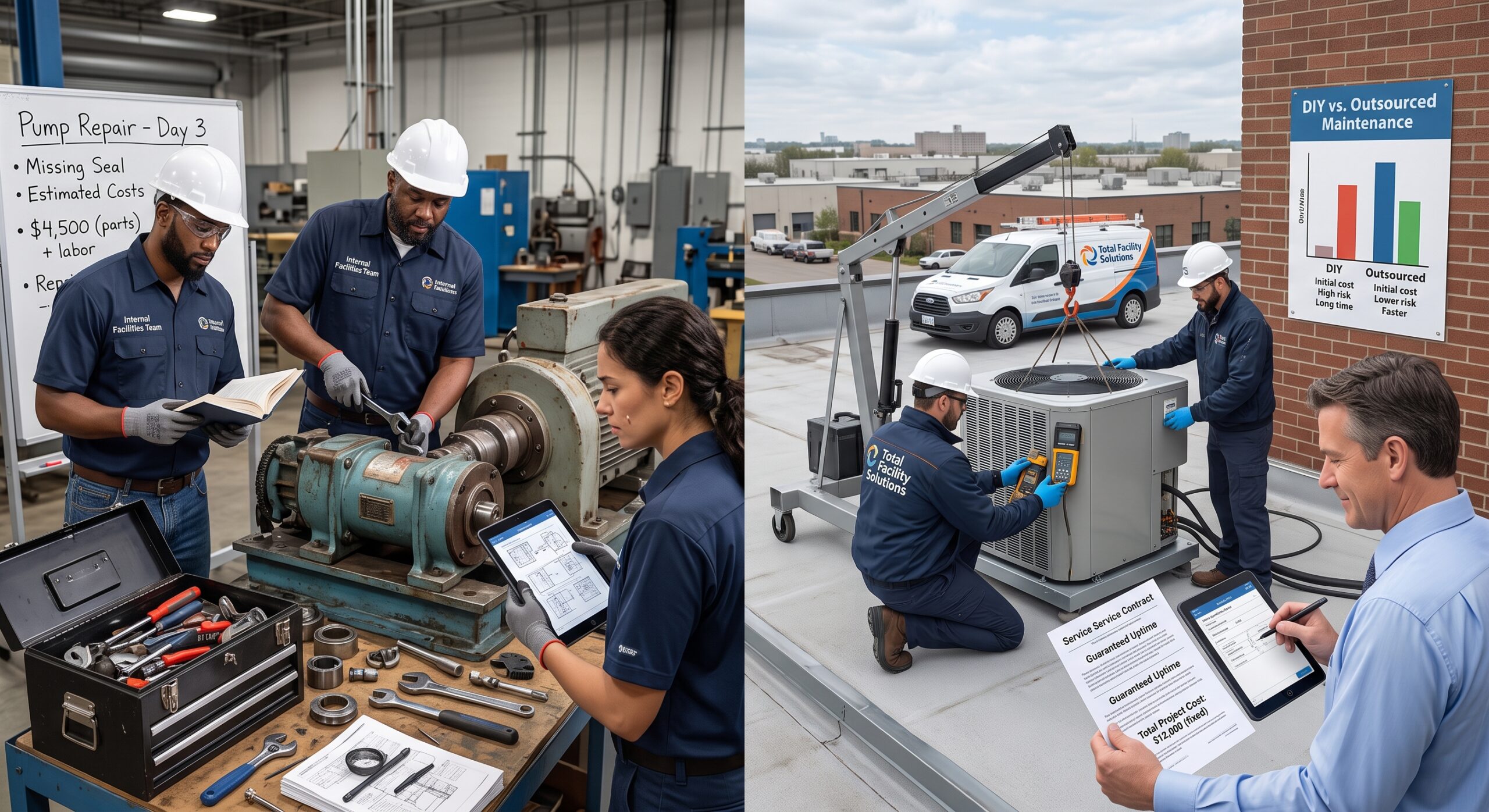
When managing small business properties, every budget meeting eventually leads to the DIY vs. outsourced maintenance debate. Do you keep repairs in-house to stretch every dollar, or do you bring in specialized third-party contractors to protect your time and reduce risk? Having managed small business portfolios for nearly a decade, I can tell you there is no single plug-and-play formula. What I have instead is a set of hard-earned observations from running both models—sometimes in the exact same building.
I’ve run maintenance programs for small business portfolios for the better part of a decade. One question comes up in almost every budget meeting I sit in: DIY vs outsourced maintenance. Do we keep fixing things ourselves, or do we bring in outside help? I wish I had a clean formula to hand someone on their first day as a facilities manager. I don’t. What I have instead is a set of hard-earned observations. I’ve run both models, sometimes at the same time in the same building. I’ve watched what happened to our costs, our downtime, and our stress levels.
This isn’t a theoretical debate for most small business owners. It’s a Tuesday afternoon problem. The walk-in cooler at the restaurant runs warm. The HVAC unit at the office suite short-cycles. A tenant calls about a leak in the ceiling tile. Somebody has to decide, right then, whether to grab a wrench or grab the phone. Over time, those individual decisions add up to a maintenance strategy, whether you planned one or not. This piece lays out what I’ve learned about the DIY vs outsourced maintenance question. My goal is simple: help you stop making that call on the fly and start making it on purpose.
Why This Decision Is Harder Than It Looks
When I managed a single retail location, doing maintenance myself felt obvious. I knew every system in that building. I could get to a problem in minutes. Calling a vendor for a five-minute fix felt wasteful. Once our portfolio grew past a handful of properties, that same instinct started costing us money in ways I didn’t see at first. Mostly, it cost me my own time. I was spending it on ladders instead of on lease renewals and vendor negotiations.
That’s the trap with the DIY vs outsourced maintenance decision. Both options look cheap when you only measure the invoice. A real comparison has to include labor hours, response time, liability, and what happens when something breaks outside business hours. I’ve made both mistakes. I kept a repair in-house too long because I was proud of not needing a vendor. I also outsourced a job that a competent handyman on staff could have handled for a third of the price. Neither mistake was fun to explain to ownership.
The Real Cost of DIY Maintenance
Where DIY Actually Saves Money
In the DIY vs outsourced maintenance comparison, doing your own maintenance is attractive because the sticker price is low. You already pay your staff, so a repair “doesn’t cost anything extra.” Except it does, just not on a separate invoice. Every hour your maintenance person spends fixing a compressor is an hour they’re not spending on preventive walk-throughs or tenant requests.
Here’s what I’ve tracked across our own properties: routine, low-skill maintenance is almost always cheaper to keep in-house. That covers changing filters, tightening fixtures, patching drywall, and basic landscaping. These tasks don’t require specialized tools or licensing. The risk of getting them wrong stays low.
Where DIY Quietly Gets Expensive
Once you move into electrical work, refrigeration, fire suppression, or structural repairs, the math flips fast. A technician without proper training on a rooftop HVAC unit can turn a $300 fix into a $12,000 replacement. I’ve seen it happen.
DIY maintenance also means owning or renting tools that sit idle most of the time. We once bought a $4,000 diagnostic unit for HVAC troubleshooting. We used it maybe seven times in two years. That’s a poor return on capital for a small operation. It’s a cost that never shows up when someone says “we’ll just handle it ourselves.”
The hidden cost that surprised me most was training and turnover. When your in-house technician who knows the building leaves, that knowledge leaves with them. Bringing a new hire up to speed on an aging boiler system takes months. During that ramp-up period, small problems tend to become bigger ones, because nobody catches them early.
The Real Cost of Outsourced Maintenance
Where Outsourcing Earns Its Keep
On the other side of the DIY vs outsourced maintenance equation, outsourcing flips the cost structure. Instead of a fixed payroll expense, you pay for expertise on demand. That sounds efficient until you get a bill for an after-hours emergency call. Vendors price in their overhead, their insurance, their trucks, and their profit margin. Line-for-line, a single outsourced repair usually costs more than doing the same job yourself.
Outsourcing earns its keep on specialized, infrequent, or high-liability work. Fire alarm testing, elevator servicing, commercial refrigeration, and major electrical work fall under strict codes and certifications. Most small businesses can’t justify keeping that expertise on staff. Letting an unlicensed employee handle fire suppression work to save money isn’t a cost-saving move. It’s a liability waiting to happen, and it can void your insurance coverage entirely.
I’ve also found that outsourcing turns a lumpy, unpredictable expense into something closer to a fixed cost, especially under a service agreement. Instead of budgeting for “whatever breaks this quarter,” you pay a predictable monthly or annual fee. That fee typically includes priority response and discounted parts. For a small business trying to forecast cash flow, that predictability carries real value on its own.
The Tradeoffs Nobody Mentions Upfront
The tradeoff is response time and institutional knowledge. A vendor doesn’t know your building the way your own staff does. They don’t know that the third-floor breaker trips every August when the rooftop units run hardest. They don’t know the loading dock door has needed a specific adjustment since we installed it. You’re paying for expertise. You’re also paying a small tax in onboarding time every time a new technician shows up.
Where the Risk Actually Lives
DIY Risk: Competency and Liability
Cost gets most of the attention in the DIY vs outsourced maintenance conversation, but risk is what actually costs small businesses more. Risk with DIY maintenance comes down to competency and liability. Send an untrained employee to work on equipment they don’t know how to service safely, and you risk three things at once: a workers’ compensation claim, a possible OSHA violation, and an actual injury. A bad repair that causes property damage, or worse, a life-safety failure, can put your business on the hook for liability that dwarfs whatever you saved on the original job.
Outsourcing Risk: Dependency and Weak Contracts
Risk with outsourced maintenance shows up differently. It’s less about safety and more about dependency and accountability. If your vendor closes shop, overbooks its schedule, or doesn’t show up during an emergency, you don’t have a backup plan unless you built one. I once lost a vendor relationship abruptly because another company bought them out. The new owner didn’t want to service accounts our size. That left us scrambling for three weeks during a heat wave with no HVAC contractor on call. We could have avoided that if we’d already lined up a backup vendor.
Contracts matter enormously here. A vague service agreement with no defined response times barely beats having no contract at all. I’ve learned to read every outsourced maintenance agreement looking for response-time guarantees, emergency procedures, and whether the price can change without notice. Weak agreements are how outsourcing quietly becomes more expensive than doing the work in-house ever was.
Efficiency and Downtime — What I’ve Actually Tracked
Where In-House Teams Win
Efficiency is where the DIY vs outsourced maintenance debate gets personal for me. Downtime doesn’t just cost money — it costs credibility with tenants, customers, and ownership. A walk-in freezer down for six hours at a restaurant isn’t just a repair bill. It’s spoiled inventory and an unhappy operator calling you every hour for updates.
In-house teams win on response time for anything they actually know how to handle. If your technician is already on-site, they can often diagnose and fix a minor issue faster than an outside vendor could even schedule a visit. That speed advantage disappears the moment the problem exceeds their skill set. You lose time on a failed attempt before you even call for outside help. I’ve watched that turn a same-day fix into a three-day ordeal more than once.
Where Vendors Win
Outsourced vendors, especially ones under a service agreement, tend to win on complex repairs. They arrive with the right parts, the right diagnostic equipment, and the experience to get it right the first time. The efficiency gain isn’t in how fast they show up. It’s in how rarely they have to come back for the same issue. A properly serviced piece of equipment under a maintenance contract tends to fail less often in the first place. The contract builds preventive maintenance into the relationship instead of letting it slide when everyone’s busy — which is exactly what happens with DIY maintenance more often than any of us would like to admit.
What This Means for a Small Business Budget
Two Maintenance Budget Buckets
Budgeting is where the DIY vs outsourced maintenance decision gets personal for a small business. Most facilities directors at larger organizations enjoy a maintenance reserve fund and a procurement department to vet vendors. Small business owners usually don’t. If you’re running a single retail space, a restaurant, or a small office building, every maintenance dollar competes directly with payroll and inventory. That raises the stakes on this decision compared to a larger company.
I push small business clients to think about maintenance in two buckets. The first bucket is predictable, budgeted maintenance: filter changes, seasonal HVAC tune-ups, landscaping, and inspections you can schedule months in advance. Plan this bucket into the annual budget as a fixed line item, whether it’s staff time or a vendor contract. The second bucket is unplanned repair. This is where small businesses get into trouble, because they treat it as a rounding error instead of setting aside a reserve. Here’s a rule of thumb I use across our properties: budget five to ten percent of the building’s operating costs for maintenance. Split that number roughly by how much work stays in-house versus goes to vendors.
The businesses that struggle most aren’t the ones that pick DIY or outsourcing. They’re the ones that never set a maintenance budget at all. They end up making every decision reactively, under pressure, picking whichever option is fastest rather than smartest. A little planning up front removes most of the panic later.
Seven Factors I Weigh Before Choosing Either Path
Every building and every business is different. Over the years I’ve settled on seven questions I ask myself before making the DIY vs outsourced maintenance call on any given task.
1. Does the task require a license or certification?
If yes, that’s usually an automatic vote for outsourcing, full stop.
2. How often does this type of work come up?
Frequent, routine tasks favor keeping the skill in-house. Rare, specialized tasks favor outsourcing, because it isn’t worth training staff for something they’ll do twice a year.
3. What’s the real cost of failure?
A cosmetic repair gone wrong is an inconvenience. A refrigeration or electrical failure gone wrong can shut down a business or hurt someone. That changes the calculation entirely.
4. Do we already own the tools?
Buying specialized equipment for a one-time job almost never pencils out.
5. What’s our actual response-time need?
A two-day wait for a vendor might be fine for one system. Four hours of downtime might be unacceptable for another. That points you toward in-house capability, or a vendor with a guaranteed emergency-response clause.
6. How does this affect insurance and compliance?
Some insurers require licensed professionals to service certain systems to keep coverage valid. I check this before I assume DIY is even an option.
7. What does this do to my team’s workload and morale?
This one took me longest to appreciate. Loading every odd job onto an already-stretched in-house team burns people out. That drives turnover, and turnover eventually costs more than any vendor invoice would have.
Running a task through those seven questions doesn’t always produce an obvious answer. But it stops me from deciding purely on habit or gut feeling, which is how most bad maintenance calls happen.
The Hybrid Model I’ve Landed On
After years of leaning too hard one direction and then the other on DIY vs outsourced maintenance, the approach that actually works for our properties is a hybrid one. We keep a small in-house team for routine, frequent, low-risk work: filter changes, general repairs, landscaping, basic plumbing, and daily inspections. We outsource everything that requires licensing, specialized diagnostic equipment, or real safety risk. Those jobs go to vetted vendors under service agreements with clear response-time commitments.
The part that made this work wasn’t the split itself. It was building real relationships with a short list of vendors for each major trade, so we’re never starting from scratch during an emergency. We also keep a backup vendor on file for our most critical systems. I learned the hard way what happens when your only HVAC contractor becomes unavailable during a heat wave.
This hybrid approach isn’t the cheapest option on paper, and it isn’t the fastest either. It’s the one that has actually reduced our emergency repair frequency and our total maintenance spend over several years. It works because it plays to the strengths of both models instead of forcing every problem through the same solution.
A Real Example From Our Portfolio
A couple of years ago, a small business tenant’s rooftop HVAC unit kept short-cycling during peak summer months. Our in-house technician, capable as he was, hadn’t worked on that specific commercial unit’s control board before. Two attempted DIY fixes bought us nothing but two more days of a hot building and an increasingly frustrated tenant. We finally brought in a licensed HVAC contractor under our service agreement. They diagnosed and fixed the real problem — a failing capacitor and a miscalibrated thermostat — in under two hours.
The lesson wasn’t “outsourcing is always faster.” It was that misjudging the DIY vs outsourced maintenance call on a given task costs more than either path on its own. Had we called the vendor first, we would have saved two days of tenant frustration and skipped the wasted labor hours. That single incident is part of why the seven-factor check above exists. It forces a pause before defaulting to whatever feels easiest in the moment.
Final Thoughts
There’s no universal right answer to the DIY vs outsourced maintenance question. I’d question anyone who claims otherwise. What matters is being honest about three things: your team’s actual skills, the real risk of getting something wrong, and the true cost of your own time when a repair ties it up instead of letting you run the business. For most small businesses, the answer isn’t picking one model. It’s building a deliberate mix, revisiting it as the business grows, and not letting old habits make the decision for you.
Frequently Asked Questions
Is it cheaper to hire an in-house maintenance person or outsource to a vendor?
The DIY vs outsourced maintenance cost question depends on the volume and type of work. For frequent, low-skill tasks, in-house staff usually costs less, because you’re already paying their salary. For infrequent or specialized repairs, outsourcing tends to cost less overall once you factor in training and tools. FacilitiesNet breaks down this tradeoff in Outsourcing Maintenance: When It Makes Sense and When It Doesn’t.
Which maintenance tasks should you never handle in-house without proper certification?
Fire suppression and alarm systems, elevator servicing, commercial refrigeration, and major electrical work typically require licensed professionals. Attempting these without certification can void insurance coverage. It can also create serious liability exposure. Manufacturing.net covers this comparison well in The Pros & Cons Of Outsourced vs. In-House Maintenance.
How much can preventive maintenance actually save a small business?
Running equipment until it fails typically costs around ten times more than maintaining it on a regular schedule. Deferred maintenance can also compound into much higher capital repair costs down the line. WorkTrek lays out these figures in detail in The True Cost of Maintenance: Statistics & Insights.
What should be in an outsourced maintenance contract?
At minimum, a service agreement should define response-time guarantees, emergency procedures, pricing terms, and performance expectations. Vague agreements tend to underperform compared to a well-run in-house team. FMX covers common contract pitfalls in Is Outsourcing Facilities Management Right For Your Organization?
Can a small business switch between DIY and outsourced maintenance later?
Yes, and many do. Businesses commonly bring outsourced work back in-house once they have the volume and staff to justify it. Others move the other direction as they grow. PlanRadar discusses this shift in Outsourcing vs. In-House Facility Management: Pros and Cons.
Is a hybrid maintenance model realistic for a small business?
Yes. Most small businesses I’ve worked with eventually land on a mix. They keep routine work in-house while outsourcing licensed or high-risk tasks, rather than committing entirely to one model. Upkeep’s overview touches on how businesses evolve their approach over time in Maintenance Statistics: Predictive & Preventive, Labor & Costs.
References
- FacilitiesNet. “Outsourcing Maintenance: When It Makes Sense and When It Doesn’t.” https://www.facilitiesnet.com/maintenanceoperations/article/Outsourcing-Maintenance-When-It-Makes-Sense-and-When-It-Doesnt–21016
- FacilitiesNet. “How to Make Outsourcing Maintenance Work.” https://www.facilitiesnet.com/outsourcing/article/How-to-Make-Outsourcing-Maintenance-Work–19473
- FMX. “Is Outsourcing Facilities Management Right For Your Organization?” https://www.gofmx.com/blog/outsourcing-facilities-management/
- WorkTrek. “The True Cost of Maintenance: Statistics & Insights.” https://worktrek.com/blog/maintenance-cost-statistics/
- Upkeep. “Maintenance Statistics: Predictive & Preventive, Labor & Costs.” https://upkeep.com/learning/maintenance-statistics/
- PlanRadar. “Outsourcing vs. In-House Facility Management: Pros and Cons.” https://www.planradar.com/au/outsourcing-vs-in-house-facility-management/
- Manufacturing.net. “The Pros & Cons Of Outsourced vs. In-House Maintenance.” https://www.manufacturing.net/home/article/13150064/the-pros-cons-of-outsourced-vs-inhouse-maintenance