
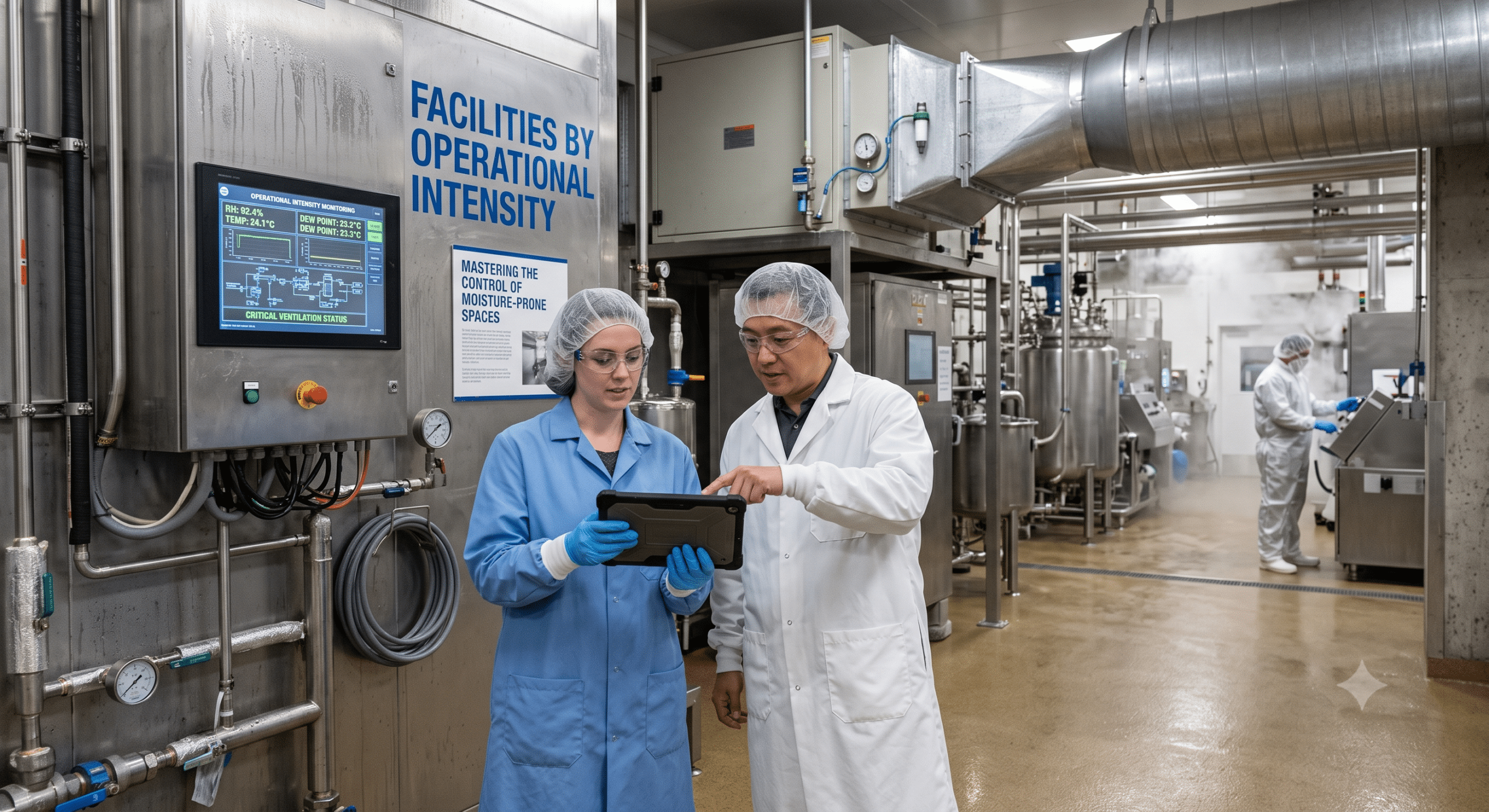
As experienced facilities management and operations consultants, we spend a lot of our working lives managing moisture-prone spaces across commercial, industrial, and institutional properties. When we evaluate real estate, we do not merely look at square footage, tenant capacity, or architectural finishes. Instead, we evaluate a building through the lens of operational intensity—the sheer physical, biological, and mechanical stress placed on a facility by its daily functions.
At the absolute apex of operational intensity sits a uniquely challenging environment: moisture-prone spaces.
Whether you are overseeing a food processing plant running 24/7 sanitization cycles, a subterranean transit terminal, a commercial kitchen pumping out thousands of meals daily, a high-throughput laundry center, or a life-sciences laboratory requiring continuous humidity suppression, water is your primary operational liability. Consequently, managing moisture-prone spaces effectively is often the single most critical factor in preserving your facility’s long-term value.
Left unchecked, water vapor and liquid intrusion do not just cause cosmetic issues. Ultimately, they trigger immediate safety hazards, destroy structural elements, degrade indoor air quality (IAQ), and create catastrophic maintenance liabilities. Therefore, this comprehensive guide unpacks how to analyze, design, and maintain moisture-prone spaces across different tiers of operational intensity. As a result, you will gain an actionable operational roadmap to protect asset value and preserve business continuity.
1. Defining Operational Intensity in Facility Operations
To understand why water behaves so destructively in high-use environments, we must first define operational intensity clearly.
Essentially, operational intensity refers to the cumulative stress exerted on a building’s physical structure and mechanical systems over a given timeframe. Specifically, it is determined by four core metrics:
-
Occupancy & Foot Traffic: The sheer number of human beings introducing heat, bio-loads, and movement through space.
-
Duty Cycle: The operating schedule—ranging from a simple 8-hour daily shift to continuous 24/7/365 operations.
-
Process Load: Internal activities that release heat, particulate matter, chemicals, or moisture into the air.
-
Regulatory and Hygiene Standards: The level of sanitation required by governing bodies (e.g., FDA, USDA, OSHA, or healthcare compliance).
As operational intensity rises, the buffer for facility error shrinks significantly. For example, in a low-intensity suburban office building, a minor HVAC imbalance or a small seal failure might cause a musty odor that can be fixed days later. In contrast, within high-intensity moisture-prone spaces like a commercial laundry facility, a similar HVAC failure leads to massive ceiling condensation within 8 hours. Subsequently, mold growth appears on structural joists within 48 hours, and ruined inventory follows shortly after.
2. The Mechanics of Water Intrusion in High-Intensity Spaces
In these environments, water attacks buildings in two main physical states: as liquid water (bulk moisture) and as invisible water vapor.
In low-intensity facilities, moisture is mostly seasonal or weather-driven. However, in high-intensity moisture-prone spaces, moisture is constantly produced inside the space by human activity, hot-water washdowns, cooking steam, washing equipment, or specialized manufacturing processes.
┌─────────────────────────────────────────────────────────────────────────┐
│                    THE MOISTURE CYCLE IN FACILITIES                     │
├─────────────────────────────────────────────────────────────────────────┤
│                                                                         │
│   [ Internal Process ] ──> Generates Humidity / Bulk Water            │
│            │                                                            │
│            ▼                                                            │
│   [ Air & Thermal Traps ] ──> Reaches Dew Point on Cold Surfaces        │
│            │                                                            │
│            ▼                                                            │
│   [ Condensation ] ──> Saturates Porous Materials (Concrete, Drywall)   │
│            │                                                            │
│            ▼                                                            │
│   [ Degradation ] ──> Mold, Structural Corrosion, Equipment Failure     │
│                                                                         │
└─────────────────────────────────────────────────────────────────────────┘
To effectively control moisture-prone spaces, facility managers must master three baseline thermodynamic principles:
A. Vapor Pressure Gradients
First, moisture naturally moves from areas of high vapor pressure to areas of low vapor pressure. In hot, humid operational settings, water vapor forcefully pushes itself into surrounding cooler walls, ceilings, and interstitial wall cavities. Thus, if those walls lack continuous vapor barriers or proper sealing, water becomes trapped inside the building envelope indefinitely.
B. Condensation and Dew Point Management
Second, when air saturated with water vapor touches a surface cold enough to hit its dew point, moisture condenses back into liquid water. In moisture-prone spaces with cold-water piping, refrigerated storage, or poor exterior insulation, structural surfaces will continuously “sweat” as a direct result.
C. Capillary Action
Finally, concrete, mortar, grout, and drywall act like massive sponges. Liquid water on a floor does not simply sit there; instead, it climbs up structural walls and column bases via capillary action. Eventually, this process dissolves adhesives, rots framing studs, and degrades concrete from within.
3. Categorizing Facilities and Moisture-Prone Spaces by Operational Intensity
To manage these issues systematically, we categorize facilities and their internal moisture-prone spaces into three distinct operational intensity tiers:
| Tier Level | Operational Profile | Examples of Moisture-Prone Spaces | Primary Moisture Drivers | Primary Operational Risk |
| Tier 1: Low-to-Moderate Intensity | Single-shift operations (8–10 hrs/day), standard occupancy, minimal process humidity. | Office breakrooms, standard restrooms, fitness center locker rooms. | Human usage, occasional localized water spills, standard HVAC cycles. | Surface mold, cosmetic finish degradation, minor air quality complaints. |
| Tier 2: High Intensity | Multi-shift operations (12–16 hrs/day), heavy foot traffic, continuous wash/steam cycles. | Commercial kitchens, hotel laundries, public aquatic centers, indoor hydroponics. | Steam generation, constant floor washdowns, high occupant respiration, heavy exhaust requirements. | Slip/fall accidents, wall and floor assembly failure, localized structural decay. |
| Tier 3: Extreme Operational Intensity | 24/7/365 non-stop operations, strict regulatory compliance, high thermal swings. | Food and beverage plants, pharmaceutical labs, subterranean transit hubs, cold-chain facilities. | Chemical hot washdowns, ambient thermal changes, heavy mechanical ventilation loads. | Regulatory shutdowns, severe structural concrete/steel corrosion, microbial contamination. |
4. The Operational Blueprint for Managing Moisture-Prone Spaces
Regardless of whether you are managing Tier 1 office amenities or Tier 3 food processing facilities, maintaining moisture-prone spaces requires a structured approach built across 8 key operational pillars.
                           8 OPERATIONAL PILLARS
                       FOR MOISTURE CONTROL IN FM
                                   │
      ┌───────────┬───────────┬────┴──────┬───────────┬───────────┐
      │           │           │           │           │           │
   [1. Envelope] [2. HVAC] [3. Drain] [4. Surfaces] [5. Press.] [6. Sensors]
                                                      │           │
                                                 [7. Maint.] [8. SOPs]
Pillar 1: Building Envelope Continuity and Vapor Control
Your building envelope is your first line of defense. However, in moisture-prone spaces, traditional building details fail rapidly. Standard drywall, non-vapor-permeable insulation, and basic exterior sealants quickly decay under continuous humidity exposure.
-
Vapor Retarders and Air Barriers: Always install continuous vapor barriers on the warm side of the wall assembly. Furthermore, ensure that wall-to-floor and wall-to-ceiling transitions are fully sealed, because air leaks carry far more moisture than vapor diffusion alone.
-
Capillary Breaks: Additionally, require non-porous capillary breaks (such as closed-cell foam insulation, rubberized asphalt membranes, or plastic shims) under all bottom wall plates and structural base connections in wet rooms.
-
Thermal Bridging Mitigation: Meanwhile, insulate all cold structural elements—including steel columns, uninsulated ductwork, and cold-water pipes—that pass through moisture-prone spaces to prevent localized condensation.
Pillar 2: High-Performance HVAC and Latent Load Management
The single biggest error operations teams make when managing moisture-prone spaces is sizing HVAC systems purely for temperature (sensible load) while ignoring water removal (latent load).
-
Dedicated Outdoor Air Systems (DOAS): High-intensity moisture-prone spaces often require 100% outdoor air exchange to purge contaminants and moisture. Therefore, a dedicated DOAS pre-treats, dehumidifies, and cools outdoor air before delivering it to the space, effectively keeping moisture out.
-
Desiccant vs. Refrigerant Dehumidification: Standard refrigerant dehumidifiers work well in warm, humid zones. On the other hand, for cold moisture-prone spaces like walk-in coolers or cold processing rooms, desiccant dehumidifiers are necessary so they can pull moisture from the air without freezing the coils.
-
Preventing Coil Bypass: Furthermore, ensure that Air Handling Unit (AHU) cooling coils are clean and operating at correct chilled water temperatures. Otherwise, dirty coils or incorrect airflow rates will prevent water vapor from condensing on the coils, ultimately sending humid air right back into your facility.
Pillar 3: Specialized Floor Assemblies and Drainage Systems
Water always seeks the lowest point. Therefore, if a floor in high-intensity moisture-prone spaces pools water for more than 15 to 30 minutes, it represents an operational failure.
                     OPTIMAL SLOPED FLOORING DETAIL

      [ Wall Surface ]
           │
           │   [ Seamless Coved Base (4" to 6") ]
           │  /
           │ /
    ───────┴/───────────────────────────────────┐
            \                                   │  Slope: 1/4" per foot min.
             \                                  ▼
              └────────────────────────────────────┐
                                                   │ [ Trench Drain ]
                                                   └───────────────────
-
Slope Integrity: High-intensity wet zones require a minimum floor slope of 1/4 inch per foot (2%) toward drains. In critical processing zones, however, the slope should increase to 3/8 inch per foot to clear washdown water even faster.
-
Drain Selection: Similarly, abandon basic point drains in heavy washdown areas. Instead, use continuous, slot-drained, or trench-drained 316-grade stainless steel assemblies with built-in sediment baskets. After all, stainless steel naturally resists biological growth, harsh chemical sanitizers, and thermal shock.
-
Seamless Resin Flooring: In addition, epoxy, polyaspartic, and cementitious urethane floor systems provide a seamless, non-porous wear surface. Cementitious urethane is particularly preferred in moisture-prone spaces because its thermal expansion rate closely matches concrete, thereby preventing delamination during hot-water washdowns.
Pillar 4: Impervious Surface Selection and Impact Protection
Porous surfaces in moisture-prone spaces are open invitations for biological growth, chemical degradation, and deep structural damage.
-
Coved Wall Bases: For this reason, never permit a flat 90-degree wall-to-floor junction in wet or moisture-prone spaces. Instead, specify a continuous, seamless resinous coved base extending at least 4 to 6 inches up the wall. As a result, water cannot pool in corners or penetrate behind wall systems.
-
Wall Cladding: Likewise, replace painted drywall with Fiber-Reinforced Plastic (FRP) panels, PVC wall cladding, or stainless steel sheet goods. Then, seal every panel seam with structural rivets and hot-welded PVC rods or antimicrobial silicone sealants.
-
Impact Protection: In high-traffic facilities, wall cladding is often damaged by carts, forklifts, and rolling machinery. Once a wall panel is cracked, water inevitably gets trapped behind it. Thus, install heavy-duty stainless steel crash rails and floor-mounted bollards to protect sealed wall surfaces over time.
Pillar 5: Precision Pressure Cascades and Air Balancing
Air naturally flows from high pressure to low pressure. Consequently, in moisture-prone spaces, if you do not control space pressurization, humid air will migrate into dry zones, creating condensation and air quality issues throughout the entire building.
     HIGH HUMIDITY ZONE                    DRY ADJACENT ZONE
   ┌────────────────────┐                ┌────────────────────┐
   │                    │                │                    │
   │  Negative Pressure │ <───────────── │  Positive Pressure │
   │   (Exhaust > Supply)│   Airflow Flow │   (Supply > Exhaust)│
   │                    │  Direction     │                    │
   └────────────────────┘                └────────────────────┘
-
Negative Pressurization for Wet Spaces: High-moisture areas (such as commercial kitchens, laundries, and locker rooms) must be kept under negative air pressure relative to surrounding corridors and offices. Consequently, this setup pulls air into the wet space and prevents damp, odorous air from escaping into dry areas.
-
Positive Pressurization for Clean/Dry Spaces: Conversely, keep dry inventory rooms, electrical closets, and clean offices under positive air pressure so they continuously repel outdoor humidity and wet-zone air migration.
-
Airlocks and Vestibules: In extreme Tier 3 facilities, install pressurization airlocks or high-velocity air curtains at access points to moisture-prone spaces. Thus, you can maintain atmospheric control even during heavy personnel traffic.
Pillar 6: IoT Monitoring and Predictive Moisture Analytics
Because you cannot manage what you do not measure, traditional visual inspections often miss hidden moisture issues until mold, rot, or structural damage has already occurred.
-
Continuous Dew Point Monitoring: To prevent this, install integrated IoT sensors inside moisture-prone spaces that measure dry-bulb temperature, relative humidity (RH), and surface temperatures in real time. Then, program your Building Management System (BMS) to trigger immediate alarms when surface temperatures come within 5°F of the dew point.
-
In-Slab Moisture Probes: Additionally, place wireless moisture probes inside concrete floor slabs near high-risk water sources. This allows you to spot under-slab leaks or capillary rise before tile or epoxy coatings fail.
-
Automated Leak Detection Cables: Finally, run low-voltage, continuous water-sensing cables along pipe chases, under mechanical coils, beneath raised access floors, and around perimeter walls for early warnings.
Pillar 7: Specialized Preventive Maintenance (PM) Schedules
Standard maintenance schedules designed for low-intensity buildings will quickly fail when applied to moisture-prone spaces. Therefore, you must establish frequency-based PM tasks tailored specifically to moisture management:
┌──────────────────────────────────────────────────────────────────────────┐
│                    MOISTURE-CONTROL MAINTENANCE SCHEDULE                 │
├───────────────┬──────────────────────────────────────────────────────────┤
│ FREQUENCY     │ RECOMMENDED OPERATIONAL TASKS                            │
├───────────────┼──────────────────────────────────────────────────────────┤
│ Daily         │ • Clean trench drain baskets and clear debris.           │
│               │ • Check floor surfaces for standing or pooling water.    │
├───────────────┼──────────────────────────────────────────────────────────┤
│ Weekly        │ • Inspect exhaust fan belt tension and air velocity.     │
│               │ • Check wall-to-floor sealant joints for tears or gaps.  │
├───────────────┼──────────────────────────────────────────────────────────┤
│ Monthly       │ • Calibrate humidity and CO2/pressure sensors.           │
│               │ • Inspect AHU condensate drain pans and trap seals.     │
│               │ • Clean and sanitize HVAC cooling coils.                 │
├───────────────┼──────────────────────────────────────────────────────────┤
│ Quarterly     │ • Perform thermal imaging audits on exterior envelopes.  │
│               │ • Inspect insulation jacketing on chilled water pipes.   │
└───────────────┴──────────────────────────────────────────────────────────┘
Pillar 8: Operational SOPs and Human-Factor Protocols
Even the best-engineered facility will experience moisture issues if daily operational habits are sloppy. For that reason, human protocols must actively reinforce physical systems in all moisture-prone spaces:
-
Washdown SOPs: First, train sanitation crews to use targeted, high-pressure, low-volume washing techniques rather than flooding floors with hoses. Furthermore, require squeegeeing toward drains immediately after wash cycles complete.
-
Door Management Protocols: Second, implement fast-acting roll-up doors or automated door closers on high-intensity moisture-prone spaces. As a rule, never allow staff to prop doors open between high-humidity wash zones and dry storage areas.
-
Immediate Spill Reporting: Third, train all staff to treat standing water as an immediate safety hazard and report leaks, dripping pipes, or unusual damp spots right away.
5. Financial and Risk Management: The Cost of Operational Neglect
Failing to properly manage moisture-prone spaces in high-intensity facilities carries a severe financial cost. As operations consultants, we systematically evaluate moisture risk across four direct financial metrics:
1. Accelerated Capital Expenditure (CapEx) Depreciation
High ambient humidity speeds up structural decay significantly. As a result, unprotected structural steel in moisture-prone spaces can lose structural integrity faster, while electrical panels and motor control centers suffer from premature short circuits, contact corrosion, and unexpected failure.
2. Regulatory Fines and Operational Shutdowns
In food production, pharmaceutical, and healthcare spaces, uncontrolled humidity or surface mold in moisture-prone spaces can trigger immediate regulatory intervention. Consequently, this leads to expensive product recalls or complete facility closures.
            THE RECURRING COST OF UNCONTROLLED MOISTURE

   ┌──────────────────────────────────────────────────────────┐
   │ High Indoor Humidity / Standing Water                    │
   └──────────────────────────┬───────────────────────────────┘
                              │
            ┌─────────────────┴─────────────────┐
            ▼                                   ▼
   [ Regulatory Shutdowns ]            [ Microbial Growth ]
   • Immediate Lost Revenue            • Air Quality Violations
   • Product Spoilage                  • Expensive Remediation
            │                                   │
            └─────────────────┬─────────────────┘
                              │
                              ▼
   [ Total Operational Downtime & Accelerated CapEx Losses ]
3. Indoor Air Quality (IAQ) Liabilities
Damp indoor environments consistently invite mold growth. Subsequently, this leads to air quality complaints, employee absenteeism, and potential legal exposure.
4. Severe Energy Inefficiency
Moist air requires significantly more thermal energy to cool or heat than dry air. Furthermore, wet insulation loses up to 80% of its thermal resistance (R-value), causing utility bills to skyrocket as HVAC equipment works overtime to compensate.
6. Real-World Case Study: Transforming a High-Intensity Laundry Facility
To see these operational principles in action, consider a real-world transformation from our consulting practice involving severe issues in moisture-prone spaces.
The Problem
A commercial laundry facility operating 18 hours a day was suffering from severe moisture problems. Specifically, droplets constantly dripped from ceiling trusses, floor epoxy was peeling off in sheets, and worker safety grievances were mounting over slick floors and musty air. In addition, the facility was replacing exhaust fans every 14 months due to severe motor corrosion.
The Operational Audit
Our comprehensive audit revealed three main structural failures:
-
First, the mechanical system was operating under an improper pressure differential, pulling hot, humid exhaust back down through roof vents.
-
Second, the concrete floor in these moisture-prone spaces lacked a capillary break and proper slope, causing washwater to collect along wall bases.
-
Third, the wall assembly used standard exterior sealants that deteriorated rapidly under daily exposure to steam and high-pH detergents.
The Solution Implementation
To address these root causes, we introduced a phased, 3-step operational fix:
  ┌─────────────────────────────────────────────────────────────────┐
  │                   3-STEP FACILITY RETROFIT                      │
  ├─────────────────────────────────────────────────────────────────┤
  │ STEP 1: Re-engineered Air Delivery                            │
  │ • Installed DOAS unit maintaining slight negative relative      │
  │   pressure inside, protecting surrounding warehouse space.   │
  │                                                                 │
  │ STEP 2: Concrete & Drainage Reconstruction                      │
  │ • Scarified floor slab and installed sloped cementitious        │
  │   urethane flooring with 6-inch seamless coved bases.     │
  │ • Replaced point drains with continuous 316 stainless steel     │
  │   trench drains.                                                │
  │                                                                 │
  │ STEP 3: Automated Monitoring & SOP Overhaul                     │
  │ • Deployed continuous dew-point sensors tied directly to        │
  │   exhaust fan variable frequency drives (VFDs).             │
  │ • Trained staff on dry-floor washdown protocols.                │
  └─────────────────────────────────────────────────────────────────┘
The Results
Within 90 days of implementation, ambient relative humidity dropped from an average of 86% down to 48%. Furthermore, roof truss condensation vanished entirely, slip-and-fall incidents dropped to zero, and annual energy costs fell by 18% thanks to lower latent HVAC loads and dry building insulation.
Frequently Asked Questions (FAQ)
What defines moisture-prone spaces in facility management?
Moisture-prone spaces are areas within a facility where liquid water, high relative humidity, or steam is regularly generated by occupants, operational processes, or mechanical equipment. Common examples include commercial kitchens, indoor pools, industrial laundries, food processing rooms, and heavy-use restrooms.
How does operational intensity impact moisture-prone spaces?
Higher operational intensity means longer operating hours, heavier equipment use, higher occupancy, and more frequent cleaning cycles. Consequently, these factors continuously push heat and water vapor into moisture-prone spaces, requiring commercial-grade HVAC systems, continuous moisture monitoring, and durable building surfaces.
What is the ideal relative humidity level for commercial spaces?
For standard indoor environments, relative humidity should ideally be kept between 30% and 50%. In high-intensity moisture-prone spaces, humidity may spike during active operations; however, mechanical systems should quickly pull it back below 60% to prevent condensation, mold growth, and structural decay.
Why does flooring fail so quickly in wet operational areas?
Flooring typically fails because water gets underneath the surface. This usually happens when concrete lacks a proper vapor barrier, floors are not sloped correctly toward drains, or water seeps through cracked grout and unsealed wall joints in moisture-prone spaces. Furthermore, thermal shock from hot washdowns can cause coatings to pull away from concrete over time.
How can facilities prevent condensation on walls and ceilings in moisture-prone spaces?
To prevent condensation in moisture-prone spaces, keep surface temperatures above the dew point of the surrounding air. You can achieve this by adding proper thermal insulation, removing humid air through dedicated exhaust systems, using continuous dehumidification, and keeping air moving across cold surfaces.
References & Further Reading
For facility leaders looking to expand their knowledge on moisture management, building envelope design, and operational best practices, consult these industry resources:
-
Environmental Protection Agency (EPA): Moisture Control Guidance for Building Design, Construction and Maintenance — A definitive guide on moisture dynamics, building materials, and HVAC design.
Source Link: EPA Moisture Control Guide
-
Whole Building Design Guide (WBDG): Managing Moisture in Commercial Building Envelopes — Excellent technical insights on vapor retarders, air barriers, and capillary breaks.
-
ASHRAE (American Society of Heating, Refrigerating and Air-Conditioning Engineers): Position Document on Indoor Mold and Moisture — Technical standards for latent load HVAC calculations, building pressurization, and air balancing.
-
Sto Corp Architectural Resources: Moisture Control in Buildings: Definitive Guide — Practical details on building envelopes, water-resistive barriers, and surface drainage.
Source Link: Sto Corp Moisture Control Guide
-
A.G. Coombs Advisory: Combating High Humidity in Commercial Buildings — In-depth analysis of HVAC commissioning, coil maintenance, and building pressurization strategies.
Source Link: A.G. Coombs Humidity Advisory