
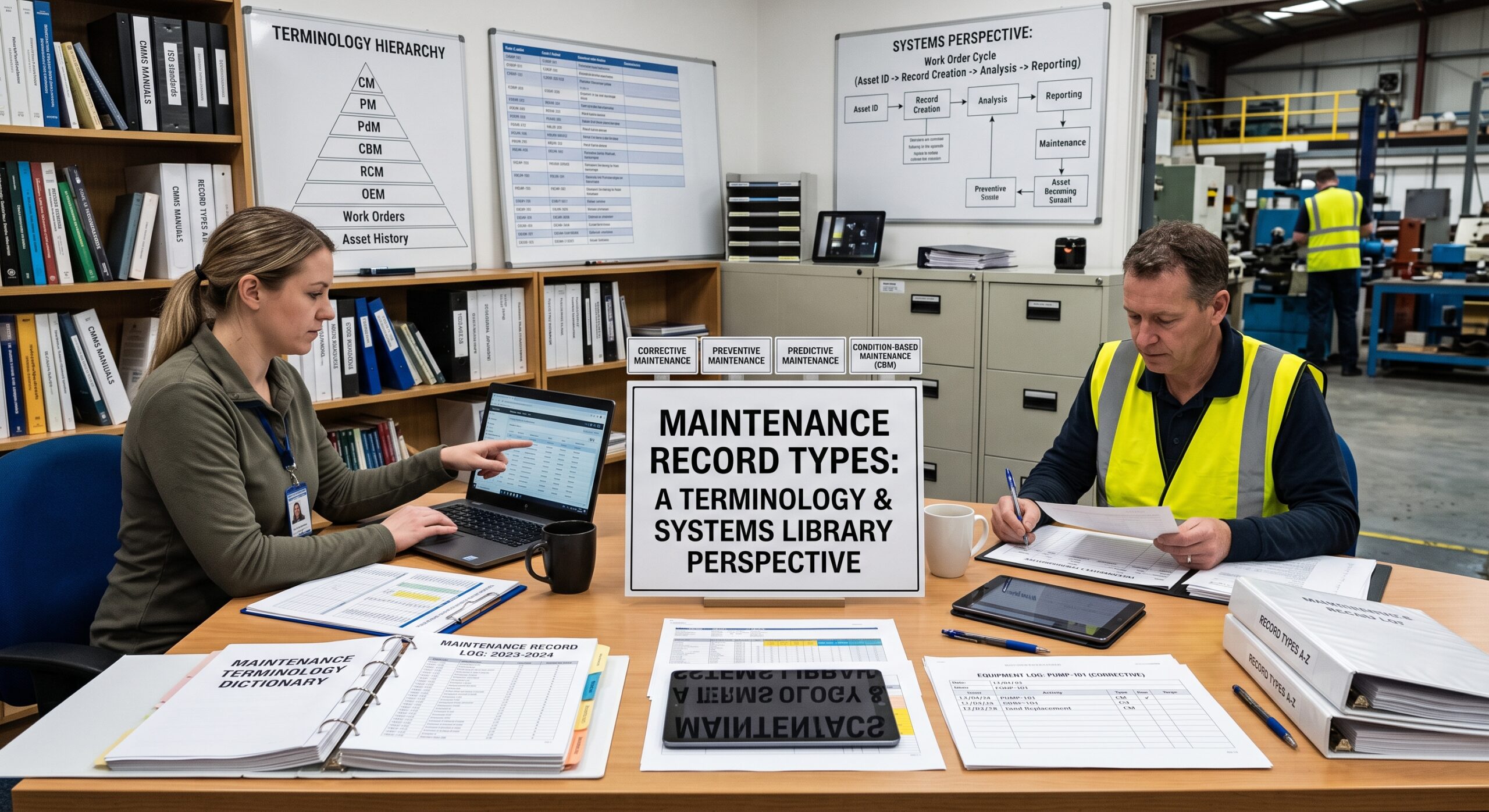
In any organization that relies on physical assets, machinery, or complex hardware systems, the discipline of maintenance is only as strong as the records that document it. Consequently, maintenance record types form the backbone of a functional Terminology & Systems Library, enabling teams to track, analyze, and improve asset performance over time. From the perspective of a Knowledge Management (KM) Specialist or Information Architect, these records are not merely administrative artifacts; rather, they serve as structured knowledge assets that support decision-making, compliance, and continuous improvement.
This article explores maintenance record types through the lens of system architecture and hardware mechanics. Specifically, it deconstructs how functional parts of a maintenance ecosystem interlock to create a coherent, searchable, and actionable knowledge base. Ultimately, the author aims to provide a practical, human-centered guide that avoids AI-generated vagueness and instead delivers concrete, field-tested insights.
Defining Maintenance Record Types
At its core, a maintenance record documents the history of inspection, service, repair, or replacement activities on an asset. However, not all records serve the same purpose. Because different record types capture different facets of maintenance activity, each operates with its own distinct triggers, owners, and downstream uses.
The primary maintenance record types include:
- Work Orders: Formal authorizations that describe a specific task, assign it to a technician, and capture the result upon completion. Thus, teams use work orders as the primary document to authorize, assign, and close maintenance operations.
- Inspection Logs: Structured findings from scheduled or unscheduled examinations of equipment condition, including measurements, photographs, and pass/fail determinations. For instance, technicians use these logs to record periodic check results against a defined checklist.
- Repair Histories: Chronological summaries of every corrective or emergency intervention on an asset. As a result, equipment repair history provides a clear timeline of failures, replaced parts, and invested labor.
- Preventive Maintenance Logs: Records of all scheduled, time-based, or usage-based servicing tasks. Specifically, calendar dates, runtime hours, or cycle counts trigger these logs.
- Predictive Maintenance Logs: Sensor readings, vibration data, oil analysis results, and actions taken based on that data. Consequently, condition monitoring alarms or threshold breaches trigger these records.
- Calibration Records: For assets subject to measurement accuracy requirements, these documents capture when a technician calibrated the asset, against what standard, and the final result.
- Failure Reports: Detailed accounts of equipment failures, including the failure mode, probable cause, corrective action, and recommended preventive measures.
- Standard Operating Procedures (SOPs): Step-by-step instructions for performing specific maintenance tasks, including safety precautions, required tools, torque specifications, and acceptance criteria.
Together, these 8 record types form a comprehensive taxonomy that simultaneously supports operational execution and strategic analysis.
System Architecture & Hardware Mechanics: Deconstructing Functional Parts
To understand how maintenance record types function within a larger system, teams benefit from deconstructing the maintenance ecosystem into its functional parts—much like reverse engineering a physical device. From an Information Architecture standpoint, this process means mapping the flow of data, the roles of actors, and the interfaces between systems.
Hardware Layer: The Physical Asset
At the base of the architecture lies the physical asset itself, whether it is a CNC machine, a fleet vehicle, or a server rack. Each asset features a unique identifier (asset ID) that serves as the primary key for all associated maintenance records. Meanwhile, the hardware layer continuously generates data through sensors, manual inspections, and technician interventions.
Data Capture Layer: Work Orders and Logs
The next layer consists of the mechanisms through which technicians record maintenance activities. While work orders initiate and close tasks, logs accumulate historical data over time. In a Computerized Maintenance Management System (CMMS), the maintenance log does not exist as a separate document; instead, it compiles the cumulative record of all closed work orders attached to a specific asset. Therefore, this layer ensures that technicians timestamp, attribute, and link every action—whether preventive, corrective, or predictive—to the asset ID.
Knowledge Layer: Taxonomy and Metadata
Above the data capture layer sits the knowledge layer, where taxonomy and metadata transform raw records into searchable, analyzable knowledge assets. In this context, a well-designed taxonomy aligns record types with retrieval contexts, such as incident response, audit preparation, or reliability analysis. Furthermore, metadata fields might include validity periods, owner roles, confidence tiers, and scope dimensions. Additionally, controlled vocabularies ensure that teams consistently apply terms like “bearing failure” or “lubrication interval” across all records.
Interface Layer: Search and Reporting
The topmost layer is the interface through which users retrieve and act on maintenance knowledge. Here, search configurations align index fields, facet structures, and relevance weighting with the underlying taxonomy and metadata schema. Consequently, dashboards and reports surface critical patterns—such as recurring failure modes or optimal replacement intervals—enabling data-driven decisions.
By deconstructing the system in this way, we see that maintenance record types are not isolated documents; rather, they act as interconnected nodes within a larger knowledge network. Although each record type serves a specific function, all of them ultimately contribute to a unified view of asset health and organizational learning.
The Role of the KM Specialist / Information Architect
A Knowledge Management Specialist or Information Architect plays a critical role in designing and governing this ecosystem. Consequently, their responsibilities include:
- Asset Type Inventory: Enumerating all knowledge asset categories in scope, including runbooks, known error records, policy documents, architecture decision records, expert profiles, and lessons learned.
- Taxonomy Design: Constructing hierarchical and faceted classification structures aligned directly with asset types and retrieval contexts.
- Metadata Schema Definition: Specifying mandatory and optional metadata fields for each distinct asset type.
- Controlled Vocabulary Development: Defining canonical terms for domain concepts, documenting synonyms, and establishing governance protocols for term additions.
- Relationship and Linking Model: Defining which asset types must carry cross-references, while specifying whether relationships exist as hyperlinks, ontological assertions, or structured knowledge graph edges.
- Contribution Workflow Design: Mapping authoring, review, and publication steps to minimize friction while preserving classification accuracy.
- Deprecation and Maintenance Protocol: Establishing review triggers—whether time-based, event-based (such as system changes or incidents), or version-based—and defining clear deprecation labeling conventions.
- Governance Structure Assignment: Assigning clear ownership for taxonomy maintenance, metadata schema updates, and classification audit responsibilities to named roles.
In practice, this means that the KM Specialist does not merely catalog static documents; instead, they architect a living system where knowledge flows seamlessly from creation to consumption.
Best Practices for Maintenance Record Management
To ensure that maintenance record types deliver maximum value, organizations should adopt the following best practices:
- Centralize Records in a CMMS: Replace paper-based systems, spreadsheets, and ad hoc processes with a centralized platform where technicians manage every work order, service history, inspection record, and spare part in one place.
- Standardize Failure Codes: Utilize standardized alphanumeric identifiers to classify why an asset stopped working, what specific part failed, and what action restored it. As a result, this practice significantly improves maintenance analysis and root cause identification.
- Capture Rich Context: Always include technician names, parts used, photos, manuals, and before-and-after measurements in records. Consequently, this converts every routine repair into a valuable future reference.
- Automate Where Possible: Leverage CMMS automation to update asset histories automatically whenever a technician closes a work order. In turn, this reduces manual entry errors and guarantees completeness.
- Link Records to Asset Lifecycle: Transform the asset record into an evidence base for reliability analysis by linking service history, work orders, inspection results, parts used, and manuals directly together.
- Conduct Regular Audits: Assign classification audit responsibilities to named roles to ensure ongoing data accuracy and relevance.
- Train Technicians on Documentation Standards: Good documentation turns every repair into a searchable reference asset; conversely, poor documentation clutters the CMMS with unhelpful entries.
- Integrate with Broader Knowledge Systems: Ensure teams can easily discover maintenance records alongside runbooks, SOPs, and lessons learned to support holistic problem-solving.
FAQ: Maintenance Record Types
Q1: What is the difference between a work order and a maintenance log?
A work order authorizes technicians to perform work, whereas a maintenance log records what technicians actually performed. In a CMMS, the maintenance log functions as the cumulative record of all closed work orders attached to a specific asset.
Q2: How many types of maintenance records exist?
At least 8 primary types exist: work orders, inspection logs, repair histories, preventive maintenance logs, predictive maintenance logs, calibration records, failure reports, and SOPs.
Q3: Who maintains maintenance records?
Responsibility varies depending on the record type. For example, assigned technicians or the CMMS maintain work orders, whereas inspectors or reliability engineers handle inspection logs. Similarly, calibration technicians or quality assurance teams maintain calibration records.
Q4: Why are failure codes important?
Failure codes classify equipment issues using problem, cause, and remedy parameters. Standardizing them improves maintenance analysis, accelerates root cause identification, and enhances failure pattern recognition over time.
Q5: Can teams use maintenance records for predictive maintenance?
Yes. Predictive maintenance logs capture sensor readings, vibration data, oil analysis results, and responsive actions. Therefore, these records enable condition-based interventions before physical failures occur.
Q6: How often should teams audit maintenance records?
The organization should explicitly define audit frequency in the deprecation and maintenance protocol, using triggers based on time intervals, system changes, incidents, or version updates. Regular audits ensure ongoing classification accuracy.
Q7: What role does a KM Specialist play in maintenance record management?
A KM Specialist designs the overarching taxonomy, metadata schema, controlled vocabulary, and governance structure required to make maintenance records searchable, analyzable, and actionable.
Q8: Do maintenance records equal maintenance documentation?
Not entirely. Maintenance records represent a specific subset of broader maintenance documentation, which also includes procedural guides, vendor manuals, and strategic compliance reports.
Reference Section
- Tractian. “Maintenance Logs: Definition.” https://tractian.com/en/glossary/maintenance-logs
- Information Architecture Authority. “Knowledge Management Information Architecture in Technology Services.” https://informationarchitectureauthority.com/knowledge-management-ia
- Tractian. “Maintenance Record.” https://tractian.com/en/glossary/maintenance-record
- Tractian. “Equipment Maintenance Log: Definition.” https://tractian.com/en/glossary/equipment-maintenance-log
- Engineer Fix. “What Is Reverse Engineering and How Does It Work?” https://engineerfix.com/what-is-reverse-engineering-and-how-does-it-work/
- Cryotos. “How to Track Asset Maintenance History.” https://www.cryotos.com/blog/how-to-track-asset-maintenance-history-in-cmms
- Dovient. “Maintenance Documentation Standards: What to Record and Why.” https://dovient.com/learning/maintenance-documentation-standards
- Process Navigation. “Maintenance Log: Template, Examples, and What to Include.” https://processnavigation.com/insights/maintenance-log/
- MapTrack. “CMMS Guide: Asset Registry Fields & Work Orders.” https://www.maptrack.com/blog/cmms-complete-guide
- Tractian. “Failure Code: Definition.” https://tractian.com/en/glossary/failure-code
- Information Architecture Authority. “Taxonomy: Organizing Information for Clarity.” https://informationarchitectureauthority.com/taxonomy-in-information-architecture.html
- Tractian. “Maintenance History: Definition.” https://tractian.com/en/glossary/maintenance-history
- Connect981. “Maintenance Records.” https://connect981.com/glossary/maintenance-records
- Tractian. “Maintenance Documentation: Definition.” https://tractian.com/en/glossary/maintenance-documentation
- Tractian. “Status of Repair.” https://tractian.com/en/glossary/status-of-repair
This article synthesizes current best practices and definitions from high-authority sources in maintenance management, knowledge architecture, and systems engineering. By treating maintenance record types as structured knowledge assets within a larger Terminology & Systems Library, organizations can unlock deeper insights, improve reliability, and foster a culture of continuous learning.