
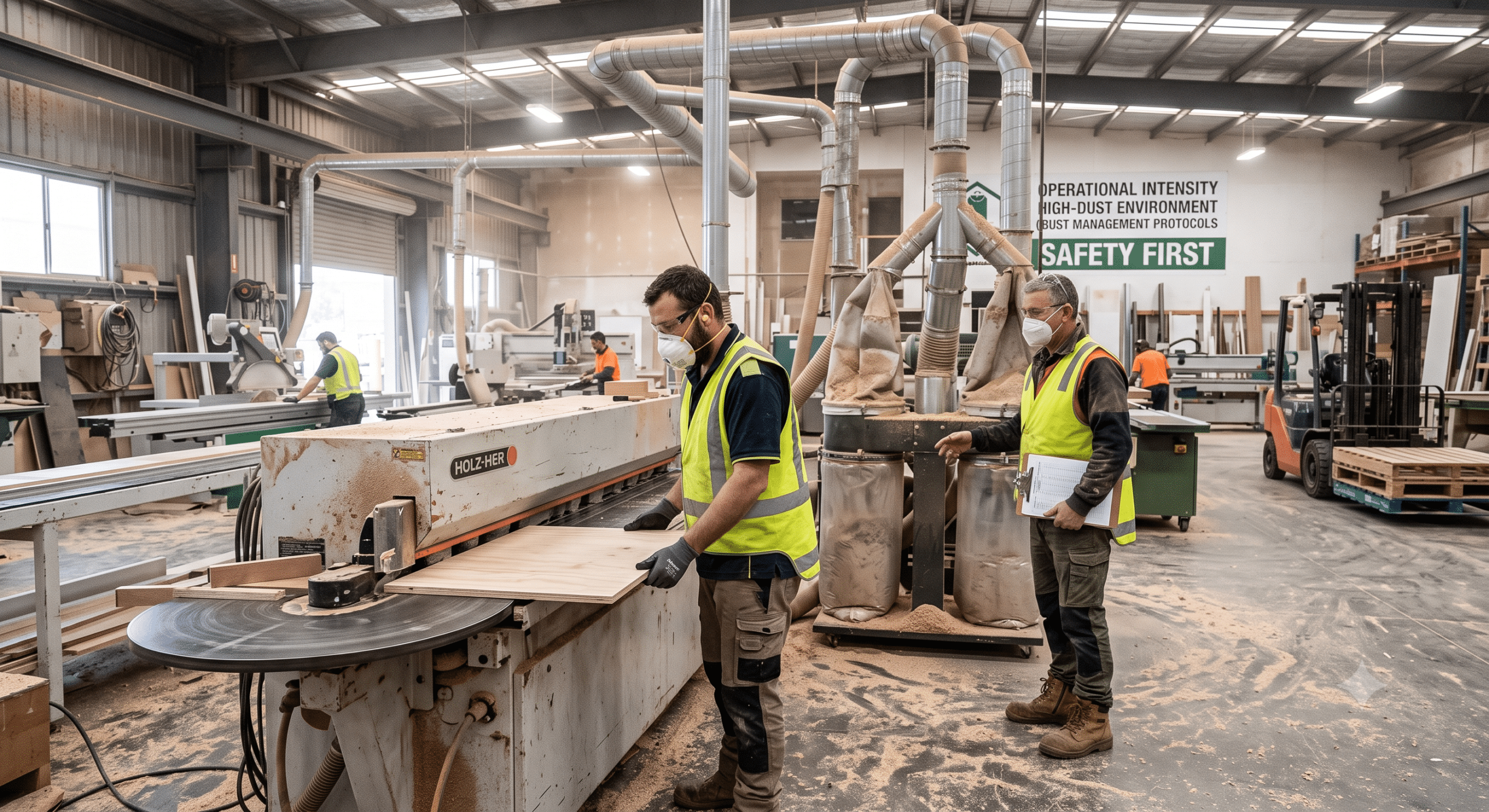
When you step onto the floor of a standard corporate office, the operational stakes feel relatively low. A burnt-out LED panel here, a finicky thermostat there, perhaps a spilled latte near the water cooler. But step into high-dust environments—like a commercial woodworking plant, a recycling hub, or a grain storage facility—and you enter a completely different universe where operational intensity dictates every move.
This is the realm where facility management isn’t just about preserving assets; it’s about survival, safety, and maintaining tight profit margins under relentless physical stress.
Among the various operational classifications, high-dust environments present some of the most brutal, complex, and high-risk challenges a facility or operations manager will ever face.
When microscopic particulates fill the air, every piece of machinery becomes a target, every electrical junction box becomes a hazard, and every square foot of elevated steel beam becomes a quiet fire risk.
Whether you are managing a bustling warehouse processing thousands of cardboard shipments an hour, an aggregate quarry, or a high-throughput food production plant, understanding how operational intensity dictates your facility management strategy is the difference between smooth, profitable throughput and catastrophic downtime.
1. Defining Operational Intensity in Facility Management
Operational intensity measures the degree of physical, environmental, and operational strain placed on a building, its mechanical systems, and its human operators during daily business.
We generally categorize facilities across a spectrum of four distinct intensity tiers:
[Low Intensity] ----> [Medium Intensity] ----> [High Intensity] ----> [Severe / Extreme Intensity]
(Standard Office)     (Light Assembly/Retail)    (24/7 Logistics)      (Heavy High-Dust / Chemical)
| Operational Tier | Facility Examples | Primary Environmental Stressors | Key Maintenance Focus |
| Low Intensity | Commercial offices, bank branches | Foot traffic, basic HVAC load | Aesthetics, energy management, occupant comfort |
| Medium Intensity | Retail outlets, light electronics assembly | Moderate wear, localized dust, long operating hours | Planned preventative maintenance (PPM), basic filtration |
| High Intensity | E-commerce distribution hubs, 24/7 data centers | High mechanical wear, nonstop heat generation, structural vibration | Asset life-extension, rapid response, power redundancy |
| Severe / Extreme | Mills, recycling facilities, foundries, grain elevators | Continuous high-dust environments, chemical exposure, extreme temps | Specialized HVAC, explosion prevention, source-capture ventilation |
As a facility moves up this ladder, the cost of maintenance shifts from reactive repairs to predictive engineering. In high-dust environments, standard off-the-shelf facility practices fall apart almost immediately.
2. The Mechanics of Airborne Hazards in High-Dust Environments
To control dust, you have to understand what it actually does to your building ecosystem. Airborne particulates aren’t just an aesthetic inconvenience; they are aggressive physical agents.
The Three Silent Killers of High-Dust Operations
-
Mechanical Abrasion:
Dust acts like sandpaper. Fine silica, wood fibers, or metal shavings settle onto exposed drive belts, bearings, conveyor rollers, and hydraulic seals. As machinery operates, these particles mix with lubricants, creating a grinding paste that chews through steel components, accelerating mechanical failure by 300% to 500%.
-
Thermal Insulative Trapping:
Electric motors, control panels, and server racks generate heat during standard operation. Dust blanketed over motor fins or pulled into electrical cabinets acts as a blanket. The heat can’t escape. A motor designed to run at 60°C quickly reaches 90°C, causing winding insulation to degrade, leading to sudden electrical burnouts.
-
Combustible Air-Dust Mixtures:
Perhaps the most dangerous threat in high-dust environments is the risk of a primary or secondary explosion. Organic dusts (flour, grain, sugar, wood, paper) and metallic dusts (aluminum, titanium) suspended in the air at specific concentrations can ignite instantly from a single spark.
Consultant’s Field Note:
Secondary dust explosions cause far more damage than primary ones. A small pressure wave from a tiny equipment spark shakes settled dust off overhead structural beams. That falling dust forms a massive airborne cloud, which instantly ignites, burning through the entire structure.
3. Structural and HVAC Frameworks for High-Dust Facilities
If you are managing a facility operating under severe intensity, your heating, ventilation, and air conditioning (HVAC) and dust collection engineering are your main lines of defense. Standard commercial HVAC setups simply cannot handle this particulate load; their coils choke, fans unbalance, and ductwork clogs in days.
The Dual-System Strategy: LEV vs. General Dilution
To keep a high-dust facility compliant and operational, you must balance two air handling strategies:
                       +-------------------------------------------------+
                       |              INDUSTRIAL FACILITY                |
                       |                                                 |
  FRESH AIR INFLOW --->|   [ General Dilution Air / HVLS Circulation ]   |<--- MAKE-UP AIR
                       |                        |                        |
                       |                        v                        |
                       |             [ High-Dust Operations ]            |
                       |              (Cutting, Grinding, etc)           |
                       |                        |                        |
                       +------------------------|------------------------+
                                                v
                                  [ Local Exhaust Ventilation ]
                                                |
                                                v
                                  [ Multi-Stage Dust Collector ]
                                                |
                                                v
                                    [ Clean Air Discharge ]
-
Local Exhaust Ventilation (LEV):
Capture particulate matter directly at its point of generation. Hoods, shrouds, and flexible extraction arms placed directly over cutting tools, transfer points, or mixing vats trap dust before it escapes into the surrounding room.
-
General Dilution & Air Balance:
For dust that escapes source capture, large-volume air turnover keeps the background concentration low. High-Volume, Low-Speed (HVLS) ceiling fans help keep air moving toward return registers rather than letting dust settle quietly onto hard-to-reach overhead trusses.
Pressure Cascades and Zoning
In modern facility design, we use room pressure differentials to protect sensitive operations from high-dust spaces.
By setting up a pressure cascade, clean zones (control rooms, break rooms, offices) are kept at positive air pressure relative to dusty processing floors. When a worker opens an access door between the processing floor and the office, clean air rushes out, preventing fugitive dust from floating in.
4. The 6 Critical Pillars of High-Dust Operations Management
When advising facility managers struggling with operational intensity in high-dust environments, we structure our turnaround strategies around 6 core pillars:
             +-------------------------------------------------------+
             |         6 PILLARS OF HIGH-DUST OPERATIONS             |
             +-------------------------------------------------------+
             |  1. Source-Capture Filtration Engineering            |
             |  2. Precision Air Pressure & Dynamic Balancing        |
             |  3. HEPA-Filtered "High-Dusting" Overhead Routines    |
             |  4. Ingress Prevention & Sealed Building Envelope     |
             |  5. Condition-Based Mechanical Asset Maintenance      |
             |  6. Total Operator Engagement & Safety Culture        |
             +-------------------------------------------------------+
Pillar 1: Source-Capture Filtration Engineering
Never rely on general cleaning staff to deal with dust that should have been captured at the tool head. Engineering dynamic source capture—such as down-draft tables, suction hoods, and specialized multi-stage baghouses—removes up to 95% of particulates before they ever become airborne.
Pillar 2: Precision Air Pressure & Dynamic Balancing
If your exhaust fans pull out thousands of cubic feet of air per minute without adequate make-up air units (MAUs) replacing it, your facility enters a negative pressure vacuum. This vacuum drags unfiltered outdoor dirt through door gaps and pulls fine process dust straight into clean administrative areas. Dynamic balancing keeps room pressures exactly where they belong.
Pillar 3: HEPA-Filtered “High-Dusting” Overhead Routines
Cleaning isn’t just sweeping the floor. The real danger sits 20 to 40 feet above floor level on structural I-beams, ductwork tops, lighting fixtures, and cable trays. Establishing scheduled, HEPA-filtered overhead vacuuming routines—using aerial lifts or specialized long-reach equipment—prevents hazardous dust buildups that trigger secondary explosions.
Pillar 4: Ingress Prevention & Sealed Building Envelope
Dust doesn’t just stay inside; outside dirt enters, and inside process dust escapes. High-speed roll-up doors, air curtains, double-door vestibules, and sealed wall penetrations isolate high-intensity zones, keeping dirt where it can be properly managed.
Pillar 5: Condition-Based Mechanical Asset Maintenance
Standard calendar-based maintenance schedules fail in intense environments. A filter designed to last 90 days in a commercial building might clog in 48 hours in a high-dust facility. Installing differential pressure sensors across filter banks and vibration sensors on electric motors allows you to maintain assets based on real-time operational data, long before catastrophic failure occurs.
Pillar 6: Total Operator Engagement & Safety Culture
The best engineering design in the world won’t save a facility if floor operators leave access doors propped open, blow off machinery with compressed air hoses (which creates explosive airborne clouds), or ignore missing LEV shrouds. Train your workforce to respect dust hazards as seriously as they do live electrical lines.
5. Standard Operating Procedures vs. High-Dust SOPs
To see how operational intensity changes real-world facility tasks, compare standard management practices with specialized high-intensity protocols:
[Standard Facility Maintenance]               [High-Dust Facility Operations]
* Sweeping floors with broom/dustpan    ===>   * Industrial explosion-proof HEPA vacuums
* Monthly calendar filter changes        ===>   * Real-time differential pressure monitoring
* Standard open motor enclosures         ===>   * Sealed TEFC (Totally Enclosed Fan Cooled)
* Periodic cosmetic ceiling dusting      ===>   * Certified high-reach overhead extraction
Floor Maintenance Mechanics
-
Standard Facility: Janitorial staff sweeps floors with push brooms and uses a standard auto-scrubber once a week.
-
High-Dust Environment: Dry sweeping with standard brooms is strictly banned because it launches millions of settled micro-particles back into the air. Facility teams rely instead on explosion-proof, HEPA-filtered industrial vacuum systems or wet-scrubbing machines that trap dirt before it airborne.
Electrical Infrastructure Protection
-
Standard Facility: Standard NEMA 1 electrical enclosures house breakers and relays indoors.
-
High-Dust Environment: All electrical infrastructure must meet NEMA 12 (dust-tight) or NEMA 4/4X (washdown/weatherproof) standards. Control cabinets are fitted with closed-loop air conditioners or positive-pressure vortex coolers to ensure process dust never touches sensitive circuit boards.
6. Financial ROI of Managing Operational Intensity
Upgrading a facility to safely handle intense, high-dust conditions requires real capital expenditure. How do operations consultants justify these costs to corporate boards? By focusing on concrete ROI metrics:
1. Equipment Lifespan Extension
In heavy manufacturing, replace-and-repair cycles eat up capital budget. Protecting conveyor drives, gearboxes, and motors with proper sealing and dust extraction doubles or triples their service life, saving hundreds of thousands of dollars annually in premature capital expenditure.
2. Reduced Energy Consumption
A choked filtration system forces fans and compressors to work significantly harder, drawing far more electricity to maintain basic air velocity. Regular, sensor-monitored filter maintenance and clean heat exchanger coils drop facility energy consumption by anywhere from 10% to 25%.
3. Insurance Premium Reductions
Insurance underwriters inspect industrial facilities for combustible dust accumulation. Demonstrating a proactive, HEPA-backed high-dusting protocol and continuous air-monitoring system drops property and risk insurance premiums dramatically.
FAQ: Facility Management in High-Dust Environments
Q1: Why is compressed air dangerous to use for cleaning dust off machinery?
A: Blowing compressed air sends settled dust flying into the air, creating a cloud. In high-dust environments, these airborne dust clouds can easily reach combustible concentrations. A single static spark or hot surface can ignite the cloud, triggering a flash fire or explosion. Always use certified explosion-proof vacuum systems instead.
Q2: What is the difference between inhalable and respirable dust in facility safety?
A: Inhalable dust refers to larger particles (up to 100 microns) that get trapped in the nose and throat. Respirable dust consists of tiny micro-particles (typically under 10 microns, such as respirable crystalline silica) that travel deep into lungs, causing permanent tissue damage or long-term diseases like silicosis. Facilities need finer filtration (like HEPA or MERV 15+) to capture respirable dust.
Q3: How do I know if my facility HVAC system is under negative pressure?
A: A simple sign is a hard-to-push exterior door, or an exterior door that whistles and slams shut violently. You can also hold a smoke pen or piece of tissue paper near an open door or window; if it gets pulled inside, your building is under negative pressure, meaning you need to balance your exhaust with fresh make-up air.
Q4: How frequently should high-dusting of overhead structures be performed?
A: High-dusting frequency depends on your facility’s operational intensity and dust generation rate. High-intensity operations like wood mills, recycling plants, or grain facilities typically require monthly or quarterly overhead HEPA cleaning, while light assembly environments may only need semi-annual or annual service. Regular visual inspections with lifts or drone cameras help you set the right schedule.
References & Authority Resources
To learn more about industrial ventilation guidelines, dust control standards, and facilities management best practices, consult these industry resources:
-
Industrial Ventilation Systems & Air Quality: Review engineering guides on air balance and exhaust capture principles at CCOHS Industrial Ventilation Guide.
-
Factory Air Movement & HVAC Engineering: Explore insights on system design and airflow strategies at Vindus Fans Factory Ventilation Guide.
-
Industrial Dust Management & High-Dust Operations: Learn more about deep-cleaning protocols, fall protection, and safety compliance in heavy-intensity environments at Millfac High Dusting Standards.