
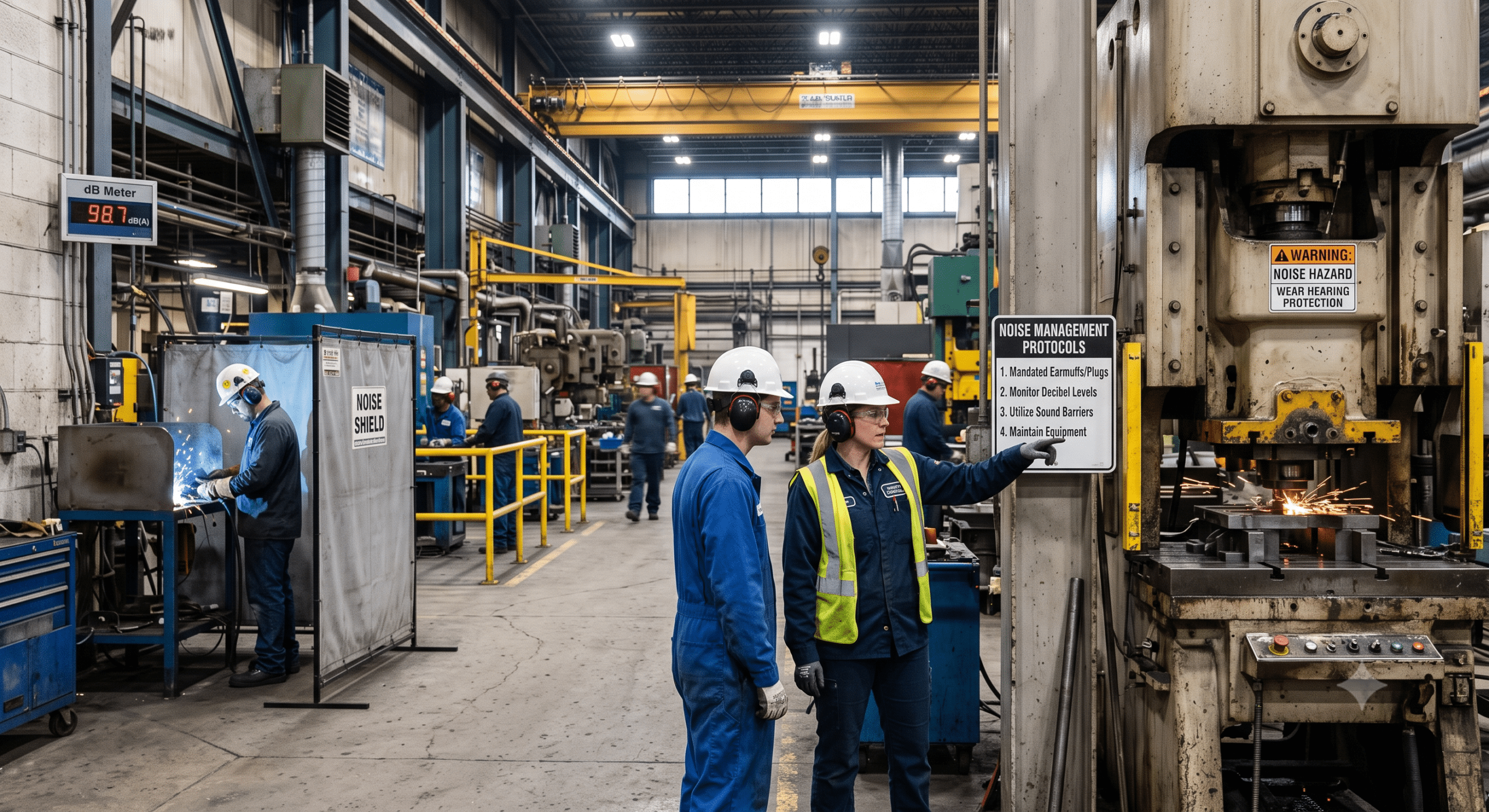
When you step onto the floor of a high-volume manufacturing plant, a busy regional logistics hub, or a central processing facility, you immediately enter one of industry’s most challenging noise-intensive environments. Motors hum smoothly, heavy machinery clatters rhythmically, forklifts reverse with sharp beeps, and pneumatic tools exhaust compressed air. In these noise-intensive environments, managing sound isn’t just about comfort—it is a core operational priority.
In the consulting world, we categorize facilities by their operational intensity—a comprehensive measure that combines workload throughput, equipment run-time, labor density, and physical environmental stress.
At the highest end of this operational spectrum sit noise-intensive environments. Managing noise-intensive environments requires far more than simply handing out foam earplugs at the front door. On the contrary, operating within noise-intensive environments demands a synchronized operational strategy that treats sound as a vital indicator of mechanical efficiency, structural health, and workforce safety.
Whether you run a bottling plant, a metal fabrication shop, a heavy fulfillment center, or a power generation station, mastering facilities management in noise-intensive environments is critical. Ultimately, doing so keeps your operations profitable, compliant, and running without interruption.
Defining Facilities by Operational Intensity
To manage a building well, you must first understand how hard it is working. Operational intensity isn’t just about how many shifts run in a day; rather, it measures how much physical and environmental wear-and-tear a facility endures during regular operations.
┌────────────────────────────────────────────────────────────────────────┐
│                   FACILITY INTENSITY SPECTRUM                           │
├─────────────────┬──────────────────┬─────────────────┬─────────────────┤
│ Low Intensity   │ Moderate         │ High Intensity  │ Extreme         │
│ (Corporate)     │ (Retail/Labs)    │ (Warehousing)   │ (Noise-Intensive)│
│  • 35–50 dBA    │  • 50–65 dBA     │  • 65–80 dBA    │  • 85–120+ dBA  │
└─────────────────┴──────────────────┴─────────────────┴─────────────────┘
Low-Intensity Facilities
These environments include standard commercial office spaces, administrative centers, and light retail units. Background sound levels typically hover between 35 dBA and 50 dBA. As a result, maintenance is mostly reactive or light preventive, and building systems operate under minimal mechanical stress.
Moderate-Intensity Facilities
In contrast, moderate sites include healthcare clinics, educational buildings, light assembly spaces, and tech labs. Here, noise levels range from 50 dBA to 65 dBA. Consequently, the operational focus shifts toward maintaining clean air, consistent temperature control, and flexible space planning.
High-Intensity Facilities
Moving up the scale, these facilities include high-volume fulfillment hubs, automated distribution centers, and commercial laundries. Sound levels regularly sit between 65 dBA and 80 dBA. Furthermore, these facilities run long hours, use continuous conveyor belts, and rely heavily on material-handling equipment.
Extreme / Noise-Intensive Environments
Finally, at the top of the spectrum are noise-intensive environments like processing plants, stamping facilities, automotive manufacturing plants, lumber mills, and turbine halls. Continuous ambient sound in noise-intensive environments regularly crosses 85 dBA, while intermittent peak spikes frequently exceed 100 dBA to 140 dBA.
In these specific settings, acoustic energy isn’t just a nuisance. Instead, it is a severe operational factor that can degrade building components, cause early equipment failures, and directly impact worker safety.
Key Operational Takeaway: Sound is essentially lost energy. Specifically, when a machine produces high noise levels, it is releasing mechanical energy as vibration and sound waves. Therefore, high sound levels across a facility often indicate mechanical friction, structural resonance, and system inefficiencies.
What Characterizes Noise-Intensive Environments?
Noise-intensive environments are defined by specific acoustic properties that affect both human health and facility performance. From an operations perspective, we classify acoustic exposure in noise-intensive environments into two main categories:
                  ┌──────────────────────────────────────┐
                  │   TYPES OF SOUND IN FACILITIES       │
                  └──────────────────┬───────────────────┘
                                     │
           ┌─────────────────────────┴─────────────────────────┐
           ▼                                                   ▼
┌───────────────────────────┐                       ┌─────────────────────┐
│   Continuous Noise        │                       │    Impulse Noise    │
│  • Steady-state machinery │                       │  • Sudden impacts   │
│  • HVAC, blowers, motors  │                       │  • Stamping, presses│
│  • Evaluated as 8-hr TWA  │                       │  • Peak cap: 140 dB │
└───────────────────────────┘                       └─────────────────────┘
-
Continuous (Steady-State) Noise: Unbroken sound generated by running fans, high-pressure blowers, compressors, and electric motors. Thus, it creates a high background baseline that forces workers to strain to communicate.
-
Impulse (Impact) Noise: Brief, intense bursts of acoustic energy caused by punch presses, drop hammers, pneumatic actuators, or metal dropping into bins. For example, these short events often reach 120 dB to 140 dB and carry a high risk for immediate acoustic trauma.
+-----------------------------------------------------------------------+
|  NOISE LEVEL COMPARISON & REGULATORY THRESHOLDS                       |
+-----------------------------------------------------------------------+
|  140 dB SPL ────────────────── Absolute OSHA Peak Impact Limit        |
|  120 dBA     ────────────────── Threshold of Physical Discomfort     |
|  100 dBA     ────────────────── Heavy Machinery / Drop Hammers        |
|  90 dBA      ────────────────── OSHA 8-Hour Action Ceiling (PEL)      |
|  85 dBA      ────────────────── Mandatory Hearing Conservation Limit  |
|  70 dBA      ────────────────── Typical Industrial Background Sound   |
|  50 dBA      ────────────────── Standard Private Office Environment   |
+-----------------------------------------------------------------------+
When high acoustic pressure is combined with round-the-clock shift schedules, the strain on building systems and staff compounds quickly. Additionally, sound waves reflect off hard concrete floors, metal decking, and uninsulated walls, thereby creating reverberant spaces that make noise problems even worse.
The True Cost of Neglecting Acoustic Intensity
Ignoring sound management in noise-intensive environments leads to noticeable financial and operational costs across the entire enterprise.
                     ┌────────────────────────────────┐
                     │   COSTS OF UNMANAGED NOISE     │
                     └───────────────┬────────────────┘
                                     │
     ┌──────────────────┬────────────┴─────┬──────────────────┐
     ▼                  ▼                  ▼                  ▼
┌─────────┐        ┌──────────┐      ┌───────────┐      ┌───────────┐
│ Health  │        │  Safety  │      │ Product'y │      │  Fines    │
│ Claims  │        │ Hazards  │      │ Downtime  │      │ Penalties │
└─────────┘        └──────────┘      └───────────┘      └───────────┘
1. Workforce Health and Retention Risks
Occupational Noise-Induced Hearing Loss (NIHL) remains one of the most common workplace illnesses today. Furthermore, beyond direct hearing damage, working in loud environments consistently increases stress, triggers cardiovascular fatigue, and contributes to burnout. As a result, high employee turnover requires continuous hiring and retraining, which drags down overall facility throughput.
2. Reduced Operational Safety
In noise-intensive environments, workers struggle to hear warning sirens, backup alarms, overhead crane signals, or verbal warnings from teammates. Consequently, masked auditory cues significantly increase the risk of collisions involving forklifts, automated guided vehicles (AGVs), and foot traffic.
3. Masked Machinery Failure Signals
Experienced operators and maintenance techs often detect early equipment problems simply by ear. For instance, a worn bearing, a slipping belt, or a cavitating pump all make distinct sounds long before they fail completely. However, in loud environments without monitoring systems, these early warning sounds are easily missed, ultimately leading to sudden mechanical breakdowns.
4. Regulatory Penalties
Under OSHA Standard 1910.95, employers must establish a formal Hearing Conservation Program whenever worker exposure reaches or exceeds an 8-hour Time-Weighted Average (TWA) of 85 dBA. Therefore, failing to monitor sound levels, maintain equipment, or provide proper protection in noise-intensive environments can lead to high regulatory fines and increased workers’ compensation premiums.
The 10 Core Pillars for Managing Noise-Intensive Environments
Managing noise-intensive environments requires an organized, end-to-end operational framework. Below are 10 practical pillars that operations and facility leaders can use to tame sound levels, protect workers, and optimize plant performance:
┌────────────────────────────────────────────────────────────────────────┐
│                   THE 10 PILLARS OF NOISE CONTROL                      │
├───────────────────────────────────┬────────────────────────────────────┤
│ 1. Dynamic Acoustic Mapping       │ 6. Shift & Exposure Scheduling     │
│ 2. Structural Decoupling          │ 7. Dual-Protection PPE Programs    │
│ 3. Engineering Source Controls    │ 8. HVAC & Air-Handling Attenuation │
│ 4. Acoustic Vibration Maintenance │ 9. Workforce Culture & Training    │
│ 5. Strategic Spatial Layouts      │ 10. Continuous Auditing Frameworks │
└───────────────────────────────────┴────────────────────────────────────┘
1. Dynamic Acoustic Mapping & Real-Time IoT Monitoring
First, static, annual sound audits are no longer sufficient for noise-intensive environments. Instead, modern industrial facilities rely on networked IoT acoustic sensors installed across the floor.
These sensors continuously capture sound pressure levels ($L_{eq}$ and peak values) and build dynamic heat maps of acoustic energy. Consequently, when a machine starts producing abnormal sound levels, the system immediately alerts maintenance before a major failure occurs.
2. Structural Decoupling and Building Vibration Isolation
Second, sound travels easily through solid building materials. For example, heavy stamping presses, chillers, and large compressors send low-frequency vibrations through concrete floor slabs and structural steel frames, thereby radiating sound throughout the building.
To control this issue, facility managers should install isolated equipment foundations, inertia blocks, and elastomer or spring vibration isolators. By decoupling heavy machinery from the main slab, you effectively prevent sound from traveling to administrative offices and quieter work zones.
3. Engineering Controls Directly at the Source
Third, the most effective way to manage sound in noise-intensive environments is to reduce it right where it is made. In fact, engineering controls offer a permanent fix, unlike personal protective gear.
-
Acoustic Enclosures: Enclose noisy air compressors, granulators, and high-speed pumps inside sound-dampened housings.
-
Pneumatic Silencers: Fit porous metal or baffle mufflers on pneumatic exhaust valves to drop discharge noise by up to 15 dBA to 20 dBA.
-
Damping Compounds: Apply viscoelastic dampening layers to metal chutes, hoppers, and drop bins to stop loud ringing when materials hit them.
4. Acoustic-Focused Preventive Maintenance
Fourth, poorly maintained equipment is noticeably louder than well-kept machinery. For instance, unlubricated bearings, loose drive belts, unaligned shafts, and worn gear teeth create excess friction and noise.
By incorporating acoustic checks into routine preventive maintenance (PM) schedules, teams can keep equipment running quietly. In addition, simply applying grease to high-friction zones and tightening loose housing panels often lowers machine sound by 3 dBA to 6 dBA—which cuts perceived volume significantly.
5. Strategic Spatial Layouts and Acoustic Buffer Zones
Fifth, facility planning directly impacts noise exposure. Therefore, in noise-intensive environments, you should always group loud operations together, away from quieter work spaces.
Specifically, use low-noise zones—such as tool cribs, staging areas, and material storage racks—as sound buffers between production lines and office areas. Indeed, for every doubling of distance from a sound source, the sound pressure drops by up to 6 dBA in open spaces.
               ┌────────────────────────────────────────┐
               │    STRATEGIC SPATIAL BUFFER LAYOUT     │
               └───────────────────┬────────────────────┘
                                   │
 ┌──────────────────────┐  ┌───────┴────────┐  ┌──────────────────────┐
 │ HIGH-NOISE ZONE      │  │ BUFFER ZONE    │  │ QUIET ZONE           │
 │ • Stamping Presses   │  │ • Storage      │  │ • Assembly Lines     │
 │ • Air Compressors    │  │ • Warehousing  │  │ • Quality Control    │
 │ (95–110 dBA)         │  │ (70–80 dBA)    │  │ (60–70 dBA)          │
 └──────────────────────┘  └────────────────┘  └──────────────────────┘
6. Administrative Controls and Smart Shift Scheduling
Sixth, when engineering fixes cannot bring sound below target limits, management must use administrative controls to limit exposure times.
-
Task Rotation: Rotate technicians between high-noise stations (like metal grinding) and quieter areas (like packing) throughout their shift.
-
Staggered Production Runs: Schedule high-noise processes during off-peak shifts when fewer personnel are on the main floor.
-
Quiet Break Spaces: Provide sound-insulated breakrooms ($<45\text{ dBA}$) on the floor so workers’ ears can fully recover during rest periods.
7. Modern Personal Protective Equipment (PPE) Programs
Seventh, personal protective equipment serves as the final defense layer. However, in noise-intensive environments with extreme sound ($>100\text{ dBA}$), standard earplugs alone may not offer enough protection.
┌───────────────────────────────────────────────────────────────────────┐
│              PERSONAL PROTECTIVE EQUIPMENT (PPE) MATRIX               │
├───────────────────┬─────────────────────┬─────────────────────────────┤
│ Noise Level Range │ Required Protection │ Preferred Tech/Option       │
├───────────────────┼─────────────────────┼─────────────────────────────┤
│ 85 dBA – 95 dBA   │ Single Protection   │ Custom Molded Earplugs      │
│ 95 dBA – 105 dBA  │ High-Attenuation    │ Passive Earmuffs (NRR 28+)  │
│ 105 dBA +         │ Dual Protection     │ Plugs + Active Electronic   │
│                   │                     │ Level-Dependent Muffs       │
└───────────────────┴─────────────────────┴─────────────────────────────┘
Fortunately, modern electronic hearing protection allows clear speech pass-through while actively clipping harmful impulse sounds, thus keeping workers safe without isolating them from their surroundings.
8. HVAC and Air-Handling Acoustic Attenuation
Eighth, heating, ventilation, and air-conditioning (HVAC) systems in large facilities are major sources of continuous background sound. In particular, high-velocity air moving through ductwork creates air turbulence, while large roof-top units (RTUs) transmit hums throughout the space.
To address this, install duct silencers, acoustic baffles, flexible duct connectors, and variable-frequency drives (VFDs) to control air velocity. As a result, lowering fan speeds during reduced operational hours drops ambient background noise while saving energy.
9. Building a Culture of Safety and Awareness
Ninth, technology and facility changes work best when teams actively support them. Therefore, regular training helps staff understand the long-term impact of noise exposure and the correct way to fit hearing protection.
Additionally, encouraging operators to report unusual equipment noises or damaged acoustic panels makes proactive maintenance a natural part of daily plant culture.
10. Routine Auditing and Compliance Reviews
Tenth and finally, acoustic conditions change as operations scale up, production lines shift, and machines age over time. Consequently, facility managers operating noise-intensive environments should schedule annual audiometric testing for staff and re-map facility noise every time new machinery is installed.
Ultimately, reviewing noise control data helps keep the facility fully compliant with regulatory standards while continually improving workplace conditions.
Comparing Facility Types Across Intensity Metrics
To build a solid operations strategy, compare your site’s operational parameters with these established industry benchmarks:
| Facility Type | Primary Sound Sources | Average Baseline (dBA) | Dominant Noise Pattern | Recommended Engineering Solutions |
| Corporate Office / HQ | HVAC vents, speech, office equipment | 40 – 50 | Low, continuous background | Acoustic ceiling tiles, wall panels, quiet HVAC design |
| E-Commerce Logistics Hub | High-speed conveyors, sorters, backup alarms | 70 – 82 | Intermittent mixed continuous | Belt dampening, quiet rollers, proximity radar alarms |
| Food Processing & Bottling | High-pressure washdown, bottling lines, blowers | 82 – 92 | Continuous high-frequency | Stainless acoustic enclosures, washdown-rated dampeners |
| Heavy Stamping & Fabrication | Hydraulic presses, grinding, plasma cutting | 92 – 112+ | High impulse & severe impact | Isolated machine slabs, sound curtains, source enclosures |
| Power Generation & Energy | Turbines, pressure valves, large generators | 95 – 115+ | Extreme continuous low-frequency | Silencers, isolated control rooms, structural isolation |
Step-by-Step Acoustic Upgrade Plan for Facility Leaders
If you are stepping into a loud, fast-moving plant, tackling noise issues in noise-intensive environments can feel overwhelming at first. However, following a structured roadmap will make the task manageable:
┌────────────────────────────────────────────────────────────────────────┐
│               PHASED IMPLEMENTATION ROADMAP                            │
├────────────────────────────────────────────────────────────────────────┤
│ PHASE 1: Assessment & Measurement (Weeks 1–4)                         │
│  • Conduct baseline dosimetry and peak sound assessments        │
│  • Identify key high-noise sources across the floor           │
├────────────────────────────────────────────────────────────────────────┤
│ PHASE 2: Quick-Win Implementation (Weeks 5–12)                          │
│  • Fit pneumatic silencers and lubricate high-friction components│
│  • Set up dynamic hearing protection stations                │
├────────────────────────────────────────────────────────────────────────┤
│ PHASE 3: Structural & System Isolation (Months 3–6)                    │
│  • Build localized enclosures around target equipment           │
│  • Install acoustic curtains and duct silencers                 │
├────────────────────────────────────────────────────────────────────────┤
│ PHASE 4: Continuous Optimization & Policy (Ongoing)                    │
│  • Integrate real-time acoustic sensors into your CMMS            │
│  • Implement "Buy Quiet" equipment procurement policies       │
└────────────────────────────────────────────────────────────────────────┘
Phase 1: Assessment & Measurement (Weeks 1–4)
Conduct Sound Level Surveys: Begin by mapping workplace noise levels with calibrated Type 1 or Type 2 sound level meters. Use A-weighting for general exposure measurements and C-weighting/Peak settings to capture impact or impulse noise.
Pinpoint Critical Noise Zones: After collecting the data, identify equipment, production lines, and workstations that exceed the 85 dBA Time-Weighted Average (TWA) exposure threshold.
Phase 2: Quick-Win Implementation (Weeks 5–12)
Implement Immediate Noise Controls: Prioritize simple improvements such as installing mufflers on pneumatic exhausts, repairing compressed air leaks, and adding rubber bumpers to material handling bins to reduce impact noise.
Improve Hearing Protection Accessibility: Place well-stocked hearing protection stations throughout the facility so employees can easily access properly fitted earplugs and earmuffs whenever required.
Phase 3: Structural & System Isolation (Months 3–6)
Install Equipment Enclosures: Reduce noise at the source by constructing sound-dampened enclosures around compressors, pumps, blowers, and other high-noise machinery.
Enhance Acoustic Treatments: Ceiling baffles, acoustic curtains, and wall-mounted sound-absorbing panels can significantly minimize sound reflections in large, echo-prone production spaces.
Phase 4: Continuous Optimization & Policy (Ongoing)
Establish “Buy Quiet” Standards: Include low-noise performance as a mandatory purchasing criterion when evaluating new production equipment and facility upgrades.
Automate Noise Monitoring: Integrating IoT-enabled acoustic sensors with your Computerized Maintenance Management System (CMMS) allows maintenance teams to receive real-time alerts and proactively address abnormal noise conditions before they become larger operational issues.
Frequently Asked Questions (FAQ)
What defines noise-intensive environments in facility management?
Noise-intensive environments are industrial or commercial facilities where ambient background sound continuously meets or exceeds 85 dBA, or where frequent impulse noises top 120 dB to 140 dB. Consequently, these settings require specialized noise control, structural isolation, and active safety management.
What is the difference between dBA and peak dB SPL?
dBA (A-weighted decibels) adjusts sound readings to match how human ears hear sound at moderate volumes, thus making it ideal for measuring continuous noise exposure over an 8-hour shift. In contrast, Peak dB SPL (Sound Pressure Level) measures instantaneous maximum sound pressure without frequency weighting, so it is used to track sudden impact sounds like press strikes or blasts.
How does noise control improve machinery maintenance?
Because high noise levels often stem from mechanical friction, vibration, imbalance, or wear, monitoring acoustic changes allows maintenance teams to identify worn bearings, loose drive belts, or system leaks early before unexpected equipment failure occurs.
What are the legal noise limits for industrial workplaces under OSHA?
Specifically, OSHA sets an Action Level of 85 dBA TWA, requiring employers to offer a formal Hearing Conservation Program, baseline testing, and hearing protection. Meanwhile, the Permissible Exposure Limit (PEL) is 90 dBA TWA over an 8-hour shift, using a 5-dB exchange rate. Furthermore, impulse sounds must never exceed 140 dB peak SPL.
Can structural modifications really reduce building noise?
Yes, absolutely. Structural isolation—such as cutting perimeter isolation joints into floor slabs, adding spring isolators, and installing sound-absorbing wall panels—prevents sound energy from vibrating through the building. As a result, this cuts ambient noise transfer to adjacent spaces significantly.
References & Further Reading
-
Occupational Safety and Health Administration (OSHA) — Standard 1910.95: Occupational Noise Exposure. U.S. Department of Labor.
-
National Institute for Occupational Safety and Health (NIOSH) — Preventing Occupational Noise-Induced Hearing Loss and Engineering Controls Guidelines. Centers for Disease Control and Prevention (CDC).