
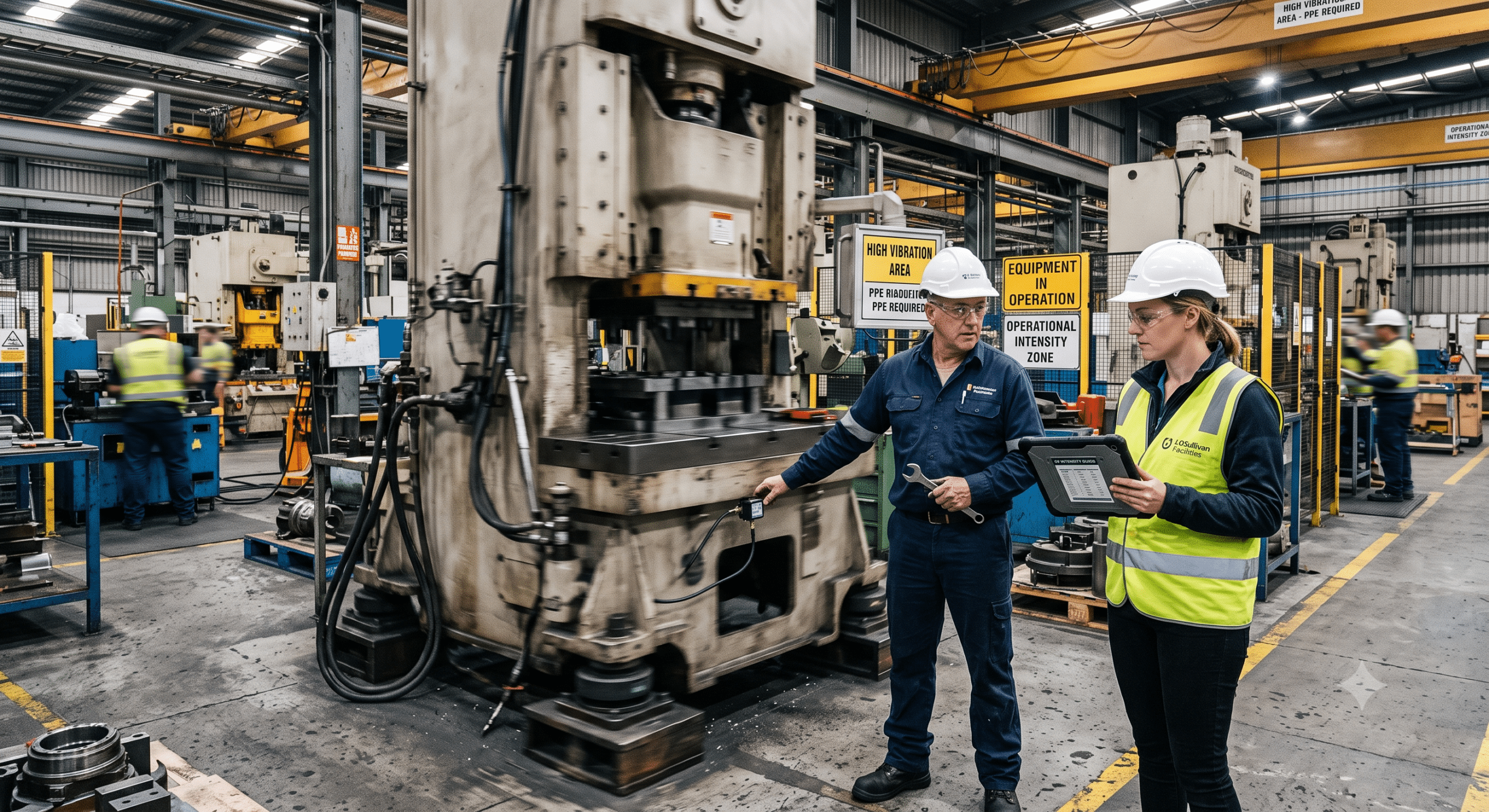
When managing high-vibration facilities, you step onto the floor of a modern manufacturing plant, a high-speed logistics hub, or a heavy industrial processing plant and immediately feel it in your boots. Specifically, you notice the steady hum, the rhythmic thump of heavy machinery, or the subtle micro-tremors running through the concrete floor under your feet.
As a result, when I consult with plant directors and real estate leaders, I often ask a simple yet critical question: Do you manage your facility based on its square footage, or based on its operational intensity?
Traditionally, facility management (FM) relied heavily on total floor space. For example, teams scheduled cleaning, inspections, and basic maintenance based purely on how many square feet a building covered. However, in today’s high-demand industrial landscape, that legacy approach consistently falls short. Buildings do not wear out simply because time passes; rather, they wear out because of how hard they work.
Therefore, in this comprehensive guide, we will break down facility management through the lens of operational intensity. In particular, we will place our primary focus on high-vibration facilities. Furthermore, we will explore why mechanical vibration is one of the most critical drivers of operational cost, how to control dynamic forces before they break your equipment or foundations, and the 9 core principles every facility leader must apply to keep these high-demand spaces running safely and efficiently.
What Is Operational Intensity in Facility Management?
Operational intensity describes the total mechanical, operational, and environmental stress placed on a facility’s physical infrastructure over time. In other words, it measures how hard a building’s assets work, how continuously they run, and how severe the physical forces generated inside or around the building truly are.
To better understand where your facility fits, we generally categorize industrial real estate along an Operational Intensity Spectrum:
1. Low-Intensity Facilities
-
Examples: Standard corporate office spaces, light archives, static storage warehouses.
-
Characteristics: Low foot traffic, standard HVAC operating hours, minimal heavy mechanical loads, and virtually no structural vibration.
-
FM Strategy: Consequently, management relies on time-based preventative maintenance and standard scheduled cleaning routines.
2. Medium-Intensity Facilities
-
Examples: Commercial kitchens, light assembly plants, retail shopping centers, and standard healthcare clinics.
-
Characteristics: Moderate equipment duty cycles, higher occupancy, variable thermal loads, and localized structural wear near mechanical rooms.
-
FM Strategy: In response, teams shift toward usage-based maintenance, regular system rebalancing, and active vendor management.
3. High-Intensity Facilities
-
Examples: 24/7 automated fulfillment centers, data centers, food and beverage bottling plants, and pharmaceutical manufacturing facilities.
-
Characteristics: Continuous operation, heavy equipment duty cycles, strict climate and cleanliness tolerances, and elevated mechanical energy.
-
FM Strategy: As a result, leadership implements condition-based monitoring, real-time IoT alerts, and predictive maintenance protocols.
4. Extreme / High-Vibration Facilities
-
Examples: Heavy manufacturing, stamping and forging plants, mining processing facilities, high-speed rail maintenance hubs, power generation plants, and facilities operating large vibrating screens or heavy stamping presses.
-
Characteristics: Severe mechanical loads, continuous cyclic excitation, structural micro-motion, elevated noise levels, and a high potential for structural resonance.
-
FM Strategy: To address these threats, management requires advanced dynamic structural isolation, real-time vibration telemetry, structural health monitoring, and active tuned mass damping.
OPERATIONAL INTENSITY SPECTRUM
-------------------------------------------------------------------------------------
[ Low Intensity ]     [ Medium Intensity ]     [ High Intensity ]     [ High-Vibration ]
Offices & Archives    Retail & Light Assembly  24/7 Fulfillment Hubs   Heavy Industrial
Routine Maintenance   Usage-Based Maintenance  Predictive Analytics   Dynamic Control & TMDs
-------------------------------------------------------------------------------------
Ultimately, understanding where your building sits on this spectrum dictates every strategic decision you make—ranging from your capital expenditure budgets to your daily operational workflows.
Deep Dive: What Are High-Vibration Facilities?
In essence, high-vibration facilities are specialized industrial, manufacturing, or operational environments where structural components, building foundations, and mechanical systems are subjected to ongoing, high-amplitude, or high-frequency vibrations.
Specifically, these dynamic forces originate from two distinct sources: internal operational sources and external environmental sources.
Internal Sources of Vibration
First, internal vibration is generated by the machinery and industrial processes designed to run inside the facility itself:
-
Reciprocating and Rotating Machinery: Large industrial compressors, multi-stage pumps, high-RPM turbines, and emergency diesel generators.
-
Impact and Shock Equipment: Stamping presses, drop hammers, industrial crushers, and heavy forging machinery.
-
Material Handling Systems: High-speed sorting conveyors, vibrating screens, shaking tables, and automated storage and retrieval systems (ASRS).
-
Building Mechanical Systems: Large chillers, cooling tower fans, and high-volume air handlers running at variable speeds.
External Sources of Vibration
On the other hand, even if your indoor processes are quiet, surrounding external factors can transform standard buildings into high-vibration facilities:
-
Transportation Infrastructure: Adjacent freight rail corridors, heavy highway truck traffic, or nearby subway tunnels.
-
Neighboring Operations: Nearby quarrying, heavy construction, pile-driving, or mining operations.
The Hidden Costs of Uncontrolled Vibration
When vibration goes unchecked in high-intensity operations, the physical damage builds quietly over time. For instance, as a consultant, I frequently observe facilities suffering from four major systemic issues:
-
Accelerated Equipment Wear: Because of unbalanced dynamic loads, bearings, shafts, seals, and gearboxes wear out long before their manufacturer-rated lifecycle.
-
Structural Fatigue: Moreover, concrete foundations crack, weld joints loosen, and floor slabs experience severe cyclic fatigue over time (Yu et al., 2022).
-
Product Quality Drift: Additionally, precision instruments, high-tolerance CNC machines, and semiconductor lithography tools lose calibration, which leads to high scrap rates.
-
Safety and Comfort Issues: Finally, structural vibrations pass through floors and walls into occupied zones, causing fatigue, discomfort, and health concerns for facility staff (Zhang et al., 2024).
The 9 Core Operational Principles for High-Vibration Facilities
To successfully manage a high-vibration facility, leadership must shift from reactive fire-fighting to continuous structural and mechanical management. Over years of consulting with operations and facility teams, I have identified 9 core operational principles that form the foundation of a reliable high-vibration management strategy.
+-----------------------------------------------------------------------+
|              THE 9 PILLARS OF HIGH-VIBRATION MANAGEMENT               |
+-----------------------------------------------------------------------+
| 1. Continuous Monitoring      | 6. Environmental Compliance           |
| 2. Decoupling & Isolation     | 7. Human Vibration Comfort            |
| 3. Predictive Maintenance     | 8. Root Cause Analysis (RCA)          |
| 4. Precision Balancing        | 9. Integrated FM-Ops Operations       |
+-----------------------------------------------------------------------+
1. Continuous Vibration Monitoring & IoT Sensing
First, you cannot manage what you do not measure. In high-vibration facilities, periodic manual spot-checks with hand-held vibration pens are simply no longer enough. Instead, modern facilities rely on permanently installed triaxial accelerometers and IoT sensors placed at critical measurement points across machinery and building structures. Consequently, these sensors feed real-time velocity, acceleration, and frequency spectra into a central dashboard, allowing management to detect tiny changes in dynamic response before catastrophic failures occur (Bouabdallaoui et al., 2021).
2. Dynamic Structural Isolation & Foundation Decoupling
Second, heavy vibrating equipment should never sit directly on standard slab-on-grade concrete. Instead, implementing decoupled inertia blocks—massive concrete foundations isolated from the main building floor by elastomeric pads, springs, or air mounts—prevents mechanical energy from transferring directly into the building frame.
3. Predictive Maintenance Over Reactive Repairs
Third, moving from reactive maintenance (“fix it when it breaks”) to predictive maintenance (PdM) is essential. In fact, by combining machine learning models with continuous vibration telemetry, facility teams can spot early bearing inner-race defects, gear mesh errors, or mechanical unbalance weeks before equipment failure occurs (Bouabdallaoui et al., 2021).
4. Equipment Alignment and Precision Balancing
Fourth, a primary driver of unnecessary vibration in industrial environments is basic mechanical misalignment and rotational unbalance. Therefore, establishing strict installation tolerances—using laser alignment tools and dynamic field balancing—reduces parasitic vibration at the source, extending machine life and lowering energy consumption.
5. Structural Attenuation & Tuned Mass Dampers
Fifth, when high-rise industrial structures or multi-story manufacturing floors experience excessive sway or floor vibration, structural retrofits are often required. For example, installing passive or active Tuned Mass Dampers (TMDs) dissipates vibrational energy efficiently, reducing structural displacement and protecting both building frames and non-structural components (Zhang et al., 2024).
6. Acoustic and Environmental Noise/Vibration Permitting Compliance
Sixth, high-vibration facilities frequently generate low-frequency noise and groundborne vibrations that travel beyond the property boundary. To operate within regulatory limits, facility teams must establish clear threshold monitoring systems based on Peak Particle Velocity (PPV) metrics to ensure compliance with local environmental standards and avoid operational shutdown notices (Bronkhorst et al., 2021; Mitchell, 2000).
7. Operator Ergonomics and Human Vibration Comfort
Seventh, vibration does not just damage steel and concrete; in addition, it physically impacts human operators. Specifically, long-term exposure to high whole-body vibration (WBV) or hand-arm vibration (HAV) causes fatigue, decreased concentration, and long-term musculoskeletal disorders. Thus, setting facility standards based on human comfort and exposure thresholds protects workers while boosting daily productivity (Zhang et al., 2024).
8. Root Cause Analysis (RCA) for Resonance and Fatigue Prevention
Eighth, when structural cracks, anchor bolt failures, or repeated bearing lockups happen, high-vibration facilities must perform detailed Root Cause Analysis (RCA). Specifically, this includes dynamic structural modeling and modal testing to verify that machine operating frequencies do not match the natural resonance frequencies of the supporting structure (Yu et al., 2022).
9. Cross-Functional Operations and FM Collaboration
Ninth, in high-vibration facilities, the Operations team (focused on production volume) and the Facilities Management team (focused on building health) must work closely together. For instance, equipment speed adjustments, production rescheduling, and preventative maintenance windows require joint coordination to maintain high uptime without compromising structural integrity.
Engineering and Technical Mitigation Strategies
To handle high operational intensity effectively, facility managers and operations teams need practical, field-proven engineering tools. Below, the table compares the primary vibration mitigation technologies used across modern industrial plants:
| Mitigation Technology | Primary Use Case | How It Works | Key Operational Benefit |
| Elastomeric / Neoprene Isolators | Small to medium pumps, fans, and motor bases | First, it absorbs high-frequency shear and compression forces | As a result, it provides low-cost, easy installation and isolates high-frequency motor hum |
| Steel Coil Spring Mounts | Heavy HVAC chillers, large air handlers, slow-speed pumps | Specifically, it provides large static deflection to isolate low-frequency vibration | Therefore, it offers excellent isolation for low-RPM equipment where soft suspension is needed |
| Inertia Blocks (Decoupled Pads) | Stamping presses, vibrating screens, large crushers | In practice, it adds massive mass to lower amplitude and decouples foundation from floor | Consequently, it prevents deep structural shock waves from spreading across floor slabs |
| Tuned Mass Dampers (TMDs) | High-rise industrial floors, long-span floor bays, tall towers | Furthermore, it uses an isolated counter-mass and damping spring to absorb specific frequencies | Thus, it mitigates structural resonance and dramatically improves human comfort (Zhang et al., 2024) |
| Active Vibration Suppression Systems | Semiconductor labs, optical manufacturing, precision tool benches | Finally, it uses electronic sensors and force actuators to cancel out motion in real time | Overall, it provides extreme sub-micron stability for ultra-sensitive processes |
How to Assess Your Facility’s Operational Intensity: A Practical 4-Step Framework
If you manage an industrial building, manufacturing site, or logistics plant, here is a practical roadmap to assess and stabilize your facility’s physical environment:
+--------------------------------------------------------------------------+
|                  THE 4-STEP FACILITY ASSESSMENT ROADMAP                  |
+--------------------------------------------------------------------------+
|  STEP 1: Audit Equipment & Map Vibration Sources                         |
|  STEP 2: Establish PPV & Spectral Baselines                              |
|  STEP 3: Implement Targeted Isolation & Damping Solutions                |
|  STEP 4: Deploy Continuous Telemetry & PdM Workflows                     |
+--------------------------------------------------------------------------+
Step 1: Audit Equipment and Map Vibration Sources
To begin, walk your facility floor with your operations leadership team. Specifically, document all rotating, reciprocating, and impact equipment. Then, map these assets directly against your building’s structural drawing to highlight load-bearing walls, expansion joints, suspended floor bays, and delicate operational areas.
Step 2: Establish Peak Particle Velocity (PPV) Baselines
Next, work with an acoustic or structural engineering firm to measure baseline vibration levels across your floor slab. In particular, measure peak particle velocity (PPV) in millimeters or inches per second across different operational shifts (Bronkhorst et al., 2021). Afterward, compare these baseline numbers against international structural health and human comfort standards.
Step 3: Implement Targeted Isolation and Damping Solutions
Furthermore, address the worst vibration sources first. For example, retrofit un-isolated motor mounts, repair degraded foundation pads, or introduce decoupled inertia blocks beneath dynamic machinery. If dynamic floor movement persists in long-span areas, consider structural damping retrofits like tuned mass dampers (Yu et al., 2022; Zhang et al., 2024).
Step 4: Deploy Continuous Telemetry and Predictive Maintenance Workflows
Finally, install wireless, IoT-enabled vibration sensors on critical production machinery and dynamic structural points. Then, connect this sensor network to your computerized maintenance management system (CMMS). As a result, configure automated alerts to trigger work orders automatically when vibration levels exceed normal operating thresholds (Bouabdallaoui et al., 2021).
Frequently Asked Questions (FAQ)
What makes a building a “high-vibration facility”?
In brief, a high-vibration facility is any operational building where continuous or heavy cyclic vibration forces are generated internally by industrial equipment (such as stamping presses, vibrating screens, or large turbines) or externally by surrounding infrastructure (such as railways or heavy traffic). Consequently, these dynamic forces require specialized foundation designs, dynamic isolation systems, and structural monitoring to ensure ongoing structural health and operational safety.
How does dynamic vibration damage building foundations over time?
Over time, uncontrolled vibration creates cyclic stresses within concrete and structural steel. As a result, these dynamic loads lead to micro-cracking in floor slabs, loosened structural fasteners, loss of concrete bond around anchor bolts, and localized structural fatigue. Moreover, if equipment operating frequencies match the building’s natural structural frequencies, resonance can occur, significantly magnifying structural stress and accelerating physical wear (Yu et al., 2022).
What is Peak Particle Velocity (PPV) and why is it important?
Specifically, Peak Particle Velocity (PPV) is a primary physical metric used to measure the intensity of ground and structural vibration. Expressed in millimeters per second (mm/s) or inches per second (in/s), PPV represents the maximum speed at which a concrete or soil particle moves as a vibration wave passes through it. Therefore, facilities management teams use PPV thresholds to monitor structural safety, prevent building damage, and maintain environmental regulatory compliance (Bronkhorst et al., 2021).
Can predictive maintenance eliminate vibration entirely?
Although predictive maintenance cannot eliminate mechanical vibration entirely—because operational equipment inherently generates mechanical energy—it successfully prevents destructive excessive vibration. In fact, by analyzing vibration spectra using machine learning and continuous sensing, predictive maintenance identifies imbalance, misalignment, and bearing wear early, allowing maintenance teams to correct issues before minor vibrations turn into structural damage (Bouabdallaoui et al., 2021).
How does vibration impact worker productivity and safety?
In addition to structural wear, continuous exposure to high-level operational vibration can cause fatigue, lower operator concentration, and increase physical stress. Specifically, whole-body vibration (WBV) from vibrating plant floors or heavy equipment can cause chronic lower back issues and musculoskeletal fatigue. Thus, controlling facility vibration improves workplace ergonomics, reduces operator distraction, and enhances overall site safety (Zhang et al., 2024).
References
Blog & Industry Publications:
-
CALMFLOOR (2024). The Facilities Manager’s Guide to Vibration Control. CALMFLOOR Asset & Building Performance Insights. https://calmfloor.com/the-facilities-managers-guide-to-vibration-control/
-
Tractian (2024). 5 Ways Vibration Equipment Reduces Unplanned Downtime. Tractian Industrial Operations Blog. https://tractian.com/en/blog/5-ways-vibration-equipment-reduces-unplanned-downtime
-
Fabreeka (2024). The Basic Principles of Vibration Control. Fabreeka Engineering Blog. https://www.fabreeka.com/blog/the-basic-principles-of-vibration-control/