
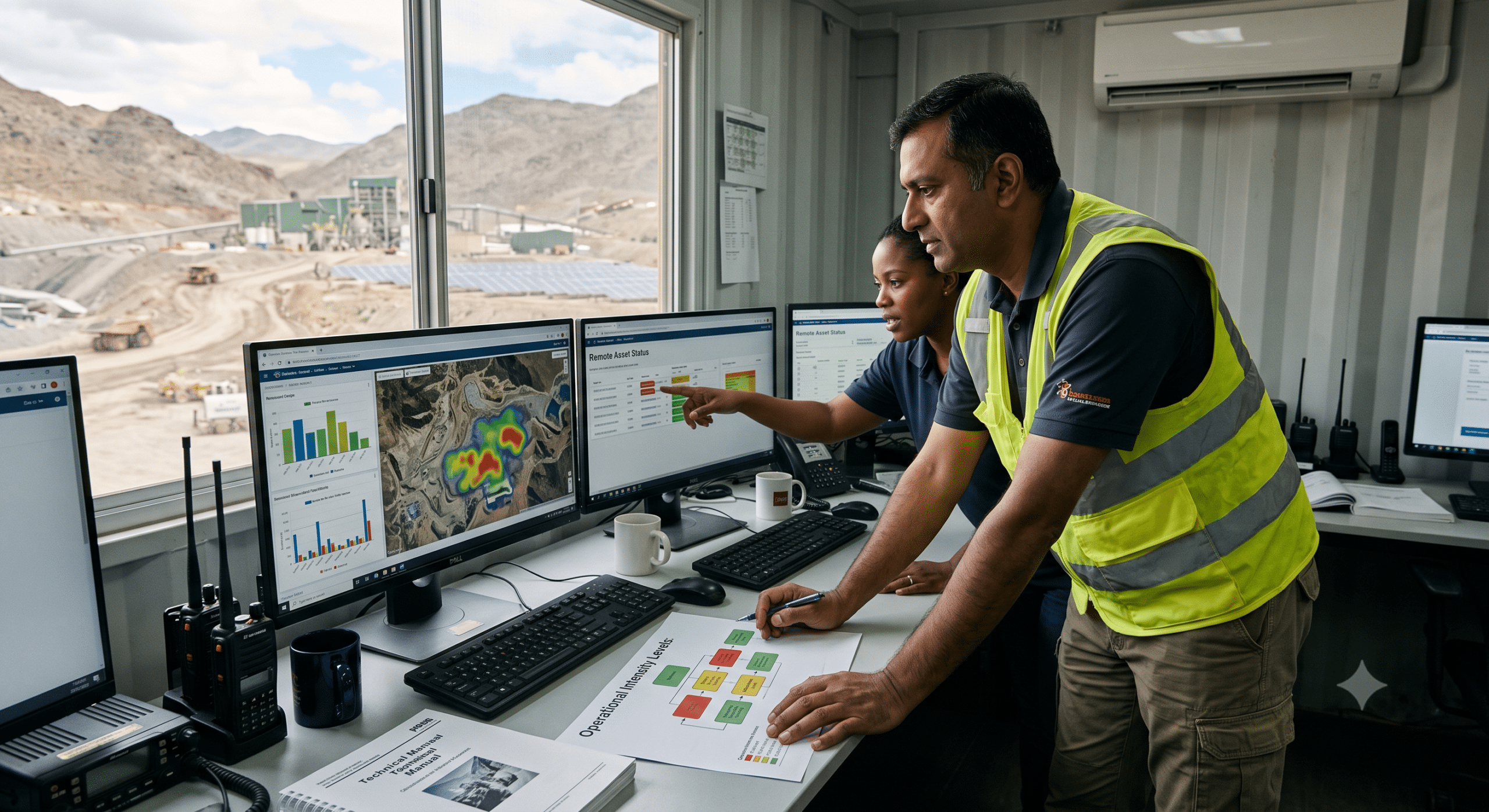
When managing remote infrastructure sites—such as rural cell towers, pipeline pumping stations, or off-grid power grids—facilities leaders quickly discover that standard urban management playbooks simply do not work. In urban environments, if an air conditioner breaks in a high-rise corporate tower or a water line leaks in a suburban fulfillment center, repairs happen remarkably fast. For instance, a technician typically arrives within thirty minutes because replacement parts are stored right down the street. Consequently, a service crew is always just a quick phone call away.
As an operations consultant, however, I frequently see leaders make a major mistake. Specifically, they try applying those urban facility management playbooks to isolated remote infrastructure sites located hours or even days away from major cities.
Unfortunately, that traditional approach almost always fails.
When you oversee remote infrastructure sites, the rules change completely. Furthermore, you cannot measure your operational strategy by square footage alone. Instead, you must manage your assets based on their operational intensity.
Ultimately, understanding operational intensity protects asset lifespan across all your remote infrastructure sites. In addition, it prevents catastrophic downtime and keeps overall operating costs under control over the long term.
What Is Operational Intensity in Facility Management?
In simple terms, operational intensity measures how hard a facility works. Moreover, it measures sensitivity to disruption as well as the overall cost of system failures.
However, it is not just about physical building size. On the contrary, operational intensity depends on five distinct variables:
-
Uptime Criticality: How much revenue do you lose for every minute of downtime?
-
Occupancy & Human Workload: Are workers stationed on-site 24/7, or is the location completely unstaffed?
-
Environmental Exposure: Is the facility in a climate-controlled office park, or is it exposed to sub-zero cold, desert heat, or saltwater corrosion?
-
System Interdependency: Does a single generator keep everything running, or must multiple complex systems trigger flawlessly in sequence?
-
Accessibility: How fast can a certified technician physically reach the broken asset with tools and spare parts?
      LOW INTENSITY                                    HIGH INTENSITY
  [ Standard Storage ] ---> [ Corporate Office ] ---> [ Data Center / Remote Site ]
  - High tolerance for lag                           - Zero tolerance for lag
  - Easy physical access                            - Complex physical access
  - Standard maintenance                            - Predictive maintenance
Consequently, asset size can be highly deceiving. For example, a small unstaffed microwave relay station on a mountain peak often needs a far higher response strategy than a massive corporate office.
The Operational Intensity Spectrum
Facilities leaders need a clear framework to manage diverse portfolios effectively. Therefore, we divide facilities into four operational intensity tiers:
| Intensity Tier | Typical Facility Types | Primary Operational Goal | Main Failure Risk | Maintenance Strategy |
| Tier 1: Low Intensity | Warehouses, archival storage, vacant property | Asset preservation & basic security | Unnoticed leaks, environmental decay | Scheduled inspections & basic corrective response |
| Tier 2: Medium Intensity | Corporate offices, retail branches, light assembly | Occupant comfort & energy efficiency | Employee distraction, minor business friction | Scheduled preventive maintenance (PM) |
| Tier 3: High Intensity | High-throughput factories, processing plants | Continuous yield & safety compliance | Machine stoppage, revenue loss | Condition-based monitoring & rapid response |
| Tier 4: Mission-Critical | Remote infrastructure sites, data centers, telecom hubs | 100% continuous uptime & survival | Total service outage, massive financial penalties | Predictive maintenance, edge automation, deep redundancy |
As a result, moving from Tier 1 to Tier 4 shifts your philosophy entirely. Thus, you move from reactive repair to predictive resilience.
Why Remote Infrastructure Sites Belong in a Class of Their Own
Managing remote infrastructure sites presents unique operational challenges. Indeed, standard assumptions break down in three major areas:
1. The “Travel Time” Reality
In an urban office park, a two-hour repair delay simply means a technician sat in traffic. In contrast, at remote sites, delays are much worse. For instance, you might wait for a helicopter charter. Likewise, you might need to navigate washed-out logging roads or secure snowmobile transport during a blizzard.
For this reason, travel time often exceeds actual repair time tenfold. Therefore, your strategy cannot rely on dispatching technicians after something breaks.
2. Supply Chain Isolation
In an urban facility, you can easily pick up replacement parts within an hour. However, at a remote pumping station 150 miles from town, options are severely limited. Specifically, you only have access to spare parts stored directly on-site. As a consequence, if a critical part is missing, your repair time instantly shifts from hours to days.
3. Harsh Operating Conditions
In addition, remote infrastructure is intentionally placed where humans do not live. For example, these sites sit on high ridge lines or deep in arid deserts. Thus, severe weather puts immense stress on electrical enclosures, cooling systems, and backup batteries.
Key Operational Takeaway: You cannot manage remote infrastructure sites using urban facility techniques. Instead, you must build an operational framework centered on edge automation, on-site spares, and predictive condition monitoring.
12 Strategic Pillars for Managing High-Intensity Remote Infrastructure Sites
When consulting for high-intensity remote facilities, we implement a framework built on 12 foundational pillars. Specifically, these practices bridge the gap between geographic isolation and operational reliability.
+-----------------------------------------------------------------------+
|             12 PILLARS OF REMOTE INFRASTRUCTURE MANAGEMENT            |
+------------------------------------+----------------------------------+
| 1. Edge Computing & Automation     | 7. Lifecycle Replacement Planning|
| 2. Predictive Condition Baseline   | 8. Standardized Escalations      |
| 3. Layered Power Redundancy        | 9. Microgrid Energy Autonomy     |
| 4. Hyper-Local Vendor Networks     | 10. Physical & Environmental     |
| 5. Critical On-Site Spares (Kitting)|    Hardening                     |
| 6. UAV & Remote Visual Inspection  | 11. Unified CMMS/IoT Integration |
|                                    | 12. Remote Expert Assistance     |
+------------------------------------+----------------------------------+
Pillar 1: Edge Computing and Localized Automation
Internet connectivity at remote sites can be spotty. Because of this, you cannot rely on cloud servers for critical safety actions. Instead, local edge automation controllers must trigger emergency actions instantly on-site.
Pillar 2: Predictive Condition Baseline
Waiting for an alarm means a failure already happened. Furthermore, deploying IoT sensors allows you to monitor heat, vibration, and motor current continuously. As a result, you can detect component wear weeks before an actual shutdown occurs.
Pillar 3: Layered Power Redundancy
A single diesel generator is never enough for mission-critical remote assets. On the contrary, high-intensity sites require layered power systems. Specifically, you need utility power, battery UPS banks, automated generator start systems, and solar backups.
Pillar 4: Hyper-Local Vendor SLA Localization
National service agreements sound great on paper. However, national vendors rarely station technicians near remote areas. As a result, operations teams must build local contractor networks. Thus, you need local mechanics and electricians who can respond quickly in bad weather.
Pillar 5: Critical On-Site Spares Optimization (“Kitting”)
Every high-intensity asset needs a standardized “crash kit” on-site. In particular, these kits contain critical high-wear parts such as relays, fuses, fan belts, and control boards. Consequently, storing these parts on-site eliminates massive shipping delays.
Pillar 6: Remote Visual and Aerial Inspections
Driving six hours just to inspect a fence line is wasteful. Alternatively, using drones with 3D mapping lets teams inspect structures remotely. Therefore, this approach saves significant time and keeps personnel safe.
Pillar 7: Rigorous Lifecycle Replacement Planning
Running equipment until it breaks is a bad strategy for remote sites. In fact, run-to-failure creates major operational disasters. Therefore, assets must be replaced based strictly on operating hours and predictive health scores.
Pillar 8: Standardized Incident Escalation Matrices
When an outage occurs, teams cannot waste time guessing who to call. Instead, clear escalation trees must outline exact protocols. Furthermore, triggers should depend on incident severity, response windows, and site access constraints.
Pillar 9: Microgrid and Energy Autonomy
Integrating solar panels, battery storage, and smart load-shedding keeps facilities online. Consequently, core systems remain fully functional even if fuel shipments are delayed for weeks.
Pillar 10: Environmental and Physical Hardening
Remote sites face physical tampering, wildlife intrusion, and severe storms. For these reasons, physical hardening is essential. Specifically, you need heavy-duty outdoor enclosures, automated fire suppression, and security cameras.
Pillar 11: Unified CMMS and IoT Data Integration
Isolated data is completely useless. In fact, your CMMS must convert sensor alerts into work orders automatically. For instance, when a sensor detects bearing wear, the CMMS automatically reserves the part and schedules the repair ticket.
Pillar 12: Remote Expert Assistance and Digital Twins
Field technicians often encounter complex equipment they rarely service. Fortunately, augmented reality headsets let off-site experts guide local technicians through repairs step-by-step. As a result, this prevents repeated travel trips.
Designing an Operational Intensity Strategy: Step-by-Step
Transitioning to an operational intensity model requires a clear plan. Specifically, here is how we guide client organizations through this process:
Step 1: Audit & Classify Portfolio Assets
                  │
                  ▼
Step 2: Map Access & Supply Chain Constraints
                  │
                  ▼
Step 3: Establish Intensity-Based Maintenance PMs
                  │
                  ▼
Step 4: Deploy IoT, Remote Monitoring & Edge Systems
                  │
                  ▼
Step 5: Review & Refine Based on Operational Data
Step 1: Audit and Classify
First, start by listing every asset in your portfolio. Next, rate each facility from Tier 1 to Tier 4. Base your ratings logically on downtime cost, staffing levels, weather exposure, and access limits.
Step 2: Map Access and Supply Chain Lag
For every Tier 3 and Tier 4 asset, calculate your real-world True Time to Site (TTTS). Indeed, this metric tracks total time from alarm trigger to technician arrival on-site with parts.
Step 3: Align Maintenance Spend with Asset Criticality
Stop allocating maintenance budgets purely by square footage! Instead, shift funds toward assets with the highest operational risks. For example, a tiny remote communications shelter often needs a larger maintenance budget than a large regional office.
Step 4: Integrate Sustainability and Long-Term Value
Modern facility management must balance uptime with sustainability. Furthermore, using remote monitoring reduces truck rolls significantly. Consequently, this lowers carbon emissions while extending overall equipment life.
Real-World Operational Scenarios
To illustrate this concept, let’s examine two contrasting facility management scenarios:
Scenario A: Urban Corporate Administrative Building
-
Operational Intensity: Tier 2 (Medium)
-
Location: Downtown Austin, Texas
-
Downtime Impact: Minor employee inconvenience. Meanwhile, work-from-home options are available.
-
Operational Approach: Maintenance focuses on occupant comfort and scheduled preventive care. In addition, standard 4-hour vendor SLAs work well. Furthermore, parts are sourced locally as needed.
Scenario B: Unmanned Microwave Relay Station
-
Operational Intensity: Tier 4 (Mission-Critical)
-
Location: Remote mountain ridge in Wyoming (Remote infrastructure site)
-
Downtime Impact: Loss of regional emergency communications along with severe compliance penalties.
-
Operational Approach: Complete reliance on automated condition monitoring and edge power management. Moreover, the site features dual generators and on-site spare kits. Meanwhile, drones handle routine structural inspections. Consequently, service visits are combined into planned multi-discipline trips.
Frequently Asked Questions (FAQ)
What is the main difference between urban facilities and remote infrastructure sites?
The main differences are access speed, supply chain options, and risk levels. While urban facilities rely on fast technician dispatch and nearby parts suppliers, remote sites require total operational autonomy. Thus, they rely heavily on edge automation, redundant power, and on-site spare parts.
How does operational intensity change maintenance budgets?
Managing by operational intensity shifts money away from simple square-footage formulas. Instead, capital goes directly toward risk reduction. As a result, high-intensity assets receive higher funding for sensors, spare parts, and specialized local vendor agreements.
Why is predictive maintenance vital for remote infrastructure sites?
Driving to a remote site just to diagnose a failure is extremely wasteful. In contrast, predictive maintenance uses IoT sensors to monitor heat and vibration continuously. Therefore, facility managers can detect failures weeks in advance and fix issues during planned visits.
How do drones and BIM technology help remote facility managers?
Drones combined with Building Information Modeling (BIM) allow teams to inspect remote structures safely. Ultimately, this technology generates 3D visual models, identifies weather damage, and eliminates unnecessary travel.
How do you start categorizing a building portfolio by operational intensity?
Begin by evaluating every facility against five factors: downtime cost, occupancy, environment, system complexity, and physical access. Afterwards, assign each facility to an operational intensity tier and update your maintenance strategy accordingly.
References
-
eMaint Blog (Fluke Reliability) – What is Facility Maintenance? Types, Examples, Software
URL: https://www.emaint.com/blog/what-is-facility-maintenance-management-types-strategies/
(Industry reference covering preventive vs. predictive strategies and operational criticality.)
-
MaintainX Blog – Facility Maintenance Guide: Strategies, Types, and Examples
URL: https://www.getmaintainx.com/blog/what-is-facility-maintenance
(High-DA resource detailing IoT sensor integration, condition monitoring, and edge maintenance workflows.)
-
Limble CMMS Blog – 6 Proven Strategies for Effective Multi-Site Facility Management