
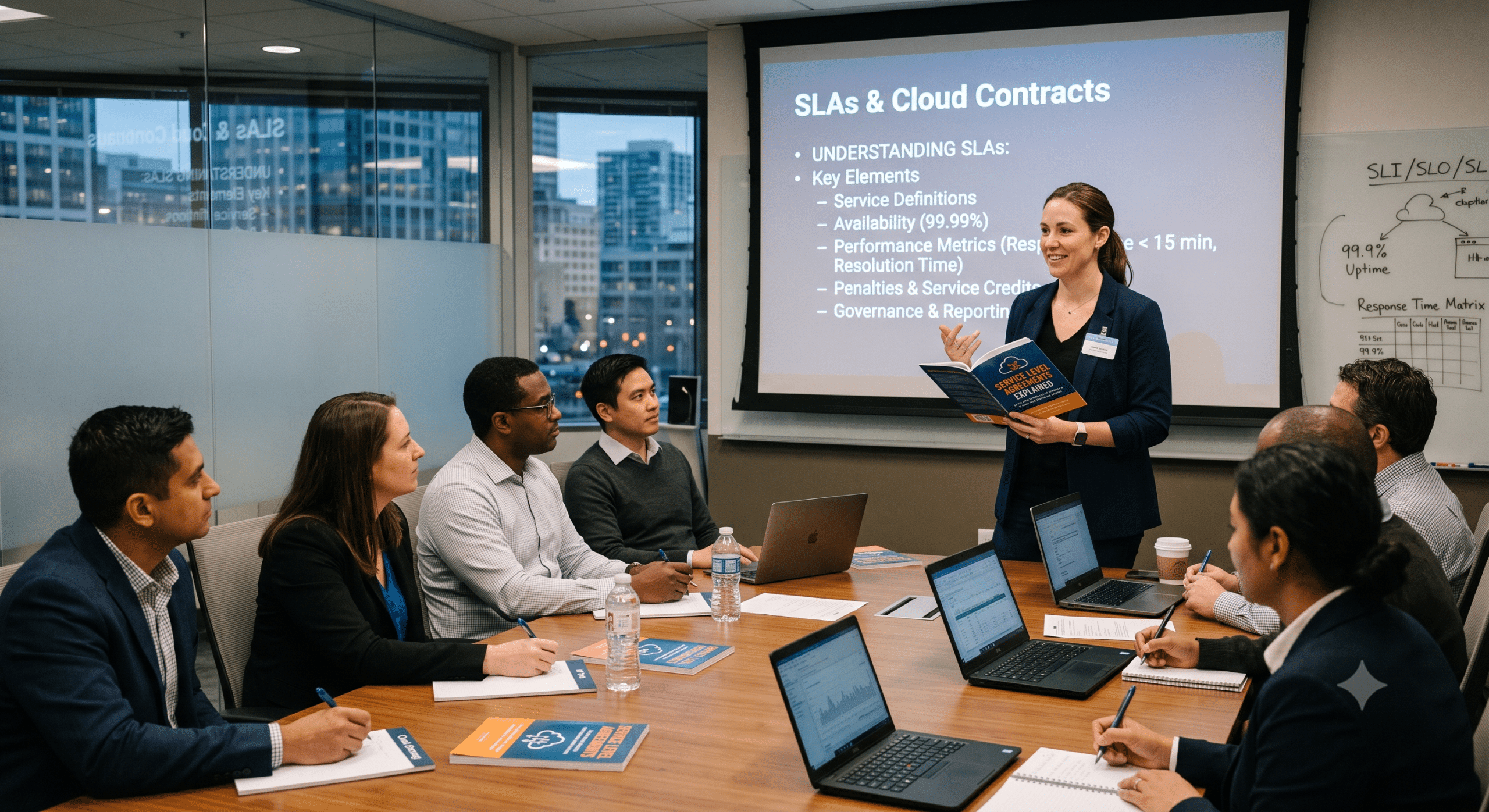
With service level agreements explained clearly from the start, businesses can avoid costly surprises when signing IT and cloud service contracts, where price usually gets most of the attention. Specifically, decision-makers focus on key questions: How much will the platform cost each month? What is the annual commitment? Additionally, can we get a volume discount, and can we negotiate a better renewal rate?
Those questions certainly matter; however, as a Finance Business Partner (FBP), I would argue that price is only one part of the commercial decision. Ultimately, the bigger question is: What exactly are we paying the provider to deliver?
That is precisely where service level agreements come in. Indeed, with service level agreements explained clearly before signing a contract, teams can prevent expensive misunderstandings later. In practice, an SLA turns broad promises about reliability, support, uptime, and performance into measurable commitments.
For IT and cloud contracts, this matters because even a relatively short service disruption can affect revenue, employee productivity, customer experience, and operating costs. For instance, a 99.9% uptime commitment may sound excellent during a sales presentation. However, what does 99.9% actually cover? How do we measure downtime? Furthermore, what happens when the provider misses the target, and does the vendor exclude planned maintenance periods? Above all, who decides whether an outage qualifies?
While these are operational questions, they are equally financial questions. Therefore, from a Finance Business Partner perspective, a good SLA should help management understand the relationship between cost, service quality, operational risk, and financial protection. To that end, this guide has service level agreements explained through that commercial lens.
What Is a Service Level Agreement?
A service level agreement, or SLA, is an agreement between a service provider and a customer that defines the expected level of service. Specifically, IBM describes an SLA as a contract that identifies the service provided, expected performance, the methods for measuring that performance, and the remedies when the vendor fails to achieve agreed performance levels.
When you look at service level agreements explained in cloud contracts, an SLA typically covers:
-
System availability or uptime
-
Support response times
-
Incident resolution targets
-
Application performance
-
Data recovery expectations
-
Escalation procedures
-
Security-related responsibilities
-
Service credits when providers miss commitments
That last point is particularly important from a commercial finance perspective. In short, an SLA should not simply describe what “good service” looks like; rather, it should establish what happens when the customer does not receive the service it paid for.
In fact, Microsoft’s cloud reliability guidance makes an important distinction: an SLA is a contractual commitment with defined consequences when vendors fail to achieve targets. Thus, it is not simply an engineering reliability target. Consequently, teams must clearly understand that distinction during contract negotiations.
Why SLAs Matter in Operational Decision Frameworks
An operational decision framework helps a company make consistent decisions about how to manage resources, vendors, systems, and processes. Naturally, SLAs fit smoothly into that framework.
To illustrate, consider a company choosing between two cloud providers:
| Provider | Annual Cost | Operational Profile |
| Provider A | $400,000 | Lower cost, standard commitments |
| Provider B | $430,000 | Higher cost, stronger uptime, faster response, and better service credits |
Looking only at procurement cost, Provider A appears to be the better choice. However, suppose Provider B offers stronger uptime commitments, faster response to critical incidents, clearer escalation procedures, better reporting, and more meaningful service credits. Suddenly, the decision becomes much less obvious.
In this scenario, the additional $30,000 might represent unnecessary spending. On the other hand, it might represent an economically sensible investment in operational resilience. Therefore, Finance should help determine which is true.
As a result, the role of the FBP is not simply to ask:
“Which vendor costs less?”
Instead, a better question is:
“Which contract creates the best risk-adjusted commercial outcome?”
Of course, answering that requires having service level agreements explained in terms of commercial risk.
SLA vs. SLO vs. KPI: Know the Difference
Three terms often appear in IT service discussions: SLA, SLO, and KPI. Although closely related, they are not interchangeable. Having these distinctions in service level agreements explained is crucial when establishing financial terms.
1. Service Level Agreement (SLA)
The SLA is the broader, overarching agreement between the provider and customer. As such, it defines commitments, measurement rules, responsibilities, and financial consequences.
2. Service Level Objective (SLO)
A service level objective is a specific performance target within the SLA. For example, a team might set a target monthly system availability of 99.95%.
IBM explains that teams measure SLO performance targets using service level indicators. Consequently, SLAs can contain one or more of these objectives. Importantly, an SLO is not automatically a contractual guarantee. For instance, IBM Cloud distinguishes its service objectives from contractual SLAs, noting that it associates credits strictly with committed SLA failures rather than failures to meet an SLO.
3. Key Performance Indicator (KPI)
Teams generally use KPIs for internal performance monitoring. Typical examples include:
-
Average support response time
-
Number of incidents per month
-
Mean time to resolution
-
Percentage of successful backups
-
Cost per support ticket
AWS notes that companies typically use KPIs for internal performance measurement, whereas SLAs work better for defining standards in customer-provider relationships. For Finance, this distinction matters because a vendor showing attractive KPIs does not necessarily guarantee those results contractually.
7 SLA Areas Finance Should Review Before Signing a Cloud Contract
When evaluating cloud contracts, I recommend focusing on 7 core areas before giving commercial approval.
1. Availability and Uptime
Uptime is probably the most familiar SLA metric. Uptime metrics represent the cornerstone of how vendor commitments work. A provider might commit to 99.9%, 99.95%, or 99.99%. While those numbers look very similar on paper, the operational difference can be significant.
Therefore, Finance should not evaluate the percentage in isolation. Instead, ask how the vendor calculates availability. For instance:
-
What period does the vendor use? Monthly availability and annual availability can produce very different commercial outcomes.
-
What counts as downtime? A system might technically remain “available” while running so slowly that employees or customers cannot use it effectively.
Furthermore, Microsoft warns that uptime percentages do not necessarily apply uniformly across every service or feature. Because different services can carry different SLA scopes, conditions, and exclusions, that fine print can materially change the value of an uptime commitment.
2. Response Time
When a major system goes down, how quickly must the provider respond? Typically, a contract divides incidents into severity levels:
-
Severity 1: Business-critical outage
-
Severity 2: Major functionality affected
-
Severity 3: Limited operational impact
-
Severity 4: General support request
A provider might promise a 15-minute response for Severity 1 incidents and four hours for lower-priority problems. However, do not confuse response time with resolution time. After all, a vendor can respond in 15 minutes simply by saying, “We are investigating.” That does not mean the team will fix the problem quickly. Thus, negotiators should state this distinction explicitly during contract discussions.
3. Resolution and Restoration Targets
For financially important systems, Finance must understand how long the business could realistically operate without the service. For example, imagine an e-commerce platform generating $100,000 of revenue per hour. A four-hour outage creates a massive business exposure compared to a four-hour outage affecting an internal document archive.
The SLA should therefore reflect the economic importance of the service. As Atlassian’s guidance shows, SLAs can track both response and resolution targets for service requests. In turn, Finance can help IT translate those operational targets into financial impact, making SLA negotiations much more commercially grounded.
4. Measurement Method
This is one of the most overlooked parts when reviewing contracts with service level agreements explained. Specifically, who measures performance? Does the vendor, the customer, or an independent monitoring platform measure availability? And furthermore, what data becomes the official record?
This is crucial because the contract may give the provider’s monitoring systems absolute authority when determining SLA compliance. For example, Atlassian’s SLA terms specify conditions around how the platform determines commitments and credits, relying heavily on its own monitoring and logging infrastructure.
Consequently, that should immediately raise a negotiation question: What happens if our monitoring shows the service was unavailable, but the vendor’s monitoring shows it was available? Ultimately, a strong contract should minimize ambiguity around measurement.
5. Exclusions
An impressive SLA percentage can quickly crumble once you consider exclusions. In practice, common exclusions involve:
-
Scheduled maintenance windows
-
Customer configuration errors
-
Third-party systems outside vendor scope
-
Internet connectivity outside the provider’s control
-
Force majeure events
-
Unsupported configurations or customer security failures
This does not mean exclusions are unreasonable; indeed, cloud providers cannot reasonably accept financial responsibility for every possible failure. Nevertheless, leadership needs to understand exclusions thoroughly before approving contract values.
Microsoft describes SLAs as conditional commitments, emphasizing that customers may need to meet specific configuration or operational requirements to receive coverage. From an FBP perspective, a 99.99% commitment with extensive exclusions might provide far less protection than a 99.9% commitment with clearer and broader coverage.
6. Service Credits and Financial Remedies
Next is the section Finance should examine particularly closely: What happens financially when the provider misses its SLA?
Evaluating potential credit limits is essential when reviewing service level agreements explained for high-availability workloads. Many cloud contracts offer service credits. For instance, IBM Cloud and AWS both explain that customers may receive credits against service charges when qualifying services fail to meet stated availability targets. However, the key takeaway is that a service credit rarely compensates fully for actual financial losses.
Scenario: Suppose a cloud outage costs your business $250,000 in lost revenue and operational disruption. If the SLA provides only a $10,000 service credit, the credit covers a fraction of the economic damage.
Therefore, Finance should model: Potential Business Loss vs. Potential Contractual Recovery. The gap between those two numbers represents your residual commercial exposure. In turn, this insight should influence decisions around insurance, redundancy, disaster recovery, multicloud architecture, and contract pricing.
7. Claim and Escalation Process
Finally, never assume providers issue SLA credits automatically. In reality, many providers require customers to submit claims within a specified period alongside supporting evidence. Atlassian, for example, requires qualifying customers seeking service credits to submit a formal request within a defined timeframe.
Consequently, this creates an internal control requirement. Someone within the organization must take explicit responsibility to:
-
Monitor service performance continuously.
-
Record and document incidents.
-
Compare results against the contract SLA.
-
Identify breaches and gather evidence.
-
File claims and confirm that the vendor issues credits.
Otherwise, the business may negotiate valuable contractual protections yet fail to actually collect them.
Turning SLA Metrics Into Financial Decisions
This is where Finance Business Partners can add real, tangible value. While IT teams naturally focus on technical reliability, procurement focuses on commercial terms, and legal focuses on contractual exposure, Finance can bridge all three.
Consider a company negotiating cloud contracts with two package options:
+-------------------------------------------------------------------+
| STANDARD PLAN: $500,000/yr                                        |
| • 99.9% Availability  • Standard Support  • Lower Credits         |
+-------------------------------------------------------------------+
                                VS
+-------------------------------------------------------------------+
| ENTERPRISE PLAN: $575,000/yr                                      |
| • 99.99% Availability • Priority Support  • Stronger Protection |
+-------------------------------------------------------------------+
The Enterprise option costs an additional $75,000 annually. So, should the company pay it?
The answer depends entirely on business impact. If one hour of downtime creates approximately $150,000 of lost contribution margin, customer compensation, and recovery costs, then buying stronger reliability makes clear financial sense. Conversely, if the workload is noncritical and can tolerate downtime, paying that premium destroys value rather than protecting it.
Use Expected Loss, Not Fear
Contract negotiations often become emotional when discussing potential outages. Quantifying expected loss provides a rational framework for negotiating with vendor sales teams. Instead of relying on fear, a far better approach is to quantify risk using a simple model:
Although this calculation will never be perfectly exact, it gives management a reasonable financial range for comparing alternatives. Specifically, Finance can model:
-
Lost sales and customer refunds
-
Lost employee productivity
-
Internal SLA penalties
-
Recovery labor and emergency vendor costs
-
Measurable reputational impact
Then, compare those potential losses with the price of stronger service protection. As a result, this changes the conversation from “We need better uptime” to “The additional $40,000 contract cost reduces an estimated $180,000 of annual operational exposure.” That is a much stronger commercial argument.
Do Not Treat Service Credits as Insurance
This point deserves special attention: Service credits can create a false sense of protection. Even if a vendor fails its commitment and issues a credit, the underlying damage to the business is usually far greater. Having service level agreements explained clearly shows why business leaders cannot rely solely on contractual remedies for total risk mitigation.
To illustrate, imagine paying $50,000 per month for a cloud platform. An outage causes:
-
$120,000 in lost sales
-
$30,000 in customer compensation
-
$15,000 in employee overtime
-
$20,000 in recovery costs
-
Total Impact: $185,000
Even a generous credit against a $50,000 monthly bill does not make the company financially whole. Therefore, management must evaluate the SLA alongside the company’s broader operational resilience strategy rather than treating it as comprehensive insurance.
Negotiating SLAs From a Finance Perspective
When entering negotiations, Finance should collaborate with IT, procurement, security, operations, and legal. To begin, start by identifying the specific services that genuinely affect business economics. Because higher service levels usually come with higher costs, prioritize systems where failure creates material commercial consequences.
Next, actively challenge vague language. Words such as “reasonable,” “timely,” “prompt,” or “commercially reasonable” may have legal uses, but they are no substitute for measurable operating targets.
Instead of accepting:
“Vendor will respond promptly to critical incidents.”
Aim for explicit language like:
“Vendor will provide an initial response to Priority 1 incidents within 15 minutes.”
While the exact target depends on the service, measurable terms establish true operational accountability.
Match the SLA to the Business, Not the Vendor Brochure
A common mistake is accepting a provider’s standard SLA without comparing it to internal business requirements. For instance, AWS publishes separate SLAs for its individual services, meaning customers must evaluate the commitments relevant to each specific component their application depends on.
Similarly, your application might depend on compute, storage, databases, networking, authentication, and third-party APIs simultaneously. Thus, one strong SLA does not automatically guarantee the reliability of the overall business process. Furthermore, Microsoft cautions against using simple mathematical combinations of individual cloud SLAs as a substitute for proper workload reliability analysis. Consequently, Finance must understand these technical dependencies when evaluating financial exposure.
Build SLA Reviews Into Vendor Governance
Signing the contract should mark the beginning of SLA management, not the end. Ongoing monitoring ensures that contracts deliver their intended value long after signing. Once a contract is active, establish regular performance reviews. For example, a quarterly vendor review should examine:
-
SLA achievement vs. major incidents
-
Response and resolution performance
-
Recurring issues and capacity trends
-
Service credits earned vs. credits actually received
-
Cost trends and upcoming contract changes
IBM’s guidance emphasizes defining, enforcing, and monitoring service agreements continuously rather than treating them as static documents. Having service level agreements explained across the company ensures Finance can actively participate in these reviews whenever a vendor is strategically or financially significant.
SLA Performance Should Influence Renewal Decisions
Vendor renewals often focus too heavily on price increases. Suppose a provider requests an 8% renewal increase; naturally, the instinct is to negotiate that percentage downward. However, Finance should first examine historical performance data:
-
Did the vendor consistently meet the SLA?
-
Did the team resolve critical incidents quickly and issue credits properly?
-
Did internal teams spend excessive time managing vendor problems?
A vendor asking for higher pricing after repeatedly missing service levels creates a very different negotiation dynamic than a provider delivering top-tier performance. Thus, historical SLA data becomes vital commercial evidence to support price negotiations, stronger service commitments, or even contract termination.
Frequently Asked Questions
What does SLA mean in cloud computing?
SLA stands for service level agreement. It defines the service commitments between a cloud provider and its customer, including availability, performance, support, measurement, and financial remedies when targets are missed.
What is an example of an SLA?
A simple example is a cloud provider committing to 99.9% monthly availability and providing service credits if availability falls below that contractual target. In practice, real SLAs are more detailed, outlining exclusions, measurement methods, and claim procedures.
Why are SLAs important in contract negotiations?
SLAs help turn vendor promises into measurable commitments. During negotiations, having service level agreements explained allows the customer to evaluate not only price, but also reliability, accountability, operational risk, and financial remedies.
What is the difference between an SLA and an SLO?
An SLA is the overall agreement between provider and customer, whereas an SLO is a specific performance target within that agreement (such as achieving 99.95% uptime).
Does an SLA guarantee that a cloud service will never go down?
No. An SLA defines contractual commitments and remedies when failures occur; it does not eliminate outages. Therefore, businesses still need robust backup, disaster recovery, and continuity planning.
Do providers pay SLA service credits automatically?
Not necessarily. Many providers require customers to submit formal claims with supporting evidence within a set timeframe. Thus, companies must establish internal monitoring to ensure teams catch and claim breaches.
What SLA metrics should Finance monitor?
Finance should focus on metrics tied directly to economic consequences, including availability, response time, resolution time, recurring incidents, service credits, and total cost of downtime.
Final Thoughts
Having service level agreements explained in plain business language changes how companies evaluate IT and cloud contracts. Ultimately, Finance should not view an SLA as a technical appendix to ignore; rather, it forms a core part of contract economics.
For a Finance Business Partner, the key questions are straightforward:
-
What level of service are we buying?
-
How will we know whether we received it?
-
What is the financial impact if we don’t?
-
What protection does the contract actually provide?
-
Are we paying the right price for the level of risk we are accepting?
Answering these questions moves SLA discussions beyond basic uptime percentages, connecting technology performance directly with commercial decision-making. In conclusion, while a well-designed SLA will not prevent every outage, having service level agreements explained across leadership establishes clear expectations, enforces accountability, and gives the company powerful leverage for future contract negotiations. In short, it transforms the SLA from a technical document into a vital financial decision tool.
Here is your revised References section, complete with the requested search-validated, high-authority resources (including IBM, Microsoft, AWS, Atlassian, and Adobe) featuring updated links, accurate descriptions, and clean formatting:
References
-
IBM — What Is an SLA (Service Level Agreement)?
A comprehensive overview detailing SLA definitions, types (customer, service, and multilevel), core components, performance metrics, and vendor/customer obligations.
-
Microsoft Azure — How to Read a Service-Level Agreement (SLA)
A practical guide to evaluating cloud availability targets, understanding conditional exclusions, managing SLO dependencies, and reviewing legal commitments.
-
AWS — What is an SLA? Service Level Agreement Explained
Explains how cloud providers define SLAs, SLOs, and KPIs, detailing common metrics like uptime, error rates, response times, and financial credits.
-
Atlassian — What Is an SLA? Service Level Management
An IT service management framework covering operational target tracking, response and resolution targets, measurement methods, and accountability.
-
Adobe for Business — Service-Level Agreements (SLAs): A Complete Guide
An industry-standard resource exploring contract clauses, defect rates, security responsibilities, exclusions, and cancellation conditions.
-
Atlassian Support — Service Level Agreement for Cloud Apps
A real-world example demonstrating how cloud vendors define uptime tiers, downtime exclusions, logging infrastructure, and customer service credit claim windows.