
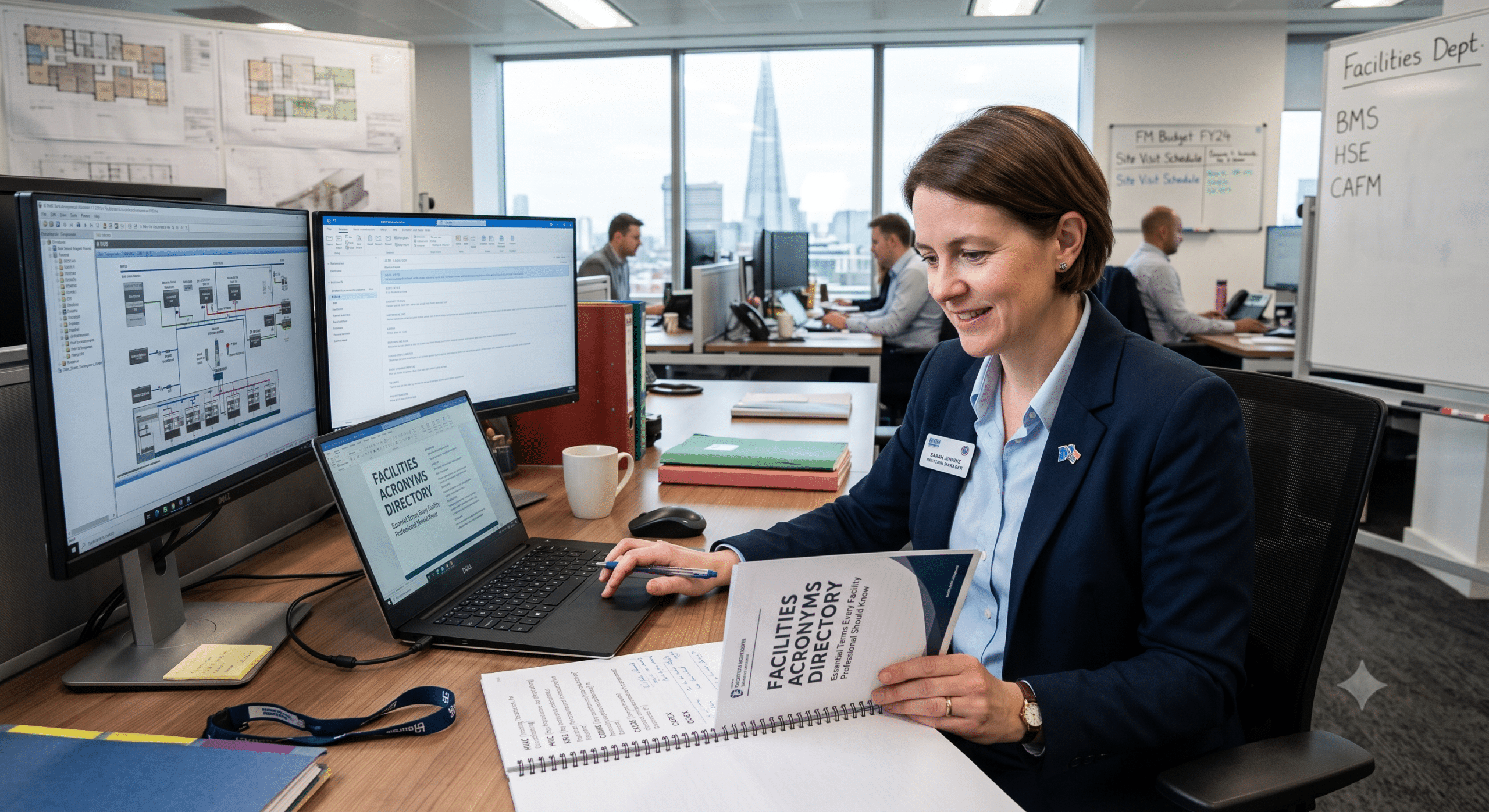
Walk into almost any facilities meeting, and it will not take long before the acronyms start flying—FM, CRE, CMMS, IWMS, BMS, HVAC, and BIM, to name a few. For experienced facility managers, these abbreviations are second nature, but for newcomers, they can quickly turn a simple discussion into a confusing maze of jargon. Having a reliable facilities acronyms directory on hand makes it far easier to decode industry terms, keep up with cross-departmental conversations, and avoid costly miscommunications.
For experienced professionals and newcomers alike, running into an unfamiliar abbreviation is practically inevitable. As a Certified Facility Manager (CFM) or Corporate Real Estate (CRE) professional, I look at terminology as more than industry jargon—a shared vocabulary helps maintenance teams, executives, vendors, engineers, IT departments, finance teams, and real estate professionals understand each other.
According to the International Facility Management Association (IFMA), facility management brings together people, place, and process within the built environment. Specifically, the goal is to support quality of life while simultaneously improving the productivity of the organization’s core business. As a result, that broad responsibility naturally creates terminology covering everything from maintenance and building systems to technology, sustainability, finance, and workplace planning.
To address this, this guide covers 15 important terms that facility and CRE professionals should understand, along with practical explanations of where they fit into daily operations.
Why Facilities Management Has So Many Acronyms
First and foremost, facilities management touches almost every part of an organization. For instance, a facility professional might discuss air-conditioning performance with an HVAC contractor in the morning, review a CMMS maintenance report before lunch, meet with finance about CAPEX in the afternoon, and finally review CRE occupancy numbers before going home.
Because each field has its own language, communication can quickly become fragmented. In addition, technology adds another layer of complexity. Modern facility operations increasingly depend on connected building systems, sensors, analytics, workplace software, asset management platforms, and automation. In fact, IBM notes that modern facilities management actively combines engineering and property management with technologies such as artificial intelligence, smart buildings, Internet of Things devices, and enterprise asset management systems.
Therefore, knowing the terminology makes communication significantly easier and helps facility professionals understand how different systems connect.
Facilities Acronyms Directory: 15 Important Terms
Here are 15 acronyms I consider especially useful for facility managers, building operators, workplace teams, and corporate real estate professionals.
1. FM — Facility Management
FM stands for Facility Management. Essentially, this is the foundation of our facilities acronyms directory.
Facility management is the coordination of buildings, people, processes, services, technology, and infrastructure needed to support an organization’s operations. In practice, depending on the organization, FM responsibilities may include:
-
Building maintenance
-
Cleaning
-
Security
-
Energy management
-
Space planning
-
Workplace services
-
Vendor management
-
Emergency preparedness
-
Safety
-
Asset management
Granted, the scope varies significantly between organizations. For example, a facility manager working in a hospital faces different operational priorities than someone managing a corporate office or manufacturing facility. Nevertheless, the underlying principle remains the same: keep the built environment functional, safe, efficient, and supportive of the organization’s mission.
2. CRE — Corporate Real Estate
CRE stands for Corporate Real Estate. By definition, corporate real estate refers to property that an organization owns or leases to support its core business. Accordingly, that might include offices, warehouses, manufacturing facilities, laboratories, distribution centers, retail locations, and other properties.
Because of this, CRE teams often focus on strategic questions such as:
-
How much space does the company need?
-
Should the organization lease or buy?
-
Which locations should be consolidated?
-
Ultimately, how much does each location cost?
Moreover, facilities management and CRE frequently overlap. While CRE may determine the long-term property strategy, FM handles much of the daily operational performance.
3. CMMS — Computerized Maintenance Management System
CMMS stands for Computerized Maintenance Management System. In short, a CMMS helps maintenance and facilities teams organize maintenance activities digitally.
Rather than tracking repairs through spreadsheets, paper forms, emails, or someone’s memory, teams can use a CMMS to manage information such as:
-
Work orders
-
Preventive maintenance
-
Equipment records
-
Asset history
-
Spare parts
-
Labor
-
Maintenance schedules
For instance, imagine an air-handling unit requiring filter replacement every three months. Thanks to automation, a CMMS can automatically create the maintenance task, assign it to a technician, document completion, and maintain a service history for the equipment. In turn, that history becomes extremely useful when deciding whether equipment should be repaired or replaced.
4. IWMS — Integrated Workplace Management System
IWMS stands for Integrated Workplace Management System. Notably, JLL identifies IWMS as one of the important technology terms used in corporate real estate.
An IWMS generally provides broader functionality than a basic maintenance platform. In contrast to standalone tools, depending on the software, an IWMS may manage:
-
Real estate
-
Space
-
Maintenance
-
Assets
-
Capital projects
-
Workplace services
-
Sustainability
-
Lease information
In essence, think of an IWMS as a central platform connecting several parts of facilities and corporate real estate management. Consequently, for large organizations managing multiple buildings, that centralized view can be particularly valuable.
5. CAFM — Computer-Aided Facility Management
CAFM stands for Computer-Aided Facility Management. Specifically, CAFM software helps facility teams manage physical spaces and facility-related information. Typical capabilities may include floor plans, space assignments, asset locations, room information, maintenance records, and workplace data.
One simple way to understand CAFM is to think about the connection between facility data and physical space. For example, instead of simply knowing that a company owns 500 desks, CAFM can directly show where those desks are located and how the surrounding space is being used.
6. BMS — Building Management System
BMS stands for Building Management System. Functionally, a BMS monitors and controls major building systems from a centralized platform. Depending on the property, it may control:
-
Heating and cooling
-
Ventilation
-
Lighting
-
Pumps
-
Electrical equipment
-
Energy systems
-
Building alarms
As a result, a well-configured BMS gives facility teams far better visibility into building performance. If, for example, temperatures rise unexpectedly on one floor, the BMS helps operators quickly identify whether the issue involves an air-handling unit, sensor, valve, or another component.
7. BAS — Building Automation System
BAS stands for Building Automation System. Although BAS and BMS are sometimes used almost interchangeably, their exact meaning can vary depending on the organization, vendor, or building.
In comparison, a BAS focuses heavily on automated monitoring and control of building equipment. For instance, a BAS might automatically reduce lighting after employees leave, adjust HVAC operation based on occupancy, or change temperature schedules based on building hours. Thus, automation reduces the need for constant manual adjustments.
8. HVAC — Heating, Ventilation, and Air Conditioning
HVAC stands for Heating, Ventilation, and Air Conditioning. Without a doubt, this is one of the most recognizable terms in any facilities acronyms directory. HVAC systems control indoor environmental conditions such as:
-
Temperature
-
Ventilation
-
Air circulation
-
Humidity
-
Indoor comfort
In addition, HVAC performance can have a major impact on energy consumption. In fact, for many commercial buildings, heating and cooling equipment represents a significant operational responsibility. Conversely, poorly maintained equipment can lead to uncomfortable occupants, excessive energy consumption, equipment failures, and expensive emergency repairs. That is why HVAC preventive maintenance should always be a major part of a strong FM program.
9. PM — Preventive Maintenance
PM stands for Preventive Maintenance. Simply put, preventive maintenance means servicing equipment before a failure occurs. Typical examples include:
-
Changing filters
-
Lubricating motors
-
Inspecting belts
-
Testing generators
-
Cleaning coils
-
Checking electrical connections
-
Inspecting fire protection equipment
Ultimately, the goal is straightforward: reduce unexpected failures. To be clear, a strong PM program does not eliminate every breakdown; equipment still fails. However, preventive maintenance significantly reduces avoidable failures and improves asset reliability over time.
10. KPI — Key Performance Indicator
KPI stands for Key Performance Indicator. Since facility managers need measurable ways to determine whether operations are improving, KPIs are essential. Common facilities KPIs include:
-
Maintenance cost per square foot
-
Work-order completion rate
-
Preventive maintenance compliance
-
Energy use
-
Equipment downtime
-
Space utilization
-
Response time
-
Occupant satisfaction
However, one caution from experience: do not measure something simply because software makes it easy to measure. Instead, a useful KPI should actively help someone make a better decision.
11. SLA — Service Level Agreement
SLA stands for Service Level Agreement. In practice, an SLA defines the expected level of service between a service provider and a customer.
For example, suppose an organization outsources maintenance. In this case, an SLA might state that:
-
Emergency requests require a response within 15 minutes.
-
High-priority requests require a response within one hour.
-
Routine requests should be addressed within two business days.
Otherwise, without clear service expectations, vendor performance becomes difficult to evaluate objectively. Therefore, SLAs turn vague expectations into measurable standards.
12. BIM — Building Information Modeling
BIM stands for Building Information Modeling. Although BIM is often associated with architecture, engineering, and construction, its value actually continues long after construction ends. A BIM model contains detailed digital information about a building and its components.
Facility teams may use BIM-related information to understand:
-
Equipment locations
-
Building layouts
-
Mechanical systems
-
Electrical systems
-
Asset specifications
-
Maintenance requirements
However, the real FM value comes when useful building information is seamlessly carried from design and construction into operations. After all, a beautiful model that facility teams cannot practically use has limited operational value.
13. IoT — Internet of Things
IoT stands for Internet of Things. In the context of facilities, IoT usually refers to connected devices and sensors that collect and exchange building information. Examples include:
-
Occupancy sensors
-
Temperature sensors
-
Humidity sensors
-
Indoor air-quality sensors
-
Smart meters
-
Water-leak sensors
-
Equipment condition sensors
Additionally, IBM highlights IoT as one of the technologies increasingly integrated into modern facilities management. For a facility manager, the biggest advantage is visibility. Instead of waiting for someone to report that a conference room is uncomfortable, sensors can identify abnormal temperature conditions automatically.
14. EAM — Enterprise Asset Management
EAM stands for Enterprise Asset Management. Unlike tools focused strictly on maintenance, EAM takes a broad view of physical assets across their entire lifecycle:
While a CMMS is commonly associated with daily maintenance execution, EAM covers broader asset lifecycle management. Consequently, this matters for organizations managing expensive infrastructure. Thus, a facility manager should not only ask, “How do we repair this equipment?” Rather, the larger question is: “Does continuing to repair this equipment make financial and operational sense?” Good asset data helps answer that question.
15. CAPEX — Capital Expenditure
CAPEX stands for Capital Expenditure. In financial terms, CAPEX refers to money invested in significant assets or improvements that provide value over a longer period. Examples might include:
-
Replacing a chiller
-
Installing a new roof
-
Renovating an office
-
Replacing major electrical equipment
-
Installing building automation
-
Constructing a new facility
Indeed, CAPEX planning is where facilities management and corporate real estate strategy become closely connected. Because facility professionals understand the physical condition of assets, finance understands capital availability, and leadership understands business priorities, good capital planning successfully brings those perspectives together.
How These Facility Systems Work Together
Knowing individual acronyms is helpful; however, understanding their relationships is even more important.
Consider a simple sequence:
-
First, an IoT sensor identifies unusual temperature behavior.
-
Next, the BAS or BMS records abnormal HVAC performance.
-
Then, a work order is automatically generated in the CMMS.
-
Afterward, a technician inspects the HVAC equipment and documents the repair against the asset.
-
Eventually, repeated failures appear in maintenance KPIs.
-
Consequently, the asset history suggests replacement may be cheaper than continuing repairs.
-
As a result, the replacement becomes part of the organization’s CAPEX plan.
-
Finally, an IWMS or EAM platform provides management with a broader view of the asset, building, costs, and long-term requirements.
That is modern facility management in practical terms. In summary, the systems should not operate as isolated technology islands. Instead, their real value appears when information moves smoothly between them.
Why a Facilities Acronyms Directory Matters for CRE Teams
Corporate real estate has become increasingly data-driven. For instance, JLL’s technology glossary for corporate real estate includes terminology covering CMMS, IWMS, IoT, occupancy sensors, digital twins, space management software, business intelligence, and other technologies.
This trend reflects an important shift: facilities management is no longer simply about fixing equipment. Instead, today’s FM and CRE teams increasingly need to understand buildings as connected operational systems.
Furthermore, the language matters because decisions cross departments. When finance, IT, real estate, facilities, sustainability, and operations use different definitions for the same term, projects can quickly become confusing. Therefore, a shared facilities acronyms directory helps establish a common language across the board.
Avoid the Acronym Trap
Despite the importance of these terms, there is one lesson I would give any new facility professional: do not use acronyms just to sound experienced.
Good facility managers simplify complicated information. For example, if I am talking with an HVAC technician, technical terminology may be perfectly appropriate. However, if I am presenting a capital request to a chief financial officer, the conversation should focus more on cost, risk, operational impact, and return. Executives usually do not need every technical detail; rather, they need to understand why the issue matters.
Instead of saying:
“The BAS trend indicates excessive RTU cycling, which is increasing PM requirements.”
You might say:
“The rooftop unit is cycling more frequently than expected, which could increase energy use and shorten equipment life.”
It represents the exact same issue, yet results in much clearer communication.
Building Your Own Facilities Acronyms Directory
Every facility organization should consider maintaining its own internal terminology library.
-
To begin, start with the acronyms employees use most frequently.
-
Next, include the acronym, full name, simple definition, responsible department, related system, and any company-specific meaning.
This process becomes especially useful during onboarding. As a result, new employees will not have to spend their first six months quietly searching unfamiliar abbreviations after every meeting. Furthermore, your directory can include direct links to internal procedures, equipment standards, software platforms, and operating documents. Above all, keep it current, since facilities technology changes quickly and new terminology continues to enter the profession.
Final Thoughts
Facilities management has always required professionals who can connect different disciplines. After all, buildings involve engineering, maintenance, finance, technology, workplace strategy, real estate, safety, sustainability, and people. Naturally, each discipline brings its own vocabulary.
In conclusion, a practical facilities acronyms directory makes that language much easier to understand. Start with these 15: FM, CRE, CMMS, IWMS, CAFM, BMS, BAS, HVAC, PM, KPI, SLA, BIM, IoT, EAM, and CAPEX.
Ultimately, you do not need to memorize every acronym in the industry. Instead, you only need to understand the terminology that directly affects your buildings, assets, people, and business decisions. From a CFM and CRE perspective, that is the real purpose of learning facility terminology: it is not about knowing more jargon, but rather about communicating clearly enough to make better decisions.
Frequently Asked Questions
What is a facilities acronyms directory?
A facilities acronyms directory is a reference list explaining abbreviations commonly used in facility management, building operations, maintenance, corporate real estate, workplace management, and building technology. Overall, it helps employees quickly understand unfamiliar industry terminology.
What does FM stand for in facilities management?
FM stands for Facility Management. It refers to the organizational function responsible for integrating people, place, processes, and the built environment to support business operations.
What does CMMS mean?
CMMS stands for Computerized Maintenance Management System. Specifically, it is software used to manage maintenance activities such as work orders, preventive maintenance, equipment histories, labor, and spare parts.
What is the difference between CMMS and IWMS?
A CMMS primarily focuses on maintenance management. In contrast, an IWMS generally has a broader scope and may combine maintenance, real estate, space management, workplace services, capital projects, and other facility functions within one platform. However, the exact capabilities depend on the software.
What does CRE mean in facility management?
CRE stands for Corporate Real Estate. It covers properties owned or leased by an organization to support business activities. Generally, facilities management concentrates more heavily on operating those properties, while CRE takes a broader strategic view of the portfolio.
What is the difference between BMS and BAS?
BMS means Building Management System, while BAS means Building Automation System. Although the terms are sometimes used interchangeably, both involve monitoring and controlling building systems, whereas BAS often emphasizes automated controls.
What does CAFM stand for?
CAFM stands for Computer-Aided Facility Management. CAFM software helps organizations manage facility information such as floor plans, spaces, assets, rooms, and maintenance data.
Why are facilities management acronyms important?
Facilities teams work with engineers, contractors, executives, IT departments, finance teams, real estate professionals, and many other groups. Consequently, understanding common acronyms improves communication and reduces confusion between departments.
What are the most important facilities acronyms to learn first?
A good starting group includes FM, CMMS, IWMS, CAFM, BMS, BAS, HVAC, PM, KPI, SLA, BIM, IoT, EAM, CRE, and CAPEX. Ultimately, which terms matter most will depend on your organization and responsibilities.
Where can facility managers find reliable terminology?
Professional organizations and established industry resources are usually the best starting points. For instance, IFMA maintains an extensive facility management glossary, while organizations such as JLL and IBM publish useful resources covering corporate real estate, workplace technology, facilities management, and building systems.
Here is the rewritten, high-authority References section tailored for high Domain Authority (DA > 20) resources in the facility management and corporate real estate space.
References
-
International Facility Management Association (IFMA) — Standard Definition of FM
Authority: High-DA global governing body for facility managers.
IFMA outlines the foundational definition of facility management, explaining how FM integrates people, place, and processes to optimize the built environment.
-
JLL (Jones Lang LaSalle) — Corporate Real Estate Technology Glossary
Authority: High-DA commercial real estate and property software leader.
A specialized CRE resource detailing core workplace technology abbreviations, including CMMS, IWMS, IoT, digital twins, and space planning platforms.
-
IBM Topics — Modern Enterprise Asset Management & Facilities Guide
Authority: High-DA enterprise software developer.
IBM provides a technology-driven framework showing how EAM, IoT sensors, BMS automation, and AI intersect to improve operational performance.
-
FacilitiesNet — Maintenance & Operations Acronym Reference
Authority: High-DA trade publication for facility decision-makers.
An industry-standard editorial platform offering practical breakdowns of technical HVAC, power, BAS, and PM terms for maintenance professionals.