
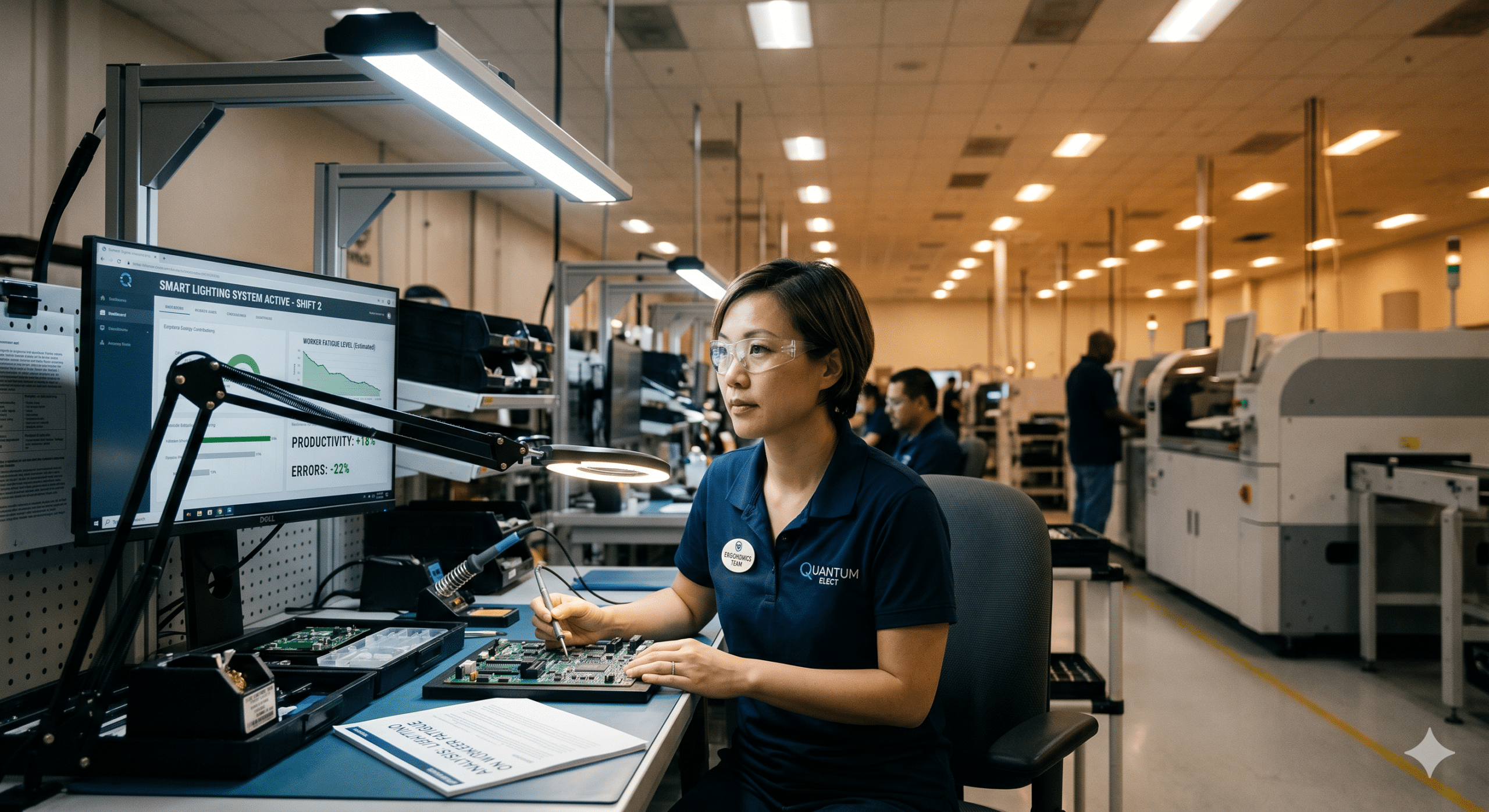
The lighting impact on worker fatigue is often overlooked in discussions about workplace productivity, safety, and employee well-being. Many organizations invest heavily in equipment upgrades, training programs, and process improvements while ignoring one of the most influential factors affecting employee performance every day: workplace lighting. As an Industrial Engineer, I have seen firsthand how poor lighting conditions contribute to eye strain, reduced concentration, mental exhaustion, and lower productivity. On the other hand, well-designed lighting and visibility systems help employees stay focused, energized, and productive throughout their shifts. Understanding how lighting affects worker fatigue is essential for creating safer, healthier, and more efficient workplaces across industries.
When companies look for ways to improve productivity, reduce mistakes, and create a safer work environment, they often focus on training programs, equipment upgrades, workflow improvements, or employee wellness initiatives. While these investments are valuable, one critical factor frequently goes unnoticed despite affecting every employee, every day: workplace lighting.
As an Industrial Engineer, I have visited manufacturing plants, warehouses, construction sites, office buildings, logistics centers, and commercial facilities where management invested heavily in operational improvements while overlooking a simple issue that was quietly impacting employee performance. Workers were experiencing headaches, eye strain, reduced concentration, and mental exhaustion, yet nobody considered that the lighting environment might be contributing to the problem.
The reality is that lighting does much more than illuminate a workspace. It directly affects how employees see, think, focus, react, and perform throughout their shifts. Poor lighting forces workers to exert additional effort just to complete routine tasks, while well-designed lighting and visibility systems help employees remain alert, comfortable, productive, and safe.
This is why understanding the lighting impact on worker fatigue has become increasingly important across nearly every industry. Whether employees work in an office, warehouse, hospital, retail store, factory, laboratory, or construction site, the quality of workplace lighting can significantly influence their energy levels and overall performance.
Organizations that recognize the connection between lighting and fatigue often discover that improving visibility is one of the simplest and most cost-effective ways to support worker well-being while simultaneously improving operational results.
Understanding Worker Fatigue Beyond Simple Tiredness
Many people assume fatigue simply means feeling sleepy after a long day of work. In reality, worker fatigue is much more complex.
Fatigue is a physical and mental state that reduces a person’s ability to perform tasks safely and efficiently. It affects concentration, reaction time, decision-making, memory, and overall performance. Workers experiencing fatigue often struggle to maintain attention, process information accurately, and respond quickly to changing situations.
Fatigue develops gradually throughout a shift. While long work hours and inadequate sleep are common contributors, workplace environmental conditions also play a significant role.
Poor ergonomics, excessive noise, uncomfortable temperatures, poor air quality, and inadequate lighting can all increase worker fatigue even when employees are otherwise healthy and well-rested.
From an Industrial Engineering perspective, fatigue is often viewed as a systems problem rather than an individual problem. Instead of asking why workers are tired, we examine workplace conditions that may be causing unnecessary strain.
Lighting is one of the most overlooked environmental factors contributing to fatigue because its effects are often subtle and cumulative. Employees may not immediately notice poor lighting, but their bodies and minds respond to it continuously throughout the workday.
Why Vision Is Critical to Workplace Performance
Human beings rely heavily on vision to perform work tasks. Studies consistently show that the majority of workplace information is received through the eyes.
Workers constantly use visual information to:
Read instructions and labels.
Inspect products and materials.
Operate machinery.
Monitor computer screens.
Navigate work areas.
Identify hazards.
Interpret warning signs.
Perform quality control checks.
Coordinate with coworkers.
Because vision plays such an important role in daily work activities, even small visibility challenges can create significant physical and mental strain.
Imagine trying to read a book in a dimly lit room for several hours. At first, the task may seem manageable. However, as time passes, your eyes begin working harder to focus. You may squint, lean closer to the page, blink more frequently, or experience discomfort.
Eventually, you become mentally tired despite performing a relatively simple activity.
The same process occurs in workplaces every day when lighting conditions are inadequate.
Workers spend countless hours compensating for poor visibility without even realizing it. Over time, this additional effort contributes directly to fatigue.
The Direct Relationship Between Lighting Impact on Worker Fatigue
The connection between lighting and fatigue is both physical and psychological.
When lighting conditions are poor, workers must continuously adapt their vision to maintain performance. The eyes constantly adjust focus, regulate incoming light, and compensate for visibility challenges.
This process requires energy.
The brain must also work harder to interpret visual information when lighting quality is poor. Reading labels becomes more difficult. Identifying details takes longer. Recognizing hazards requires greater concentration.
As visual demands increase, mental fatigue begins to develop.
Employees may experience symptoms such as eye strain, headaches, blurred vision, dry eyes, difficulty concentrating, irritability, and reduced alertness.
These symptoms often worsen as the workday progresses.
Many managers mistakenly attribute declining performance during later shifts solely to physical tiredness. In reality, poor lighting may be accelerating fatigue by forcing workers to exert additional visual and cognitive effort throughout the day.
When lighting conditions improve, employees can perform tasks with less effort, allowing them to conserve energy and maintain focus for longer periods.
How Poor Lighting Creates Visual Stress
Visual stress occurs whenever the eyes must work harder than necessary to process information.
Several common workplace lighting problems contribute directly to visual stress.
One of the most obvious issues is insufficient illumination. When light levels are too low, workers struggle to distinguish details clearly. This forces them to concentrate harder, lean closer to work surfaces, and spend more time verifying information.
Another common issue is excessive brightness. Surprisingly, brighter is not always better. Extremely bright lighting can overwhelm the eyes and create discomfort, especially when workers are exposed to high-intensity fixtures for extended periods.
Glare is another major contributor to fatigue. Glare occurs when bright light sources or reflections interfere with vision. It is particularly common in offices with computer screens, warehouses with polished floors, and industrial facilities with reflective equipment surfaces.
Uneven lighting can also create problems. Workers moving between bright and dark areas must repeatedly adjust their vision. These constant adjustments place additional strain on the visual system and contribute to fatigue over time.
Even subtle lighting deficiencies can accumulate into significant discomfort during an eight, ten, or twelve-hour shift.
Why Visibility Systems Matter as Much as Lighting
Good lighting alone does not guarantee good visibility.
This is where visibility systems become important.
Visibility systems encompass the entire environment that supports visual performance, including lighting fixtures, workstation design, signage placement, contrast levels, emergency lighting, task lighting, and overall workspace layout.
A well-designed visibility system ensures that workers can quickly and comfortably identify the information they need without excessive effort.
For example, warehouse employees should be able to read rack labels easily from appropriate distances. Manufacturing operators should clearly see machine controls and indicators. Office workers should be able to read documents and screens without excessive glare.
When visibility systems are optimized, workers spend less energy searching, verifying, correcting, and rechecking information.
This reduction in mental workload directly helps reduce fatigue while improving efficiency.
The Impact of Lighting on Concentration and Focus
Concentration requires mental energy.
When employees struggle to see clearly, part of their mental capacity is diverted toward overcoming visibility challenges rather than performing productive work.
Consider a quality inspector examining small defects on manufactured components. If lighting is inadequate, the inspector must devote additional attention simply to seeing the product clearly.
As a result, less mental energy remains available for critical thinking, decision-making, and problem-solving.
Over time, this increased cognitive demand contributes to mental fatigue.
Workers often describe this experience as feeling mentally drained despite not performing physically demanding activities.
Proper lighting reduces this burden by allowing employees to process visual information quickly and accurately.
The result is improved concentration, better decision-making, and reduced fatigue throughout the workday.
Lighting and Workplace Safety
The relationship between lighting and safety is impossible to ignore.
Fatigued workers are more likely to make mistakes, overlook hazards, and experience accidents.
Poor visibility compounds this risk.
In industrial environments, employees must constantly identify potential hazards such as moving equipment, forklifts, elevated surfaces, electrical components, and machinery.
When lighting conditions are inadequate, hazard recognition becomes more difficult.
Workers may miss warning signs, misjudge distances, or fail to notice dangerous conditions until it is too late.
Good lighting improves situational awareness and supports safer decision-making.
It helps workers identify risks earlier, react more quickly, and navigate work environments more confidently.
From an Industrial Engineering perspective, lighting should always be considered a safety investment rather than simply an operational expense.
The Role of Color Temperature in Reducing Fatigue
Color temperature influences how light appears to the human eye.
Warm lighting typically has a yellowish appearance, while cooler lighting appears brighter and more white.
Different color temperatures can influence comfort, alertness, and task performance.
In many workplaces, cooler lighting is preferred because it promotes alertness and supports visual clarity.
Inspection stations, laboratories, and production areas often benefit from cooler light because it enhances visibility and detail recognition.
Meanwhile, break rooms and relaxation areas may benefit from warmer lighting that promotes comfort and recovery.
The key is matching color temperature to the specific work activity rather than applying the same lighting approach throughout an entire facility.
Thoughtful lighting design helps create an environment that supports both performance and employee well-being.
Natural Daylight and Employee Energy Levels
Natural daylight remains one of the most effective tools for reducing worker fatigue.
Humans evolved under natural light conditions, and our biological systems continue to respond strongly to daylight exposure.
Employees who have access to daylight often report feeling more alert, energized, and satisfied with their work environment.
Natural light helps regulate circadian rhythms, which influence sleep patterns, energy levels, and alertness.
Workers who spend entire days in poorly lit environments without daylight exposure may experience reduced energy and increased fatigue over time.
Modern facility design increasingly incorporates windows, skylights, and daylight harvesting systems to maximize access to natural light while minimizing glare and heat gain.
From both a productivity and wellness perspective, daylight remains one of the most valuable components of an effective visibility system.
How Modern LED Lighting Supports Worker Performance
The transition from traditional lighting technologies to LED systems has dramatically improved workplace lighting quality.
Modern LED lighting offers several advantages that directly support worker comfort and performance.
LED fixtures provide consistent illumination, improved color rendering, reduced flicker, and enhanced energy efficiency.
They also allow facility managers to adjust brightness levels and color temperatures to match specific workplace requirements.
Unlike older lighting technologies, modern LEDs can be integrated with intelligent control systems that automatically adjust lighting conditions throughout the day.
This flexibility allows organizations to create lighting environments that support worker alertness, comfort, and productivity while reducing energy consumption.
When properly designed, LED lighting systems can significantly reduce many of the visibility issues that contribute to worker fatigue.
Industry-Specific Lighting Considerations
Different industries face unique visibility challenges.
Manufacturing facilities require lighting that supports precision work, quality inspections, and machine operation.
Warehouses need balanced illumination that allows workers to identify inventory quickly while maintaining safe vehicle movement.
Office environments require lighting that minimizes screen glare and supports prolonged computer use.
Healthcare facilities depend on exceptional visibility for patient care and medical procedures.
Construction sites require temporary lighting systems capable of adapting to changing work conditions and outdoor environments.
Despite these differences, the underlying objective remains the same: reducing unnecessary visual effort and supporting sustained worker performance.
Every industry benefits when employees can see clearly, work comfortably, and maintain energy throughout their shifts.
Warning Signs Your Facility May Have a Lighting Problem
Lighting deficiencies are not always obvious.
In many cases, employees adapt gradually to poor conditions without realizing that improvements are possible.
However, certain warning signs often indicate that workplace lighting deserves closer attention.
Frequent complaints about headaches, eye strain, blurred vision, or visual discomfort are common indicators.
Workers who consistently appear tired during later portions of their shifts may also be experiencing lighting-related fatigue.
Increased error rates, declining productivity, difficulty reading labels, and frequent use of supplemental task lighting can all signal underlying visibility problems.
Managers should pay attention to employee feedback and regularly evaluate lighting conditions as part of broader workplace improvement efforts.
The Business Case for Better Lighting
Some organizations hesitate to invest in lighting improvements because they focus solely on installation costs.
This approach overlooks the substantial long-term benefits.
Poor lighting contributes to fatigue, mistakes, rework, accidents, and reduced productivity. These hidden costs often exceed the expense of upgrading lighting systems.
Improved lighting can help reduce operational inefficiencies while supporting employee comfort and safety.
Workers perform better when they can see clearly and work comfortably.
They make fewer mistakes, maintain higher concentration levels, and experience less fatigue throughout their shifts.
For many organizations, lighting improvements generate returns through increased productivity, reduced errors, improved safety performance, and enhanced employee satisfaction.
When viewed from this perspective, lighting becomes one of the most practical investments available for improving workplace performance.
Creating a Workplace That Fights Fatigue
Reducing worker fatigue requires a comprehensive strategy that addresses both human and environmental factors.
Adequate rest, effective scheduling, ergonomic workstations, and supportive management all play important roles.
However, lighting remains one of the easiest environmental factors to improve.
Organizations that invest in high-quality lighting and visibility systems often experience benefits that extend far beyond illumination.
Employees feel more comfortable.
Concentration improves.
Safety performance increases.
Productivity rises.
Worker satisfaction grows.
Most importantly, employees can finish their shifts with less physical and mental strain.
Conclusion
The connection between workplace lighting and employee performance is stronger than many organizations realize. While lighting is often viewed as a basic facility requirement, it is actually a critical component of worker health, safety, productivity, and well-being.
The lighting impact on worker fatigue affects virtually every industry and every type of workplace. Poor visibility creates unnecessary strain that gradually drains employee energy, reduces concentration, increases errors, and contributes to workplace accidents.
By contrast, effective lighting and visibility systems help workers remain alert, focused, and productive throughout the day.
As an Industrial Engineer, I have consistently observed that organizations achieve the best results when they remove unnecessary obstacles from the work environment. Poor lighting is one of those obstacles. It quietly affects performance every day, yet it is often one of the easiest problems to solve.
When employees no longer struggle with glare, inadequate illumination, uneven lighting, or poor visibility, they can focus their energy where it belongs: performing their jobs safely, efficiently, and effectively.
Ultimately, great lighting is about much more than seeing clearly. It is about creating workplaces where people can perform at their best, maintain their energy, and finish each shift healthier, safer, and less fatigued than they otherwise would have been.
Frequently Asked Questions
How does lighting impact worker fatigue?
Poor lighting forces employees to work harder to see clearly, increasing eye strain, mental effort, and physical discomfort. Over time, this contributes to worker fatigue, reduced concentration, and lower productivity.
Can better lighting improve employee productivity?
Yes. Proper lighting improves visibility, reduces errors, supports concentration, and allows workers to perform tasks more efficiently with less mental and visual strain.
What are the signs of poor workplace lighting?
Common signs include headaches, eye strain, blurred vision, frequent mistakes, employee complaints about visibility, increased fatigue, and reduced productivity.
Are LED lights better for reducing fatigue?
Modern LED systems can help reduce fatigue because they provide consistent illumination, improved visibility, better color rendering, and customizable brightness levels.
Why are visibility systems important?
Visibility systems ensure workers can quickly and comfortably see the information, tools, equipment, and hazards necessary to perform their jobs safely and effectively.
References and Further Reading
- Canadian Centre for Occupational Health and Safety (CCOHS) – Workplace Lighting and Ergonomics
- National Institutes of Health (NIH) – Lighting Conditions and Workplace Performance
- ScienceDirect – Lighting, Visual Comfort, and Cognitive Performance
- ResearchGate – Impact of Lighting Conditions on Worker Safety and Health
- BostonTec – How Lighting Ergonomics Affect Employees
- Bayes Business School – Lighting, Well-Being and Performance at Work
- Occupational Safety and Health Administration (OSHA) – Workplace Safety Resources
- International Commission on Illumination (CIE)
- Illuminating Engineering Society (IES)
These high-authority resources provide valuable insights into workplace lighting design, visibility systems, worker fatigue, ergonomics, productivity, and occupational safety.