
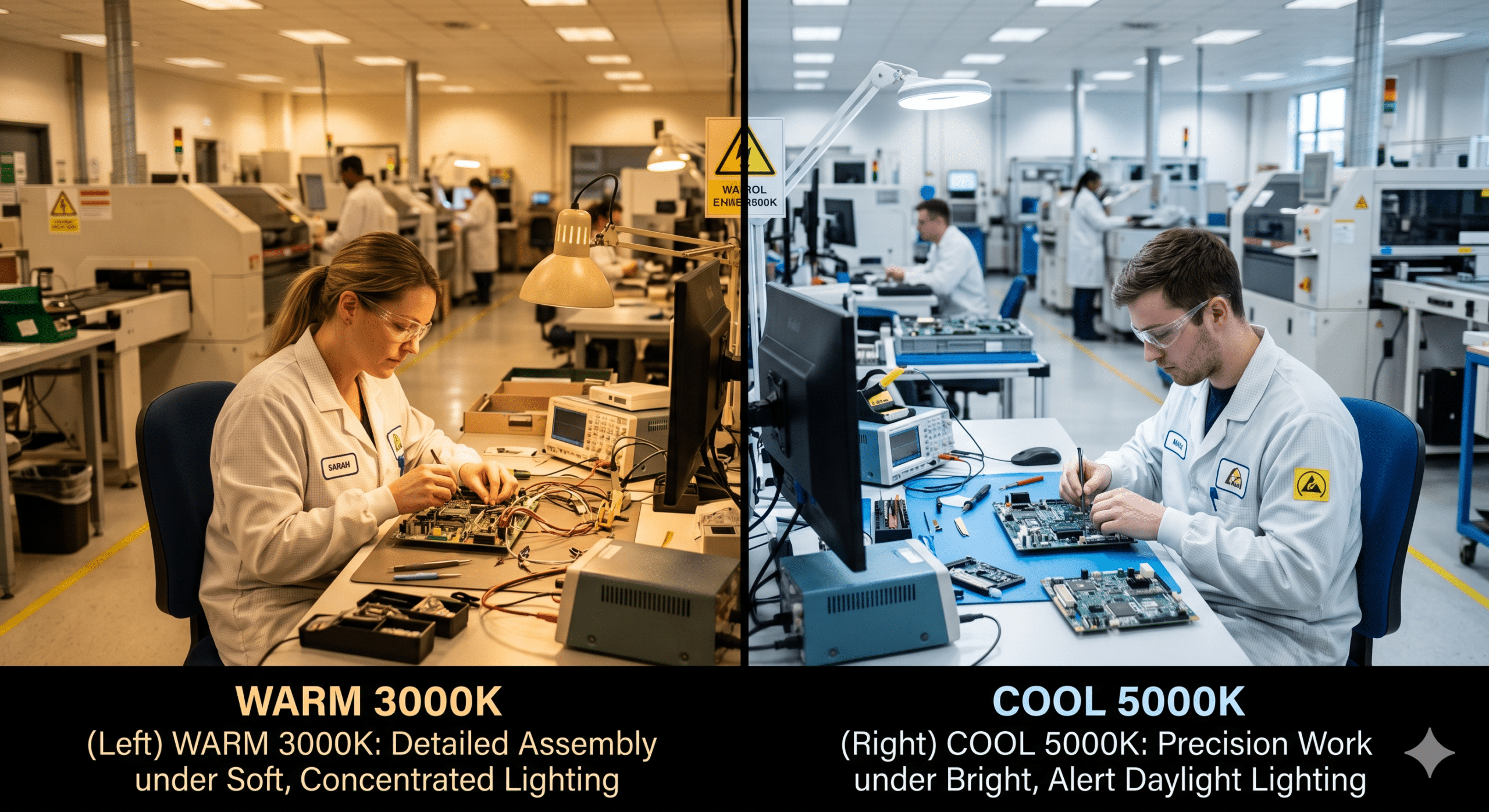
When people think about productivity, they often focus on training, technology, workflow improvements, or employee motivation. However, after years of working around industrial environments, warehouses, production floors, offices, and commercial facilities, I have learned that one factor is frequently overlooked despite having a direct impact on performance: lighting.
More specifically, the relationship between color temperature and task performance plays a much larger role than most people realize.
Many organizations invest thousands of dollars in equipment upgrades while continuing to work under lighting conditions that make concentration harder, increase visual fatigue, and contribute to mistakes. On the other hand, workplaces that carefully select lighting based on the tasks being performed often experience better focus, improved accuracy, reduced eye strain, and greater employee comfort.
Lighting and visibility systems are no longer just about making spaces brighter. Today, they are about creating environments where people can see clearly, think efficiently, and perform at their best.
Understanding Color Temperature
Before exploring how color temperature affects performance, it helps to understand what color temperature actually means.
Color temperature is measured in Kelvin (K) and describes the appearance of light emitted by a source. Lower Kelvin values produce warmer, yellowish light, while higher Kelvin values create cooler, bluish-white light. (Wikipedia)
For example:
- 2700K to 3000K creates a warm, relaxing appearance.
- 3500K to 4100K produces a neutral white light.
- 5000K to 6500K closely resembles natural daylight. (Wikipedia)
One of the most interesting aspects of color temperature is that warmer light actually has a lower Kelvin value, while cooler light has a higher Kelvin value. This often confuses people because the visual appearance seems opposite to the temperature measurement itself. (Wikipedia)
The human eye and brain respond differently to these lighting conditions, which is why color temperature has such a strong influence on task performance.
Why Lighting Matters More Than Most People Think
In industrial engineering, we often examine systems through the lens of efficiency. Every process contains inputs and outputs. Workers are expected to perform tasks accurately, consistently, and safely.
However, performance depends heavily on what people can see.
Poor visibility creates hidden inefficiencies. Workers may need extra time to inspect products, read labels, identify defects, operate machinery, or process information on screens. Small delays accumulate throughout the day and can significantly affect productivity.
Research shows that workplace lighting influences visual comfort, alertness, concentration, cognitive performance, and overall productivity. Studies have found that both illuminance levels and color temperature can affect attention and various forms of cognitive performance. (ScienceDirect)
This means lighting should be viewed as a productivity tool rather than simply a utility expense.
The Connection Between Color Temperature and Task Performance
The relationship between color temperature and task performance comes down to how different light spectra affect human perception and mental alertness.
Cooler light sources generally contain more blue-white wavelengths. These wavelengths tend to stimulate alertness and increase the feeling of wakefulness. Warmer light sources contain more yellow and red tones, which are typically associated with relaxation and comfort. (LinkedIn)
As a result, different tasks benefit from different lighting environments.
When workers are performing detail-oriented tasks that require precision and concentration, cooler color temperatures often provide advantages. When the goal is comfort, relaxation, or reducing stress, warmer color temperatures may be more appropriate.
The challenge is finding the right balance.
A lighting system that works perfectly in a manufacturing inspection area may perform poorly in a lounge, waiting room, or residential environment.
Industrial Environments and High-Performance Lighting
Throughout my experience observing manufacturing operations, I have seen firsthand how lighting affects quality control activities.
Imagine an inspector examining electronic components for defects. Tiny imperfections must be identified quickly and accurately. Under poor lighting conditions, defects may be overlooked or inspection speed may decrease.
In these situations, higher color temperatures often provide better visibility because they create stronger visual contrast and support concentration.
Many industrial facilities favor lighting systems in the 4000K to 5000K range because they provide a bright, neutral appearance that helps workers remain alert while maintaining good color recognition. (Instyle Deco Paris)
This is particularly important in environments where employees perform repetitive visual tasks for extended periods.
When visibility improves, error rates often decrease. When error rates decrease, productivity improves.
Office Productivity and Cognitive Performance
Modern office work has changed dramatically over the last decade. Employees spend much of their day interacting with computer screens, digital documents, and data-driven systems.
Because of this shift, cognitive performance has become increasingly important.
Recent research examining office environments found that lighting conditions can significantly influence attention and cognitive performance. Different combinations of color temperature and illumination levels produced measurable differences in participant performance during computer-based tasks. (ScienceDirect)
From a practical perspective, many office designers prefer color temperatures between 4000K and 5000K because they support alertness and concentration without feeling overly harsh. (Instyle Deco Paris)
Employees working on spreadsheets, reports, coding projects, design work, or data analysis often benefit from this balanced lighting approach.
The goal is not to create the brightest possible workspace. Instead, it is to create conditions that support sustained mental performance throughout the day.
Visual Fatigue: The Silent Productivity Killer
One issue that receives far too little attention is visual fatigue.
Many workers assume tired eyes are simply part of the job. However, poor lighting design frequently contributes to the problem.
Research examining workplace lighting found significant relationships between lighting conditions, color temperature, and visual fatigue. Environments with poorly designed lighting systems often resulted in higher levels of eye strain and discomfort. (Directory of Open Access Journals)
Visual fatigue affects more than comfort.
It can lead to slower reaction times, reduced concentration, headaches, increased errors, and lower productivity.
As an industrial engineer, I often view visual fatigue as an operational inefficiency. When employees must expend extra effort simply to see clearly, they have less energy available for the actual task.
Good lighting should reduce strain rather than create it.
The Role of Visibility Systems
Lighting and visibility systems extend beyond ceiling fixtures.
A complete visibility strategy includes workstation design, task lighting, glare control, surface reflectance, display positioning, and daylight integration.
Even the best color temperature cannot compensate for poor visibility caused by excessive glare.
Glare forces workers to constantly adjust their eyes, reducing visual comfort and increasing fatigue. This is especially common in offices where computer monitors are positioned directly across from windows.
Effective visibility systems ensure that light reaches work surfaces evenly and supports the visual requirements of the task being performed.
In many cases, improving visibility involves balancing multiple factors simultaneously rather than simply increasing brightness.
Why Daylight Remains the Gold Standard
Natural daylight continues to be one of the most effective lighting sources available.
Daylight typically falls within a color temperature range that promotes alertness, visual clarity, and natural color recognition. (Wikipedia)
Employees who have access to natural light often report higher levels of satisfaction and comfort.
From an engineering perspective, daylight provides excellent color rendering and dynamic variation throughout the day. These changes help maintain alignment with natural biological rhythms.
Unfortunately, many workplaces lack sufficient daylight access.
This is why modern LED lighting systems increasingly attempt to replicate natural daylight characteristics through carefully selected color temperatures.
Choosing the Right Color Temperature for Different Tasks
One of the biggest mistakes organizations make is using identical lighting throughout an entire facility.
Different tasks have different visual requirements.
For example, a conference room may benefit from slightly warmer lighting that encourages comfort and collaboration. A quality control laboratory may require cooler lighting that enhances detail recognition. A warehouse picking area may need a balance between visibility and energy efficiency.
Research consistently suggests that cooler white lighting between approximately 4000K and 5000K supports alertness and work-focused activities, while warmer lighting promotes relaxation and comfort. (Instyle Deco Paris)
Successful lighting design begins by understanding the task first and selecting the lighting environment second.
LED Technology Has Changed Everything
The widespread adoption of LED lighting has dramatically improved flexibility in lighting design.
Older lighting technologies often offered limited control over color temperature. Today, facility managers can select from a wide range of color temperatures or even install tunable systems that adjust throughout the day.
This capability allows organizations to create dynamic lighting environments tailored to human needs.
For example, cooler lighting can be used during periods requiring maximum concentration, while warmer lighting can be introduced later in the day to reduce visual stress.
This approach supports both productivity and employee well-being.
Human Factors and Lighting Design
Industrial engineering places significant emphasis on human factors.
The most efficient system is not always the fastest machine or newest technology. Often, it is the system that best supports human performance.
Lighting is a perfect example.
A workplace can have advanced automation, sophisticated software, and highly trained employees. Yet if workers struggle with poor visibility, performance suffers.
Human-centered lighting design recognizes that people are not machines. They respond emotionally, physically, and cognitively to their environment.
Thoughtful lighting design helps people perform at their highest potential.
Common Mistakes Organizations Make
One common mistake is assuming brighter lighting automatically means better performance.
Excessive brightness can create discomfort, glare, and visual fatigue.
Another mistake is selecting lighting based solely on energy efficiency without considering worker needs.
A third mistake is ignoring task-specific requirements.
For example, office spaces, manufacturing areas, inspection stations, break rooms, and meeting spaces often require different lighting strategies.
Organizations that treat lighting as a strategic resource rather than a commodity typically achieve better long-term results.
Future Trends in Lighting and Visibility Systems
The future of lighting is becoming increasingly intelligent.
Modern systems can automatically adjust brightness and color temperature based on occupancy, time of day, daylight availability, and user preferences.
Researchers continue exploring how adaptive lighting systems can improve cognitive performance, comfort, and overall well-being. Emerging studies suggest that carefully designed lighting environments may help optimize attention and task performance across different activities and times of day. (ScienceDirect)
As technology advances, lighting systems will likely become more personalized and responsive.
The focus will shift from simply illuminating spaces to actively supporting human performance.
Final Thoughts
The relationship between color temperature and task performance is far more significant than many people realize.
Lighting influences concentration, visual comfort, alertness, productivity, and workplace satisfaction. It affects how quickly people process information, how accurately they perform tasks, and how comfortable they feel throughout the workday.
From an industrial engineering perspective, lighting should be viewed as a performance-enhancing tool rather than a basic facility requirement.
The best lighting and visibility systems are those designed around people and the tasks they perform. When color temperature aligns with task requirements, employees work more comfortably, make fewer mistakes, and maintain higher levels of productivity.
In today’s competitive environment, even small improvements in performance matter. Sometimes the solution is not a new machine, a new process, or a new software platform.
Sometimes it starts with better light.
Frequently Asked Questions (FAQ)
What is color temperature in lighting?
Color temperature refers to the visual appearance of light and is measured in Kelvin (K). Lower Kelvin values create warmer yellow tones, while higher Kelvin values produce cooler blue-white light. (Wikipedia)
How does color temperature affect task performance?
Different color temperatures influence alertness, focus, visual comfort, and cognitive performance. Cooler lighting often supports concentration-intensive tasks, while warmer lighting promotes relaxation. (ScienceDirect)
What color temperature is best for office work?
Many experts recommend color temperatures between 4000K and 5000K for office environments because they promote alertness and support productivity. (Instyle Deco Paris)
Can poor lighting cause eye strain?
Yes. Research shows that inadequate lighting, poor light distribution, glare, and inappropriate color temperatures can contribute to visual fatigue and eye discomfort. (Directory of Open Access Journals)
Is daylight better than artificial lighting?
Natural daylight is generally considered ideal because it provides excellent color rendering and supports natural biological rhythms. However, modern LED systems can closely replicate many daylight characteristics. (Wikipedia)
Do industrial facilities need different lighting than offices?
Yes. Manufacturing, inspection, assembly, warehousing, and office tasks each have different visual requirements. Lighting systems should be designed according to the specific activities being performed. (BOSTONtec)
Further Reading and References
For readers who want to explore the topic in greater depth, these high-authority resources provide valuable research and insights:
- National Center for Biotechnology Information (NCBI) – Subjective and Objective Survey of Office Lighting Effects on Productivity
- ScienceDirect – Exploring the Relationship Between Office Lighting and Cognitive Performance
- DOAJ – Assessing Lighting and Color Temperature in Office Environments
- Bayes Business School – Lighting, Well-being and Performance at Work
- BenQ Ergonomic Lighting Guide – Workplace Productivity and Lighting Design