
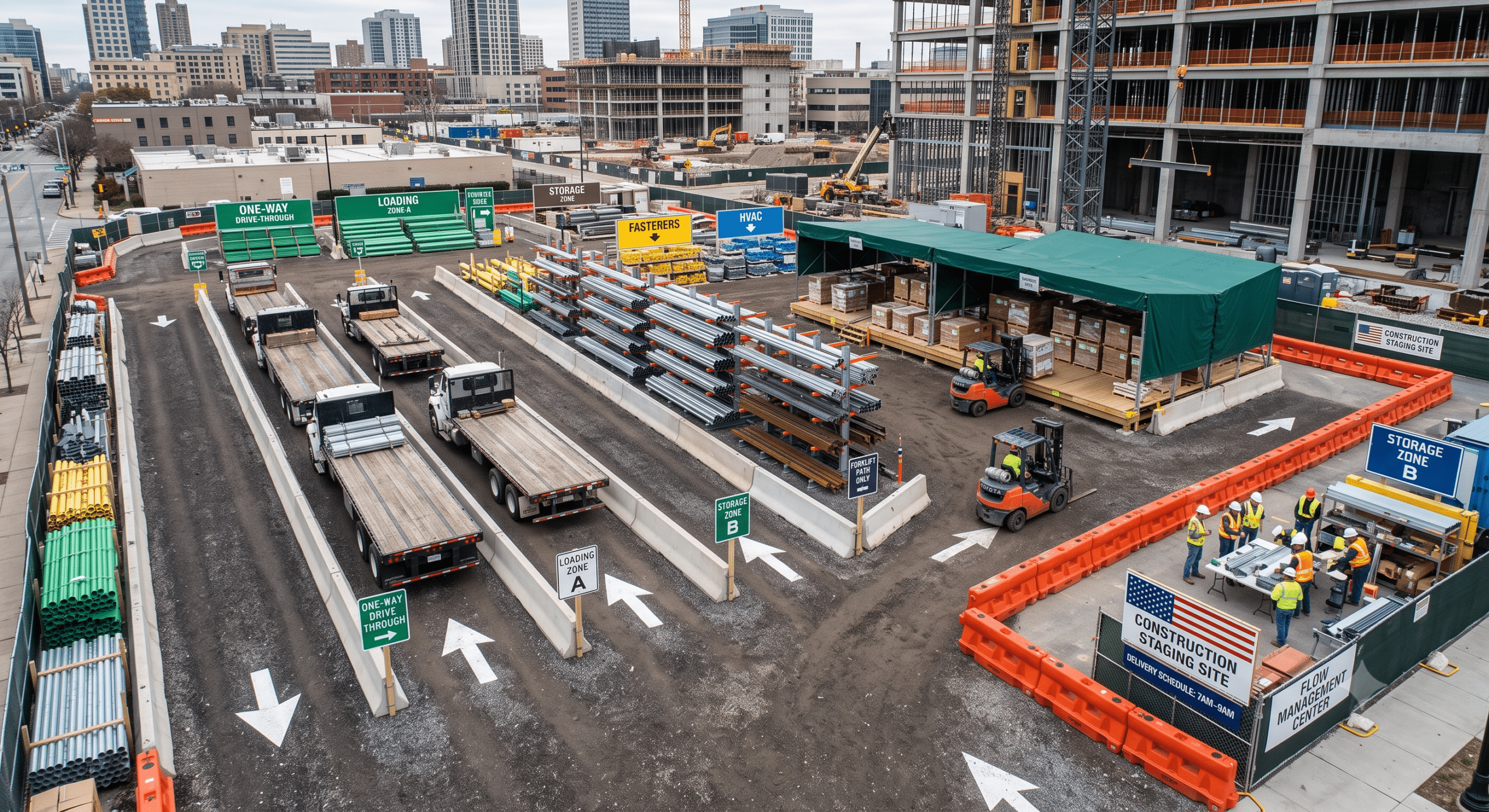
Every site manager knows that frustrating feeling when everything grinds to a sudden halt. For instance, you look across the yard and see a massive crane sitting completely idle. This expensive machinery sits unused because the flatbed truck carrying your structural steel is stuck in traffic. Meanwhile, you have three different crews walking around in circles. They are looking for rebar that a delivery driver buried under a mountain of extra drywall at one of your main construction staging sites.
When you manage a busy construction facility, the ground beneath your feet changes every single day. Therefore, unlike a factory where the assembly line stays in one place, a modern construction staging site must move constantly.
If you treat these areas like a giant outdoor closet, you will consequently lose money. Specifically, you lose cash to slow workflows, long delays, and ruined materials. Turning construction staging sites into smooth, fast-moving hubs requires a real strategy. To help you achieve this, here are twelve practical steps to keep your site moving fast and your waste to an absolute minimum.
1. Keep Your Yard Layout Flexible as the Building Grows
The biggest mistake you can make early on is assuming your initial yard layout will work forever. On the contrary, a great layout must change based on what your crew is building that week. For example, during the early digging phase, you need wide, heavy-duty dirt roads. This setup allows massive dump trucks to get in and out quickly and keeps your construction staging sites functioning at peak performance.
Subsequently, your team will start building the actual frame of the structure. At that point, you must alter those same zones. Now, you need to store materials directly under the hook of your tower crane instead.
Forklift drivers sometimes carry a load PDF fifty yards across the site just so a crane can pick it up. If so, you have essentially built an expensive delay right into your day. Therefore, you should keep distances short. This spatial awareness allows materials to move from trucks to the building in one fluid motion.
2. Create Straight Drive-Through Lanes to Avoid Traffic Jams
Trucks backing up at your front gate will quickly ruin your schedule. To keep things moving smoothly, your main entry points need straight, dedicated lanes. This setup lets delivery trucks pull completely off the public street. They can park safely before they even hit your security check or check-in desk.
Otherwise, a big delivery truck might idle in the middle of a busy public road while waiting for a spotter. When this happens, it slows down your entire supply chain.
By building a straight, one-way road right through your yard, you create a fast and predictable loop. As a result, trucks drive in and drop their load in a clearly marked zone. Afterward, they drive straight out the exit gate. Ultimately, this eliminates tricky backing maneuvers that often lead to broken equipment or damaged property at busy construction staging sites.
3. Order Only What You Need Right Now to Save Space
It is incredibly tempting to order all your materials way ahead of time just to feel safe. However, crowding tight construction staging sites with bulk inventory kills your daily speed. Indeed, too much stuff forces workers to move the exact same bundle of pipes three times. They waste energy just to get to a pallet of screws hidden behind it.
Instead, a better approach relies on ordering your supplies in small, customized batches. These deliveries should match what your crews need for the next forty-eight hours.
Consequently, this lean delivery method ensures that everything coming through the gate has an immediate home. Furthermore, it frees up massive amounts of physical space in your yard. It also keeps your main pathways clear for fast transport.
4. Use Vertical Racks to Reclaim Valuable Ground Space
Ground space on a city job site is incredibly hard to find. As a result, letting long, bulky items spread out across the dirt chokes your pathways. This clutter limits how much work your team can get done.
To solve this problem, you can install heavy-duty, weather-resistant cantilever racks along the edges of your site. This allows you to start storing items vertically.
By storing metal pipes, conduits, and steel bars on sturdy racks, you multiply your storage space. In addition, this simple change keeps your materials organized and highly visible. Machinery can grab items easily without cluttering up your main work paths or disrupting nearby construction staging sites.
5. Separate Your Materials to Prevent Costly Damage
A lot of construction waste happens because workers pile different types of materials together in a chaotic yard. For instance, you should never drop loose structural steel next to fragile glass windows. Keep heavy steel away from delicate light fixtures or moisture-sensitive drywall as well.
Instead, create clearly separated zones for different materials. This precaution ensures that heavy forklifts operate far away from fragile items.
Additionally, you should always place your sensitive finish materials in raised, covered areas. This protects them from rain, mud, and heavy equipment. By doing this, you keep your expensive supplies out of the trash bin.
6. Track Your Inventory with Simple Digital Tags
You cannot improve a process if you cannot see what is actually happening. Relying on paper clipboards to find a specific bundle of materials takes too much time. As a result, this slow method delays your crews. Therefore, managing modern construction staging sites requires basic digital tracking, like simple QR codes or scan tags.
The moment a delivery enters the site, a worker scans it. The system logs its exact location into a specific grid square in the yard.
Meanwhile, field supervisors can instantly check a phone app to see exactly where an item sits. This completely eliminates the hours workers waste wandering around the site looking for missing parts.
7. Pack Complete Project Kits Before Crews Start Working
To keep your installers moving fast, you need to reduce their search time. Stop them from hunting for tools and matching hardware. For this reason, your staging area should work like a packing station. Support workers can gather everything needed for a specific task ahead of time.
For example, a crew might plan to install air vents on the fourth floor. If so, their kit should arrive on a rolling cart. This cart will hold the exact vents, brackets, and screws required for that single shift.
Ultimately, delivering these pre-sorted kits directly to the work area keeps your skilled trade workers focused on building. They no longer waste time walking back and forth to the tool trailer for missing parts.
8. Set Up Strict Time Slots for Every Delivery
An uncoordinated delivery schedule creates instant chaos. Sometimes, three concrete trucks, a steel flatbed, and a plumbing supply van all show up at seven in the morning. Without warning, your entire site locks up.
However, using an online scheduling tool turns your front gate into a smooth, orderly checkpoint.
Specifically, suppliers must book a specific time slot. This time must match when your cranes and crews are actually ready to unload them. If a truck shows up late or early, it waits at an off-site holding lot. This policy ensures it does not block the active workspace.
9. Keep Heavy Machinery and Walkways Completely Separate
When heavy forklifts and walking workers share the exact same narrow dirt paths, accidents happen. Work slows down. Consequently, forklift operators must drive at a crawl to avoid foot traffic. This caution adds hours to your week.
To keep materials moving quickly, you must physically separate your heavy machinery lanes from pedestrian walkways.
By using bright plastic barriers or chain-link fencing to isolate machine lanes, you protect your crew. You also allow your equipment operators to move goods safely at top speed. This boundary eliminates the constant stop-and-go delays that lead to accidents and keeps your construction staging sites safe.
10. Build Strong, All-Weather Roads So Trucks Do Not Get Stuck
A construction staging site that turns into a swamp after a heavy rainstorm will ruin your project schedule. Indeed, muddy, bumpy surfaces slow down forklifts. These poor conditions strain truck engines and cause loads to shift and break.
Therefore, investing a little time and money upfront to stabilize your roads pays off massively. For example, you can use heavy-duty gravel layers or stabilization fabrics. Temporary composite mats also create a tough surface.
As a result, keeping your roads level and dry allows your equipment to travel safely. Forklifts can maintain a consistent speed all year long, regardless of bad weather.
11. Demand Better Packaging Standards from Your Suppliers
A surprising amount of construction waste happens before a worker even opens a box. Usually, it comes down to poor packaging that fails during transit. Materials also break while sitting out in the weather. Fortunately, you can stop this by setting clear rules with your suppliers.
For instance, require your vendors to use thick, waterproof plastic wrap. They should also use heavy-duty plastic edge protectors on every pallet they send.
When your materials arrive well-protected, you will see a massive drop in broken, rusted, or warped goods. This simple step saves you from a major headache. You no longer have to reject broken shipments and wait for emergency replacements.
12. Run Quick Bi-Weekly Audits to Find and Fix Delays
The final step to a fast-moving site requires paying close attention to the details. Therefore, make it a habit to check your material workflows every two weeks. Specifically, clock how long it takes to unload a typical truck. Measure how long it takes to get parts up to the builders, and track why materials sustain damage.
Afterward, review these quick notes with your team leaders. This meeting helps you catch problems before they turn into major delays.
If you notice that moving materials takes fifteen minutes longer than before, you can act immediately. Clear out clutter, adjust your paths, and get your site velocity back to where it needs to be. Proper management of your construction staging sites will always keep your workflow on the critical path.
Frequently Asked Questions
How does organizing one of these construction staging sites speed up a construction project?
An organized site ensures that you store materials in the order your team needs them. It also places them right next to cranes or hoists. Consequently, this cuts down on the time workers spend searching for supplies, reduces double-handling, and keeps your building crews working continuously.
What is the easiest way to cut down on material waste in the yard?
The best approach combines strict packaging rules for vendors with separate storage zones. This keeps heavy trucks from running over fragile items. Finally, you should use raised platforms under weather coverings for sensitive supplies.
Can you use just-in-time deliveries if your suppliers are unreliable?
Yes, you can manage this by setting up a small, temporary storage warehouse. Choose a location just a few miles away from your crowded job site. You can accept bulk orders at that location and then run small, well-timed truckloads to your main site exactly when the crews need the items.
Do small construction sites really need digital inventory tracking?
Absolutely. Simple tech like QR codes or phone apps eliminates human error and stops workers from losing track of materials. As a result, it saves hours of searching and helps you plan your deliveries based on real facts instead of guesses.
Further Reading and References
-
For a deep dive into building an effective material flow layout, see the structural template guide on ProjectManager regarding Construction Site Logistics Plans.
-
To explore professional layout frameworks and staging rules used by industry experts, read the comprehensive operational breakdown by SJVC on Construction Site Logistics and Planning.
-
For a detailed look at organizing heavy industrial layouts, read the specialized blueprint guide from Pinnacle Infotech on Best Practices in Construction Logistics.
-
To see how crowded urban zones impact transport and drop-off workflows, check out the study published in Frontiers in Built Environment regarding Urban Construction Logistics.