
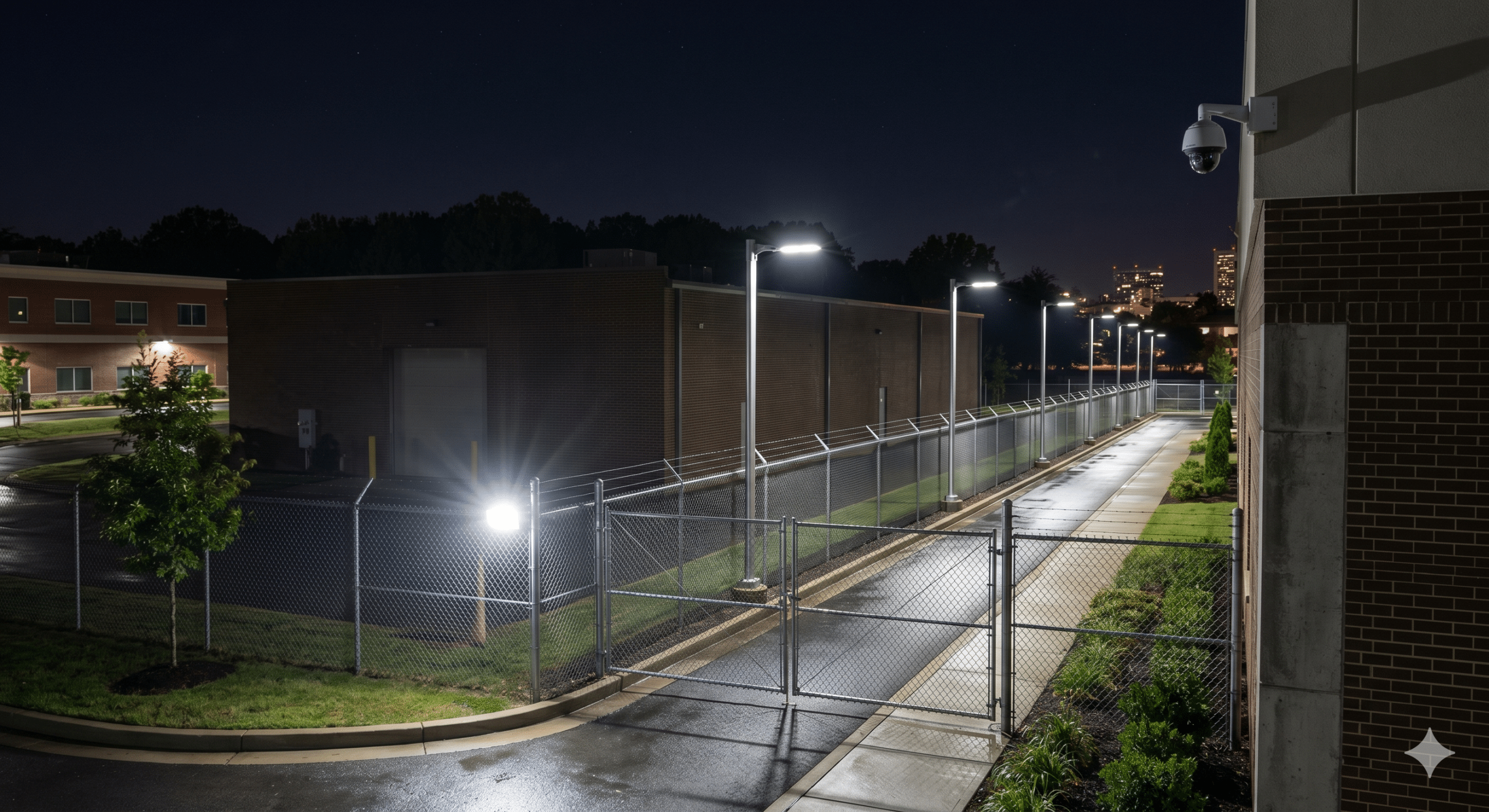
When the sun goes down, a property can look completely different from how it appears during daylight hours. Areas that seem safe and visible during the day can quickly become shadowed, difficult to navigate, and vulnerable to security risks at night. This is where outdoor perimeter and security lighting becomes one of the most important investments a property owner can make.
Many people think of security in terms of surveillance cameras, alarm systems, security guards, and access control technology. While all of those tools play an important role, they are often far less effective without proper lighting. Cameras cannot capture clear images in poorly lit areas. Security personnel cannot monitor spaces they cannot see. Visitors and employees cannot safely navigate dark pathways or parking lots.
As an Industrial Engineer, I have always viewed lighting as a critical component of both safety and operational efficiency. Throughout my experience observing commercial facilities, industrial sites, warehouses, residential communities, and public spaces, one common factor consistently stands out. Properties with properly designed outdoor perimeter and security lighting tend to experience better visibility, improved safety, more effective surveillance, and stronger overall security performance.
Good lighting is not simply about making an area brighter. Instead, it is about creating an environment where people can clearly see their surroundings, identify potential risks, and feel safe moving through a property after dark. When designed correctly, outdoor perimeter and security lighting becomes an invisible shield that protects assets, supports security systems, and creates peace of mind for everyone on the property.
Why Outdoor Perimeter and Security Lighting Matters More Than Ever
Security threats come in many forms. Property owners face concerns ranging from theft and vandalism to trespassing and unauthorized access. In many cases, criminals prefer locations where they can remain hidden and avoid detection.
Darkness naturally creates opportunities for concealment.
This is why outdoor perimeter and security lighting plays such an important role in crime prevention. A well-lit property reduces hiding places and increases the likelihood that suspicious behavior will be noticed. People are generally less likely to engage in criminal activity when they know they can easily be seen by security personnel, cameras, residents, employees, or passing traffic.
However, the benefits extend beyond security.
Proper lighting also improves safety by reducing slip, trip, and fall hazards. It helps visitors find entrances, guides drivers through parking areas, and supports employees who may work during evening or overnight shifts. In industrial and commercial environments, good lighting contributes directly to operational efficiency because workers can perform tasks with greater confidence and accuracy.
The value of outdoor perimeter and security lighting becomes even more apparent when considering the growing reliance on surveillance technology. Cameras perform significantly better when adequate illumination is available. Without sufficient lighting, even the most advanced security camera system can struggle to capture useful details.
Simply put, visibility is the foundation upon which every other security measure depends.
Understanding the Purpose of Security Lighting
One of the biggest misconceptions about security lighting is that its primary purpose is to make an area as bright as possible. In reality, effective security lighting is designed around visibility rather than brightness.
There are several important objectives that guide successful outdoor perimeter and security lighting projects.
The first objective is deterrence. Bright, visible spaces discourage unwanted activity because individuals are more likely to be observed.
The second objective is detection. Security personnel and surveillance systems must be able to identify movement or unusual behavior before a situation escalates.
The third objective is recognition. It is not enough to notice that someone is present. Security systems should allow people to recognize faces, identify vehicles, and distinguish important details.
The fourth objective is safety. Proper lighting reduces accidents by improving visibility throughout the property.
The fifth objective is operational support. Employees, contractors, residents, and visitors need clear visibility to move safely and perform their responsibilities.
When all of these objectives are achieved, lighting becomes an active contributor to security rather than simply a utility expense.
The Difference Between Brightness and Visibility
One lesson I have learned throughout industrial projects is that brighter does not always mean better.
Many property owners assume that installing powerful floodlights automatically improves security. Unfortunately, excessive brightness often creates new problems.
When certain areas are extremely bright while neighboring areas remain dark, harsh contrasts develop. The human eye must constantly adjust between light and dark zones, reducing overall visibility.
This phenomenon can create deep shadows that actually make it easier for someone to remain concealed.
Glare is another common problem. When lighting fixtures shine directly into a person’s eyes, visibility decreases rather than improves. Security guards, drivers, pedestrians, and camera systems can all be affected by excessive glare.
The goal of outdoor perimeter and security lighting is to create balanced illumination. Rather than producing isolated bright spots, lighting should provide consistent coverage across the entire area.
Uniform lighting allows people to see more clearly, move more safely, and identify potential threats more effectively.
Key Areas That Require Security Lighting
Every property is unique, but certain areas consistently benefit from dedicated security lighting.
Property boundaries are often the first priority. Fences, walls, perimeter roads, and access points should remain visible throughout the night. Dark perimeter areas can create opportunities for unauthorized entry.
Gates deserve special attention because they serve as primary entry and exit points. Whether a property uses manual gates or automated access systems, lighting should support both visibility and identification.
Parking lots are another critical area. Poorly illuminated parking areas increase the risk of accidents, vehicle damage, and criminal activity. Drivers need clear visibility to maneuver safely, while pedestrians need adequate lighting to navigate between vehicles and buildings.
Building entrances should remain highly visible at all times. Visitors, employees, customers, and delivery personnel should never struggle to locate access points after dark.
Loading docks and service yards are also important. Industrial facilities often conduct operations around the clock, making proper lighting essential for both security and productivity.
Walkways, pathways, and pedestrian routes require consistent illumination to reduce safety risks and improve user comfort.
By focusing on these high-priority areas, property owners can significantly improve overall security performance.
Why LED Technology Has Become the Industry Standard
The introduction of LED technology has transformed the way outdoor perimeter and security lighting systems are designed and operated.
Older lighting technologies such as metal halide and high-pressure sodium lamps were widely used for decades. While effective for their time, they often consumed large amounts of energy and required frequent maintenance.
LED fixtures offer several significant advantages.
The most obvious benefit is energy efficiency. LED systems consume substantially less electricity while delivering excellent illumination.
Long service life is another major advantage. Many LED fixtures can operate for tens of thousands of hours before requiring replacement, reducing maintenance costs and downtime.
LEDs also provide instant illumination. Unlike some traditional lamps that require warm-up periods, LED fixtures reach full brightness immediately.
Another important benefit is improved control. LED technology allows lighting designers to direct light precisely where it is needed rather than wasting energy illuminating unnecessary areas.
This combination of efficiency, durability, and performance has made LED technology the preferred choice for modern security lighting applications.
How Security Lighting Supports Surveillance Systems
Security cameras and lighting should never be treated as separate systems.
In reality, they work together to create a more effective security solution.
Even cameras equipped with advanced night vision capabilities perform better when adequate lighting is available. Clear illumination improves image quality, increases detail, and supports facial recognition and license plate identification.
Many surveillance failures can be traced back to poor lighting conditions rather than camera limitations.
For example, a camera positioned at a gate may struggle to capture useful images if approaching vehicles are surrounded by darkness. Similarly, cameras monitoring parking areas may miss important details when lighting is inconsistent.
When planning outdoor perimeter and security lighting, camera locations should always be considered. Lighting angles, intensity levels, and fixture placement should complement surveillance coverage rather than interfere with it.
The result is a more reliable and effective security system.
Motion Sensors and Smart Lighting Controls
Modern security lighting has become far more intelligent than traditional systems.
Rather than operating at full power throughout the night, many facilities now use motion sensors and smart controls to optimize performance.
Motion-activated lighting provides several advantages.
When movement is detected, lights can automatically increase brightness, drawing attention to activity within the area.
This sudden increase in illumination often serves as an effective deterrent because it immediately exposes anyone entering the space.
At the same time, smart controls help reduce energy consumption by lowering light levels when areas are unoccupied.
Network-connected systems can also provide remote monitoring, scheduling, and automated adjustments based on operating hours or environmental conditions.
For commercial and industrial facilities, these technologies create a balance between security and efficiency.
The Importance of Lighting Uniformity
One of the most overlooked aspects of outdoor perimeter and security lighting is uniformity.
Uniformity refers to how evenly light is distributed across an area.
Poor uniformity creates bright spots and dark zones. These variations can reduce visibility, increase eye strain, and compromise security.
Imagine walking through a parking lot where one section is brightly illuminated while the next section is almost completely dark. The transition can make it difficult to identify obstacles or detect movement.
Security cameras face similar challenges. Excessive differences in lighting levels can reduce image quality and make surveillance footage less useful.
Uniform lighting helps maintain consistent visibility across the entire property.
From an engineering perspective, achieving uniformity is often more important than maximizing brightness.
A moderately illuminated area with consistent coverage usually provides better visibility than an area filled with intense light and deep shadows.
Avoiding Common Security Lighting Mistakes
Many outdoor lighting systems fail to achieve their full potential because of avoidable design mistakes.
One common mistake is over-lighting. Installing excessively bright fixtures may seem like a good idea, but it often creates glare and visual discomfort.
Another mistake is ignoring shadows. Buildings, landscaping, vehicles, and equipment can block light and create concealed areas.
Improper fixture placement is also a frequent problem. Lights mounted at incorrect heights or angles may illuminate the wrong areas while leaving critical zones unprotected.
Some properties focus exclusively on entrances while neglecting perimeter boundaries and secondary access points.
Maintenance is another area that deserves attention. Burned-out fixtures, dirty lenses, and damaged equipment can significantly reduce system effectiveness over time.
A successful outdoor perimeter and security lighting strategy requires ongoing evaluation and maintenance to ensure consistent performance.
Balancing Security, Safety, and Energy Efficiency
In the past, improving security often meant increasing energy consumption.
Today, modern technology allows property owners to achieve both security and efficiency.
LED fixtures consume less energy while delivering excellent performance. Motion sensors reduce unnecessary operation. Smart controls optimize lighting schedules. Photocells automatically adjust operation based on daylight conditions.
These technologies allow facilities to maintain strong security without generating excessive utility costs.
From a sustainability perspective, efficient lighting systems also reduce environmental impact while supporting long-term operational goals.
This balance between security and efficiency has become one of the defining characteristics of modern lighting design.
The Future of Outdoor Perimeter and Security Lighting
The future of security lighting is becoming increasingly connected and intelligent.
Artificial intelligence, advanced sensors, and integrated security platforms are transforming how lighting systems operate.
Future systems will continue to communicate with cameras, access control devices, and building management systems in real time.
Lighting may automatically respond to detected threats, unusual activity patterns, or changing environmental conditions.
Predictive maintenance technologies may identify equipment issues before failures occur.
Data analytics will provide property managers with valuable insights into energy usage, occupancy patterns, and security performance.
While technology continues to evolve, one principle remains unchanged.
Visibility will always be one of the most powerful tools in physical security.
Conclusion
Outdoor perimeter and security lighting is much more than an exterior lighting system. It is a critical security asset that supports surveillance, improves safety, enhances visibility, and helps protect people and property after dark.
As an Industrial Engineer, I have seen firsthand how thoughtful lighting design can transform the effectiveness of a facility’s security strategy. The most successful systems focus on visibility, uniformity, reliability, and efficiency rather than simply increasing brightness.
Whether protecting a home, commercial property, industrial facility, educational campus, healthcare center, or residential community, investing in quality outdoor perimeter and security lighting delivers measurable benefits. It reduces vulnerabilities, strengthens security operations, supports safety objectives, and creates a more comfortable environment for everyone who uses the property.
In many ways, security begins with visibility. When people can clearly see their surroundings, they can make better decisions, respond more quickly to risks, and maintain a safer environment. That is why outdoor perimeter and security lighting remains one of the most valuable and cost-effective security investments available today.
Frequently Asked Questions
What is outdoor perimeter and security lighting?
Outdoor perimeter and security lighting refers to lighting systems installed around property boundaries, entrances, parking lots, pathways, fences, gates, and building exteriors to improve visibility, deter criminal activity, and support surveillance operations.
Why is outdoor perimeter and security lighting important?
It improves safety, increases visibility, discourages unauthorized activity, supports security cameras, and helps people navigate outdoor areas safely after dark.
Are LED lights recommended for security lighting?
Yes. LED fixtures provide excellent energy efficiency, long operating life, instant illumination, durability, and improved control compared to older lighting technologies.
Can security lighting reduce crime?
While lighting alone cannot eliminate crime, properly designed outdoor perimeter and security lighting can deter suspicious activity by reducing hiding places and increasing visibility.
Should security lights stay on all night?
Not necessarily. Many modern systems use motion sensors, timers, photocells, and smart controls to balance security requirements with energy efficiency.
How does security lighting help surveillance cameras?
Proper lighting improves image quality, enhances facial recognition, supports license plate identification, and increases the usefulness of recorded footage.
References and Further Reading
2. ANSI Blog – Security Lighting for Critical Infrastructure
3. ANSI Blog – Guideline for Security Lighting
4. National Protective Security Authority – Security Lighting Guidance
5. ScienceDirect – Security Lighting Overview
6. Ultimate Guide to Perimeter Security Lighting Design
7. Guide to Outdoor Security Lighting
8. DarkSky International Lighting Zones Guide
9. CDSE Exterior Security Lighting Guide