
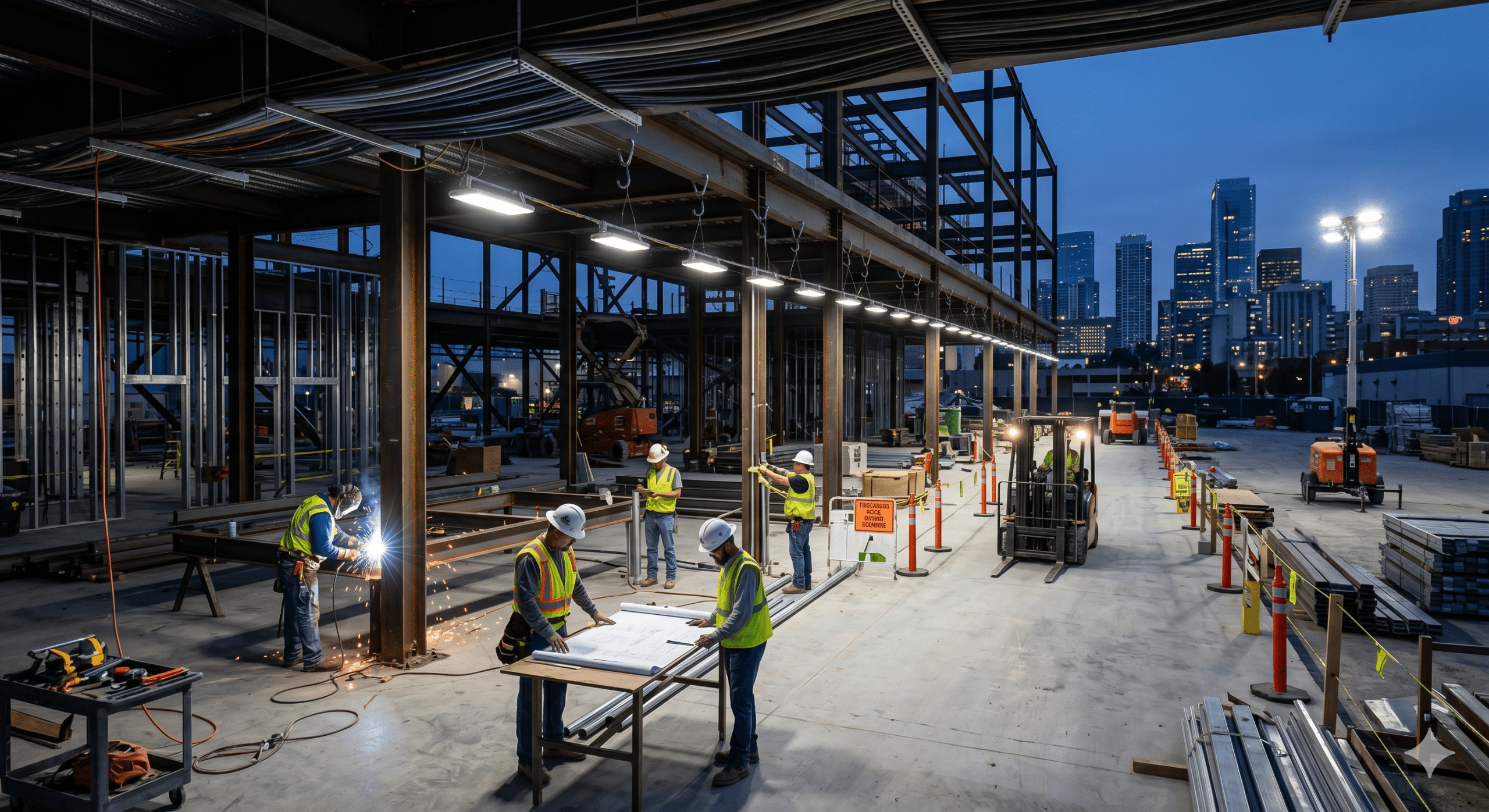
Construction sites are busy, fast-moving environments where dozens of activities happen simultaneously. Workers carry materials, equipment operators maneuver heavy machinery, supervisors inspect progress, electricians install systems, and contractors coordinate schedules. Amid all this activity, one critical element often receives less attention than it deserves: lighting.
Most people think of lighting simply as a way to help workers see in dark conditions. However, after years of looking at workplace operations through an Industrial Engineering perspective, I have learned that lighting affects far more than visibility. It influences safety, productivity, efficiency, quality control, worker comfort, and even project costs. In many cases, proper lighting can prevent accidents before they happen and help workers complete tasks faster and more accurately.
This is why temporary job-site lighting planning should never be treated as an afterthought. It should be considered a core component of project planning from the very beginning. Whether a project involves highway construction, commercial buildings, industrial facilities, bridge repairs, utility installations, or emergency response work, lighting plays a direct role in determining how safely and effectively the work will be completed.
When lighting is poorly planned, workers struggle to identify hazards, equipment operators have reduced visibility, inspection errors become more common, and productivity often declines. On the other hand, when temporary lighting is designed strategically, the entire job site operates more smoothly.
In this guide, we will explore the importance of temporary job-site lighting planning, how lighting and visibility systems contribute to workplace safety, and the best practices for creating effective lighting solutions that support both workers and project goals.
Why Temporary Job-Site Lighting Planning Matters
Construction projects rarely operate under perfect conditions. Work may continue before sunrise, after sunset, during cloudy weather, inside unfinished structures, or in enclosed spaces where natural light is limited. Even daytime projects often contain areas where shadows and obstructions reduce visibility.
Many job-site incidents occur because workers simply cannot see hazards clearly. Uneven surfaces, tools left in walkways, open trenches, equipment movements, and structural obstacles become significantly more dangerous when visibility is compromised.
Temporary job-site lighting planning addresses these challenges by creating an environment where workers can safely perform their tasks regardless of natural lighting conditions.
From an Industrial Engineering standpoint, lighting should be viewed as a system rather than a piece of equipment. Just as project managers carefully plan traffic flow, material handling, and workflow efficiency, they should also plan how light will support every activity taking place on the site.
Lighting impacts nearly every aspect of operations. It influences worker reaction times, visual accuracy, fatigue levels, equipment safety, communication effectiveness, and overall project performance. When workers can clearly see what they are doing, they tend to make fewer mistakes, complete tasks more efficiently, and maintain a higher level of situational awareness.
The benefits extend beyond safety. Proper lighting can reduce rework, improve inspection accuracy, support regulatory compliance, and help maintain project schedules.
Understanding the Difference Between Lighting and Visibility
One of the most common misconceptions on construction projects is the belief that more light automatically means better visibility.
In reality, lighting and visibility are not exactly the same thing.
Lighting refers to the amount of illumination present within a work area. Visibility refers to how clearly workers can identify objects, hazards, equipment, coworkers, and work surfaces.
A construction site may have powerful floodlights installed, yet still suffer from poor visibility if those lights create glare, deep shadows, or uneven illumination.
For example, imagine standing in front of a bright vehicle headlight at night. The area is technically illuminated, but your ability to see surrounding objects may actually decrease because the intense light overwhelms your vision.
The same principle applies on construction sites. The objective of temporary job-site lighting planning is not simply to increase brightness. The objective is to improve visibility.
Effective visibility allows workers to identify hazards quickly, judge distances accurately, recognize changes in elevation, read markings clearly, and perform detailed tasks with confidence.
The most successful lighting systems achieve a balance between illumination, uniformity, contrast, and comfort.
The Role of Lighting in Construction Safety
Safety professionals often focus on fall protection, personal protective equipment, lockout procedures, and hazard communication. While these areas are essential, lighting serves as the foundation that allows workers to recognize and avoid risks in the first place.
Poor lighting contributes to slips, trips, falls, collisions, equipment accidents, and operational errors.
Consider a worker walking through a partially completed structure during the early morning hours. If the pathway is poorly illuminated, the worker may fail to notice uneven flooring, protruding materials, or temporary obstacles.
Similarly, equipment operators rely heavily on visibility to identify pedestrians, barriers, and changing site conditions. Reduced visibility increases the likelihood of accidents involving heavy machinery.
Good lighting creates safer work environments by making hazards more visible. Workers can recognize potential dangers sooner and respond appropriately before incidents occur.
In my experience, lighting improvements often produce immediate safety benefits because they enhance awareness throughout the entire site rather than addressing a single hazard.
Starting With a Comprehensive Site Assessment
Every successful temporary job-site lighting planning process begins with a thorough site assessment.
Before selecting lighting equipment, planners should evaluate how the site functions and identify areas where visibility is critical.
This assessment should examine work activities, traffic patterns, pedestrian pathways, storage zones, access routes, inspection stations, equipment operating areas, and emergency exits.
A construction site is constantly evolving. New structures are built, materials are moved, and work zones change from week to week. As a result, lighting requirements may also change throughout the life of the project.
The assessment process helps planners determine where lighting will provide the greatest benefit.
For example, a material storage yard may require moderate illumination, while an electrical installation area may demand significantly higher visibility because of the precision involved.
By understanding how different areas are used, project teams can allocate lighting resources more effectively.
Identifying High-Risk Work Areas
Not all areas of a construction site present the same level of risk.
Certain zones require greater visibility because mistakes can have more serious consequences.
Excavations, scaffolding access points, elevated work platforms, stairways, equipment maintenance areas, crane operating zones, and electrical workstations typically demand higher illumination levels.
Workers performing detailed installation tasks also require sufficient lighting to maintain quality and accuracy.
One common mistake is distributing lighting evenly across the entire site without considering operational priorities.
A more effective approach focuses on providing enhanced visibility where it is needed most.
Risk-based lighting design ensures that critical work activities receive the support necessary to maintain both safety and productivity.
Selecting the Right Lighting Equipment
The effectiveness of any temporary lighting system depends largely on choosing equipment that matches project requirements.
Modern construction sites increasingly rely on LED technology because of its efficiency, durability, and long service life.
LED lighting offers several advantages over older technologies. It consumes less energy, generates less heat, requires less maintenance, and provides consistent illumination over extended periods.
Portable light towers remain one of the most common solutions for outdoor construction projects. These systems provide broad area coverage and can be repositioned as site conditions change.
String lighting systems are frequently used inside buildings under construction because they distribute light throughout corridors, stairwells, and workspaces.
Tripod-mounted floodlights provide focused illumination for specific tasks, while mobile lighting units offer flexibility for dynamic work environments.
The best temporary job-site lighting planning strategies often combine multiple lighting technologies rather than relying on a single solution.
The Importance of Lighting Uniformity
One of the most overlooked aspects of job-site lighting is uniformity.
Workers frequently move between different areas throughout the day. When lighting levels vary dramatically from one location to another, their eyes must continuously adjust.
This adjustment process increases visual fatigue and reduces the ability to recognize hazards quickly.
Imagine moving repeatedly between a brightly illuminated work zone and a poorly lit storage area. Each transition forces the eyes to adapt, creating temporary reductions in visual performance.
Uniform lighting minimizes these adjustments and supports consistent visibility across the site.
From an engineering perspective, lighting uniformity is often more important than achieving maximum brightness.
A moderately illuminated area with uniform lighting typically provides better visibility than a highly illuminated area filled with dark shadows and bright hotspots.
Reducing Shadows and Blind Spots
Shadows are among the most common visibility challenges on construction sites.
Heavy equipment, stacked materials, structural components, and temporary barriers can create shadowed areas where hazards become difficult to see.
A single floodlight may illuminate a work area while simultaneously creating large shadow zones behind objects.
These blind spots can conceal tools, materials, uneven surfaces, and other hazards.
Effective temporary job-site lighting planning uses multiple light sources positioned at different angles to reduce shadow formation.
By overlapping illumination patterns, planners can improve visibility throughout the site and eliminate many of the blind spots that contribute to accidents.
This approach creates a safer environment while improving worker confidence and efficiency.
Managing Glare for Better Visibility
While insufficient lighting creates obvious problems, excessive brightness can be equally problematic.
Glare occurs when intense light interferes with visual performance.
Workers exposed to glare may experience eye strain, discomfort, reduced contrast sensitivity, and difficulty identifying nearby objects.
Equipment operators are particularly vulnerable because glare can affect depth perception and reaction times.
In some cases, adding more light actually decreases visibility.
Proper fixture placement is essential for glare control. Lights should illuminate work surfaces rather than shine directly into workers’ eyes.
Beam angles, mounting heights, and fixture orientation all play important roles in reducing glare.
Good lighting design focuses on directing light where it is needed while minimizing visual discomfort.
Temporary Lighting for Night Operations
Many construction projects operate during nighttime hours to reduce traffic disruptions, meet deadlines, or take advantage of favorable working conditions.
Night operations place even greater demands on lighting systems.
Natural visibility decreases significantly after sunset, making artificial lighting the primary source of illumination.
Workers rely on lighting to navigate safely, identify hazards, and perform detailed tasks.
Equipment operators depend on clear visibility to detect pedestrians, barriers, and changing site conditions.
Road construction projects present unique challenges because lighting must support workers while minimizing distractions for motorists.
Balancing these competing needs requires careful planning and strategic fixture placement.
Successful nighttime projects often use layered lighting systems that combine general area illumination with task-specific lighting.
Weather Challenges and Environmental Conditions
Weather can dramatically affect the performance of temporary lighting systems.
Rain, fog, dust, snow, and wind all influence visibility in different ways.
Fog presents a particularly difficult challenge because excessive lighting can create reflections that reduce visibility rather than improve it.
Dust generated by construction activities can scatter light and decrease contrast.
Heavy rain may create reflections on wet surfaces, making it harder for workers to distinguish hazards.
For these reasons, temporary job-site lighting planning should account for local weather conditions and environmental factors.
Equipment should be selected for durability and resistance to outdoor conditions. Fixtures should be positioned to maximize visibility while minimizing adverse weather effects.
Reliable performance under changing conditions is essential for maintaining safety.
Productivity Benefits of Proper Lighting
Although safety is often the primary reason for improving lighting, productivity benefits should not be overlooked.
Workers perform best when they can see clearly.
Poor visibility slows task completion, increases errors, and contributes to fatigue.
Inspection activities require adequate lighting to identify defects and verify quality standards. Assembly tasks depend on visual accuracy. Equipment operators rely on visibility for efficient movement and positioning.
When lighting conditions improve, workers generally spend less time searching for tools, correcting mistakes, and navigating obstacles.
From an Industrial Engineering perspective, lighting represents a productivity investment that often delivers measurable returns.
Even modest improvements in visibility can produce significant gains in efficiency over the course of a project.
Integrating Visibility Systems Beyond Lighting
Modern job sites benefit from visibility systems that extend beyond traditional lighting equipment.
Reflective markings, illuminated signage, warning beacons, and high-visibility personal protective equipment all contribute to safer operations.
Reflective barriers help define work zones. Flashing warning lights draw attention to hazards. Illuminated exit signs support emergency response efforts.
When combined with effective lighting, these tools create a comprehensive visibility strategy that improves awareness throughout the site.
The goal is to ensure that workers can quickly recognize important information regardless of environmental conditions.
Emergency and Backup Lighting Requirements
Power disruptions can occur unexpectedly due to equipment failures, weather events, or utility issues.
Without backup lighting, workers may suddenly find themselves in hazardous conditions.
Emergency lighting provides critical visibility during power outages and supports safe evacuation procedures.
Construction sites should identify locations where emergency illumination is necessary and ensure that backup systems are available.
Battery-powered lighting units, portable generators, and emergency fixtures can help maintain visibility during unexpected events.
Regular testing is essential to ensure that backup systems function properly when needed.
Maintaining and Inspecting Temporary Lighting Systems
Even the best lighting plan can become ineffective if equipment is not maintained properly.
Construction environments are demanding. Dust, vibration, moisture, and physical impacts can affect lighting performance over time.
Regular inspections help identify damaged fixtures, burned-out lamps, loose connections, and alignment issues.
Light towers may require repositioning as work progresses. Temporary wiring should be inspected for damage and safety concerns.
Maintenance should be viewed as an ongoing part of temporary job-site lighting planning rather than a separate activity.
Consistent inspections help ensure that visibility remains adequate throughout the project.
Looking Toward the Future of Construction Lighting
Technology continues to transform how construction sites approach lighting and visibility.
Smart lighting systems now offer remote monitoring, automated controls, energy management, and real-time performance tracking.
Some advanced systems can automatically adjust illumination levels based on occupancy, weather conditions, or work activities.
These innovations help improve efficiency while reducing energy consumption.
As construction projects become more complex, intelligent lighting solutions will likely play an increasingly important role in supporting safety and productivity.
Conclusion
Temporary job-site lighting planning is one of the most valuable yet underappreciated elements of construction project management. While workers often notice lighting only when something goes wrong, its impact is present in every task performed on the site.
From an Industrial Engineering perspective, lighting should be viewed as a strategic system that supports safety, productivity, quality, and operational efficiency. Proper lighting helps workers identify hazards, operate equipment safely, perform tasks accurately, and maintain awareness of their surroundings.
The most successful projects recognize that visibility is not an accident. It is the result of thoughtful planning, careful equipment selection, ongoing maintenance, and continuous adaptation to changing site conditions.
When temporary lighting is designed effectively, workers perform with greater confidence, accidents become less likely, productivity improves, and projects move forward more smoothly. Ultimately, temporary job-site lighting planning is not simply about illuminating a construction site. It is about creating an environment where people can work safely, efficiently, and successfully every day.
Frequently Asked Questions
What is temporary job-site lighting planning?
Temporary job-site lighting planning is the process of designing, installing, managing, and maintaining temporary lighting systems that provide safe and effective visibility on construction and industrial projects.
Why is temporary lighting important on construction sites?
Temporary lighting improves worker visibility, reduces accidents, enhances productivity, supports quality control, and helps projects comply with safety regulations.
What type of lighting is commonly used for temporary construction sites?
LED light towers, portable floodlights, string lighting systems, and mobile lighting units are among the most commonly used temporary lighting solutions because they provide reliable illumination and energy efficiency.
How does lighting improve workplace safety?
Proper lighting helps workers identify hazards, recognize obstacles, navigate safely, operate equipment effectively, and perform tasks with greater accuracy.
What are the biggest mistakes in temporary job-site lighting planning?
Common mistakes include poor fixture placement, uneven illumination, excessive glare, inadequate emergency lighting, insufficient maintenance, and failing to update lighting layouts as site conditions change.
Can good lighting improve productivity?
Yes. Better visibility helps workers complete tasks more efficiently, reduces errors, improves inspection accuracy, minimizes rework, and supports smoother project operations.
References and Further Reading
- OSHA Construction Illumination Standard
- Health and Safety Executive (HSE) – Site Lighting Guidance
- WorkSite Lighting – Temporary Construction Lighting Guide
- PacLights – Portable Construction Lighting Best Practices
- ConstructConnect – Construction Lighting Best Practices
- MSC Industrial Supply – OSHA Lighting Standards Guide
- Avetta – OSHA Workplace Lighting Requirements
- Electrical Contractor Magazine – Temporary Construction Site Lighting Safety