
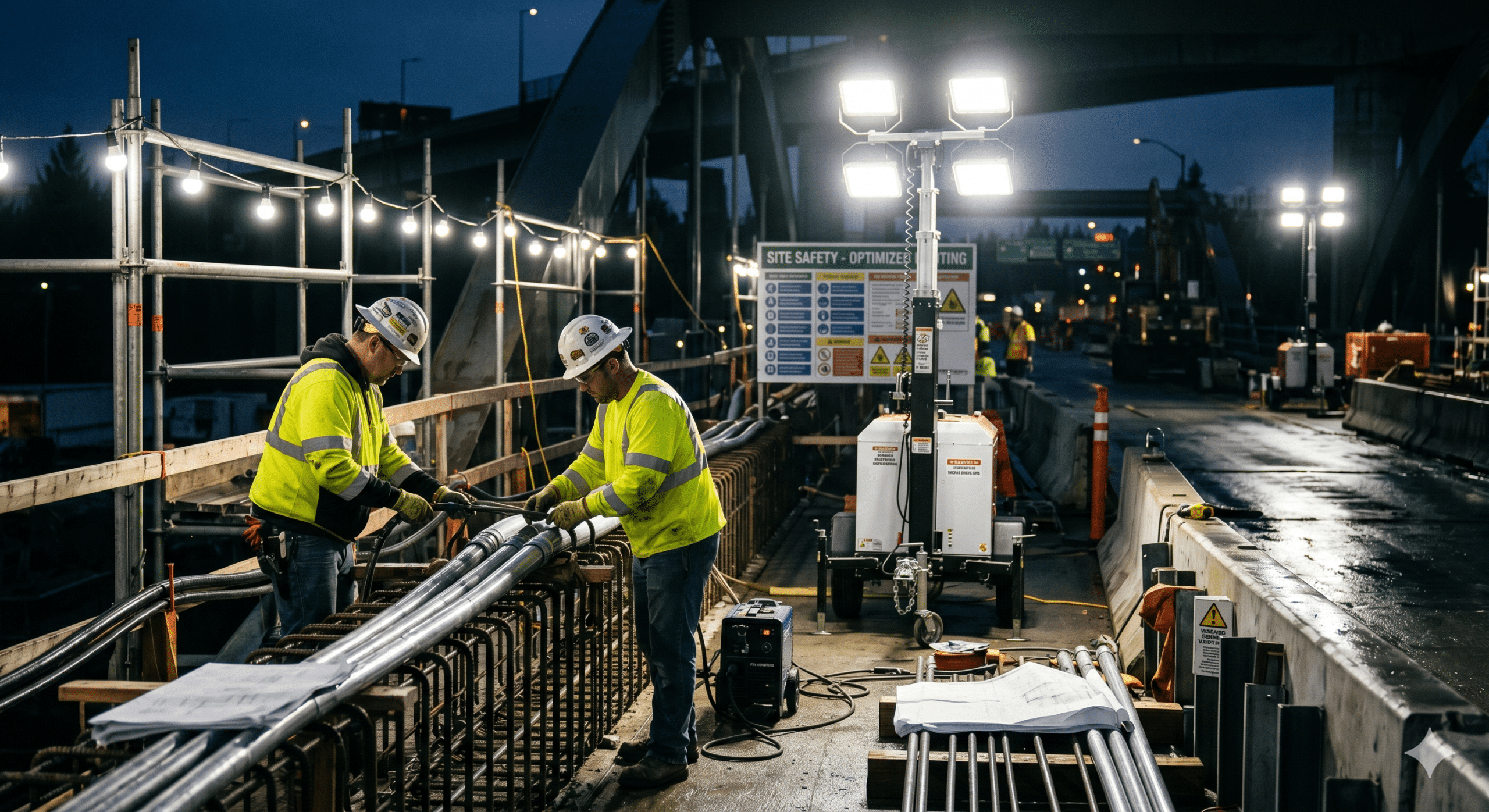
In every workplace, visibility plays a bigger role in safety and productivity than many people realize. Whether employees are working on a construction site before sunrise, performing maintenance inside a mechanical room, responding to an emergency power outage, or conducting inspections in a warehouse, their ability to clearly see their surroundings directly affects the quality of their work and their personal safety.
Throughout my experience working with industrial operations and workplace improvement projects, I have learned that many accidents do not happen because employees lack training or fail to follow procedures. Instead, they occur because workers cannot properly identify hazards, read equipment labels, inspect components, or safely navigate their environment. Something as simple as poor lighting can create a chain reaction that leads to injuries, equipment damage, project delays, and costly downtime.
This is where Portable lighting risk mitigation becomes a critical part of any workplace safety strategy. Portable lighting provides temporary, movable, and targeted illumination that helps workers maintain visibility in areas where permanent lighting is unavailable, insufficient, or temporarily out of service. Unlike fixed lighting systems, portable lighting can be deployed wherever it is needed, making it one of the most flexible and effective safety tools available across a wide range of industries.
From construction projects and manufacturing facilities to warehouses, mining operations, utility work, transportation hubs, and emergency response activities, portable lighting has become an essential component of modern risk management. It helps employees identify hazards, perform detailed tasks accurately, reduce fatigue, and maintain situational awareness in challenging environments.
The importance of portable lighting extends beyond simply making an area brighter. Effective lighting improves worker confidence, supports compliance with safety standards, enhances operational efficiency, and contributes to a stronger safety culture. Organizations that understand the value of visibility often experience fewer incidents, higher productivity levels, and better overall workplace performance.
In this article, we will explore how Portable lighting risk mitigation works, why it is essential for workplace safety, and how businesses can implement effective lighting strategies that protect workers while improving operational outcomes.
Understanding Portable Lighting Risk Mitigation
Portable lighting risk mitigation refers to the process of reducing workplace hazards through the use of temporary or movable lighting systems designed to improve visibility in specific work areas. These systems can be quickly installed, repositioned, and adjusted based on changing operational requirements.
Unlike permanent lighting installations, portable lighting provides flexibility. Workers can move lights closer to the task being performed, illuminate previously dark areas, and adapt lighting conditions as projects progress.
The primary purpose of portable lighting is to ensure workers have sufficient visibility to safely complete their tasks. When employees can clearly see their surroundings, they are more likely to identify hazards, avoid obstacles, maintain proper body positioning, and perform work accurately.
Portable lighting systems are commonly used during construction projects, maintenance activities, shutdowns, inspections, emergency situations, and outdoor operations where natural light may be limited.
From an Industrial Engineering perspective, portable lighting serves as a proactive risk control measure. Instead of waiting for accidents to occur, organizations can eliminate visibility-related hazards before they create dangerous situations.
Why Visibility Matters More Than Most People Think
Human beings depend heavily on vision when performing work-related tasks. Nearly every activity in an industrial environment requires workers to process visual information continuously.
Employees must identify hazards, monitor equipment conditions, read instructions, judge distances, recognize warning signs, inspect components, and safely move throughout their workspace.
When visibility decreases, the probability of errors and accidents increases significantly.
Poor visibility can contribute to slips, trips, falls, collisions, improper equipment operation, maintenance errors, and delayed responses to emergencies. Workers may overlook hazards that would otherwise be obvious under proper lighting conditions.
Even experienced employees can struggle when lighting conditions are poor. Skill and experience cannot compensate for an inability to see clearly.
One of the most common misconceptions in workplace safety is the belief that employees will simply exercise greater caution in dark environments. While workers may attempt to compensate, human vision has limitations. Safety systems should focus on removing hazards whenever possible rather than relying solely on human behavior.
Portable lighting helps eliminate one of the most preventable workplace hazards: inadequate visibility.
The Relationship Between Lighting and Workplace Accidents
Many workplace incidents have a direct or indirect connection to poor lighting conditions.
Consider a maintenance technician inspecting electrical equipment in a poorly illuminated room. If critical warning labels are difficult to read or damaged wiring cannot be easily identified, the risk of injury increases dramatically.
Similarly, warehouse employees navigating narrow aisles may fail to notice obstructions, damaged pallets, or uneven surfaces when lighting is insufficient.
Construction workers operating heavy machinery at night face additional challenges when shadows obscure obstacles or reduce depth perception.
In each of these situations, inadequate lighting creates an environment where hazards become more difficult to identify and avoid.
Portable lighting risk mitigation addresses these challenges by improving visibility exactly where it is needed. Better lighting allows workers to recognize dangers sooner, react more effectively, and perform tasks with greater precision.
Common Work Environments That Depend on Portable Lighting
Construction Sites
Construction projects are among the most common applications for portable lighting systems.
Because construction sites are constantly evolving, permanent lighting infrastructure is often unavailable during many phases of a project. Workers may perform excavation, framing, concrete placement, roofing, electrical installation, and finishing activities long before permanent lighting systems become operational.
Portable lighting provides a practical solution that supports safe work practices throughout each phase of construction.
Night shifts, early morning work, and seasonal daylight limitations make portable lighting even more important. Proper illumination allows workers to identify hazards, operate equipment safely, and maintain productivity despite changing conditions.
Industrial Maintenance Operations
Maintenance activities frequently occur in locations where visibility is limited.
Technicians often work inside equipment enclosures, utility tunnels, ceiling spaces, mechanical rooms, storage areas, and service corridors. In some cases, lighting systems may need to be disconnected during repairs, creating additional visibility challenges.
Portable lighting provides maintenance teams with reliable illumination that helps them perform inspections, troubleshoot problems, and complete repairs safely.
Improved visibility also reduces the likelihood of maintenance errors, which can have significant operational and financial consequences.
Emergency Response Situations
Power outages, equipment failures, severe weather events, and facility emergencies often create immediate visibility concerns.
Emergency responders must quickly assess conditions, identify hazards, and take corrective action. Without adequate lighting, response efforts become slower and more dangerous.
Portable emergency lighting provides essential illumination that supports evacuation procedures, emergency repairs, security operations, and incident management activities.
Having portable lighting readily available can significantly improve an organization’s ability to respond effectively during unexpected events.
Warehouses and Distribution Facilities
Warehouses present unique visibility challenges due to their size, storage configurations, and operational demands.
High storage racks can create shadows and dark zones that reduce visibility in specific areas. Temporary storage arrangements, maintenance projects, and seasonal inventory increases may also affect lighting conditions.
Portable lighting allows facility managers to address these issues quickly without making permanent modifications to the building.
Improved visibility helps warehouse employees locate products, operate material handling equipment safely, and navigate storage areas more efficiently.
Outdoor Work Areas
Outdoor operations face constantly changing lighting conditions.
Workers may begin their shifts before sunrise, continue working after sunset, or encounter weather conditions that reduce visibility throughout the day.
Fog, rain, snow, dust, and cloud cover can significantly impact visibility even during daylight hours.
Portable lighting systems provide the flexibility needed to adapt to these changing conditions while maintaining safe working environments.
The Hidden Costs of Poor Lighting
Many organizations underestimate the true cost of inadequate lighting.
The consequences extend far beyond employee discomfort or inconvenience.
Poor lighting can contribute to workplace injuries that result in medical expenses, workers’ compensation claims, lost productivity, and increased insurance premiums.
In addition to safety concerns, inadequate lighting often reduces work quality. Employees may make mistakes, miss defects, or require additional time to complete tasks.
Equipment damage is another common consequence. Operators who cannot clearly see their surroundings are more likely to strike obstacles, damage materials, or improperly position machinery.
Project delays can also occur when work must be slowed or suspended due to visibility concerns.
From an Industrial Engineering standpoint, lighting should be viewed as an investment rather than an expense. The cost of providing adequate illumination is typically far lower than the cost of accidents, downtime, rework, and operational inefficiencies.
Key Principles of Effective Portable Lighting Risk Mitigation
Successful portable lighting strategies require more than simply placing a light in a dark area.
Effective risk mitigation involves careful planning and consideration of several important factors.
Providing Adequate Illumination
The first goal is ensuring sufficient light reaches the work area.
Different tasks require different illumination levels. Simple walking areas may require relatively low lighting levels, while detailed inspections and precision work demand significantly brighter conditions.
The amount of light should support the specific activity being performed without creating discomfort or visual strain.
Minimizing Shadows
Shadows are often overlooked when setting up portable lighting.
A single bright light source can create dark areas behind equipment, materials, or structural components. These shadows may conceal hazards that workers need to identify.
Using multiple light sources from different angles helps create more uniform illumination and reduces shadow-related risks.
Balanced lighting improves visibility across the entire work area rather than concentrating light in a single location.
Controlling Glare
Excessive brightness can be just as problematic as insufficient lighting.
When lights are improperly positioned, workers may experience glare that interferes with their ability to see clearly.
Glare can cause eye strain, visual discomfort, reduced contrast sensitivity, and temporary loss of visibility.
Proper fixture placement and beam direction help ensure light reaches the task area without shining directly into workers’ eyes.
Illuminating Access Routes
Safety does not begin when workers arrive at their task location.
Employees must also travel safely to and from work areas.
Portable lighting plans should include walkways, staircases, entry points, exit routes, and equipment access paths.
Providing illumination along travel routes reduces the risk of slips, trips, and falls while improving overall workplace safety.
Matching Lighting to Task Requirements
Not all portable lighting applications are the same.
An equipment inspector may require focused task lighting to identify small defects, while a construction crew may need wide-area floodlighting to illuminate a large work zone.
Understanding task-specific requirements helps organizations select the most effective lighting solutions.
Selecting the Right Portable Lighting Equipment
Modern portable lighting technology offers numerous options for different applications.
LED Portable Work Lights
LED lighting has become the preferred choice for most industrial applications.
Compared to older lighting technologies, LEDs provide superior energy efficiency, longer service life, lower maintenance requirements, and improved durability.
LED lights also generate less heat, making them safer and more comfortable for workers operating in close proximity to the equipment.
Rechargeable Lighting Systems
Battery-powered lighting provides flexibility in locations where electrical power is unavailable or impractical.
Rechargeable units are commonly used during emergencies, outdoor projects, inspections, and remote operations.
Advances in battery technology have significantly increased operating times, allowing modern portable lights to function for extended periods without recharging.
Portable Light Towers
Large-scale projects often require extensive area illumination.
Portable light towers provide powerful lighting coverage for construction sites, roadwork projects, mining operations, utility repairs, and large outdoor facilities.
These systems help maintain safe working conditions across broad areas while supporting continuous operations.
Inspection and Task Lighting
Certain activities require highly focused illumination.
Inspection lights are specifically designed to provide concentrated light for detailed examinations, troubleshooting, and precision work.
Maintenance personnel frequently rely on these tools when inspecting machinery, electrical systems, piping, and structural components.
Electrical Safety Considerations
While portable lighting improves visibility, organizations must also manage associated electrical hazards.
Damaged cords, exposed wiring, overloaded circuits, and improper grounding can create significant risks.
Routine inspections should be performed before each use to identify potential defects.
Workers should be trained to recognize signs of damage and remove defective equipment from service immediately.
Ground fault protection devices provide additional safeguards against electrical shock, particularly in wet or outdoor environments.
Electrical safety should always be considered an integral part of any portable lighting risk mitigation program.
Portable Lighting in Hazardous Locations
Certain workplaces contain flammable gases, combustible dust, chemical vapors, or other explosive atmospheres.
Standard lighting equipment may create ignition sources that increase the risk of fires or explosions.
In these environments, organizations must use specially certified explosion-proof or hazardous-location-rated lighting systems.
These products are designed to prevent sparks, excessive heat, and other ignition sources from coming into contact with hazardous materials.
Selecting the correct equipment is critical for protecting workers and maintaining regulatory compliance.
Developing a Portable Lighting Strategy
Effective Portable lighting risk mitigation begins with planning.
Organizations should evaluate their facilities, identify areas where visibility challenges may occur, and develop procedures for deploying portable lighting when needed.
A comprehensive lighting strategy typically includes risk assessments, equipment selection criteria, maintenance schedules, emergency preparedness plans, and employee training programs.
The most successful organizations treat lighting as a core component of their overall safety management system rather than a temporary solution to occasional problems.
By planning ahead, businesses can respond quickly when lighting needs arise and maintain safe operations under a wide range of conditions.
The Future of Portable Lighting Technology
Portable lighting technology continues to evolve rapidly.
Modern systems now incorporate smart controls, wireless monitoring, motion sensors, solar charging capabilities, and advanced battery management features.
These innovations improve reliability, reduce energy consumption, and simplify maintenance requirements.
Future developments will likely focus on even greater efficiency, automation, and integration with broader workplace safety systems.
As organizations continue to prioritize risk reduction and operational excellence, portable lighting will remain an essential tool for creating safer and more productive work environments.
Conclusion
Portable lighting is far more than a convenience. It is a powerful safety tool that directly influences visibility, hazard recognition, worker performance, and overall operational success.
From construction sites and manufacturing facilities to warehouses, maintenance operations, and emergency response situations, effective Portable lighting risk mitigation helps organizations prevent accidents before they occur.
As an Industrial Engineer, I have consistently observed that workplaces with strong lighting strategies experience fewer safety incidents, better productivity, improved work quality, and greater employee confidence. Workers perform best when they can clearly see their environment and complete tasks without unnecessary visual challenges.
Organizations that invest in portable lighting are investing in safety, efficiency, and long-term operational performance. By providing the right light in the right place at the right time, businesses can create environments where employees work smarter, safer, and more effectively.
In many cases, one of the simplest ways to reduce risk is also one of the most powerful: ensuring that every worker has the visibility needed to do the job safely.
Frequently Asked Questions
What is Portable lighting risk mitigation?
Portable lighting risk mitigation is the process of reducing workplace hazards through the use of temporary or movable lighting systems that improve visibility and support safer working conditions.
Why is Portable lighting risk mitigation important?
It helps workers identify hazards, avoid accidents, improve task accuracy, reduce fatigue, and maintain productivity in environments where permanent lighting may be inadequate.
Where is portable lighting commonly used?
Portable lighting is commonly used on construction sites, warehouses, manufacturing facilities, maintenance projects, emergency response operations, utility work, mining sites, and outdoor job locations.
What are the benefits of LED portable lighting?
LED portable lights offer energy efficiency, durability, long operating life, low maintenance requirements, excellent visibility, and reduced heat generation.
Can portable lighting improve productivity?
Yes. Better visibility allows workers to complete tasks more accurately and efficiently while reducing delays caused by poor lighting conditions.
How often should portable lighting equipment be inspected?
Portable lighting equipment should be inspected before each use and regularly throughout its service life to identify damage, electrical issues, or performance problems.
References and Further Reading
- Health and Safety Executive (HSE) – Lighting at Work Guidance
- LEDVANCE Professional Lighting Resources
- Work Zone Safety Information Clearinghouse – Nighttime Lighting Guidance
- National Safety Council (NSC) – Workplace Safety Resources
- Illuminating Engineering Society (IES) – Lighting Standards and Best Practices
- Avetta – OSHA Workplace Lighting Requirements Guide
- PacLights – Temporary Lighting Engineering Considerations
- Occupational Safety and Health Guidelines for Workplace Lighting