
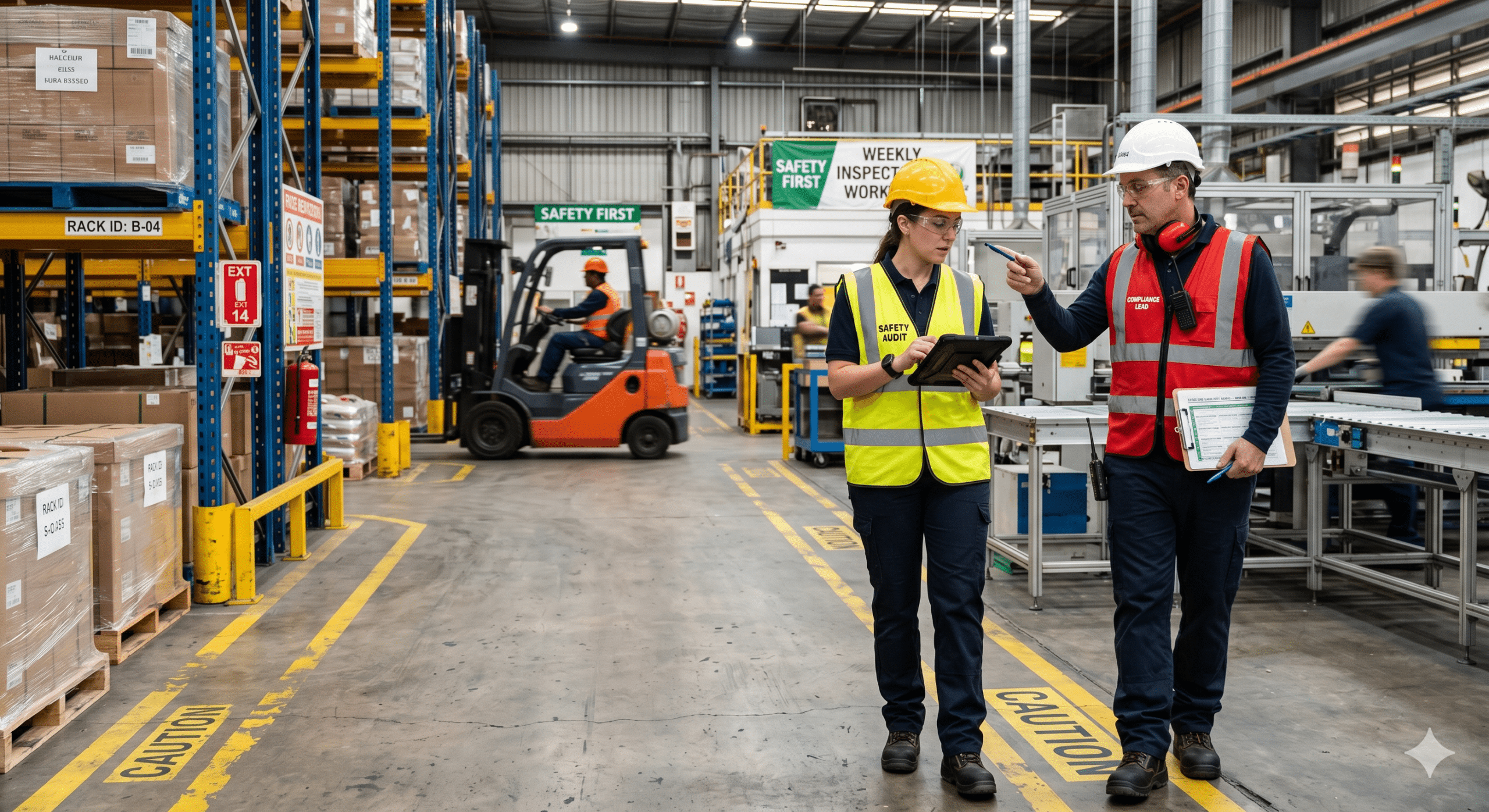
Organizations often associate facilities safety with compliance checklists, regulatory inspections, and mandatory employee training. While those activities certainly matter, they represent only one part of an effective safety program. From a Governance, Risk, and Compliance (GRC) perspective, facilities safety serves a much larger purpose. It protects employees, safeguards assets, supports operational continuity, and strengthens organizational resilience.
Many companies invest substantial time and money in developing safety policies and procedures. However, written policies alone do not prevent incidents. In fact, many workplace accidents occur because organizations fail to verify whether employees consistently follow established safety controls. Consequently, hazards remain unnoticed, unsafe behaviors become routine, and minor issues eventually grow into serious operational risks.
This reality highlights the importance of safety audits and internal inspections. Rather than reacting to incidents after they occur, organizations can identify weaknesses before those weaknesses create injuries, downtime, regulatory violations, or financial losses.
Furthermore, effective safety programs contribute directly to operational excellence. When facilities reduce hazards, they also reduce disruptions. As a result, organizations improve throughput, shorten cycle times, minimize waste, and maintain more predictable operations. Therefore, leaders should view safety audits as strategic business tools rather than administrative requirements.
In this article, we will examine thirteen significant ways safety audits and internal inspections improve facilities safety, strengthen compliance programs, and support long-term business success.
Why Facilities Safety Requires Continuous Evaluation
Many organizations assume they have achieved safety once they create policies and train employees. Unfortunately, that assumption often creates a false sense of security.
Workplaces constantly evolve. Equipment ages, production demands increase, employees change roles, and organizations adopt new technologies. Additionally, contractors, vendors, and temporary workers introduce new variables into the workplace environment.
Because facilities change continuously, yesterday’s safety controls may not adequately address today’s risks. Consequently, organizations need a reliable method for evaluating whether their controls remain effective.
Safety audits and internal inspections provide that ongoing verification. Specifically, they help organizations identify hazards, evaluate compliance, assess risk controls, and measure safety performance. More importantly, they allow leaders to address issues before those issues escalate into costly incidents.
As a result, organizations can move from a reactive approach to a proactive risk management strategy.
Understanding the Difference Between Audits and Inspections
Although many professionals use the terms interchangeably, audits and inspections serve different functions.
A safety inspection focuses primarily on physical conditions within the workplace. For example, inspectors may evaluate emergency exits, machine guards, housekeeping practices, fire extinguishers, electrical systems, and storage areas. Therefore, inspections help organizations identify immediate hazards that require prompt attention.
A safety audit, however, examines the effectiveness of the overall safety management system. Auditors review policies, training programs, incident investigations, corrective actions, documentation, leadership involvement, and compliance processes. Consequently, audits help organizations understand whether their safety framework actually works as intended.
In simple terms, inspections reveal current hazards, while audits evaluate the systems designed to prevent those hazards. Therefore, organizations achieve the best results when they combine both approaches.
1. Early Hazard Identification Prevents Serious Incidents
One of the most valuable benefits of safety audits and internal inspections involves identifying hazards before they cause harm.
Every facility contains potential risks. For example, damaged flooring can create trip hazards. Likewise, leaking equipment can create slip hazards. Similarly, blocked exits can delay emergency evacuations.
Without regular inspections, employees may overlook these conditions until an incident occurs. However, organizations that conduct routine inspections identify hazards much earlier.
Consequently, maintenance teams can correct issues while they remain manageable and inexpensive. Furthermore, early intervention prevents disruptions that often accompany accidents, equipment failures, and regulatory investigations.
Therefore, proactive hazard identification supports both workplace safety and operational efficiency.
2. Stronger Regulatory Compliance
Organizations face increasing pressure to comply with safety regulations, industry standards, and internal policies.
Regulatory agencies expect employers to provide safe workplaces and maintain appropriate documentation. Therefore, organizations must demonstrate that they actively monitor workplace conditions and address identified risks.
Safety audits and internal inspections help organizations verify compliance before regulators conduct official inspections. Additionally, these evaluations reveal gaps that could expose the organization to penalties, legal liabilities, or reputational damage.
As regulations evolve, organizations can also use audits to assess whether current procedures align with new requirements. Consequently, they reduce compliance risks while strengthening governance practices.
Most importantly, organizations create a culture of accountability when they consistently monitor compliance performance.
3. Improved Equipment Reliability and Asset Protection
Facilities safety and equipment reliability share a close relationship. In many cases, equipment failures create both operational and safety risks.
For example, worn machine components can malfunction unexpectedly. Likewise, damaged guards may expose employees to injury. Additionally, neglected maintenance can shorten equipment lifespan and increase repair costs.
Fortunately, safety inspections often reveal these issues before they escalate into major failures.
When maintenance teams identify and resolve problems early, organizations avoid unplanned downtime and expensive emergency repairs. Furthermore, they extend asset life and improve equipment performance.
Consequently, organizations protect employees while maximizing the value of their operational assets.
4. Reduced Downtime and Operational Disruptions
Every workplace incident affects productivity. Injuries trigger investigations. Equipment failures interrupt production. Regulatory violations consume management attention.
As a result, even a relatively small incident can create significant operational disruption.
However, organizations that prioritize safety audits and internal inspections experience fewer unexpected interruptions. Because teams identify and resolve risks early, operations remain more stable and predictable.
Furthermore, employees can perform their work with greater confidence in a safe environment. Consequently, workflow efficiency improves and throughput remains consistent.
This connection between safety and productivity often surprises leaders. Nevertheless, safer facilities frequently achieve stronger operational performance than facilities that neglect proactive safety management.
5. Better Corrective Action Management
Identifying hazards represents only the first step in an effective safety program. After all, organizations create real value when they take action on audit findings and inspection results.
Many facilities struggle because teams document issues but fail to resolve them completely. Consequently, the same problems appear repeatedly during future inspections. Over time, unresolved issues can create frustration among employees and weaken confidence in the organization’s commitment to safety.
Effective organizations approach corrective action management differently. Instead of treating findings as paperwork exercises, they assign ownership, establish deadlines, monitor progress, and verify completion.
Furthermore, strong corrective action programs encourage accountability at every level of the organization. Managers understand their responsibilities, employees recognize the importance of compliance, and leadership gains visibility into outstanding risks.
As a result, organizations reduce recurring issues and strengthen overall safety performance. More importantly, they build a culture where continuous improvement becomes part of daily operations rather than an occasional initiative.
6. Stronger Emergency Preparedness
Emergencies rarely occur at convenient times. Therefore, organizations must prepare long before a crisis develops.
Fire incidents, severe weather events, power failures, hazardous material releases, and security threats can disrupt operations without warning. Consequently, facilities must evaluate their readiness on a regular basis.
Safety audits and internal inspections help organizations assess emergency preparedness from multiple angles. For example, auditors may review evacuation procedures, emergency lighting systems, communication protocols, assembly areas, and fire protection equipment.
Additionally, inspections help verify that emergency exits remain accessible and that employees understand their responsibilities during emergencies.
Organizations that regularly evaluate emergency readiness typically respond more effectively when unexpected events occur. Furthermore, they often recover faster because they have already identified and addressed weaknesses within their response plans.
Therefore, emergency preparedness audits not only protect employees but also support business continuity and operational resilience.
7. Greater Employee Engagement and Safety Awareness
Safety programs achieve better results when employees actively participate in them.
Although leadership establishes expectations, frontline workers often possess the deepest understanding of day-to-day operational risks. Therefore, organizations should encourage employees to contribute during inspections and audits.
When employees participate in safety activities, they become more aware of workplace hazards and risk controls. Furthermore, they develop a stronger sense of ownership over safety outcomes.
This engagement creates several benefits. First, employees identify hazards that managers may overlook. Second, they become more likely to report concerns before incidents occur. Third, they help create practical solutions that fit real operational conditions.
Consequently, organizations improve both safety performance and workforce morale.
Moreover, employees often view active participation as evidence that management values their input. As a result, trust increases and safety culture becomes stronger across the organization.
8. Improved Risk Visibility for Leadership
Effective governance depends on accurate information.
Leaders cannot manage risks effectively if they lack visibility into workplace conditions. Therefore, organizations need reliable data that supports informed decision-making.
Safety audits provide that visibility by generating objective information about compliance performance, operational risks, and control effectiveness.
For example, audit findings may reveal recurring deficiencies in training, equipment maintenance, contractor management, or documentation practices. Individually, these issues may appear minor. However, when leaders analyze them collectively, they often identify broader trends that require strategic attention.
Furthermore, audits help organizations prioritize resources based on actual risk exposure rather than assumptions.
As a result, leadership teams can make more informed decisions regarding investments, staffing, training, and operational improvements.
From a GRC perspective, this enhanced visibility strengthens governance while supporting proactive risk management.
9. Lower Financial Losses and Unexpected Costs
Every workplace incident carries financial consequences.
Some costs are immediately visible. For instance, organizations may incur medical expenses, equipment repair costs, legal fees, insurance claims, or regulatory penalties.
However, indirect costs often create an even greater financial burden.
When incidents occur, productivity frequently declines. Supervisors spend time investigating events. Employees may require additional training. Production schedules can experience delays. In some situations, organizations may even lose customers due to operational disruptions.
Fortunately, safety audits and internal inspections help organizations prevent many of these costs.
By identifying hazards before incidents occur, organizations avoid expenses associated with injuries, downtime, and regulatory enforcement actions.
Consequently, proactive safety management often delivers substantial financial returns over time.
10. Better Contractor and Vendor Risk Management
Modern facilities frequently rely on contractors, vendors, and third-party service providers.
While these external partners provide valuable expertise, they can also introduce additional safety risks. Therefore, organizations must ensure that contractors follow the same safety standards expected of employees.
Safety audits help organizations evaluate contractor performance and verify compliance with workplace requirements.
For example, auditors may review contractor training records, work permits, equipment inspections, and hazard control procedures. Additionally, they may observe contractor activities to ensure compliance with established safety protocols.
This oversight reduces the likelihood of incidents involving third parties. Furthermore, it protects the organization from liability associated with contractor-related accidents.
As contractor relationships continue to grow across industries, effective oversight becomes increasingly important.
11. Enhanced Use of Technology and Data Analytics
Technology continues to transform safety management.
In the past, organizations often relied on paper forms, manual reporting processes, and spreadsheets. While those methods served a purpose, they frequently created delays and limited visibility.
Today, many organizations use digital platforms to manage audits, inspections, corrective actions, and incident reporting.
These systems offer several advantages. First, they improve data accuracy. Second, they accelerate reporting processes. Third, they provide real-time visibility into safety performance.
Additionally, analytics tools help organizations identify trends that may otherwise remain hidden.
For example, leaders can track recurring hazards, monitor corrective action completion rates, and analyze inspection results across multiple locations.
Consequently, organizations gain deeper insights into risk patterns and make better-informed decisions.
From a compliance perspective, technology also improves documentation quality and supports regulatory readiness.
12. Greater Organizational Resilience
Resilient organizations anticipate challenges rather than merely reacting to them.
Because operational environments continue to evolve, organizations face a wide range of risks. These risks may include regulatory changes, workforce shortages, supply chain disruptions, cybersecurity incidents, or environmental events.
Safety audits contribute to resilience by identifying vulnerabilities before they affect operations.
Furthermore, organizations that continuously evaluate controls develop stronger capabilities for adapting to change.
For example, a facility that regularly reviews emergency procedures, maintenance programs, and risk controls can respond more effectively when unexpected events occur.
Consequently, resilience becomes a competitive advantage rather than simply a risk management objective.
Organizations that prepare for uncertainty typically recover faster and maintain stronger operational stability.
13. Continuous Improvement Drives Long-Term Success
Perhaps the greatest benefit of safety audits and internal inspections involves their role in continuous improvement.
Every inspection generates information. Every audit uncovers opportunities. Every corrective action strengthens organizational performance.
Rather than focusing solely on compliance, successful organizations use audits as learning tools.
For example, audit findings may reveal opportunities to streamline processes, improve training programs, strengthen communication, or enhance maintenance practices.
As organizations implement these improvements, safety performance gradually improves. At the same time, operational efficiency increases and risk exposure decreases.
Over months and years, these incremental gains create significant business value.
Consequently, organizations develop stronger safety cultures, more effective compliance programs, and more resilient operations.
Most importantly, continuous improvement helps organizations stay ahead of emerging risks rather than constantly reacting to them.
Best Practices for Building an Effective Audit Program
Organizations achieve the greatest value from audits when they adopt a structured and consistent approach.
First, leaders should align audit schedules with operational risk levels. High-risk areas deserve more frequent attention than lower-risk environments.
Second, organizations should establish clear inspection criteria and standardized evaluation methods. Consistency improves accuracy and allows teams to compare results across locations.
Third, management should encourage employee participation throughout the audit process. Frontline employees often identify practical solutions that strengthen risk controls.
Fourth, organizations should track corrective actions until teams fully resolve them. Without follow-through, audit findings lose much of their value.
Finally, leadership should regularly analyze trends and performance metrics. This analysis helps organizations identify recurring issues and allocate resources effectively.
When organizations follow these practices, audits become powerful tools for both compliance and operational excellence.
Final Thoughts
Facilities safety is not simply a compliance requirement or a regulatory obligation. Instead, it serves as a critical business function that protects employees, preserves operational continuity, and strengthens organizational resilience.
Throughout this article, we explored how safety audits and internal inspections help organizations identify hazards, improve compliance, strengthen emergency preparedness, and reduce operational risk. However, their value extends even further. When organizations conduct audits consistently and act on the findings, they create safer workplaces while simultaneously improving efficiency, reliability, and performance.
From a Governance, Risk, and Compliance perspective, audits provide leadership with the visibility needed to make informed decisions. Furthermore, inspections help organizations verify that safety controls operate as intended rather than simply existing on paper. Consequently, management can address weaknesses before they evolve into costly incidents, regulatory violations, or operational disruptions.
Additionally, organizations that embrace regular audits often discover opportunities for process improvement. As teams identify recurring issues, they can eliminate inefficiencies, strengthen accountability, and improve resource allocation. Therefore, audits contribute not only to safety outcomes but also to operational excellence.
Most importantly, organizations should avoid viewing audits as isolated events. Instead, leaders should integrate them into a broader continuous improvement strategy. When organizations treat every audit as an opportunity to learn, improve, and strengthen controls, they create a culture where safety becomes part of everyday decision-making.
Ultimately, the most successful facilities do not wait for incidents to reveal weaknesses. Rather, they use safety audits and internal inspections as proactive tools to uncover risks, strengthen governance, and support long-term business success.
Frequently Asked Questions
What are safety audits and internal inspections?
Safety audits and internal inspections are structured evaluations that help organizations identify hazards, assess compliance, verify control effectiveness, and improve workplace safety performance. While inspections focus on identifying physical hazards, audits evaluate the overall effectiveness of the safety management system.
Why are safety audits and internal inspections important?
These evaluations help organizations detect hazards before incidents occur, improve regulatory compliance, strengthen risk management, and support continuous improvement efforts. Furthermore, they provide valuable information that leadership can use to make informed decisions regarding workplace safety.
How often should facilities conduct internal inspections?
The appropriate frequency depends on operational risk levels, facility complexity, and regulatory requirements. High-risk environments often require daily, weekly, or monthly inspections, while lower-risk environments may conduct inspections less frequently. Organizations should align inspection schedules with their risk assessments.
What is the difference between a safety audit and a safety inspection?
A safety inspection focuses on workplace conditions, equipment, employee practices, and immediate hazards. In contrast, a safety audit examines policies, procedures, training programs, documentation, and overall system effectiveness. Together, they provide a comprehensive approach to workplace safety.
How do safety audits improve operational performance?
Safety audits reduce incidents, prevent equipment failures, and minimize unplanned downtime. As a result, organizations often improve productivity, maintain consistent throughput, and reduce operational disruptions. Effective audits also help identify inefficiencies that may affect performance.
Can technology improve safety inspections?
Yes. Digital inspection platforms, mobile reporting tools, automated workflows, and analytics dashboards help organizations improve visibility, track corrective actions, and identify trends more efficiently. Consequently, many organizations use technology to strengthen both safety performance and compliance management.
Who should participate in safety audits?
A strong audit program typically involves safety professionals, supervisors, department managers, health and safety committee members, and frontline employees. Employee participation is particularly valuable because workers often identify practical risks and improvement opportunities that others may overlook.
How do audits support a strong safety culture?
Audits reinforce accountability, encourage employee involvement, and demonstrate leadership commitment to safety. Furthermore, regular evaluations remind employees that safety remains a priority across all levels of the organization. Consequently, organizations often experience stronger engagement and better safety performance.
References and Further Reading
For readers who want to deepen their understanding of safety audits and internal inspections, the following high-authority resources provide valuable guidance, best practices, and practical frameworks.
- EcoOnline – Health and Safety Inspections and Audits – A comprehensive guide covering inspections, audits, compliance requirements, employee participation, and continuous improvement. The article also explains how organizations can integrate inspections into broader safety management systems.
- Arinite – Health and Safety Audits: Compliance & Best Practice Guide – An in-depth resource focused on audit systems, ISO 45001 alignment, compliance requirements, and using audit findings to drive meaningful organizational improvements. Excellent for GRC professionals and safety leaders.
- CMX1 – How to Perform a Safety Inspection: A Comprehensive Guide – Provides practical guidance for conducting effective safety inspections, creating checklists, and using technology to improve workplace safety programs.
- Field1st – Safety Audits and Inspections: A Comprehensive Guide – Explains how audits and inspections work together to reduce incidents, improve compliance, and create proactive safety cultures across organizations.
- GoAudits – How to Perform OHS Audits and Inspections – A practical resource that covers audit types, implementation strategies, inspection checklists, and continuous improvement practices. Academic and Emerging Technology Resources
For readers interested in the future of workplace safety and inspection technologies:
- Automated construction safety inspections using AI and multimodal systems. (arXiv)
- AR-assisted safety inspections for hazard detection in construction environments. (arXiv)
- Advanced industrial inspection and safety assessment technologies. (arXiv)
These resources highlight how organizations increasingly combine traditional audits with advanced technologies to improve safety visibility and operational performance.