
Lockout/Tagout Systems Explained: 7 Safety Controls That Protect People and Performance
Introduction
Every facility depends on equipment, machinery, and systems to keep operations running smoothly. Manufacturing plants rely on production equipment. Warehouses depend on conveyors and automated systems. Commercial facilities use pumps, electrical systems, compressors, and mechanical equipment every day. While these assets help organizations achieve their goals, they also introduce significant risks during maintenance and servicing activities.
Most workplace incidents involving machinery do not happen during normal operations. Instead, they often occur when technicians inspect, repair, clean, adjust, or maintain equipment. During these tasks, employees work closer to hazardous energy sources and moving components. As a result, even a small mistake can lead to serious injuries, equipment damage, or costly operational disruptions.
This is why understanding lockout/tagout systems explained is so important for facilities safety, compliance, and risk governance.
Many organizations view lockout/tagout procedures as regulatory requirements. While compliance certainly matters, effective hazardous energy control delivers benefits that extend far beyond passing inspections. Strong lockout/tagout programs protect employees, improve maintenance quality, reduce downtime, and strengthen business continuity.
From a Governance, Risk, and Compliance perspective, organizations should treat hazardous energy control as a critical operational safeguard rather than a simple safety checklist.
When leaders fully understand lockout/tagout systems explained, they gain a practical framework for reducing workplace risks while supporting reliable operations.
Why Hazardous Energy Remains a Serious Workplace Risk
Every machine uses energy to perform work. However, that same energy can become dangerous when employees service or repair equipment.
For example, a technician may shut down a machine and assume it is safe to work on. However, stored energy can remain inside the system long after the equipment stops operating. Hydraulic pressure, compressed air, rotating parts, electrical charges, and elevated machine components can still create hazards.
Because of these hidden dangers, maintenance activities often carry greater risks than routine operations.
Imagine a worker repairing a conveyor system. While the technician performs maintenance, another employee accidentally energizes the equipment. Within seconds, moving parts can create severe injuries.
Likewise, a maintenance worker may disconnect a hydraulic line without realizing pressure remains trapped inside the system. When the pressure releases unexpectedly, it can cause serious harm.
These situations demonstrate why lockout/tagout systems explained remains one of the most important facilities safety topics today.
Organizations that fail to control hazardous energy expose employees to unnecessary risks. Furthermore, they increase the likelihood of equipment damage, regulatory violations, production delays, and financial losses.
What Is Lockout/Tagout?
To understand lockout/tagout systems explained, it helps to start with a simple definition.
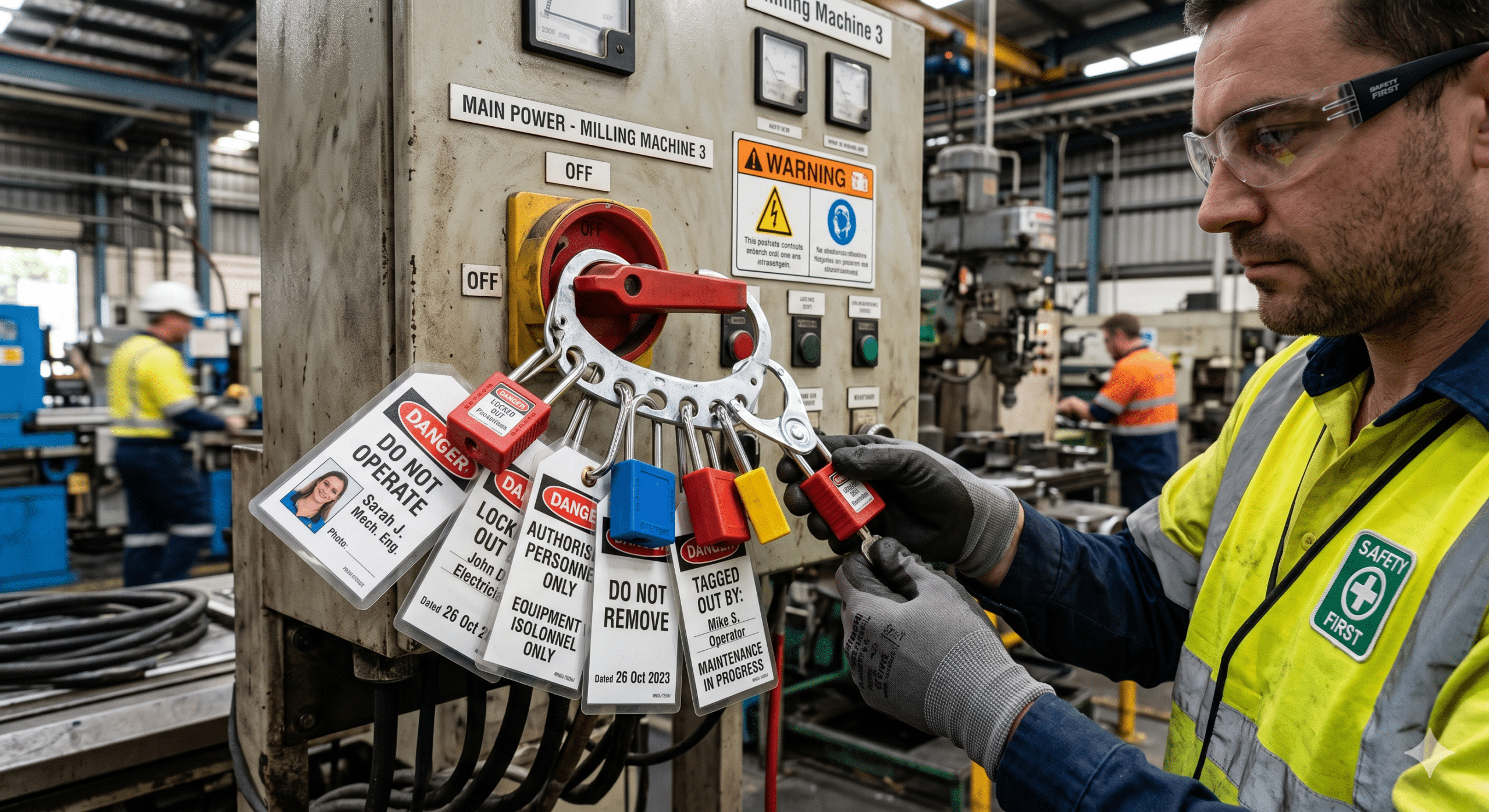
Lockout/tagout, often called LOTO, is a safety procedure that prevents machinery or equipment from starting unexpectedly while employees perform maintenance, servicing, inspection, or repair work.
The process requires authorized employees to shut down equipment, isolate energy sources, apply locks, attach warning tags, and verify that hazardous energy no longer exists before work begins.
Although the concept appears straightforward, effective implementation requires careful planning and consistent execution.
Employees must identify every energy source connected to the equipment. They must isolate those energy sources properly. They must release stored energy and verify safe conditions before beginning work.
Because each step plays a critical role, organizations cannot afford shortcuts.
A single missed energy source can undermine the entire process.
Consequently, successful facilities treat lockout/tagout as a structured risk management practice rather than a routine maintenance task.
Understanding the Different Types of Hazardous Energy
A complete discussion of lockout/tagout systems explained must include the various forms of energy that exist within facilities.
Many workers immediately think about electricity. However, several other energy sources can create equally serious hazards.
Electrical Energy
Electrical energy powers machinery, motors, control panels, pumps, conveyors, lighting systems, and automation equipment.
Maintenance personnel face risks such as electric shock, burns, arc flash incidents, and unexpected equipment startup when organizations fail to isolate electrical systems properly.
Therefore, employees must verify electrical isolation before beginning work.
Mechanical Energy
Mechanical energy exists in moving machine components such as gears, rollers, chains, flywheels, belts, and rotating shafts.
Even after operators turn off equipment, moving components may continue operating because of momentum.
As a result, technicians must ensure all motion has stopped before entering hazardous areas.
Hydraulic Energy
Hydraulic systems use pressurized fluids to create force.
Many industrial machines depend on hydraulic systems for lifting, pressing, clamping, and movement functions.
However, hydraulic pressure can remain inside the system after shutdown.
Because of this risk, maintenance personnel must release stored pressure before beginning repairs.
Pneumatic Energy
Compressed air systems create another common hazard.
Many facilities use pneumatic equipment to power valves, tools, and automated processes.
Stored air pressure can release unexpectedly if workers disconnect lines or components without proper isolation procedures.
Therefore, organizations should include pneumatic energy within their hazardous energy control programs.
Thermal Energy
Heat can also create serious workplace hazards.
Boilers, ovens, furnaces, steam systems, and industrial processing equipment often retain dangerous temperatures after shutdown.
Maintenance teams must allow sufficient cooling time before servicing these systems.
Otherwise, employees may suffer burns or heat-related injuries.
Gravitational Energy
Some equipment contains energy simply because gravity acts upon it.
Suspended loads, elevated machine parts, and heavy components can move unexpectedly if workers fail to secure them properly.
For this reason, effective lockout/tagout procedures often include blocking, bracing, and mechanical restraints.
When organizations examine lockout/tagout systems explained thoroughly, they recognize that hazardous energy extends far beyond electrical power.
Looking at Lockout/Tagout Through a Risk Governance Lens
Many organizations implement lockout/tagout programs because regulators require them.
However, compliance represents only one part of the equation.
From a risk governance perspective, lockout/tagout helps organizations protect multiple business objectives simultaneously.
First, it protects employees from serious injuries and fatalities.
Second, it reduces equipment damage that can occur when machinery starts unexpectedly.
Third, it supports operational continuity by preventing incidents that interrupt production.
Fourth, it helps organizations avoid regulatory penalties and enforcement actions.
Finally, it protects reputation and stakeholder confidence.
Every serious workplace incident triggers a chain reaction of consequences. Operations slow down. Investigations begin. Managers allocate resources to corrective actions. Regulators may become involved. Insurance costs may increase.
As a result, organizations often spend far more addressing an incident than they would have spent preventing it.
This reality explains why many compliance leaders view hazardous energy control as a business-critical risk management strategy.
How Lockout/Tagout Supports Operational Excellence
Some managers mistakenly believe lockout/tagout procedures reduce productivity.
At first glance, the process appears to add extra steps before maintenance activities can begin.
However, organizations that understand lockout/tagout systems explained often discover the opposite outcome.
Strong safety procedures support better operational performance.
Improving Equipment Reliability
Maintenance teams perform higher-quality work when equipment remains fully isolated.
Technicians can focus on inspections, repairs, adjustments, and preventive maintenance activities without worrying about unexpected startup events.
Consequently, maintenance quality improves.
Higher-quality maintenance often leads to more reliable equipment performance.
Reducing Unplanned Downtime
Unexpected equipment failures create major disruptions.
When organizations complete maintenance correctly the first time, they reduce the likelihood of repeat repairs and emergency breakdowns.
As a result, operations experience fewer interruptions.
Over time, these improvements contribute to stronger throughput and greater production stability.
Minimizing Scrap and Rework
Equipment that operates within proper specifications produces more consistent output.
When maintenance teams keep machinery in good condition, product quality often improves.
This consistency helps reduce scrap, rework, and quality-related losses.
From a business perspective, these improvements generate value far beyond compliance benefits.
Supporting Business Continuity
Every serious workplace incident affects operations.
Organizations may stop production, investigate root causes, repair damaged equipment, retrain employees, and respond to regulatory inquiries.
These activities consume significant time and resources.
By preventing incidents, strong lockout/tagout programs help organizations maintain operational momentum.
This is another reason why lockout/tagout systems explained deserves attention from safety professionals, compliance managers, and operational leaders alike.
Building a Strong Safety Culture Around Hazardous Energy Control
Policies alone do not create safe workplaces.
People determine whether safety programs succeed.
Organizations can develop excellent procedures, purchase quality equipment, and provide extensive training. However, employees must consistently follow established processes for those investments to deliver results.
This is where culture becomes important.
Facilities with strong safety cultures encourage employees to follow procedures every time. Supervisors reinforce expectations. Managers provide support. Leaders demonstrate commitment through their actions.
Employees understand that safety is not optional.
Moreover, they recognize that following lockout/tagout procedures protects their coworkers as well as themselves.
Over time, this shared commitment creates a stronger and more resilient workplace.
When organizations promote accountability and open communication, employees become more likely to report concerns, ask questions, and follow procedures correctly.
As a result, hazardous energy risks decrease significantly.
The 7 Essential Elements of an Effective Lockout/Tagout Program
Organizations that successfully manage hazardous energy risks rarely depend on individual experience alone. Instead, they build structured programs that create consistency across facilities, departments, and maintenance teams.
When safety leaders discuss lockout/tagout systems explained, these seven elements often form the foundation of a successful program.
1. Comprehensive Equipment Assessments
Every strong lockout/tagout program starts with a detailed understanding of equipment and associated hazards.
Safety teams should evaluate each machine, identify every energy source, document isolation points, and determine how employees can safely release stored energy. This assessment process helps organizations eliminate assumptions and reduce uncertainty during maintenance activities.
Additionally, equipment assessments often reveal hidden risks that employees might otherwise overlook. A machine may appear to have a single power source, yet it could also contain hydraulic pressure, pneumatic energy, or stored mechanical force.
By identifying these hazards early, organizations strengthen both safety and compliance outcomes.
2. Equipment-Specific Procedures
Generic procedures rarely provide adequate protection.
Employees need clear instructions that explain how to shut down, isolate, verify, service, and restart specific equipment safely.
Well-written procedures reduce confusion and improve consistency. Furthermore, they help new employees and contractors understand facility requirements more quickly.
When organizations develop equipment-specific instructions, they make it easier for workers to follow the correct process every time.
3. Proper Lockout Devices
The right tools play an important role in hazardous energy control.
Organizations should provide locks, tags, hasps, valve lockout devices, breaker lockouts, cable lockouts, and other equipment necessary for isolation activities.
Each authorized employee should use a personal lock whenever possible. This practice creates accountability because only the employee performing the work can remove the lock.
As a result, workers maintain greater control over their own safety.
4. Employee Training
Training remains one of the most important components of lockout/tagout systems explained.
Employees must understand hazardous energy risks, organizational procedures, and individual responsibilities.
However, effective training involves more than reviewing policies during orientation.
Organizations should include hands-on demonstrations, real-world examples, and practical exercises that help employees apply knowledge in actual workplace situations.
In addition, refresher training helps reinforce expectations and keeps employees informed about procedural changes.
5. Verification of Energy Isolation
Verification prevents assumptions from turning into incidents.
Before maintenance begins, authorized employees should verify that equipment cannot start and that hazardous energy no longer exists within the system.
This step may include testing electrical circuits, checking pressure gauges, confirming valve positions, or attempting a controlled startup test.
Organizations that emphasize verification significantly reduce the likelihood of unexpected energy releases.
6. Periodic Audits and Reviews
Even effective programs require ongoing attention.
Facilities change. Equipment evolves. Personnel move into new roles. Contractors enter and leave projects.
Because of these changes, organizations should conduct routine audits and inspections to verify compliance.
Regular reviews help identify weaknesses before they contribute to incidents. Furthermore, audits provide valuable information that organizations can use to strengthen training, procedures, and operational controls.
7. Leadership Accountability
Leadership influences safety culture more than any policy document.
Employees quickly recognize whether managers genuinely support safety initiatives or simply discuss them during meetings.
Strong leaders allocate resources, support training efforts, participate in audits, and hold teams accountable for following procedures.
Most importantly, they lead by example.
When leaders demonstrate commitment through consistent actions, employees become more likely to follow established requirements.
Common Lockout/Tagout Mistakes That Increase Risk
Despite widespread awareness, many organizations continue to struggle with hazardous energy control.
Several recurring mistakes appear across industries.
One common problem involves incomplete energy isolation. Employees disconnect electrical power but overlook stored hydraulic pressure or compressed air systems. Consequently, hazardous energy remains inside the equipment.
Another frequent issue involves outdated procedures.
Organizations often upgrade machinery, modify production lines, or install new equipment. However, they sometimes forget to update lockout/tagout instructions to reflect those changes.
As a result, workers may follow procedures that no longer match actual operating conditions.
Training deficiencies also create risk.
New employees, temporary workers, and contractors may not fully understand facility-specific requirements. Without proper guidance, these individuals can unintentionally bypass critical safeguards.
Production pressure presents another challenge.
When deadlines become aggressive, some employees may feel tempted to take shortcuts. While shortcuts may appear harmless initially, they often create conditions that increase the likelihood of incidents.
Organizations that address these common weaknesses strengthen both compliance and operational performance.
Software Platforms and Digital Lockout/Tagout Management
Technology continues to transform workplace safety programs.
Many organizations now use software platforms to manage safety documentation, inspections, audits, corrective actions, and training records.
This trend has also influenced how organizations approach lockout/tagout systems explained.
Digital platforms offer several advantages.
Maintenance personnel can access procedures instantly through mobile devices. Supervisors can monitor compliance activities in real time. Safety professionals can track corrective actions more efficiently.
Additionally, organizations can centralize documentation across multiple facilities and maintain greater visibility into program performance.
Many companies integrate lockout/tagout programs with broader Governance, Risk, and Compliance systems.
This integration allows leadership teams to evaluate hazardous energy control alongside other operational risks.
As a result, organizations gain a more complete view of overall risk exposure.
Risk Governance and Compliance Management
From a GRC perspective, hazardous energy control represents a critical operational safeguard.
Every organization faces risks that can affect people, assets, operations, finances, and reputation. Effective governance requires leaders to identify those risks and implement controls that reduce their impact.
Lockout/tagout serves exactly this purpose.
When organizations implement strong hazardous energy controls, they reduce the likelihood of workplace injuries, equipment failures, production disruptions, and regulatory violations.
Furthermore, they strengthen compliance with workplace safety requirements and industry standards.
Many organizations now include safety metrics within enterprise risk management programs.
This approach helps leadership teams monitor performance, identify trends, and allocate resources more effectively.
As safety becomes more integrated with governance processes, organizations improve both resilience and operational maturity.
Contractor Safety and Hazardous Energy Control
Many facilities depend on contractors for maintenance, repairs, construction projects, and specialized services.
While contractors provide valuable expertise, they can also introduce additional risks if organizations fail to manage them properly.
Contractors may not fully understand facility-specific hazards, equipment configurations, or lockout/tagout expectations.
Therefore, organizations should include contractors within their hazardous energy control programs.
Before work begins, contractors should receive information about facility procedures, energy isolation requirements, and emergency response processes.
Likewise, facility personnel should understand how contractor activities may affect ongoing operations.
Clear communication between both groups reduces confusion and strengthens workplace safety.
Organizations that manage contractor safety effectively often achieve better compliance results and fewer incidents.
Future Trends in Lockout/Tagout Programs
The future of lockout/tagout systems explained will likely include greater use of technology and data-driven decision-making.
Digital work permits, mobile safety applications, cloud-based compliance systems, and electronic inspections are becoming more common across industries.
Some organizations now use smart lockout devices that provide real-time status updates and electronic records.
Others leverage predictive analytics to identify trends and address potential issues before incidents occur.
Artificial intelligence may eventually help organizations analyze safety data more effectively and prioritize risk reduction efforts.
However, regardless of technological advances, people will remain at the center of every successful safety program.
Technology can support compliance. Training can improve awareness. Procedures can provide structure.
Nevertheless, employees and leaders ultimately determine whether organizations follow safety requirements consistently.
Final Thoughts
Understanding lockout/tagout systems explained provides valuable insight into one of the most important workplace safety controls available today.
Organizations that implement strong lockout/tagout programs do far more than satisfy compliance requirements.
They protect employees from serious injuries.
They improve maintenance quality.
They strengthen operational reliability.
They reduce downtime and production losses.
They support long-term business continuity.
Most importantly, they create safer workplaces where employees can perform critical maintenance activities with confidence.
Throughout this discussion of lockout/tagout systems explained, one message remains clear. Hazardous energy control protects people, supports operational excellence, and strengthens organizational resilience.
As facilities continue to evolve, lockout/tagout systems explained will remain a foundational topic for safety professionals, compliance managers, risk leaders, and operational teams.
Organizations that embrace these principles today will position themselves for safer and more reliable operations tomorrow.
Frequently Asked Questions
What are lockout/tagout systems explained in simple terms?
In simple terms, lockout/tagout systems explained refers to the process of isolating hazardous energy sources and preventing equipment from starting while employees perform maintenance, repair, servicing, or inspection activities.
Why is lockout/tagout important?
Lockout/tagout prevents unexpected equipment startup and hazardous energy releases that can cause serious injuries, equipment damage, and operational disruptions.
Does lockout/tagout apply only to electrical systems?
No. Effective hazardous energy control applies to electrical, hydraulic, pneumatic, thermal, mechanical, chemical, and gravitational energy sources.
How often should organizations review lockout/tagout procedures?
Organizations should review procedures regularly and update them whenever equipment changes, operational modifications occur, incidents happen, or audits identify deficiencies.
Can software improve lockout/tagout compliance?
Yes. Modern software platforms help organizations manage procedures, audits, training records, corrective actions, inspections, and compliance reporting more efficiently.
Who can perform lockout/tagout activities?
Only trained and authorized employees should perform lockout/tagout activities according to organizational requirements and applicable regulations.
References and Further Reading
- OSHA – Control of Hazardous Energy (Lockout/Tagout) Overview
The official OSHA resource covering regulatory requirements, compliance guidance, and hazardous energy control fundamentals. Supported by OSHA’s lockout/tagout standard and guidance materials. - SafetyCulture – Lockout Tagout: Meaning & Procedure
One of the most comprehensive modern guides covering lockout/tagout procedures, implementation strategies, and workplace safety best practices. Updated regularly and widely referenced by safety professionals. - SafetyCulture – Lockout/Tagout Procedure: Best Practices
A practical step-by-step resource that explains how organizations can implement and maintain effective lockout/tagout programs. - Vector Solutions – LOTO Safety: The 6 Steps of Lockout/Tagout
An in-depth article explaining hazardous energy control, OSHA expectations, employee training, and the six-step lockout/tagout process. - National Association of Safety Professionals (NASP) – Lockout Tagout Procedures: Step-by-Step Safety Guide
A practical industry-focused guide that discusses lockout/tagout procedures, worker responsibilities, and equipment protection strategies. - Safety Evolution – Lockout Tagout Procedures: Complete LOTO Guide
A modern compliance-focused article discussing OSHA requirements, injury prevention, and lockout/tagout program implementation.
These resources provide practical guidance, compliance updates, implementation strategies, and industry insights for organizations seeking to strengthen their hazardous energy control programs.