
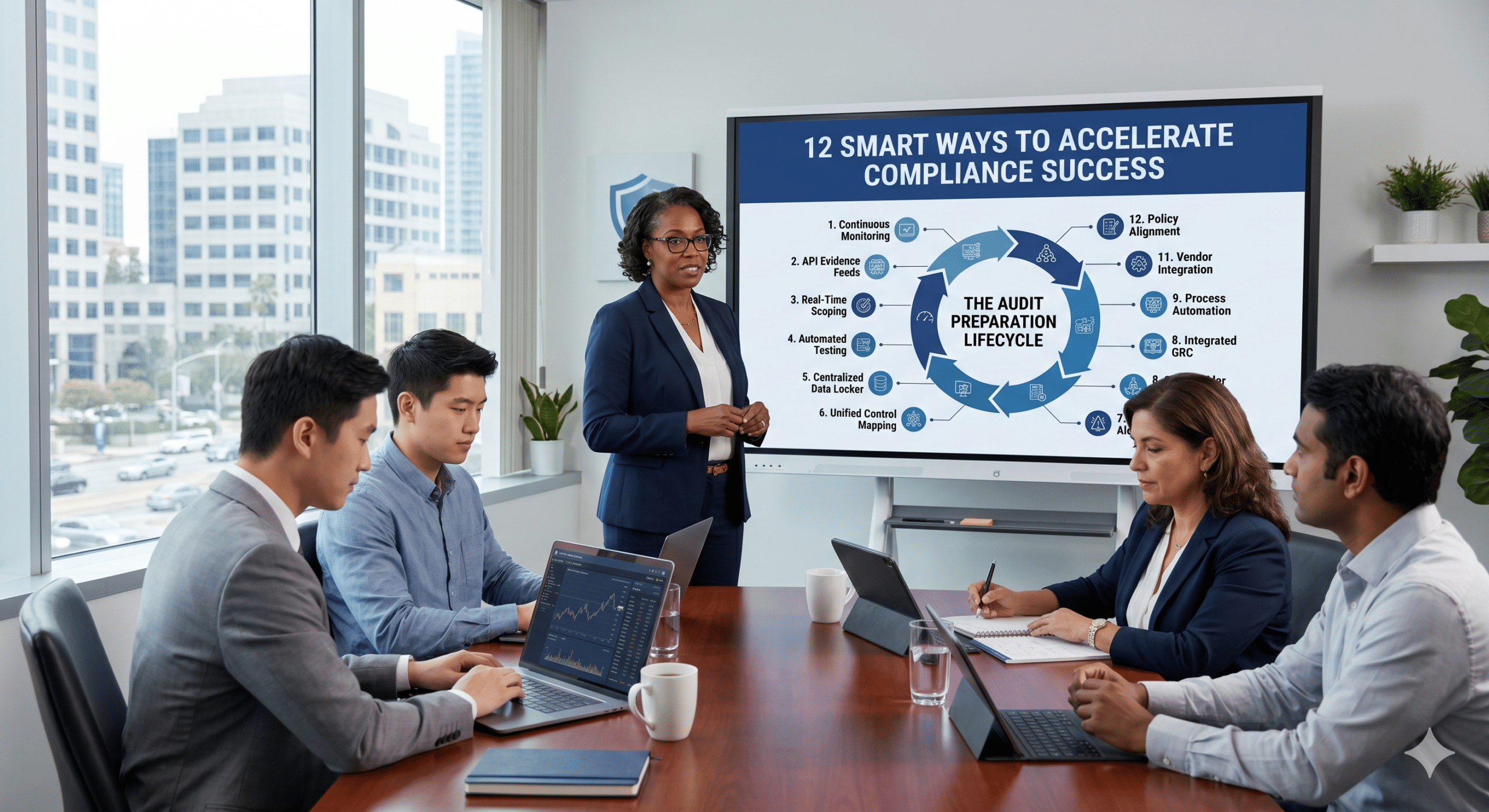
In many organizations, audits still create unnecessary stress. The moment an audit notification arrives, teams suddenly begin searching for documents, verifying records, updating procedures, and scrambling to gather evidence. As a result, productivity drops, employees become frustrated, and operational priorities often take a back seat.
However, organizations that consistently perform well during audits operate differently. Rather than treating audits as isolated events, they build strong systems that support continuous readiness throughout the year.
At the center of that strategy is the audit preparation lifecycle.
While many people view the audit preparation lifecycle as a compliance activity, experienced compliance leaders understand that it is much more than that. In fact, it directly affects operational efficiency, resource utilization, process quality, and organizational performance.
More importantly, when organizations optimize the audit preparation lifecycle, they improve throughput, reduce cycle time, and minimize compliance-related scrap. Consequently, audits become smoother, corrective actions decrease, and employees spend less time dealing with compliance emergencies.
From my experience as a Chief Compliance Officer, organizations that achieve the best audit outcomes are rarely the ones working the hardest right before an audit. Instead, they are the organizations that have built effective systems long before auditors arrive.
Therefore, understanding the audit preparation lifecycle is no longer optional. It has become an essential component of operational excellence.
Understanding the Audit Preparation Lifecycle
Before discussing optimization strategies, it is important to understand what the audit preparation lifecycle actually means.
Simply put, the audit preparation lifecycle represents the continuous process of preparing, maintaining, validating, organizing, and improving compliance documentation, records, controls, and supporting evidence.
Unlike traditional audit preparation, which often begins only weeks before an assessment, the audit preparation lifecycle operates continuously.
As a result, organizations maintain a constant state of readiness.
Typically, the lifecycle includes several interconnected stages. These stages include planning, documentation management, evidence collection, internal reviews, corrective action tracking, readiness assessments, audit execution, and continuous improvement.
Although each stage serves a different purpose, they all contribute to three critical operational goals.
First, they increase throughput by reducing unnecessary delays.
Second, they reduce cycle time by eliminating inefficient activities.
Third, they minimize scrap by preventing errors, rework, and nonconformities.
Therefore, when organizations improve one stage of the lifecycle, they often improve the performance of the entire compliance program.
Why Throughput Matters in Compliance
When people hear the word throughput, they often think about manufacturing. However, throughput is equally important in compliance operations.
In simple terms, throughput measures how efficiently work moves through a process.
For example, consider a compliance team responsible for gathering audit evidence. If documentation requests take weeks to complete, throughput is low. On the other hand, if evidence can be retrieved quickly and accurately, throughput is high.
Consequently, higher throughput enables organizations to respond faster to auditors, regulators, customers, and certification bodies.
Furthermore, strong throughput reduces employee frustration because less time is wasted searching for information.
Many compliance departments unknowingly create bottlenecks that slow throughput.
For instance, evidence may be stored in multiple systems. Alternatively, approval workflows may require too many reviews. In some cases, documentation ownership may be unclear.
As a result, even simple requests become time-consuming.
Therefore, one of the primary goals of a mature audit preparation lifecycle is removing obstacles that prevent information from flowing efficiently.
The Hidden Cost of Extended Audit Cycle Times
Cycle time represents the total amount of time required to complete a process from beginning to end.
Unfortunately, many organizations underestimate the cost of long audit preparation cycles.
When cycle times increase, organizations consume more resources. Moreover, extended timelines create additional opportunities for mistakes.
For example, if it takes three weeks to locate evidence for an auditor, employees may spend dozens of hours searching files, contacting coworkers, and verifying records.
Meanwhile, their normal responsibilities continue to accumulate.
Consequently, productivity declines across multiple departments.
Furthermore, longer cycle times often trigger secondary problems. Managers may rush approvals, employees may overlook important details, and documentation errors may increase.
As a result, organizations create more compliance risks rather than reducing them.
Therefore, reducing cycle time should be a central objective of every audit preparation lifecycle strategy.
Looking at Compliance Scrap Through a Different Lens
Most organizations understand scrap in a manufacturing environment.
However, fewer organizations apply the same concept to compliance.
Compliance scrap includes any activity, document, or record that consumes resources without creating value.
For example, duplicate files represent scrap.
Similarly, outdated procedures represent scrap.
Likewise, incomplete records, expired certifications, missing approvals, and incorrect forms all create compliance scrap.
Although these issues may appear small individually, their collective impact can be substantial.
For instance, a single missing approval may trigger multiple follow-up requests, additional reviews, and corrective actions.
Consequently, the organization spends valuable time fixing preventable problems.
Moreover, recurring compliance scrap often signals deeper process weaknesses.
Therefore, organizations that actively reduce compliance scrap usually experience faster audits, lower costs, and stronger compliance outcomes.
Begin with Process Visibility Instead of Documentation
One of the most common mistakes I encounter is an excessive focus on documentation before understanding how work actually occurs.
While documentation remains important, it should always reflect operational reality.
Unfortunately, many organizations create policies that no longer match actual business practices.
As a result, employees follow one process while documentation describes another.
Eventually, auditors discover these inconsistencies.
Consequently, findings, corrective actions, and additional reviews become unavoidable.
Therefore, organizations should begin by mapping critical workflows.
Process mapping provides visibility into how information moves throughout the organization.
Additionally, it identifies control points, evidence sources, approval requirements, and process owners.
Most importantly, it exposes bottlenecks that increase cycle time.
For example, a process may require five approvals when only two are necessary.
Likewise, documentation may pass through multiple departments without adding meaningful value.
By identifying these inefficiencies early, organizations can simplify workflows before updating documentation.
As a result, the entire audit preparation lifecycle becomes more efficient.
Create Documentation That Employees Actually Use
Documentation should support operations rather than complicate them.
Unfortunately, many organizations produce documents that employees rarely read or use.
Consequently, documentation becomes little more than an audit artifact.
Effective documentation serves a different purpose.
It provides clear guidance, supports consistent execution, and helps employees understand their responsibilities.
Furthermore, effective documentation remains accessible, current, and easy to understand.
When employees can quickly locate the correct document, they spend less time searching and more time performing productive work.
Similarly, when procedures are written clearly, errors decrease and consistency improves.
Therefore, documentation quality directly influences compliance performance.
In addition, organizations should establish strong version control practices.
Without proper version control, employees may unknowingly use outdated forms or obsolete procedures.
As a result, compliance scrap increases and audit findings become more likely.
For this reason, maintaining documentation accuracy should remain a continuous priority rather than an annual project.
Build a Continuous Evidence Collection Process
Evidence collection remains one of the most time-consuming aspects of compliance management. Nevertheless, many organizations continue to treat evidence gathering as an activity that only occurs shortly before an audit.
Unfortunately, this approach creates significant inefficiencies.
When teams wait until audit season to collect records, they often discover missing files, incomplete approvals, outdated reports, or inconsistent documentation. Consequently, employees must spend additional time locating information that should already be available.
Moreover, delayed evidence collection increases the likelihood of errors because memories fade, systems change, and records become harder to locate over time.
For this reason, organizations should adopt a continuous evidence collection model.
Under this approach, evidence is captured and stored as activities occur. Therefore, records remain current, accurate, and readily accessible whenever auditors request them.
Furthermore, continuous evidence collection reduces stress across the organization. Instead of launching large-scale document hunts every audit cycle, teams simply retrieve information that has already been organized and validated.
As a result, audit preparation becomes faster and significantly more predictable.
From an operational perspective, continuous evidence collection improves throughput because information flows into compliance repositories consistently rather than arriving in large batches.
Likewise, it reduces cycle time because auditors receive requested evidence more quickly.
Most importantly, it minimizes compliance scrap by reducing duplicate effort and unnecessary rework.
Strengthen Internal Validation Before External Auditors Arrive
Although external audits receive significant attention, internal validation often delivers greater long-term value.
After all, it is far better to discover weaknesses internally than to have auditors identify them first.
Therefore, every mature audit preparation lifecycle should include periodic validation activities.
These reviews should examine documentation accuracy, control effectiveness, evidence completeness, and process consistency.
Additionally, validation efforts should focus on identifying root causes rather than simply correcting symptoms.
For example, if an internal review discovers multiple missing approvals, the goal should not only be obtaining those approvals. Instead, compliance leaders should determine why the approvals were missed in the first place.
Perhaps employees lacked training.
Alternatively, approval workflows may have been overly complex.
In some cases, responsibilities may have been unclear.
By addressing root causes, organizations prevent recurring issues rather than repeatedly correcting the same problems.
Consequently, audit findings decrease over time.
Furthermore, internal validation supports continuous improvement because it provides valuable insights into process performance.
As a result, organizations can make targeted improvements that enhance both compliance outcomes and operational efficiency.
Establish Clear Ownership Throughout the Audit Preparation Lifecycle
Many compliance delays can be traced to one simple problem: nobody knows who owns a specific task.
When ownership remains unclear, requests sit unanswered, corrective actions stall, and documentation updates fall behind schedule.
Consequently, audit preparation slows dramatically.
For this reason, clear accountability should exist at every stage of the audit preparation lifecycle.
Each policy should have a designated owner.
Likewise, each control should have an accountable individual responsible for maintaining effectiveness.
Similarly, every corrective action should have a clearly assigned leader.
When ownership is defined, decision-making becomes faster.
Furthermore, accountability improves follow-through because responsibilities cannot easily be transferred or ignored.
In addition, ownership creates greater visibility for leadership teams.
Managers can quickly identify bottlenecks, monitor progress, and allocate resources where needed.
As a result, cycle times decrease and compliance performance improves.
Most importantly, clear accountability helps create a culture where compliance becomes part of everyday operations rather than the responsibility of a single department.
Use Corrective Actions as a Tool for Continuous Improvement
Many organizations view corrective actions as administrative requirements.
However, this perspective overlooks their true value.
In reality, corrective actions provide some of the most useful data available within a compliance program.
Every finding tells a story.
For example, repeated documentation errors may indicate ineffective training.
Similarly, recurring control failures may reveal process weaknesses.
Likewise, repeated evidence gaps may highlight ownership issues.
Therefore, corrective actions should be analyzed collectively rather than individually.
By examining trends over time, organizations can identify recurring patterns and address systemic issues.
Consequently, future findings become less frequent.
Moreover, corrective action data often reveals opportunities to improve throughput and reduce cycle time.
For instance, if multiple findings involve delayed approvals, leaders may discover that approval workflows contain unnecessary steps.
After simplifying those workflows, both compliance performance and operational efficiency improve.
Thus, corrective actions become valuable improvement tools rather than merely audit responses.
Integrate Compliance Into Daily Operations
One of the most effective ways to improve the audit preparation lifecycle is integrating compliance into normal business activities.
Unfortunately, many organizations still operate compliance as a separate function.
As a result, employees often view compliance requirements as additional work rather than part of their regular responsibilities.
This separation creates inefficiencies.
Employees complete operational tasks first and then perform compliance activities later.
Consequently, duplicate effort increases.
Furthermore, documentation quality often suffers because records are created after the fact.
A better approach involves embedding compliance directly into operational workflows.
For example, evidence generation should occur naturally as employees complete tasks.
Likewise, control activities should align with existing business processes whenever possible.
As a result, compliance becomes part of normal operations rather than a separate burden.
Additionally, integration improves data quality because records are created in real time.
Therefore, organizations benefit from both stronger compliance performance and greater operational efficiency.
Measure What Matters
Many compliance programs focus heavily on audit results.
While audit outcomes remain important, they represent lagging indicators.
In other words, they reveal what has already happened.
Therefore, organizations should also monitor leading indicators that predict future performance.
Examples include document review completion rates, corrective action closure times, training completion percentages, evidence retrieval times, and control testing results.
These metrics provide valuable insight into the health of the audit preparation lifecycle.
Furthermore, they help compliance leaders identify problems before they become audit findings.
For example, increasing evidence retrieval times may indicate documentation management issues.
Similarly, delayed corrective action closures may signal resource constraints.
By monitoring performance continuously, organizations can take proactive action.
Consequently, they reduce risks while improving efficiency.
Moreover, performance metrics help demonstrate the value of compliance initiatives to executive leadership.
As a result, compliance teams are often better positioned to secure support for future improvements.
Invest in Training That Supports Execution
Training remains one of the most powerful drivers of compliance success.
Nevertheless, many organizations still rely on generic compliance presentations that employees quickly forget.
Unfortunately, ineffective training creates confusion, inconsistency, and unnecessary rework.
Therefore, training programs should focus on practical application.
Employees should understand not only what requirements exist but also why those requirements matter.
More importantly, they should know exactly how compliance responsibilities relate to their daily work.
When employees understand expectations clearly, documentation accuracy improves.
Likewise, control execution becomes more consistent.
Furthermore, employees are more likely to identify and report potential issues before they become significant problems.
As a result, organizations experience fewer findings and lower remediation costs.
Ultimately, effective training strengthens every stage of the audit preparation lifecycle.
Prepare for Audits Every Day, Not Every Year
Perhaps the most important lesson in compliance management is that audit readiness should never be seasonal.
Organizations that wait for audit announcements inevitably face higher costs, longer preparation cycles, and greater operational disruption.
In contrast, organizations that maintain continuous readiness experience a very different reality.
Because documentation remains current, evidence remains organized, and controls remain monitored, audit preparation requires far less effort.
Consequently, audits become confirmation exercises rather than emergency projects.
Moreover, continuous readiness improves organizational agility.
When regulators introduce new requirements or customers request compliance information, organizations can respond quickly and confidently.
Therefore, continuous readiness should be viewed as a strategic capability rather than a compliance objective.
The Future of the Audit Preparation Lifecycle
The future of compliance is moving toward continuous assurance.
Rather than relying on periodic reviews, organizations increasingly monitor controls, evidence, and performance throughout the year.
As technology continues to evolve, this trend will likely accelerate.
However, technology alone will not solve compliance challenges.
Successful organizations will continue to focus on process design, accountability, documentation quality, and operational integration.
After all, technology supports good processes; it does not replace them.
Therefore, compliance leaders should concentrate on building sustainable systems that balance efficiency, quality, and regulatory requirements.
By doing so, they create compliance programs capable of adapting to future challenges while maintaining operational excellence.
Final Thoughts
The audit preparation lifecycle is far more than a collection of compliance activities. Instead, it serves as a framework for improving operational performance across the entire organization.
When organizations optimize documentation management, evidence collection, internal validation, ownership structures, corrective actions, and performance monitoring, they achieve benefits that extend far beyond audit readiness.
As a result, throughput improves.
At the same time, cycle times decrease.
Moreover, compliance scrap declines significantly.
From my perspective as a Chief Compliance Officer and Principal Compliance Architect, the organizations that consistently excel during audits are not necessarily those with the largest compliance departments. Rather, they are the organizations that build efficient systems, maintain discipline throughout the year, and treat compliance as an integral part of business operations.
Ultimately, a mature audit preparation lifecycle transforms compliance from a reactive obligation into a strategic advantage.
Frequently Asked Questions
What is the audit preparation lifecycle?
The audit preparation lifecycle is the continuous process of planning, organizing, maintaining, validating, and improving compliance documentation, evidence, controls, and corrective actions to ensure ongoing audit readiness.
Why is the audit preparation lifecycle important?
The audit preparation lifecycle helps organizations reduce audit preparation time, improve compliance performance, minimize findings, and maintain continuous readiness throughout the year.
How does the audit preparation lifecycle reduce cycle time?
It reduces cycle time by improving documentation management, streamlining evidence collection, eliminating bottlenecks, and establishing clear ownership of compliance activities.
What causes compliance scrap?
Compliance scrap often results from duplicate documentation, missing records, outdated procedures, incomplete approvals, expired certifications, and recurring process failures.
How often should organizations review audit readiness?
Most organizations benefit from quarterly reviews. However, highly regulated industries may require monthly assessments and continuous monitoring activities.
Can small businesses benefit from a formal audit preparation lifecycle?
Yes. In fact, smaller organizations often see substantial benefits because structured compliance processes reduce administrative burdens, improve efficiency, and lower remediation costs.
References and Further Reading
1. IS Partners – Audit Readiness 101: Proven Techniques and a Practical Audit Readiness Checklist – This comprehensive guide explains why audit readiness should be treated as a continuous process rather than a one-time event. It covers documentation management, control testing, evidence collection, and cross-functional accountability, making it highly relevant to the audit preparation lifecycle.
2. Linford & Company – Audit Readiness: Professional Tips for a Successful Audit – A practical resource that discusses organized documentation, employee training, management support, risk management, and corrective actions. The article provides real-world guidance for reducing audit friction and improving preparation efficiency.
3. Anaplan – A Guide to Audit Readiness as a Year-Round Process – This article emphasizes continuous audit readiness, transparency, traceability, and maintaining compliance throughout the year. It supports the concept that audit preparation should be integrated into daily operations rather than performed only before assessments.
4. VComply – Are You Audit-Ready? A Deep-Dive Guide for Internal Compliance Leaders – An excellent resource for compliance professionals seeking insight into centralized evidence management, ownership structures, policy governance, and compliance maturity. The guide strongly aligns with modern audit preparation lifecycle principles.
5. Sage – Audit Readiness: A Complete Guide for Finance Teams – Although finance-focused, this guide provides valuable information on maintaining organized records, conducting readiness assessments, closing compliance gaps, and establishing year-round audit preparedness.
6. Empowered Systems – A Comprehensive Guide to Audit Readiness – This article explains readiness assessments, compliance gap identification, and proactive audit planning. It is particularly useful for organizations developing formal audit preparation lifecycle programs.
7. VComply – Building Year-Round Audit Readiness Beyond Spreadsheets – A modern perspective on continuous compliance management, accountability, evidence traceability, and reducing recurring audit disruptions through better operational practices.
8. DealHub – What Is Audit Readiness? This resource clearly explains audit readiness as the ability to support audits without last-minute cleanup, making it particularly useful for discussions around throughput, cycle time, and operational efficiency.
9. Atlas Systems – What Is Audit Readiness? Benefits and Examples for Organizations – Provides practical audit readiness checklists, evidence management recommendations, documentation strategies, and internal review guidance that directly support audit lifecycle optimization.
10. Tailride – Your Ultimate Audit Readiness Checklist – A detailed roadmap covering documentation, internal controls, communication, and audit planning activities that help organizations create a repeatable audit preparation lifecycle.
These sources provide the most comprehensive coverage of continuous audit readiness, compliance management, evidence collection, and operational audit preparation. (I.S. Partners)