
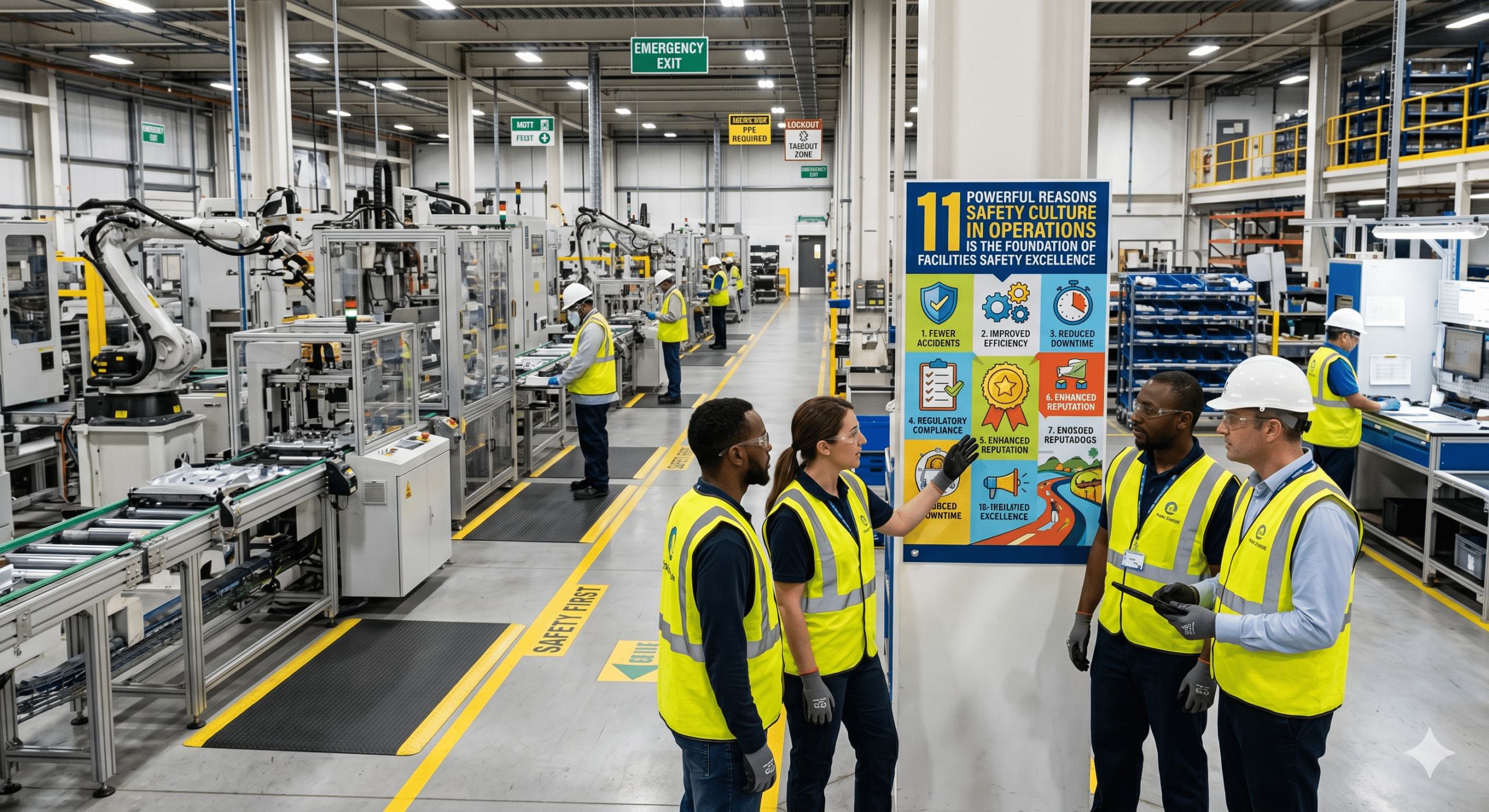
When people think about facilities safety, they often imagine fire extinguishers, emergency exits, safety signs, protective equipment, and compliance inspections. While all of these elements are important, they represent only part of the picture. In reality, the safest organizations are not necessarily the ones with the most policies. Instead, they are the ones that successfully build a strong safety culture that influences every decision made throughout the organization.
As a Governance, Risk, and Compliance (GRC) professional, I have observed that organizations frequently invest substantial resources into safety programs yet continue to experience recurring incidents, operational disruptions, and avoidable losses. In many cases, the issue is not a lack of procedures. Rather, the challenge lies in how people perceive, prioritize, and practice safety during their daily work activities.
This is precisely why safety culture in operations has become one of the most important factors in modern facilities safety management. When safety becomes embedded in the culture, organizations not only reduce workplace incidents but also improve operational efficiency, increase throughput, reduce cycle times, and minimize costly waste. As a result, safety evolves from a compliance requirement into a strategic business advantage.
Why Facilities Safety Is More Than Regulatory Compliance
Most organizations begin their safety journey with compliance requirements. After all, regulations exist to protect employees, visitors, contractors, and business assets. Consequently, companies establish policies, conduct training sessions, perform inspections, and maintain documentation to satisfy legal obligations.
However, compliance alone does not guarantee a safe workplace.
In fact, many organizations that technically meet regulatory requirements still experience incidents, near misses, and operational failures. This happens because compliance focuses on meeting minimum standards. By contrast, safety culture focuses on influencing behavior and decision-making at every level of the organization.
For example, a company may have a documented procedure for reporting hazards. Nevertheless, if employees feel uncomfortable speaking up, the procedure becomes ineffective. Similarly, a facility may conduct routine inspections. Yet if workers ignore unsafe conditions between inspections, risks can continue to grow unnoticed.
Therefore, facilities safety must go beyond policies and checklists. Instead, it should create an environment where employees actively identify risks, communicate concerns, and contribute to continuous improvement efforts.
Understanding Safety Culture in Operations
At its core, safety culture refers to the collective attitudes, beliefs, and behaviors that influence how people approach workplace safety. In other words, it reflects how employees think about safety when nobody is watching.
A strong safety culture exists when employees consistently make safe decisions because they genuinely value safety rather than simply complying with rules.
Likewise, leaders in organizations with strong safety cultures actively demonstrate their commitment to safety through their actions, decisions, and communication. As a result, employees understand that safety is not merely a slogan displayed on a wall but an operational priority that influences every aspect of the business.
On the other hand, organizations with weak safety cultures often struggle with inconsistent behaviors. Employees may take shortcuts, delay reporting hazards, or ignore warning signs to meet production goals. Unfortunately, these behaviors eventually create operational risks that lead to incidents, downtime, and financial losses.
Therefore, building a positive safety culture requires more than periodic training. Instead, it requires ongoing commitment from leadership and active participation from employees throughout the organization.
How Safety Culture Improves Operational Throughput
Many business leaders mistakenly assume that safety initiatives slow down productivity. However, the opposite is often true.
When viewed through the lens of operational performance, safety culture actually supports higher throughput by reducing disruptions and maintaining workflow stability.
For instance, consider a warehouse operation where employees regularly bypass equipment inspections to save time. Initially, productivity may appear to improve because tasks are completed more quickly. However, equipment failures eventually occur. Consequently, operations experience unexpected downtime, delayed shipments, emergency repairs, and frustrated customers.
As a result, the organization loses far more productivity than it initially gained.
By contrast, organizations with strong safety cultures encourage employees to identify maintenance issues before they become critical failures. Consequently, equipment remains reliable, workflows remain uninterrupted, and throughput remains consistent.
Furthermore, employees who prioritize safety are often more attentive to operational details. Because of this, they identify inefficiencies earlier and contribute to smoother process execution.
Therefore, safety culture should not be viewed as an obstacle to productivity. Instead, it should be recognized as a critical driver of operational reliability.
Reducing Cycle Time Through Safer Operations
Cycle time is one of the most important metrics in operational performance. Simply put, it measures how long it takes to complete a process from beginning to end.
Although organizations often focus on improving cycle time through technology and automation, they sometimes overlook the role safety plays in process efficiency.
When incidents occur, organizations must stop work, investigate root causes, repair equipment, retrain employees, and implement corrective actions. Naturally, these activities consume valuable time and resources.
Consequently, cycle times increase.
However, organizations with strong safety cultures experience fewer disruptions because employees proactively identify and address risks before they escalate into larger problems.
Moreover, safer workplaces often have clearer procedures and more standardized workflows. As a result, employees spend less time dealing with confusion, uncertainty, and preventable mistakes.
In addition, effective communication tends to improve in organizations that prioritize safety. Therefore, teams collaborate more efficiently and resolve issues more quickly.
Ultimately, reduced interruptions and improved coordination lead to shorter cycle times and stronger operational performance.
The Link Between Safety and Scrap Reduction
One of the most overlooked benefits of a strong safety culture is its impact on quality and waste reduction.
Many operational leaders separate safety and quality into different categories. However, the two are closely connected.
Employees working in unsafe environments often experience distractions, fatigue, stress, and uncertainty. Consequently, the likelihood of mistakes increases.
These mistakes can result in damaged products, defective output, rework activities, material waste, and customer dissatisfaction.
By contrast, organizations that emphasize safety typically promote discipline, attention to detail, and procedural consistency.
As a result, employees are more likely to follow quality standards, identify defects early, and report process deviations before they become larger problems.
Furthermore, workers who feel safe and supported are generally more engaged in their responsibilities. Because of this, they take greater ownership of both safety and quality outcomes.
Therefore, organizations seeking to minimize scrap rates should recognize that safety culture can be a powerful quality improvement tool.
Why Leadership Determines Safety Success
Leadership commitment remains one of the strongest indicators of safety culture maturity.
Employees pay close attention to leadership behavior. Consequently, they quickly identify whether safety is genuinely important or merely discussed during meetings.
For example, leaders who prioritize production targets while ignoring safety concerns unintentionally send a clear message about organizational priorities. As a result, employees may begin taking shortcuts to meet performance expectations.
Conversely, leaders who consistently reinforce safety expectations create an environment where safe behaviors become the norm.
Moreover, effective leaders actively participate in safety initiatives rather than simply delegating responsibility to safety teams. They visit worksites, engage employees in discussions, review safety metrics, and allocate resources to risk management efforts.
Most importantly, they make safety part of strategic decision-making.
Therefore, organizations seeking to improve facilities safety must ensure leadership commitment remains visible, consistent, and authentic.
Creating Accountability Without Fear
Accountability plays an important role in safety management. However, accountability should never create a culture of fear.
Unfortunately, some organizations respond to incidents by focusing exclusively on blame. As a result, employees become reluctant to report hazards, near misses, and mistakes.
This creates a dangerous situation.
When employees stop reporting problems, risks remain hidden. Consequently, organizations lose valuable opportunities to learn and improve.
A more effective approach focuses on understanding why incidents occur rather than simply identifying who made a mistake.
For example, organizations should examine training effectiveness, process design, equipment conditions, communication practices, and workload expectations.
By doing so, leaders gain a more complete understanding of underlying risks.
Furthermore, employees become more willing to participate in safety improvement efforts because they trust that reporting concerns will lead to positive outcomes rather than punishment.
Therefore, accountability should encourage learning, transparency, and continuous improvement.
Integrating Safety Into Risk Governance
Modern organizations face a wide range of interconnected risks. These risks include operational failures, cybersecurity threats, supply chain disruptions, regulatory violations, and facility-related hazards.
Consequently, safety should not operate in isolation.
Instead, safety must be integrated into the broader governance, risk, and compliance framework.
When safety becomes part of enterprise risk management, organizations gain a more comprehensive understanding of operational vulnerabilities.
For example, safety incidents can impact productivity, financial performance, reputation, regulatory compliance, and business continuity. Therefore, safety metrics should be reviewed alongside other strategic risk indicators.
Moreover, integrated governance allows leadership teams to make more informed decisions regarding resource allocation and risk mitigation priorities.
As a result, organizations become more resilient and better prepared to manage emerging challenges.
The Growing Role of Technology in Facilities Safety
Technology continues to reshape facilities safety programs across nearly every industry.
Today, organizations use digital inspections, predictive maintenance systems, connected sensors, mobile reporting applications, and advanced analytics platforms to strengthen risk management capabilities.
For example, real-time monitoring systems can identify equipment issues before failures occur. Consequently, maintenance teams can address problems proactively rather than reacting to unexpected breakdowns.
Likewise, digital reporting tools make it easier for employees to report hazards and near misses. As a result, organizations gain faster visibility into emerging risks.
However, technology alone cannot create a strong safety culture.
After all, software platforms and applications can collect data, but people must still act on the information provided.
Therefore, organizations should view technology as an enabler rather than a replacement for leadership, communication, and employee engagement.
When technology and culture work together, safety outcomes improve significantly.
Measuring What Truly Matters
Many organizations focus heavily on lagging indicators such as injury rates and incident statistics. While these metrics provide valuable information, they primarily reflect past performance.
Therefore, organizations should also monitor leading indicators that provide insight into future risk conditions.
For instance, hazard reports, safety observations, training participation rates, corrective action completion metrics, and near-miss reporting activity can reveal potential issues before incidents occur.
Furthermore, leading indicators encourage proactive behavior because they focus on prevention rather than reaction.
As a result, organizations gain earlier visibility into emerging risks and can implement corrective measures before disruptions occur.
Consequently, safety performance becomes more predictable and sustainable.
Building a Sustainable Culture of Safety Excellence
Creating a strong safety culture is not a one-time initiative. Rather, it is an ongoing journey that requires commitment, consistency, and continuous improvement.
Organizations that achieve long-term safety excellence understand that culture develops gradually through everyday actions and decisions.
Therefore, they continuously reinforce safety expectations, encourage employee involvement, and invest in leadership development.
Moreover, they celebrate positive safety behaviors and learn from mistakes without creating fear.
At the same time, they integrate safety into operational planning, performance management, and strategic decision-making processes.
Because of these efforts, safety becomes a natural part of how work gets done rather than an additional requirement imposed on employees.
Ultimately, this cultural transformation leads to stronger operational performance, improved employee engagement, reduced waste, and greater organizational resilience.
Conclusion
Facilities safety is no longer just a compliance function. Instead, it has become a strategic business capability that directly influences operational performance and organizational success.
When organizations prioritize safety culture in operations, they create environments where employees actively identify risks, communicate concerns, and contribute to continuous improvement efforts.
As a result, throughput increases, cycle times decrease, and scrap rates decline.
Furthermore, organizations experience fewer disruptions, stronger employee engagement, and improved business continuity.
Most importantly, they create workplaces where people feel valued, protected, and empowered to succeed.
Therefore, organizations that invest in safety culture today are not only reducing risk. They are also building the foundation for sustainable operational excellence tomorrow.
Frequently Asked Questions
What is safety culture in operations?
Safety culture in operations refers to the shared beliefs, attitudes, and behaviors that influence how employees approach workplace safety. It shapes daily decisions and affects how risks are identified and managed.
Why is safety culture important for facilities safety?
A strong safety culture encourages proactive risk management, improves communication, reduces incidents, and supports operational efficiency. Consequently, organizations experience better safety and business outcomes.
How does safety culture reduce operational waste?
Safety culture promotes discipline, consistency, and attention to detail. As a result, organizations experience fewer errors, less rework, reduced material waste, and improved product quality.
Can safety culture improve productivity?
Yes. Although some people believe safety slows operations, strong safety cultures reduce downtime, prevent disruptions, and improve workflow stability. Therefore, productivity often improves alongside safety performance.
What role does leadership play in safety culture?
Leadership establishes organizational priorities. Consequently, visible leadership commitment is essential for building trust, encouraging participation, and reinforcing safe behaviors throughout the organization.
References and Further Reading
- SafetyCulture – Operational Excellence: How It Works – A comprehensive guide explaining how operational excellence, continuous improvement, and safety culture work together to improve organizational performance and reduce operational waste. This is highly relevant to your discussion of throughput, cycle time, and operational efficiency.
- Proaction International – How to Build a Safety Culture in the Manufacturing Industry – An excellent article focused on creating a sustainable safety culture through leadership engagement, employee participation, and continuous improvement. The concepts apply well beyond manufacturing and align closely with facilities safety management.
- ComplianceQuest – Safety Management for Operational Excellence – This article connects safety management directly to operational excellence by showing how standardized processes, employee engagement, and risk management contribute to improved business performance.
- CDC NIOSH – Why a Culture of Safety Is Important – One of the most authoritative resources available on safety culture. It explains how leadership commitment, worker participation, and proactive hazard management create safer and more effective workplaces.
- EHS Insight – How to Improve Safety Culture: A Comprehensive Guide – Provides practical strategies for improving workplace safety culture while highlighting the connection between safety performance, employee engagement, compliance, and productivity.
- EcoOnline – Eleven Fundamentals of Health and Safety Excellence – A valuable resource covering leadership commitment, employee involvement, communication, accountability, and continuous improvement as foundations of safety excellence.
- IFS – How to Build a Culture of Safety Into Your Manufacturing Operations – Focuses on leveraging technology, reporting systems, and workforce engagement to create continuous safety improvement and stronger operational performance.
- HereSafe – Why Safety Culture Matters for Operational Success – Explains how safety culture directly impacts compliance, operational continuity, productivity, and contractor management. Particularly useful for facilities and operational leaders.
- ResearchGate – The Influence of Safety Communication on Safety Culture and Operational Excellence – A recent research study demonstrating the relationship between safety communication, employee engagement, safety culture, and operational excellence. Excellent academic support for your article’s core arguments.
- PepTalk – How to Create a Culture of Safety in the Workplace – A practical guide that discusses safety culture characteristics, implementation strategies, and leadership responsibilities in creating safer workplaces.