
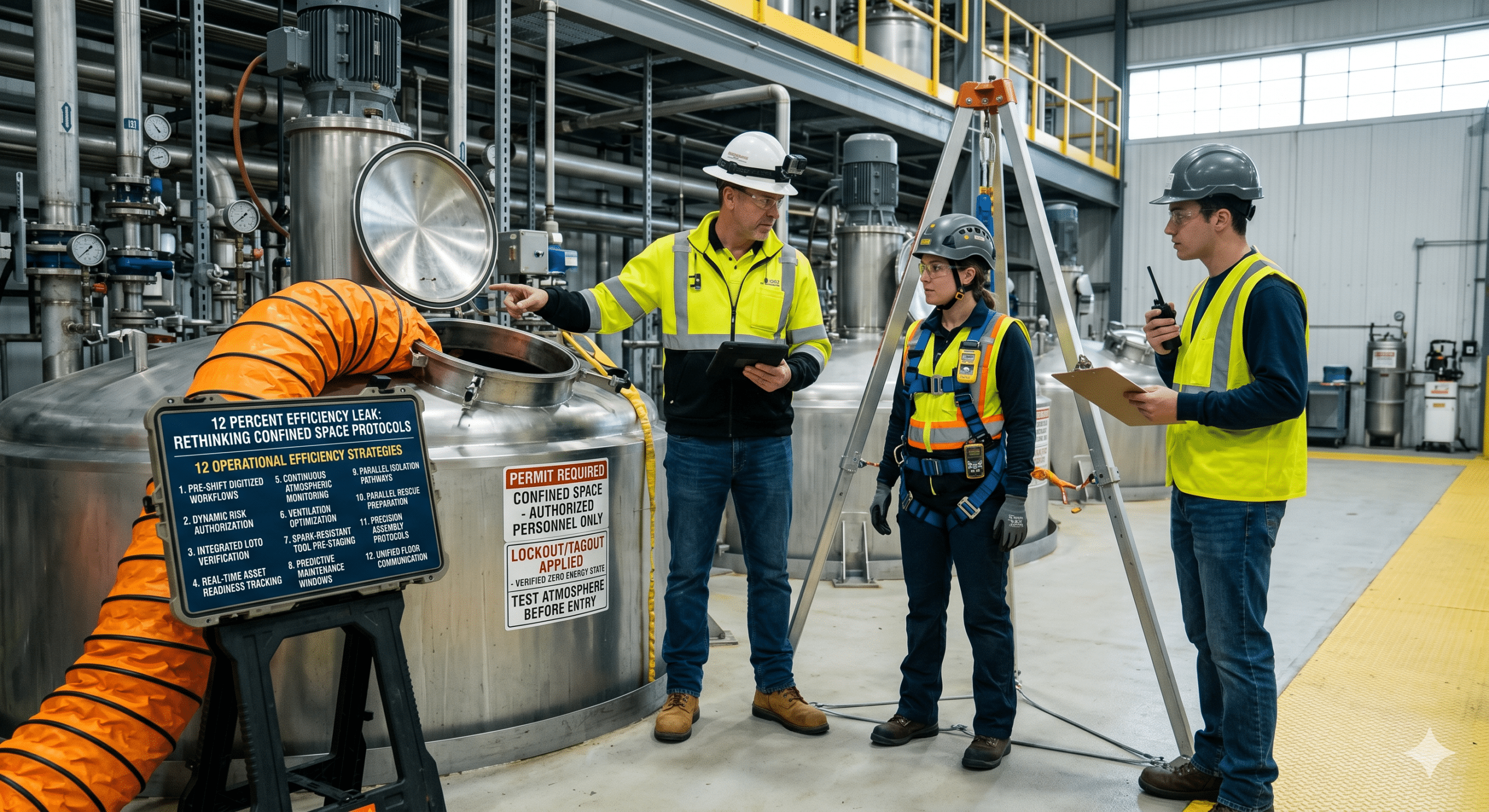
Every facility leader understands that workplace safety extends far beyond warning signs, protective equipment, and compliance checklists. In reality, some of the most serious risks hide in places that employees rarely see. Tanks, silos, tunnels, utility vaults, pits, and underground chambers often support daily operations, yet these spaces can become deadly within minutes when organizations fail to implement proper safeguards.
That reality makes confined space protocols one of the most critical components of any facilities safety program.
As a Governance, Risk, and Compliance (GRC) professional, I often see organizations focus heavily on productivity, maintenance schedules, and operational targets. Those objectives certainly matter. However, companies that overlook confined space risks often experience costly incidents, regulatory violations, operational disruptions, and, in the worst cases, tragic fatalities.
The good news is that effective confined space protocols do more than protect workers. They also improve operational performance, reduce downtime, strengthen compliance efforts, and support long-term business resilience.
Organizations that establish clear procedures, train their teams consistently, and monitor risks proactively create safer environments while maintaining strong operational throughput. Rather than slowing operations, effective safety programs help organizations complete work correctly the first time.
In this guide, we will explore practical strategies that strengthen facility safety, improve compliance performance, and help organizations build a sustainable culture of risk management.
Why Confined Space Protocols Matter in Modern Facilities
Many facility hazards remain visible. Employees can easily identify slippery floors, exposed wiring, damaged equipment, or blocked walkways. Confined spaces present a different challenge because workers cannot always recognize the dangers immediately.
A confined space generally has three characteristics. First, it allows workers to enter and perform assigned tasks. Second, it has limited entry or exit points. Third, facility designers never intended people to occupy it continuously.
Examples include storage tanks, sewers, pipelines, process vessels, boilers, utility tunnels, and underground vaults.
Although these spaces often appear harmless, they can contain toxic gases, oxygen-deficient atmospheres, combustible vapors, engulfment hazards, mechanical dangers, and environmental risks. Even worse, conditions can change rapidly without warning.
For example, oxygen levels can decrease unexpectedly during maintenance activities. Similarly, chemical reactions can generate hazardous gases within minutes. Ventilation systems may fail, equipment can malfunction, or nearby operations can introduce additional hazards.
Consequently, organizations must treat confined spaces as high-risk environments that require strict controls.
Strong confined space protocols provide those controls by creating clear expectations before, during, and after entry operations.
The Business Impact of Confined Space Incidents
When organizations discuss confined space safety, they often focus on worker protection. While that remains the highest priority, leaders should also recognize the broader business consequences.
A single incident can trigger investigations, production delays, regulatory inspections, legal actions, equipment damage, and reputational harm.
From a GRC perspective, confined space incidents create several layers of risk simultaneously.
Operational teams may lose valuable production hours. Safety teams may spend weeks conducting investigations. Compliance professionals may need to respond to regulatory inquiries. Meanwhile, executives may face increased insurance costs and reputational challenges.
These consequences directly affect throughput, cycle time, and operational efficiency.
Facilities that implement strong confined space protocols reduce the likelihood of incidents and create more predictable operations. As a result, teams spend less time responding to emergencies and more time completing productive work.
Understanding Risk Before Entry Begins
Every successful confined space program starts with thorough risk identification.
Unfortunately, many incidents occur because organizations underestimate hazards during planning stages. Workers sometimes assume that a space remains safe simply because previous entries occurred without problems.
That assumption creates unnecessary risk.
Instead, organizations should conduct a comprehensive hazard assessment before every entry operation.
The assessment should evaluate atmospheric hazards, mechanical dangers, electrical risks, thermal exposures, engulfment hazards, structural concerns, communication limitations, and emergency response challenges.
Furthermore, facilities should maintain a detailed inventory of all confined spaces across the organization.
This inventory should identify the location of each space, associated hazards, entry requirements, rescue considerations, and risk classifications.
When organizations maintain accurate records, supervisors can make better decisions and reduce uncertainty before work begins.
Most importantly, thorough risk identification establishes the foundation for all other confined space protocols.
Building a Reliable Permit-to-Work Process
Many organizations rely on permit systems to manage confined space entry. Unfortunately, some facilities treat permits as administrative paperwork rather than operational safeguards.
A permit should never function as a simple form.
Instead, it should serve as a structured verification process that confirms every required control before workers enter a confined space.
A strong permit system requires supervisors to verify hazards, complete atmospheric testing, confirm equipment isolation, inspect personal protective equipment, establish communication procedures, and validate rescue plans.
By completing these steps systematically, organizations reduce the likelihood of overlooking critical risks.
Moreover, permit systems improve accountability because every responsible party must review and approve the planned work.
From a compliance standpoint, permit records also provide documented evidence that the organization followed established procedures.
That documentation becomes especially valuable during audits, inspections, and incident investigations.
Why Atmospheric Monitoring Requires Continuous Attention
Atmospheric hazards remain among the leading causes of confined space fatalities.
Unlike visible hazards, dangerous gases often provide no warning signs. Workers cannot always see, smell, or feel harmful atmospheric conditions.
Therefore, organizations must rely on testing and monitoring equipment to identify threats before they become emergencies.
Many facilities conduct atmospheric testing before entry and assume conditions will remain stable. However, that assumption creates unnecessary risk.
Oxygen depletion, toxic gas accumulation, chemical reactions, and equipment failures can quickly transform a safe environment into a dangerous one.
For that reason, modern confined space protocols increasingly emphasize continuous monitoring throughout the duration of work activities.
Continuous monitoring provides real-time visibility into changing conditions. If oxygen levels drop or hazardous gases increase, workers can evacuate immediately before conditions become life-threatening.
In addition, continuous monitoring improves decision-making because supervisors can respond to emerging risks without delay.
Organizations that invest in reliable monitoring technology often experience fewer incidents and greater confidence during maintenance operations.
Strengthening Isolation and Energy Control Procedures
Many confined space incidents occur because equipment unexpectedly starts, moves, or releases stored energy.
Even experienced workers can face serious injuries when organizations fail to control energy sources properly.
As a result, facilities must integrate lockout and tagout procedures directly into their confined space programs.
Before entry begins, authorized personnel should isolate mechanical systems, disconnect electrical sources, release hydraulic pressure, secure pneumatic equipment, and remove hazardous process materials.
However, isolation alone does not eliminate risk.
Teams must also verify that isolation remains effective.
Verification ensures that workers do not rely solely on assumptions or incomplete procedures. Instead, they confirm that equipment cannot activate unexpectedly while personnel remain inside the space.
Strong energy control practices reduce risk significantly and strengthen the overall effectiveness of confined space protocols.
Creating Training That Builds Real Competence
Compliance regulations establish minimum training requirements. However, organizations should aim far beyond minimum standards.
Effective training programs build confidence, improve decision-making, and strengthen hazard recognition skills.
Employees who understand confined space risks can identify potential dangers before incidents occur.
Therefore, organizations should provide practical instruction that reflects actual workplace conditions.
Workers should learn how to recognize atmospheric hazards, use monitoring equipment, follow permit procedures, communicate effectively, respond to emergencies, and operate safety equipment correctly.
In addition, organizations should conduct realistic drills that allow employees to apply their knowledge in controlled environments.
Hands-on exercises often produce stronger learning outcomes than classroom instruction alone.
When employees practice critical skills regularly, they retain information more effectively and respond more confidently during real-world situations.
Strengthening Communication During Confined Space Operations
Even the most detailed permit process can fail if workers cannot communicate effectively.
Communication plays a critical role in every confined space entry because conditions can change without warning. Workers inside the space must remain connected to attendants, supervisors, and emergency personnel throughout the operation.
Many organizations underestimate this requirement until an emergency occurs. Unfortunately, by that point, communication failures can create confusion and delay critical decisions.
Effective confined space protocols establish clear communication expectations before work begins. Supervisors should identify communication methods, escalation procedures, backup systems, and emergency contacts during the planning phase.
The chosen communication method should match the specific work environment. In some situations, direct voice communication may provide sufficient coverage. In other cases, teams may need radios, wireless communication devices, or specialized monitoring systems.
The goal remains simple. Every worker must be able to report hazards immediately and receive instructions without delay.
Strong communication reduces uncertainty, improves situational awareness, and supports faster response times when conditions change.
More importantly, effective communication creates a safer environment where workers feel supported throughout the entire operation.
Developing Rescue Plans Before Emergencies Occur
One of the biggest mistakes organizations make involves assuming that emergency responders can solve any problem after an incident occurs.
In reality, confined space rescue requires specialized planning, equipment, and training.
When workers face a medical emergency or hazardous atmospheric condition inside a confined space, every minute matters. Delays can significantly increase the severity of injuries and reduce the likelihood of a successful rescue.
For that reason, organizations should develop rescue procedures before any entry operation begins.
A comprehensive rescue plan identifies rescue personnel, equipment requirements, medical support resources, communication methods, and emergency escalation procedures.
The plan should also address facility-specific challenges.
For example, rescuing a worker from a vertical tank requires different equipment and techniques than rescuing someone from a horizontal vessel or underground vault.
Organizations should conduct rescue drills regularly to evaluate readiness and identify improvement opportunities.
These exercises help teams uncover gaps before a real emergency occurs.
From a GRC perspective, rescue planning demonstrates due diligence and strengthens organizational preparedness. It also supports compliance requirements while reducing operational risk.
Using Technology to Improve Confined Space Protocols
Technology continues to transform facility safety programs.
Years ago, organizations relied heavily on paper forms, manual inspections, and disconnected recordkeeping systems. Although these methods provided basic documentation, they often created delays and limited visibility into risk management activities.
Today, software platforms help organizations manage safety and compliance more effectively.
Modern solutions support digital permits, inspection management, incident reporting, corrective action tracking, training records, and compliance monitoring.
For facilities managing multiple locations, technology provides significant advantages.
Supervisors can review permit approvals in real time. Safety professionals can monitor compliance activities across multiple facilities. Leadership teams can identify trends before they become major issues.
Most importantly, technology helps organizations strengthen confined space protocols without increasing administrative burden.
Instead of spending valuable time searching for records, teams can focus on risk reduction and operational improvement.
As organizations continue their digital transformation efforts, safety management systems will play an increasingly important role in supporting compliance and operational excellence.
Building a Safety Culture That Supports Compliance
Policies and procedures create structure, but culture determines whether employees follow them consistently.
Many organizations possess excellent safety documentation. Unfortunately, some employees bypass procedures because they view them as obstacles to productivity.
That mindset creates significant risk.
Successful facilities foster a culture where employees understand the value of safety controls and actively support them.
Leaders play a critical role in shaping that culture.
When executives, managers, and supervisors consistently prioritize safety, employees notice. Likewise, when leaders ignore procedures or tolerate shortcuts, workers often follow that example.
Strong organizations encourage employees to speak up when they identify hazards. They reward proactive reporting and use incidents as learning opportunities rather than assigning blame.
As a result, employees become active participants in risk management rather than passive observers.
Over time, this approach strengthens compliance, improves operational performance, and reduces workplace incidents.
Integrating Compliance Into Daily Operations
Many companies treat compliance as a separate function that operates independently from day-to-day activities.
That approach often creates unnecessary complexity.
The most effective organizations integrate compliance requirements directly into operational workflows.
When compliance becomes part of routine work, employees no longer view it as an additional burden.
For example, supervisors can incorporate permit reviews into daily planning meetings. Maintenance teams can include safety inspections within standard maintenance procedures. Operations leaders can discuss compliance metrics alongside production goals.
This integrated approach creates several benefits.
First, it improves consistency because employees perform compliance activities regularly.
Second, it increases visibility into operational risks.
Third, it reduces the likelihood of regulatory violations because teams address issues proactively rather than reactively.
From a GRC standpoint, integration represents one of the most effective ways to strengthen confined space protocols while supporting operational objectives.
Measuring the Effectiveness of Confined Space Protocols
Many organizations evaluate safety performance by tracking injuries and incidents.
Although those metrics provide valuable information, they only reveal problems after they occur.
Forward-thinking organizations also monitor leading indicators that help predict future performance.
Leading indicators provide insight into whether safety systems function effectively before incidents happen.
Examples include training completion rates, permit quality reviews, inspection findings, safety observations, equipment testing records, and corrective action closure rates.
Organizations should review these metrics regularly and use the results to guide continuous improvement efforts.
For example, if permit reviews reveal recurring documentation errors, leaders can provide additional training.
If inspections identify communication equipment failures, teams can prioritize corrective actions before the next entry operation.
Continuous improvement remains a core principle of effective compliance management.
Rather than waiting for incidents to expose weaknesses, organizations should identify opportunities for improvement through ongoing measurement and analysis.
Reducing Operational Waste Through Better Risk Management
When people think about operational waste, they often focus on manufacturing defects, equipment downtime, or inefficient workflows.
However, safety failures create significant waste as well.
A confined space incident can trigger production delays, investigations, equipment damage, legal expenses, regulatory penalties, and corrective action projects.
Each of these consequences consumes valuable resources.
Organizations that implement strong confined space protocols reduce this waste by preventing incidents before they occur.
They also improve throughput because employees can perform work with greater confidence and fewer disruptions.
In addition, effective risk management shortens cycle times by establishing standardized procedures that eliminate confusion and unnecessary delays.
From an operational perspective, prevention almost always costs less than recovery.
That reality makes safety one of the most valuable investments an organization can make.
Looking Ahead: The Future of Facility Safety
Facilities continue to evolve as organizations adopt new technologies, automation systems, and digital tools.
At the same time, regulatory expectations continue to increase.
These trends create new opportunities and new responsibilities for safety and compliance professionals.
Future-ready organizations will combine technology, training, leadership engagement, and continuous improvement to strengthen workplace safety programs.
They will use data more effectively, identify risks earlier, and respond faster to emerging challenges.
Most importantly, they will recognize that strong confined space protocols protect more than regulatory compliance.
They protect employees, support operational resilience, preserve organizational reputation, and contribute to long-term business success.
Facilities that embrace this mindset position themselves for sustainable growth while maintaining a strong commitment to worker safety.
Final Thoughts
Confined space safety remains one of the most important responsibilities facing facility leaders today.
While regulations establish minimum requirements, truly effective organizations go beyond compliance. They create systems that identify hazards early, control risks consistently, and empower employees to make safe decisions.
Strong confined space protocols support these efforts by providing a structured framework for managing one of the most hazardous workplace environments.
When organizations invest in training, planning, communication, technology, and continuous improvement, they reduce risk while strengthening operational performance.
The result is a safer workplace, a stronger compliance posture, and a more resilient organization.
For GRC leaders, safety professionals, and facility managers, that outcome represents the ultimate goal: protecting people while enabling sustainable operational success.
Frequently Asked Questions
What are confined space protocols?
Confined space protocols are documented procedures and safety controls that organizations use to manage risks associated with confined space entry. These protocols typically include hazard assessments, permit systems, atmospheric monitoring, communication requirements, rescue planning, and employee training.
Why are confined space protocols important?
Confined space protocols help organizations prevent injuries, fatalities, operational disruptions, and regulatory violations. They create a structured process that allows workers to perform tasks safely in potentially hazardous environments.
Who should receive confined space training?
Organizations should train all employees who participate in confined space operations, including entrants, attendants, supervisors, rescue personnel, maintenance teams, and safety professionals.
How often should organizations review confined space protocols?
Organizations should review confined space protocols at least annually. They should also conduct reviews after incidents, near misses, regulatory changes, equipment upgrades, or significant operational changes.
What industries commonly use confined space protocols?
Manufacturing, construction, utilities, oil and gas, wastewater treatment, chemical processing, mining, transportation, and facilities management organizations frequently rely on confined space protocols.
Can software platforms improve confined space compliance?
Yes. Modern software platforms help organizations manage permits, inspections, training records, corrective actions, audits, and compliance reporting more efficiently. These tools improve visibility, accountability, and overall program effectiveness.
Recommended High-Authority References for Further Reading
- OSHA Confined Spaces Resource Center – The official OSHA guidance covering permit-required confined spaces, employer responsibilities, atmospheric testing, rescue planning, and compliance requirements. This should be your primary regulatory reference.
- SafetyCulture – Confined Space Safety: Hazards and Examples – One of the most comprehensive modern guides covering confined space hazards, permit requirements, safety controls, inspections, and best practices for facility operators. SafetyCulture has a very strong authority score and regularly updates its safety content.
- National Association of Safety Professionals (NASP) – A Practical Guide to Understanding Confined Spaces – An excellent resource that breaks down confined space classifications, permit-required spaces, hazard identification, and regulatory expectations in practical language.
- Canadian Centre for Occupational Health and Safety (CCOHS) – Confined Space Program – A highly respected safety resource that provides detailed guidance on hazard assessments, permit systems, atmospheric monitoring, emergency planning, and worker training.
- EHS Insight – Confined Space Hazards: A Short Guide – Particularly useful for facility managers and compliance teams seeking practical explanations of common confined space risks and prevention strategies.
- Intelex – Confined Space Safety: Best Practices for Risk Prevention – A strong governance and compliance-focused article that discusses regulations, risk management, best practices, and safety management systems for confined space operations.
- SafetyStratus – EH&S Software for Simplified Confined Space Work – Particularly relevant for your audience because it explains how software platforms and digital permit systems improve compliance, documentation, and operational efficiency.