
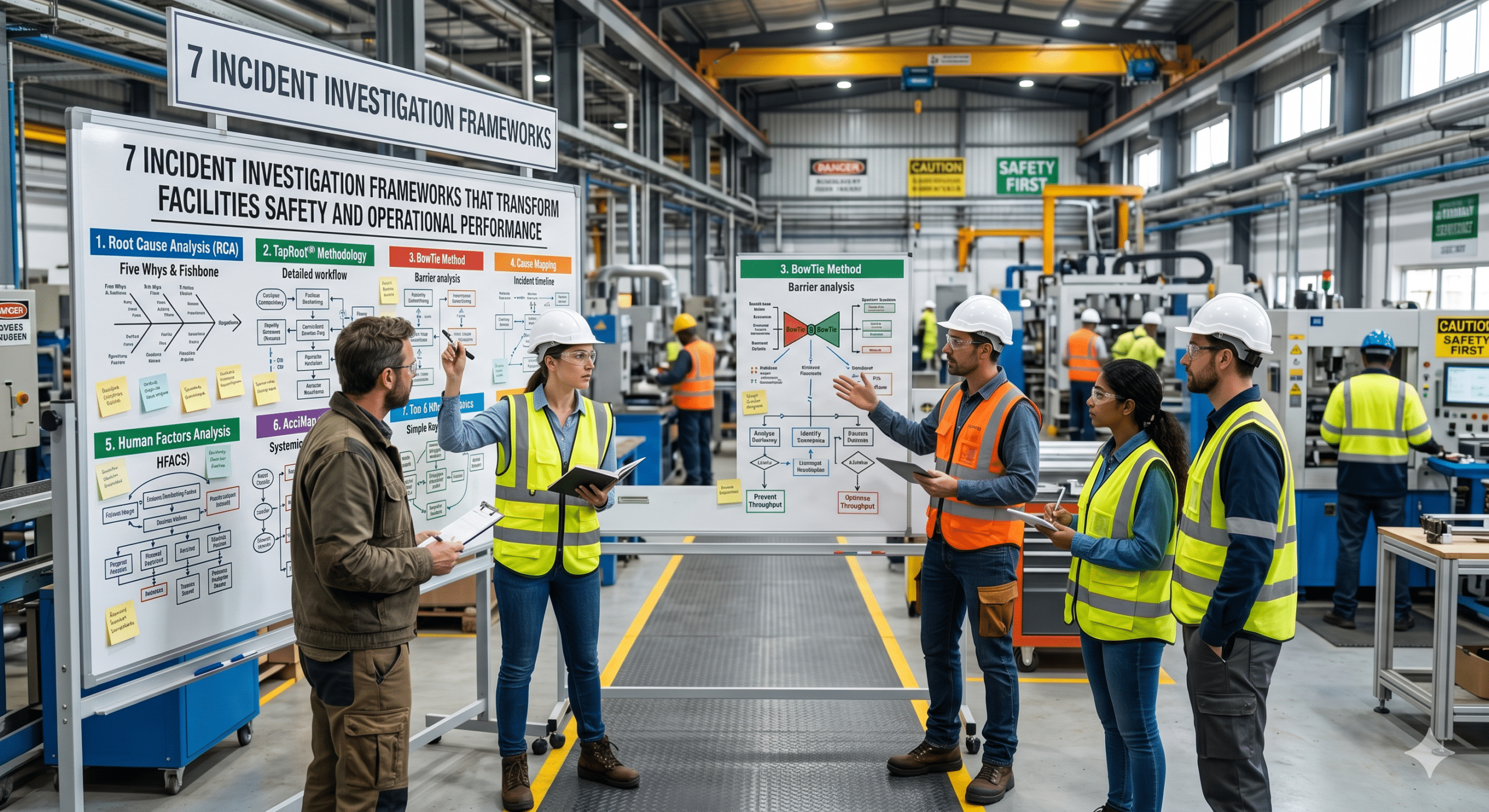
In every facility, whether it is a manufacturing plant, warehouse, distribution center, healthcare facility, or commercial building, safety incidents create consequences that extend far beyond the immediate event. An employee injury, equipment failure, chemical spill, or near miss can disrupt production schedules, delay projects, increase costs, and expose organizations to regulatory scrutiny. While many companies focus on responding quickly to incidents, the organizations that consistently achieve strong safety performance take a different approach. They focus on learning from every event.
This is where incident investigation frameworks become essential.
From a Governance, Risk, and Compliance (GRC) perspective, incident investigations are not simply administrative requirements. Instead, they are strategic tools that help organizations understand why incidents occur, identify weaknesses in controls, and implement improvements that reduce future risk. Moreover, effective investigations contribute directly to operational efficiency by reducing downtime, improving process reliability, and minimizing waste.
Many leaders think of safety and productivity as separate objectives. However, the reality is very different. Facilities with strong safety cultures often achieve better operational results because safe processes tend to be stable, predictable, and repeatable. Consequently, organizations that invest in effective incident investigation frameworks frequently experience improvements in throughput, shorter cycle times, and lower scrap rates.
As facilities become more dependent on software platforms and digital applications for maintenance management, safety reporting, workflow automation, and compliance tracking, the quality of incident investigations becomes even more important. Technology can accelerate reporting and analysis. Nevertheless, technology alone cannot solve safety problems. Organizations still need structured frameworks that uncover root causes and drive meaningful corrective action.
In this article, we will examine seven proven incident investigation frameworks and explore how they strengthen facilities safety while supporting compliance, operational excellence, and long-term business resilience.
Why Incident Investigation Frameworks Matter More Than Ever
Every incident tells a story.
Unfortunately, many organizations stop reading that story too early.
For example, a worker may slip on a wet floor. At first glance, the explanation appears simple. The floor was wet, the employee slipped, and an injury occurred. Therefore, management may decide to remind staff about housekeeping procedures and consider the issue resolved.
However, a thorough investigation often reveals deeper problems.
Perhaps a leaking machine created the hazard. Furthermore, maintenance requests may have been delayed because of staffing shortages. Meanwhile, supervisors may not have been monitoring unresolved work orders. As a result, the visible incident becomes a symptom of broader operational weaknesses.
Without a structured investigation framework, these underlying issues often remain hidden. Consequently, the organization becomes vulnerable to repeat incidents, increased downtime, and additional compliance risks.
This is precisely why incident investigation frameworks are so valuable. They provide a systematic process for collecting evidence, analyzing contributing factors, identifying root causes, and implementing corrective actions. More importantly, they help organizations move beyond assumptions and focus on facts.
As facilities continue to face increasing regulatory requirements, workforce challenges, and operational complexity, structured investigations are becoming a critical component of effective risk governance.
The Hidden Relationship Between Safety and Operational Performance
Many organizations evaluate safety and operations through separate reporting structures. Safety teams monitor incident rates, while operations teams focus on production targets. Although this approach is common, it often overlooks the strong connection between these areas.
Every incident disrupts operational flow.
When equipment fails unexpectedly, production stops. When an employee is injured, resources are redirected toward emergency response activities. Additionally, investigations consume management time that could otherwise support productivity initiatives.
Because of these disruptions, incidents increase cycle times and reduce throughput.
Furthermore, recurring safety issues frequently contribute to quality problems. Equipment malfunctions can create defective products. Inconsistent procedures can increase error rates. Likewise, communication failures can lead to rework and wasted materials.
Therefore, organizations that improve safety often experience measurable operational benefits.
When incident investigation frameworks successfully identify and eliminate root causes, processes become more reliable. Consequently, equipment uptime improves, production interruptions decrease, and operational performance becomes more predictable.
From a GRC perspective, this relationship is particularly important because it demonstrates that effective risk management supports business objectives rather than competing with them.
Framework 1: Root Cause Analysis
Root Cause Analysis remains one of the most widely used incident investigation frameworks across industries.
Rather than focusing solely on what happened, Root Cause Analysis seeks to understand why it happened.
This distinction is significant because many incidents involve multiple contributing factors. For instance, an equipment failure may appear to be the primary cause of an injury. However, a detailed investigation may reveal inadequate preventive maintenance, insufficient training, poor communication, and ineffective supervision.
By identifying these underlying factors, organizations can implement corrective actions that address the true sources of risk.
Moreover, Root Cause Analysis supports continuous improvement because it encourages organizations to examine systems rather than individuals. Consequently, corrective actions are more likely to produce lasting results.
From an operational perspective, eliminating root causes reduces recurring disruptions. Therefore, facilities can improve throughput while simultaneously strengthening safety performance.
Framework 2: The Five Whys Method
The Five Whys Method is one of the simplest yet most effective investigation techniques available.
The concept is straightforward. Investigators repeatedly ask “why” until they uncover the fundamental cause of an incident.
For example, a machine stops unexpectedly.
Why did it stop?
Because a component failed.
Why did the component fail?
Because maintenance was not performed.
Why was maintenance not performed?
Because the maintenance schedule was outdated.
Why was the schedule outdated?
Because no one was responsible for reviewing it.
By continuing to ask questions, investigators move beyond immediate causes and discover underlying process weaknesses.
Furthermore, the Five Whys Method requires minimal resources. Therefore, it is particularly useful for organizations that want a practical and accessible approach to incident investigations.
Framework 3: Fishbone Analysis
Fishbone Analysis, also known as the Ishikawa Diagram, helps investigators explore multiple categories of potential causes.
Instead of focusing on a single explanation, this framework encourages teams to examine factors related to people, equipment, processes, materials, management, and environmental conditions.
As a result, investigators gain a broader understanding of how various factors may have contributed to an incident.
This approach is especially valuable in facilities where operations involve multiple departments and interconnected systems. Moreover, Fishbone Analysis promotes collaboration because team members from different functions can contribute their perspectives.
Consequently, organizations often uncover contributing factors that might otherwise be overlooked.
Framework 4: Barrier Analysis
Barrier Analysis focuses on preventive controls.
In simple terms, investigators examine which barriers should have prevented the incident and why those barriers failed.
For example, a facility may rely on training programs, lockout procedures, alarms, inspections, personal protective equipment, and engineering controls to manage risk.
When an incident occurs, Barrier Analysis evaluates whether these controls existed, whether they functioned properly, and whether employees used them correctly.
This framework aligns closely with risk management principles because it evaluates the effectiveness of existing controls. Furthermore, it provides valuable insights into compliance gaps and control deficiencies.
As a result, organizations can strengthen risk governance while reducing the likelihood of future incidents.
Framework 5: Event and Causal Factor Analysis
Event and Causal Factor Analysis focuses on timelines.
Investigators document the sequence of events leading to an incident and identify contributing conditions at each stage.
This structured approach helps organizations understand how multiple factors interacted over time.
For example, a serious equipment failure may have resulted from several smaller issues that developed over weeks or months. Individually, these issues may not have appeared significant. However, together they created the conditions necessary for a major incident.
Therefore, this framework is particularly effective for complex investigations involving multiple systems, departments, or operational processes.
Framework 6: Human Factors Analysis
While equipment failures and procedural issues often receive the most attention during investigations, human factors frequently play an equally important role. However, organizations sometimes make the mistake of stopping their analysis after identifying employee actions. As a result, they miss the broader conditions that influenced behavior.
Human Factors Analysis takes a different approach.
Instead of asking why an employee made a mistake, investigators examine the environment in which the decision occurred. For example, fatigue, excessive workloads, poor communication, unclear instructions, inadequate training, and workplace distractions can all affect employee performance.
Moreover, human factors often reveal weaknesses in management systems rather than individual shortcomings. An employee who bypasses a safety procedure may not be acting recklessly. Instead, production pressures, unrealistic deadlines, or conflicting instructions may have influenced that decision.
Consequently, organizations that use Human Factors Analysis gain a deeper understanding of operational realities. Furthermore, they can implement corrective actions that improve both safety and productivity.
From a GRC perspective, this framework supports a culture of accountability without creating a culture of blame. Therefore, employees are more likely to report concerns, participate in investigations, and contribute to continuous improvement efforts.
Framework 7: Systems-Based Investigation
Modern facilities operate as interconnected systems. Equipment, employees, software platforms, maintenance processes, vendors, and management decisions all influence one another. Therefore, incidents rarely occur because of a single isolated failure.
Systems-Based Investigation recognizes this reality.
Rather than focusing on one event or one person, investigators examine how different elements interacted to create the incident. As a result, organizations gain a more comprehensive understanding of risk.
For example, a forklift collision may involve operator actions, traffic flow design, warehouse layout, training effectiveness, maintenance practices, and supervision. While each factor may appear manageable on its own, the interaction between them can create significant hazards.
Moreover, this framework aligns closely with enterprise risk management principles because it examines the entire operational ecosystem. Consequently, organizations can identify vulnerabilities that extend beyond the immediate incident.
In increasingly complex facilities, Systems-Based Investigation provides valuable insights that support long-term operational resilience.
The Growing Role of Software Platforms in Incident Investigations
As facilities continue to digitize operations, software platforms are becoming essential components of incident management programs.
In the past, investigations often relied on paper forms, spreadsheets, and email chains. Although these methods were functional, they frequently created delays, inconsistencies, and documentation challenges.
Today, organizations can leverage software platforms to streamline the entire investigation process.
For example, digital incident management systems allow employees to report incidents in real time. Furthermore, investigators can collect photographs, witness statements, maintenance records, and corrective actions within a centralized platform.
Because all information is stored in one location, investigations become more efficient and easier to manage.
Additionally, software applications provide automated workflows that ensure tasks are assigned, tracked, and completed on schedule. Consequently, corrective actions are less likely to be forgotten or delayed.
Another significant advantage is trend analysis.
Modern platforms can identify recurring issues across multiple facilities, departments, or operational areas. Therefore, organizations can proactively address emerging risks before they result in serious incidents.
From a compliance standpoint, digital platforms also improve audit readiness. Documentation becomes easier to retrieve, records remain consistent, and reporting accuracy improves significantly.
Nevertheless, technology should support investigations rather than replace critical thinking. While software can organize information and automate processes, effective investigations still depend on skilled analysis and strong leadership.
How Incident Investigation Frameworks Maximize Throughput
Many executives view incident investigations primarily as safety activities. However, the operational benefits are often just as significant.
Every incident disrupts workflow.
Machines stop running. Employees shift their attention away from productive work. Supervisors become involved in response efforts. Meanwhile, production schedules must be adjusted to accommodate the disruption.
Consequently, throughput declines.
When organizations consistently apply incident investigation frameworks, they reduce the likelihood of recurring disruptions. Therefore, production processes become more stable and predictable.
For example, if investigations reveal recurring maintenance failures, corrective actions can improve equipment reliability. As a result, downtime decreases and production capacity increases.
Similarly, if investigations identify communication breakdowns between departments, organizations can improve coordination and reduce delays.
Over time, these improvements create a cumulative effect. Facilities experience fewer interruptions, smoother operations, and stronger overall performance.
Therefore, incident investigation frameworks should be viewed as operational improvement tools rather than merely compliance requirements.
Reducing Cycle Time Through Organizational Learning
Cycle time represents the total time required to complete a process from start to finish.
When incidents occur, cycle times almost always increase.
Production stops unexpectedly. Equipment repairs become necessary. Employees may require medical attention. Furthermore, investigations consume valuable resources.
Because of these factors, organizations often experience significant delays after workplace incidents.
However, effective investigation frameworks help reduce cycle time by accelerating organizational learning.
Instead of repeatedly addressing symptoms, teams focus on eliminating root causes. Consequently, the same problems are less likely to occur in the future.
Moreover, lessons learned from one incident can often be applied to multiple processes. Therefore, organizations gain benefits that extend beyond the specific event being investigated.
As operational knowledge grows, processes become more efficient and predictable. In turn, cycle times decrease and productivity improves.
This relationship highlights an important principle of risk governance: preventing problems is usually far less expensive than responding to them.
Minimizing Scrap Rates Through Better Risk Controls
Safety and quality are closely connected.
In fact, many of the factors that contribute to workplace incidents also contribute to defective products and material waste.
For example, equipment failures can damage inventory. Similarly, procedural deviations can lead to inconsistent product quality. Furthermore, communication breakdowns can result in production errors that require rework or disposal.
Because of this connection, effective incident investigation frameworks often produce quality improvements as well.
When organizations identify root causes and strengthen controls, they reduce the likelihood of both safety incidents and quality defects.
Moreover, investigations frequently uncover inefficiencies that affect multiple areas of the business. Consequently, corrective actions may improve production quality, equipment reliability, and employee safety simultaneously.
Lower scrap rates deliver significant financial benefits.
Organizations spend less money replacing materials, less time correcting errors, and fewer resources managing customer complaints. As a result, profitability improves while operational waste decreases.
From a GRC perspective, this outcome demonstrates the value of integrating safety, quality, and risk management initiatives.
Creating a Culture That Supports Effective Investigations
Even the best investigation framework will fail if employees do not trust the process.
Therefore, organizations must create a culture that encourages openness, transparency, and continuous improvement.
Employees should feel comfortable reporting incidents, hazards, and near misses without fear of punishment. Otherwise, valuable information may never reach investigators.
Furthermore, leadership must demonstrate a genuine commitment to learning. If investigations focus primarily on assigning blame, employees will naturally become reluctant to participate.
On the other hand, when organizations emphasize problem-solving and prevention, reporting rates typically improve.
Moreover, managers should communicate investigation findings throughout the organization. By sharing lessons learned, companies help employees understand how corrective actions contribute to safer operations.
Over time, this approach strengthens safety culture and improves organizational resilience.
Consequently, investigations become more than compliance exercises. They become opportunities for learning, collaboration, and operational improvement.
Compliance Benefits of Strong Investigation Programs
Regulatory agencies expect organizations to investigate workplace incidents thoroughly.
However, compliance benefits extend far beyond meeting regulatory requirements.
Effective investigation programs demonstrate due diligence. Furthermore, they provide documented evidence that organizations actively identify hazards, assess risks, and implement corrective actions.
This documentation can be extremely valuable during audits, inspections, and legal proceedings.
Additionally, structured investigations help organizations identify trends that may indicate broader compliance concerns. Therefore, corrective actions can be implemented before violations occur.
From a GRC standpoint, incident investigation frameworks strengthen governance by providing visibility into operational risks. They also support risk management by identifying weaknesses in existing controls. Finally, they enhance compliance by ensuring organizations maintain accurate records and demonstrate continuous improvement.
Because of these benefits, incident investigations should be viewed as essential components of a mature governance program.
Final Thoughts
Facilities safety is about much more than preventing injuries.
While protecting employees remains the primary objective, effective safety programs also improve operational performance, strengthen compliance, and support long-term business success.
This is precisely why incident investigation frameworks are so important.
Rather than treating incidents as isolated events, these frameworks help organizations uncover root causes, identify systemic weaknesses, and implement meaningful improvements.
Furthermore, strong investigations contribute directly to higher throughput, shorter cycle times, and lower scrap rates. As a result, organizations gain both safety and operational advantages.
In today’s facilities, where software platforms, automation systems, and interconnected processes play increasingly important roles, the ability to investigate incidents effectively has become a strategic capability.
Organizations that embrace structured investigation frameworks position themselves for stronger compliance outcomes, safer workplaces, and more resilient operations.
Ultimately, every incident contains a lesson. The organizations that learn from those lessons consistently outperform those that simply move on.
Frequently Asked Questions
What are incident investigation frameworks?
Incident investigation frameworks are structured methodologies used to identify the causes of workplace incidents, determine corrective actions, and prevent similar events from occurring again.
Why are incident investigation frameworks important?
They help organizations identify root causes, improve compliance, strengthen risk management, and reduce recurring operational disruptions.
How do incident investigation frameworks improve throughput?
By identifying and eliminating recurring causes of downtime, organizations reduce interruptions and improve process stability, which supports higher productivity.
Can software platforms improve incident investigations?
Yes. Modern software platforms streamline reporting, documentation, corrective action tracking, trend analysis, and audit preparation, making investigations more effective and efficient.
What is the most common investigation framework?
Root Cause Analysis remains one of the most widely used frameworks because it focuses on identifying underlying causes rather than surface-level symptoms.
How do investigations help reduce scrap rates?
Many safety incidents and quality defects share common causes. Therefore, addressing root causes often improves both workplace safety and product quality.
References for Further Reading
If you want to deepen your understanding of incident investigation frameworks, root cause analysis, and facilities safety management, the following resources provide practical guidance, industry insights, and proven methodologies used by safety professionals worldwide.
- SafetyCulture – Root Cause Analysis: Process and Methods – This comprehensive guide explains how Root Cause Analysis (RCA) helps organizations identify underlying causes of incidents rather than simply addressing symptoms. It also covers common RCA methodologies and practical implementation strategies.
- SafetyCulture – Incident Investigation: Uncover Safety Risks – A detailed resource covering incident investigation processes, evidence gathering, root cause identification, corrective actions, and continuous improvement practices for workplace safety programs.
- OSHA – Incident Investigation – The Occupational Safety and Health Administration provides guidance on conducting effective incident investigations, identifying root causes, and preventing future workplace incidents through systematic analysis.
- OSHA – Root Cause Analysis for Safety Incidents – This publication explains how organizations can use root cause analysis techniques to move beyond immediate causes and identify underlying management system failures that contribute to incidents.
- Weekly Safety – Effective Root Cause Analysis for Incident Prevention – This article explains how root cause analysis supports incident prevention by uncovering systemic issues related to workplace design, training, maintenance, procedures, and organizational culture. It also highlights the importance of team-based investigations.
- QMII – Building a Culture of Safety Through Root Cause Analysis – An insightful article exploring how root cause analysis contributes to a stronger safety culture by helping organizations identify and eliminate recurring workplace hazards.
- Canadian Centre for Occupational Health and Safety (CCOHS) – Incident Investigation – One of the most trusted workplace safety resources available, providing practical guidance on investigation planning, evidence collection, reporting, and corrective action management.
- EHS Insight – Safety Incident Investigation Plan – A practical guide for developing structured incident investigation programs that align with compliance requirements and continuous improvement objectives.
- Access Professional Development – Root Cause Analysis in the Workplace – This article focuses on transforming workplace incidents into learning opportunities through structured investigations, emphasizing continuous improvement and risk management.
- SafetyCulture – Incident Management: Process, Systems, and Tools – This resource explores how modern organizations use incident management systems, corrective action processes, and root cause analysis to strengthen safety performance and operational resilience.