
Keeping It Frozen: 6 Practical Ways to Move Products Faster and Cut Down on Waste in Cold Storage
Running a regular warehouse is all about moving boxes from point A to point B. However, managing cold storage facilities means fighting a constant, exhausting battle against thermodynamics. When the ambient floor temperature drops to a bone-chilling -20°C, the cold stops being a background detail. It turns into the primary force dictating every single action on the floor. Operating modern cold storage facilities changes how fast your team can move, rewrites how long simple tasks take, and controls how much spoiled product your team throws away.
Meeting High Market Expectations
Today, customer expectations have reached an all-time high. Consumers and B2B clients alike expect fast-commerce delivery timelines. Meanwhile, food safety and pharmaceutical regulations get tighter by the day. We can no longer afford slow workflows, lazy dock habits, or clunky layout designs. If a pallet of frozen food or highly sensitive medicine sits on a warm loading dock for even twenty minutes, it creates a total operational disaster. When you operate high-throughput cold storage facilities, you are not just dealing with a minor delay in your shipping schedule. You are actively throwing away valuable inventory and taking a direct hit to your operating margins.
The Freezer as a Single System
To keep things running smoothly, you must treat your entire freezer footprint like a single, living machine. Every door opening, every forklift drive, and every pallet drop requires a rock-solid operational plan. The goal remains incredibly simple: keep your inventory moving quickly to maximize throughput, minimize the cycle times of your equipment, and protect the product from temperature damage to completely crush your scrap rate. Maximizing the ultimate yield of cold storage facilities means looking past high-level corporate theories. Instead, we need to focus on the practical, gritty realities that actually work on the sub-zero warehouse floor.
1. Smart Floor Plans: Arranging Your Space to Keep the Cold Locked In
Boosting your daily throughput starts long before anyone drives a forklift into a trailer. It all comes down to the structural geography of your space. In a dry warehouse, a long walk across the building just wastes a few minutes of labor time. In cold storage facilities, that same long walk can destroy an entire pallet of temperature-sensitive goods. When a building layout ignores the laws of temperature changes, the whole operation slows to a crawl. Items simply spend too much time sitting in dangerous transition climates, forcing your material handling teams to take slow, cautious paths that kill efficiency.
Structuring the Thermal Gradient
To fix this, you need to arrange your space based on product temperature needs. Create a smooth path that moves logically from the outside world into a chilled staging area. From there, move items into a blast freezer, and finally into deep frozen storage.
[ Outside Dock ] ──> [ Chilled Staging Area ] ──> [ Deep Frozen Storage ]
         │                          │                          │
   (Fast Loading)             (Inbound Sorting)          (High-Density Racking)
This structural layout reduces the distance your products travel through different temperature zones. Position every single conveyor belt, aisle pathway, and pallet rack carefully to compress travel times. This layout allows workers to get inbound items to their freezing spots as fast as possible, which prevents the product from warming up. When you shorten the physical distance between the delivery truck and the freezer rack, you instantly increase your daily throughput speed. Best of all, you eliminate the temperature spikes that trigger product degradation, protecting cold storage facilities from unnecessary scrap.
Optimizing Internal Travel Paths
Furthermore, consider the layout of your picking paths within the deep freeze itself. If your operators have to traverse the entire length of a sub-zero room to fulfill a single order, you are wasting valuable battery life and human energy. Grouping high-velocity SKUs near the exit doors minimizes cycle time significantly. This staging methodology ensures that the items moving out the fastest spend the absolute minimum amount of time in transit. Every second shaved off a picking run keeps your operators warmer, your equipment batteries charged longer, and your throughput numbers climbing higher.
2. Speeding Up Deliveries: The Best Way to Handle Your Loading Dock
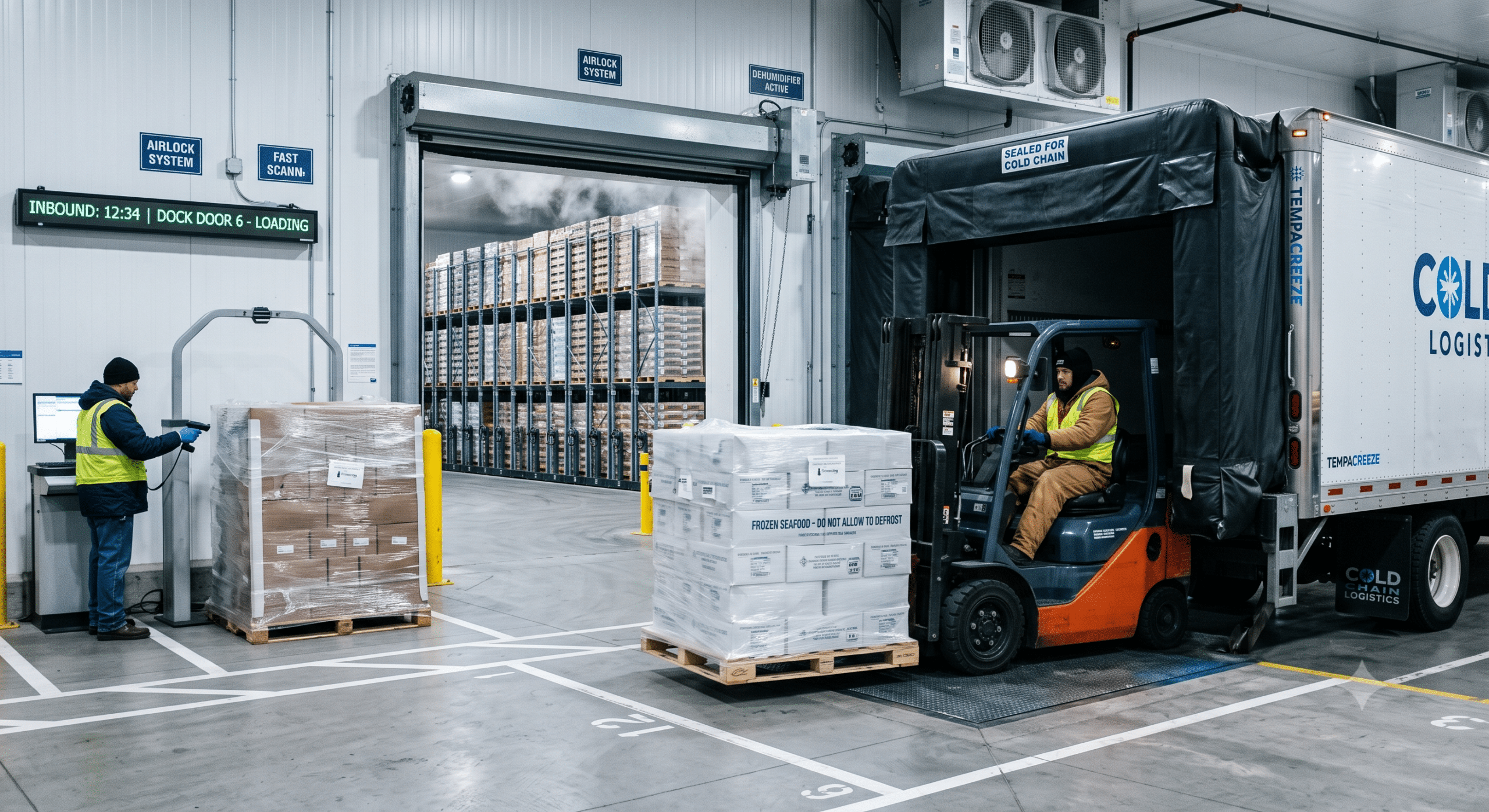
The inbound loading dock represents the most vulnerable spot in your entire building. At this exact place, you break your cold chain and allow warm, humid outside air to sneak into your workspace. If your unloading team moves too slowly, problems add up fast. Frost starts coating the boxes, obscuring labels and creating a mess. Moisture ruins the structural integrity of the corrugated packaging, causing boxes to collapse. Soon, the internal product temperature begins to climb. This creates a chain reaction of mistakes that ruins your inventory before you even log it into your warehouse management system.
Removing Dock-Side Guesswork
To speed things up, you need to remove the guesswork for your dock workers. Use automated pre-receiving tools to streamline the entire inbound workflow. This software helps your warehouse computer system know exactly where a pallet belongs before the truck doors even open. Your workers should never have to wander around looking for an open slot while a perishable product sits exposed to ambient temperatures.
Do not let pallets sit on a humid dock while workers print out stickers and scan labels by hand. Instead, you should install fast scanning arches that read barcodes and RFID tags automatically. The moment a forklift operator pulls a pallet out of the trailer, the system should scan it and verify it instantly. Then, the computer assigns the pallet to a permanent spot in the freezer without a single second of delay. Cleaning up this first step turns a messy, slow process into a fast, predictable routine. It keeps your loading dock clear, drops your cycle times, and keeps your products safe from ambient heat.
Installing Advanced Shelters
Beyond scanning, the physical connection between the truck and the dock requires specialized engineering. Traditional dock seals often leave small gaps where outside air bleeds into the building. Upgrading to inflatable dock shelters completely seals the perimeter of the truck trailer before the rear doors open. This prevents the hot summer air or humid rainy air from rushing onto your dock floor. By controlling the climate at the absolute point of entry, you reduce the thermal stress on your inbound inventory. This simple structural change helps keep dock cycle times fast, as workers do not have to battle fog or slick floors while moving pallets.
3. High-Density Racks: Finding the Right Balance Between Airflow and Speed
In modern cold storage facilities, space costs a massive amount of money. Cooling down empty air wastes an incredible amount of electricity, which acts as a constant drain on your operating budget. Because of this, many managers try to pack as many pallets into a room as humanly possible. However, packing your racks too tightly blocks the air coming from your cooling fans. This lack of air circulation causes uneven cooling and creates dangerous warm spots in the middle of your storage blocks. In the end, poor airflow leads to spoiled products, inconsistent internal temperatures, and a massive spike in your scrap rate.
Choosing Dynamic Racking Systems
The trick requires picking a racking system that holds a lot of inventory while still allowing the cold air to move freely. At the same time, the system must not slow down your forklift drivers. Drive-in racks save great amounts of space by eliminating traditional aisles. Unfortunately, they slow down your team because drivers must navigate carefully inside narrow steel structures. This slow movement increases your cycle times and raises the risk of rack damage, which can bring your entire operation to a standstill.
Switching to motorized mobile racks or automated shuttle systems changes the game completely. These systems slide whole rows of racks along heavy-duty tracks built directly into the floor. They open up walking and driving paths only when an operator needs to access a specific row. This gives you maximum storage density while keeping every single pallet easy to reach. As a result, your pickers maintain high speeds and compress their cycle times without losing any cooling efficiency. The cold air continues to circulate through planned ventilation channels, ensuring uniform temperatures across the entire inventory block.
Maximizing Retrieval Efficiencies
When evaluating these automated systems, look closely at the speed of the shuttles themselves. A high-speed pallet runner can dive into a deep lane, retrieve a pallet, and bring it to the front face while the forklift driver is still returning from the shipping dock. This parallel processing eliminates the time a driver spends waiting for a pick. By keeping your forklifts constantly moving and your racks fully utilized, you achieve a massive boost in hourly throughput. This setup also minimizes the space required for aisles, meaning you can store more product in a smaller, easier-to-cool footprint.
4. Better Door Management: How to Fix the Biggest Slowdown on the Floor
If you ask any experienced warehouse manager about their biggest operational headache, they will complain about freezer doors. Every time a heavy forklift rolls through an open doorway, a massive, violent air exchange happens. Expensive cold air pours out along the floor because it is heavy and dense. At the same time, warm, humid air rushes in through the top of the opening. This moisture creates instant ice on your ceilings, walls, and automated sensors. Heavy frost can jam up your equipment, cloud your scanning lenses, and create incredibly dangerous, slippery floors.
Warm, Humid Air Comes In (Top of Door) ──> Creates Ice and Frost Cleanup
             ▲
             │  ◄── [ Open Freezer Doorway ]
             ▼
Cold Air Escapes Out (Bottom of Door) ──> Wastes Energy and Creates Slippery Floors
Implementing Air Barriers
Fixing this issue requires a few different tools working together in harmony. Basic plastic strip curtains cannot protect busy cold storage facilities sufficiently, as they quickly become scratched, frozen, and rigid. Instead, you need high-speed roll-up doors that open and close in just a couple of seconds. Pair these rapid-acting doors with powerful air blowers that create an invisible, high-velocity wall of air across the opening. This air curtain acts as a barrier, preventing the exchange of hot and cold air even while the physical door is wide open.
For the best results, build an enclosed, dehumidified airlock room between your main freezer and the loading dock. This room acts as a buffer zone, stripping the moisture out of the air before it can ever sneak inside your deep freeze. A proper airlock keeps your aisles free of ice and ensures your automated tracking sensors read perfectly. Finally, the barrier stops the daily delays that happen when teams must pause their work to scrape ice off the walls or mop up dangerous puddles. Your forklifts can maintain their top safe speeds, keeping cycle times low and throughput high.
Mitigating Mechanical Fatigue
Think about the wear and tear these doors experience over a fiscal year. A door that cycles hundreds of times a day will eventually suffer mechanical fatigue. If a door breaks down and gets stuck open for an hour, the thermal damage to your inventory can cost tens of thousands of dollars. Investing in heavy-duty doors with break-away tracks ensures that if a forklift accidentally bumps the door, the panel pops out of its track without breaking the motor. The operator can easily pop it back into place, keeping the facility secure and avoiding a massive bottleneck in the middle of a busy shift.
5. Smarter Inventory Tracking: Keeping Products Fresh to Avoid Waste
Cutting down on ruined inventory requires total control over your tracking data. Unlike dry goods, frozen items have strict, unforgiving expiration dates. These timelines shrink rapidly if the product experiences temperature fluctuations during transit, staging, or storage. If your facility uses a loose, disorganized inventory system, workers will inevitably push older items to the back of the racks. They forget them there for months, turning valuable inventory into useless garbage that directly inflates your scrap rate.
Enforcing Software Rotation Policies
To stop this waste, your facility must follow a strict picking policy managed by your warehouse software. The warehouse management system must automatically schedule the oldest expiration dates for shipment first. This method ensures you move stock based on shelf-life realities rather than just convenience. Back up this software process by placing small, wireless temperature sensors right on the product racks to monitor conditions every minute of the day.
Sometimes, a specific section of the warehouse gets warm due to maintenance work, an unexpected evaporator failure, or a stuck door. If this happens, the computer system instantly flags those specific pallets. It moves them to the front of the line for immediate shipment or transfer. Rapid dispatch allows your team to ship them out safely before the quality drops. This kind of active inventory control keeps you ahead of problems so you no longer have to react constantly to spoiled goods and lost revenue.
Balancing Financial and Thermal Lifespans
Let’s look at the financial impact of this level of tracking. When you integrate real-time temperature data with your inventory rotation, you create a dynamic system that actively protects product value. If a pallet of frozen beef sits near a cooling unit that goes through a temporary defrost cycle, the system calculates the thermal impact. It knows exactly how much shelf life remains. By shipping that pallet to a local customer who will consume it immediately, rather than a distant distributor, you save the product from becoming scrap. This data-driven approach keeps your scrap rate near zero while maintaining high customer satisfaction.
6. Smart Machine Maintenance: Keeping Your Equipment Running in the Cold
In a normal warehouse, a broken conveyor belt or a dead forklift battery causes a minor annoyance. In cold storage facilities, it creates a total operational emergency. When a machine breaks down inside a sub-zero room, your entire workflow stops instantly. On top of that, fixing machinery in the freezing cold presents an incredible challenge for your engineering team. Metals get brittle and snap under pressure. Standard lubricants freeze solid, turning into sticky sludge that burns out electric motors. Your maintenance team cannot stay inside the room for very long without suffering from extreme cold fatigue.
Freezing Cold Room ──> Cold Oil Freezes / Metal Snaps ──> Sudden Machine Breakdown ──> Work Stops Completely
                                                                         ▲
[ Continuous Tracking & Thermal Camera Checks ] ─────────────────────────┘
Transitioning to Predictive Analytics
To keep your speeds up, stop waiting for things to break. Start tracking the health of your equipment ahead of time using predictive analytics. This prep work means using special low-temperature synthetic oils that won’t freeze up or thicken in the cold. Also, use thermal imaging cameras to check your cooling fans, conveyor bearings, and compressor units regularly to spot hidden issues.
Try to spot tiny friction spots, worn gear teeth, or minor temperature changes before a machine actually breaks down completely. Early detection allows your team to schedule and fix the issue during a quiet, low-traffic shift. This practice keeps your material handling equipment running smoothly and ensures your cooling systems stay online without interruption. Most importantly, proactive care guarantees your warehouse keeps moving at top speed, protecting your daily throughput from sudden, costly crashes.
Upgrading Sub-Zero Fleet Power
Consider the batteries that power your forklift fleet as well. Cold temperatures drain standard lead-acid batteries at an alarming rate, often cutting their operational runtime in half. Upgrading to specialized lithium-ion batteries designed for cold storage facilities changes everything. These advanced batteries handle the freezing cold without losing capacity, and they support fast opportunity charging during worker breaks. By keeping your forklifts powered up and running at peak performance throughout the entire shift, you eliminate battery swap delays, compress your cycle times, and keep your throughput completely steady.
7. The Human Factor: Ergonomics and Safety as Throughput Drivers
While automation and heavy machinery dominate the conversation around cold storage facilities, the human element remains a huge variable. A freezing worker is an inefficient worker. When human operators get too cold, their fine motor skills decline, their decision-making slows down, and they become far more prone to making costly mistakes. These mistakes lead directly to dropped pallets, damaged racks, and extended cycle times. To maximize throughput, you must treat driver comfort as a core operational metric.
Managing Environmental Exposure
Providing advanced, multi-layered cold-weather gear is the first step, but you must also design the workflow to respect human limits. Implementing a structured rotation schedule where workers spend a set amount of time in the deep freeze followed by a recovery period in a warm zone keeps morale and speed high. Heated forklift cabs represent another massive win for throughput. When a driver operates from inside a sealed, warm environment, they can focus entirely on speed and accuracy rather than just trying to stay warm. This investment keeps your cycle times consistent across the entire twelve-hour shift.
Cold Worker ──> Slow Reflexes ──> Pallet Dropped ──> High Scrap Rate & Broken Workflow
                                       ▲
[ Heated Cabs & Gear Invested ] ───────┘ ──> Fast Reflexes ──> Smooth Flow
Keeping Drive Lanes Clear
Additionally, look at how safety protocols interface with your daily speed goals. Ice buildup on the floor isn’t just a slip hazard; it is a major brake on your forklift speeds. Drivers naturally slow down when they feel their tires slipping on frosted concrete. By deploying automated floor scrubbers equipped with specialized anti-freeze solutions, you keep the driving lanes perfectly clear. When drivers have complete traction, they can confidently travel at optimal speeds, keeping your inbound and outbound cycle times exactly where they need to be to hit your daily targets.
8. Optimizing the Shipping Dock: The Final Sprint in the Cold Chain
You have optimized your inbound flow, sorted your racks, and managed your freezer doors perfectly. Now, the product faces its final challenge: the outbound shipping dock. If your staging process for outgoing orders is disorganized, all your hard work up to this point goes right out the window. Pallets waiting for a delayed carrier will sit on the shipping floor, slowly soaking up ambient heat and risking temperature rejection at the receiver’s gate.
Enforcing Just-in-Time Staging
To prevent this final bottleneck, implement a strict just-in-time staging protocol. Outbound orders should only leave the deep freeze when the delivery truck is fully backed into the dock shelter and cleared for loading. Use your warehouse software to coordinate the exact arrival time of the truck with the picking schedule of your team. This tight integration ensures that pallets move directly from the sub-zero racks, across the dock, and into the refrigerated trailer without ever sitting idle.
[ Deep Freeze Rack ] ──(Just-In-Time Pick)──> [ Dock Cross Line ] ──(Immediate Load)──> [ Reefer Trailer ]
Coordinating Late Carrier Holds
If a carrier arrives late, the system must hold the picked orders inside the freezer zone rather than letting them sit on the dock. This preserves product integrity and keeps your shipping lanes completely clear for the trucks that actually arrive on time. By treating the outbound dock as a high-speed transit lane rather than a storage area, you keep your cycle times incredibly low. This discipline eliminates the final risk of product scrap, ensuring that every shipment leaves your facility in pristine condition.
9. Leveraging Real-Time Data: The Digital Twin of Cold Storage
In modern supply chain management, you cannot manage what you do not measure. To truly push your throughput to its absolute limit, you need a comprehensive, real-time view of your facility’s operational data. Many advanced cold storage facilities now deploy what is known as a “digital twin.” This is a real-time digital model of the warehouse that pulls data from thousands of IoT sensors scattered across the building, the racking systems, the forklifts, and the refrigeration units.
Resolving Localized Aisle Drop-offs
By analyzing this stream of continuous data, your management team can spot micro-bottlenecks before they impact your daily numbers. For instance, if the sensor data shows that forklifts are slowing down by 15% in Aisle 4, you can investigate immediately. You might find a small ice patch forming on the floor or a cooling fan that is blowing air too low. Spotting these minor issues early prevents them from snowballing into major delays that kill your throughput.
[ Floor IoT Sensors ] ──> [ Digital Twin Analysis ] ──> [ Early Micro-Bottleneck Fix ] ──> Stable Throughput
Matching Power with Schedules
This data density also allows you to optimize your energy consumption alongside your throughput goals. Refrigeration accounts for the vast majority of your operational costs. By matching your heavy picking schedules with the times of day when energy rates are lowest, and by pre-cooling the rooms before high-traffic shifts, you save money while keeping the facility running at peak performance. Data turns cold storage facilities from reactive environments into proactive logistics powerhouses.
10. The Future of Cold Storage: Embracing Continuous Improvement
Achieving peak efficiency in cold storage facilities is never a one-time project. It is a continuous journey of adjustment, tracking, and refinement. Every time your product mix changes, every time a new carrier joins your network, and every time the external climate shifts, your facility must adapt. As facilities managers, we have to look at every single operational variable through the clear, uncompromising lens of performance metrics.
Building Competitive Advantage
By focus-targeting your structural layout, dock speed, racking configuration, door control, inventory rotation, and asset maintenance, you build a resilient operation. You create a infrastructure that shrugs off the harsh challenges of sub-zero temperatures and turns them into a competitive advantage. The cold will always try to slow your team down and spoil your inventory, but with the right systems and strategies in place, you can keep your products moving faster, safer, and more efficiently than ever before.
Frequently Asked Questions
What is the ideal temperature for a cold storage warehouse?
The exact temperature you need depends entirely on the products you store. Chilled storage areas usually stay between 0°C and 4°C. This range works perfectly for fresh fruits, vegetables, milk, and certain types of medicine. Frozen storage areas must stay much colder, usually between -18°C and -25°C. Deep freezing keeps meat, seafood, and ice cream perfectly preserved without letting ice crystals ruin the food.
How do fast roll-up doors help a freezer warehouse run better?
Fast roll-up doors drastically cut down the time a freezer opening exposes the room to warm outside air. They open and close in just a few seconds. Because of this speed, they stop a lot of humid air from entering the space. This prevents ice from forming on the floors and sensors. Rapid cycles keep the workspace safe for drivers and prevent unexpected stops during the workday.
Why must managers ship out items based on their expiration dates?
Shipping out items based on expiration dates ensures workers do not stack older inventory in the back of the room. Without proper tracking, the product can easily spoil. Perishable items lose shelf life quickly if they experience temperature changes during transit. Keeping track of these dates ensures you ship out the oldest usable items first, which slashes your overall waste and saves money.
How does humidity affect cold storage operations?
Humidity is one of the biggest hidden enemies in a sub-zero facility. When warm, moist air enters a freezer, the water vapor condenses and freezes instantly. This creates ice buildup on structural racks, floors, and cooling units. It can also coat barcode labels and optical sensors, causing automated systems to misread data and halt production. Managing humidity through airlocks and dehumidifiers is essential for maintaining smooth operations.
What are the main benefits of using automated shuttles in deep freeze environments?
Automated shuttles offer massive benefits by eliminating the need for forklifts to drive deep into racking structures. This keeps your cycle times low and prevents accidental rack collisions. Shuttles operate at high speeds in the freezing cold without needing warm breaks, which keeps your throughput numbers stable throughout the day. They also allow for incredibly dense storage, maximizing your usable space.
References & Further Reading
-
For a closer look at the latest logistics trends happening in this industry, check out the detailed report on the US Cold Storage Market Size, Trends, Share 2026 – 2035 by Custom Market Insights.
-
To understand the long-term building and setup costs for these specialized environments, explore the academic study on the Analysis of Investment Cost of Apple Cold Storage Facilities on ResearchGate.
What specific areas on your warehouse floor are currently causing the biggest slowdowns for your team?