
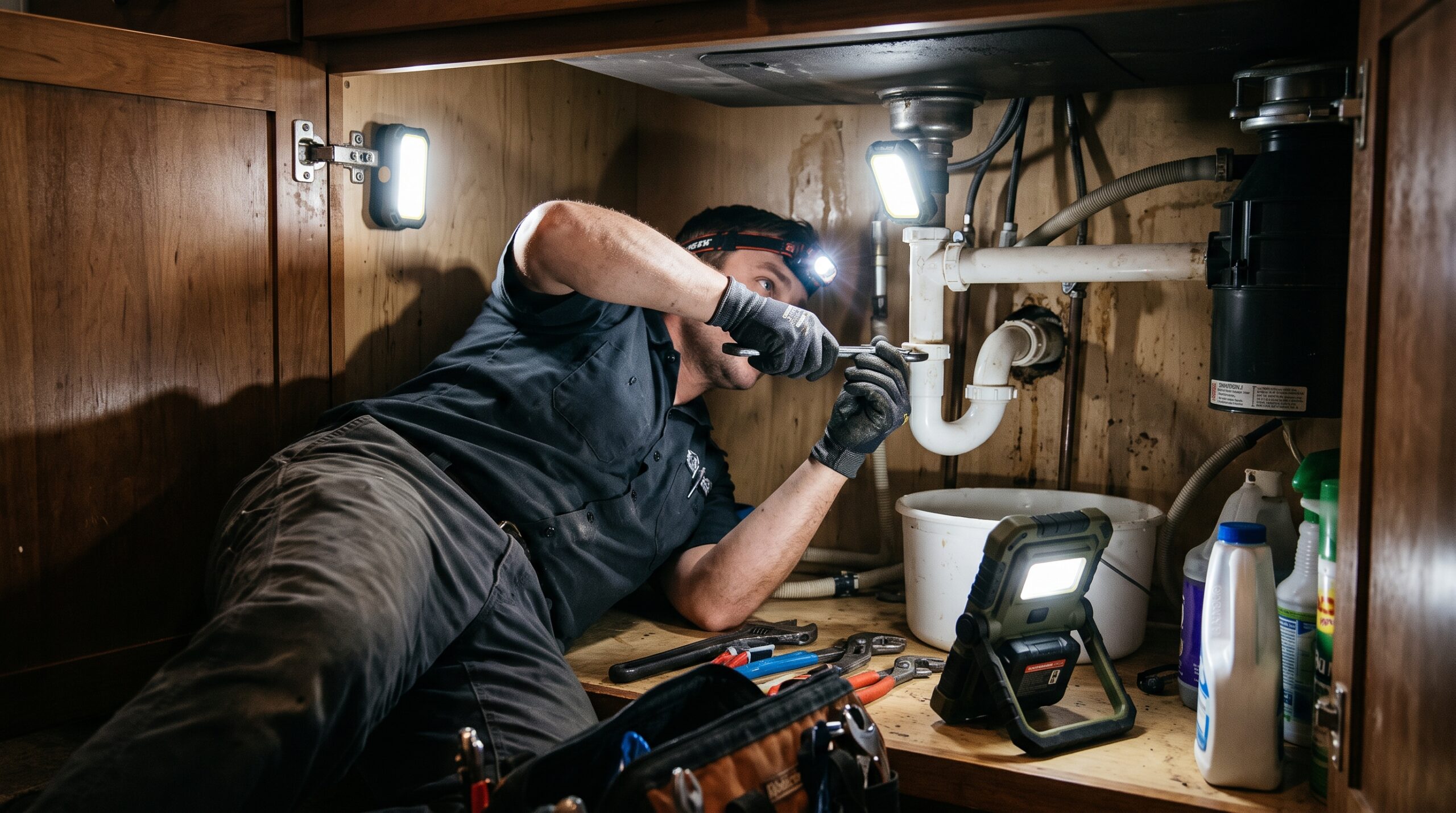
Best Compact LED Work Lights for Plumbers Working Under Sinks
There is a particular kind of dark that only exists inside a sink base cabinet. Unlike a crawl space or a basement, this dark is cramped and crowded. Picture a box about two feet deep, packed with a disposal, a dishwasher drain loop, and two supply lines. Add a P trap and a pair of angle stops nobody has touched in years. Meanwhile, you are flat on your back, and the kitchen light stops at the cabinet face. That is exactly where good work lights for plumbers earn their place in the van.
I have done service plumbing for a long time. In that time, I have learned that the right light matters more under a sink than almost any other tool. Of course, a good basin wrench helps. Still, a good light decides whether you spot a hairline crack in a compression nut. Miss it, and you get the callback two days later.
For that reason, this guide is the list I wish I had as an apprentice. First, it covers what matters in compact LED work lights for plumbers. Next, it walks through the lights my crew and I keep reaching for. Finally, it explains how to light a sink cabinet so you never work with a flashlight in your teeth.
Why Under Sink Jobs Need Better Work Lights for Plumbers
Most jobsite lighting advice is written for open spaces. Area lights and tripod lights, for example, are built to wash an entire room. Under a sink, however, that kind of light is useless or worse. In fact, a 4,000 lumen area light in a vanity just bounces off the cabinet floor and blinds you.
Shadows and Space
The real problems under a sink are specific. To begin with, the plumbing itself creates shadows. The disposal body throws a huge one, and so does the trap arm. As a result, a single light always leaves the back of a fitting in darkness. Unfortunately, the back of the fitting is usually where the leak is.
On top of that, there is no place to put anything. You will find no shelf, no tripod space, and rarely a dry surface. Therefore, a light that cannot stick, hang, clip, or stand on its own ends up in your hand or mouth.
Water, Glare, and Color
Water is the next problem, because every under sink job involves water at some point. Sometimes it is a dribble from a loosened supply line. Other times, a full trap empties onto your chest. Consequently, a light that dies after a splash is a liability.
Close range glare causes trouble as well. You often work six to eighteen inches from the fitting. At that distance, a tight spot beam creates a hot center and dark edges. Your eyes then spend the whole job trying to adjust.
Finally, there is color. Under cold blue light, corroded brass, galvanized pipe, white PEX, and rust stains all look alike. Since spotting a fresh drip is half of leak diagnosis, color quality matters more than most people think.
Keep those five problems in mind. Every recommendation below comes back to solving them.
What I Look For in Work Lights for Plumbers
Lumens: How Bright Should Work Lights for Plumbers Be?
People chase lumens. Under a sink, though, more is not better past a certain point. In my experience, 300 to 700 lumens covers most under sink repairs. Ideally, the light also has a low setting for close work. Similarly, a trade write up from Wexford Insurance on work lights for plumbers suggests a similar range for under sink jobs. Our guide to work light lumens explains how to size output for any space.
Even so, what matters more is whether the light holds that output. Many cheap lights advertise a big number that only lasts a few minutes. That brings me to the rating system worth understanding.
ANSI FL1 Numbers Tell You What the Box Will Not
If a light carries the ANSI icons, its numbers were measured a consistent way. Specifically, the FL1 standard covers six measurements: light output, runtime, beam distance, peak beam intensity, impact resistance, and water resistance. In addition, runtime is counted until output dims to 10 percent of its starting level. That is why a “10 hour” light may give far less usable brightness.
The folks at Nitecore’s FL1 guide also make a good point. Because the standard does not require a runtime graph, two lights with equal ratings can behave very differently. My rule, therefore, is simple. I want a light that holds steady medium output for at least two or three hours. After all, a disposal swap with a stuck flange can easily eat that much time.
Likewise, the impact rating matters. The drop test is done onto concrete. In short, a 1 meter rating means the light survived repeated drops from that height. Work lights for plumbers get kicked and dropped constantly, so this number counts.
Flood Beam Over Spot Beam
For close work, I want a wide, even flood. After all, a wide flood beam spreads light evenly and cuts eye strain during close range jobs such as inspecting under a sink. Save the spot beam for wall cavities or long drain lines instead. Under the sink, in short, flood wins every time.
COB style panels are especially good at this. COB means chip on board, or many small LEDs packed onto one surface. Because they produce a soft, broad wash, they leave fewer harsh shadows than a single LED.
Color Rendering and Color Temperature
This one gets ignored, and it should not. Color rendering index, or CRI, is a 0 to 100 scale. It describes how faithfully a light shows colors compared with daylight. However, it has nothing to do with brightness. In fact, CRI has no direct connection with color temperature in Kelvin or with lumens.
So why does a plumber care? Simply put, high CRI light helps you tell copper from brass. It also reveals early corrosion and separates a damp stain from a dry one. According to ElectricianU’s breakdown of CRI, a CRI of 90 to 100 counts as excellent, while 70 to 85 is merely good. Personally, I prefer a 400 lumen light with high CRI over a dull 1,000 lumen one.
As for color temperature, neutral white around 4,000 Kelvin is easy on the eyes. By contrast, very cool 6,500 Kelvin lights look bright in the store. Yet they tire your eyes after an hour under a vanity.
Water Resistance in Work Lights for Plumbers
Every under sink light should have a real ingress protection rating. To read it, remember that the letters IP are followed by two digits. The first digit covers solids, while the second covers liquids. Our waterproof work light guide goes deeper on both digits.
Here is how I translate it for sink work:
- IPX4 or IP54: splash resistant, which is fine if you drain the trap into a bucket.
- IP65: protected against low pressure water jets from any direction.
- IP67: rated for immersion to 1 meter for up to 30 minutes, so it survives a drop into a full sink.
One caution from the lighting side, though. Per LEDVANCE’s explanation of IP ratings, submersion protection is a feature IP65 does not offer. Consequently, do not expect an IP65 light to survive a dunk.
Mounting Options That Keep Work Lights for Plumbers Hands Free
Under a sink, the best light is the one you set and forget. For that reason, I look for at least two of these:
- Magnet: grabs a disposal housing, steel bracket, or cast iron drain.
- Pivoting head: sits flat on the cabinet floor yet aims up at the trap.
- Hook or keyhole: hangs from a supply line, drain arm, or screw.
- Clamp or clip: holds onto the cabinet face frame.
- Bendable body: snakes around the disposal.
Battery Platform and Size
If you already run a 12 volt tool platform, a matching power tool battery work light is an easy choice. That way, you never hunt for a separate charger. On the other hand, USB C rechargeable lights now handle daily service work well. Either way, the light head should fit easily through a vanity door. Equally important, the unit should tuck between the disposal and the cabinet wall.
The Compact Work Lights for Plumbers That Earn Space in My Bag
These are the lights I see most often in service plumbers’ kits, including my own. Throughout this list, I stick to what I have used or what manufacturers publish. After all, made up numbers do nobody any good.
Best Overall Compact Flood: Milwaukee M12 ROVER Service and Repair Flood Light
If I could keep only one light for sink work, this would be it. Not only does it fit behind the trap, but it also puts out a clean wall of light. Milwaukee lists 700 lumens with up to 24 hours of runtime on an M12 XC 4.0 battery, a 110 degree pivoting head, and a strong rear magnet. Furthermore, distributor spec sheets list a low mode of 250 lumens and an IP54 enclosure rating.
In practice, the magnet holds firmly on a disposal body. The pivot also lets me aim up at a basket strainer from below. Better still, the low mode is ideal right next to a compression fitting. Retailers also note an integrated keyhole for hanging, which helps on all wood vanities. In addition, Pro Tool Reviews points out its USB port, which has charged my phone on long days.
There are tradeoffs, of course. Since it is rated IP54, it handles splashes but not a dunk. Besides that, it only makes sense if you run M12 tools.
Best Magnetic Handheld: Streamlight Syclone
This light suits plumbers who want something pocketable that still mounts. For instance, JourneymanHQ’s under sink roundup highlights the Syclone’s magnetic base that grabs metal sink hardware or steel cabinet frames. The head also rotates 360 degrees. That is the real selling point, because you can stick it on a disposal and swing the beam anywhere.
That said, it is smaller and less powerful than a dedicated flood. Therefore, I treat it as a second light or inspection light.
Best Hands Free Option: A Right Angle Light or a Good Headlamp
A headlamp under a sink is a mixed blessing. On one hand, it goes wherever you look. On the other hand, the shadows move every time you turn your head. You can also easily blind a homeowner standing behind you. Even so, nothing gets light to your line of sight faster.
My compromise, then, is a right angle light that clips to a pocket or chest strap. Olight’s Perun series is a popular example. In fact, Olight describes the Perun line as multi function headlamps built around a right angle design. Clipped to your collar, it throws light right toward the trap without a headband.
If you still prefer a true headlamp, pick a slim one. As JourneymanHQ notes, a slim profile keeps you from bumping your head on the underside of the sink cabinet. That sounds minor until you have done it twenty times in a day.
Best Flexible Design: NEBO Big Larry 2 COB
The Big Larry has a broad COB panel on its side. As a result, it gives a soft, wide flood instead of a hot spot. Moreover, it is light and easy to wedge beside a disposal. JourneymanHQ likewise notes its lightweight construction for overhead plumbing work where heavier lights cause arm fatigue.
Personally, I use this style of light as fill. Once I set it opposite my main light, the disposal shadow mostly disappears.
Best Budget Pick: COAST FL75R
Not every plumber wants to spend serious money on lights. This is especially true for apprentices and occasional DIYers. In that situation, the COAST FL75R is my usual recommendation among budget work lights for plumbers. According to JourneymanHQ, it puts out 435 lumens, enough for most under sink diagnostics and pipe fitting. It also fits behind toilet tanks and under bathroom vanities.
Granted, it will not match a premium light for runtime or toughness. For the price, however, it covers the basics well.
Best Inspection Penlight: Streamlight MicroStream
Every kit needs one small, focused light for close checks. Is that a crack in the ferrule or just a scratch? Similarly, is the drip from the stem packing or the supply nut? In those moments, a tight beam lets you light a single joint. Notably, JourneymanHQ ranks the MicroStream as its top compact penlight pick. As a habit, I keep one in my shirt pocket.
For DEWALT Platform Users
If your drills are yellow, skip buying a second battery system for a light. Instead, look at DEWALT’s compact LED work lights on its 12 volt and 20 volt MAX lines. Notably, Wexford’s plumber lighting guide includes a pick for DEWALT users. As long as yours has a pivoting head and a hook or magnet, you are covered.
How I Set Up Work Lights for Plumbers Under a Sink
Owning good work lights for plumbers is only half the job. Placing them well is the other half. With that in mind, here is the two light method I teach every apprentice.
- Clear the cabinet first. Pull everything out before you begin. Otherwise, every bottle left inside becomes a shadow and a spill waiting to happen.
- Set your main light low and behind. Place your main flood on the cabinet floor toward the back corner. Aim it up and forward at your work area. Light from behind and below hits the underside of fittings, where you cannot see from the floor.
- Add fill from the opposite side. Then wedge a softer light on the other side of the disposal. As a result, the big disposal shadow mostly disappears.
- Keep a small light on your body. In addition, carry a penlight or right angle light for checking joints after tightening.
- Dim the main light up close. At arm’s length, drop it to low. Too much light up close causes glare off wet chrome.
- Check for leaks in the dark. Finally, turn the water back on and kill the kitchen lights. Then aim one light sideways across the fittings and look for a glint. After that, run a dry paper towel around every joint. Honestly, that step alone has saved me more callbacks than any tool I own.
Safety Notes on Work Lights for Plumbers
Electrical Hazards and Heat
Mind the electrical under the sink. Disposals and many dishwashers are hardwired or plugged in inside the sink base. For that reason, never run a corded light through standing water. Likewise, keep cords away from the disposal wiring. Cordless work lights for plumbers, by comparison, remove that problem entirely.
Also remember why old work lights earned a bad reputation. Fine Homebuilding once ran a reader story about a homeowner using a 300 watt halogen work light in a base cabinet. He burned himself twice and kicked the lamp over repeatedly. Admittedly, LEDs run far cooler, as we cover in our LED vs halogen comparison. Nevertheless, cheap high output LEDs can still get hot at the head. So never leave one pressed against a plastic drain on high for an hour.
Lighting Rules and Eye Strain
Lighting is part of jobsite safety, not just convenience. Under OSHA’s construction illumination rule, for example, work areas must meet the minimum foot candle levels in Table D 3 while work is in progress. However, in July 2025 OSHA proposed rescinding that construction illumination standard. Check its current status before quoting it in a safety plan, and see our guide to job site lighting requirements for the bigger picture.
Regulation or not, the practical point still holds. As Electrical Contractor magazine notes, too much or too little light can strain the eyes and cause discomfort, irritation, or headaches. Simply put, a tired plumber with sore eyes makes mistakes.
On a related note, protect your eyes from your own light. Never stare into a bright LED after your eyes adjust to the cabinet. Instead, aim lights at the work, not your face. Also switch off headlamps before turning to talk with the customer.
Common Mistakes With Work Lights for Plumbers
- Buying the brightest light on the shelf. Ironically, a 2,000 lumen light in a 30 inch vanity is a glare machine. Buy a light with a good low mode instead.
- Relying on the phone flashlight. It works for a quick look, but not for an hour. Phones overheat, dim themselves, and are hard to prop up. Worse still, a phone soaked in trap water is an expensive mistake.
- Using one light for everything. One light always leaves shadows, whereas two lights fix it.
- Ignoring the IP rating. Sooner or later, a light that cannot handle a splash will fail. Usually, that happens right when a supply line lets go.
- Skipping color quality. When every fitting looks gray, you will miss corrosion and early leaks.
- Forgetting to charge between calls. Rechargeable lights are only as good as your habits. For this reason, I charge every light in the van overnight. I also keep a spare battery for my main light, and our guide to LED work light battery life covers how to stretch runtime.
Final Thoughts on Work Lights for Plumbers
After years on cabinet floors, I can tell you something simple. The best work lights for plumbers under sinks are not the biggest or brightest. Rather, they are compact, steady, and easy to mount. Good ones throw a wide, even flood with true color. Beyond that, they shrug off splashes and survive drops onto tile. They also run long enough for a disposal swap that goes sideways.
So if you are building a kit, start with one solid compact flood on your battery platform. After that, add a magnetic or flexible fill light. Keep a penlight in your pocket, too. Then learn the two light setup and check for leaks with the lights off. In the end, you will work faster, see more, and get fewer callbacks. That is what a good light is really for.
Frequently Asked Questions
How many lumens do work lights for plumbers need under a sink?
For most under sink repairs, 300 to 700 lumens is plenty. Ideally, the light also has a low setting for close work. Even then, steady output matters more than peak brightness. Similarly, Wexford Insurance’s plumber lighting guide suggests a comparable range.
What IP rating should work lights for plumbers have?
Generally, IP54 or IPX4 handles splashes, and IP65 handles low pressure spray. Meanwhile, IP67 can survive a short dunk. For daily sink work, therefore, IP65 or better is ideal. LEDVANCE’s IP rating guide explains each level in detail.
Is a headlamp or a work light better under a sink?
Both have a place. A compact flood gives steady light that reduces shadows. By contrast, a headlamp follows your eyes for close inspection. That is why most service plumbers carry both. JourneymanHQ’s under sink flashlight guide compares the two approaches.
Does color rendering really matter for plumbing?
Yes. High CRI light makes corrosion easier to spot. It also helps you tell brass from copper and fresh drips from old stains. Ledlenser’s CRI explainer covers how the scale works.
What do the ANSI icons on a flashlight box mean?
They show the light was tested under the ANSI FL1 standard. The tests cover output, runtime, beam distance, peak intensity, impact resistance, and water resistance. Notably, runtime is measured until output drops to 10 percent. HD Supply’s FL1 explainer defines each icon.
Are magnetic work lights for plumbers worth it?
Absolutely. In fact, a magnet turns a handheld light into a hands free work light. For under sink jobs, that is the single biggest upgrade. For example, Milwaukee’s M12 ROVER announcement describes how its rear magnet mounts to jobsite surfaces.
References
- OSHA: 29 CFR 1926.56, Illumination
- J. J. Keller: OSHA Proposes Rescinding Construction Illumination Requirements
- 1000Bulbs: OSHA Lighting Requirements for Workplaces
- Electrical Contractor Magazine: Lighting and Illumination in the Workplace
- Milwaukee Tool: M12 ROVER Service and Repair Flood Light Announcement
- Pro Tool Reviews: Milwaukee M12 Rover Floodlight
- SupplyHouse: M12 ROVER Service and Repair Flood Light Product Page
- Nitecore: ANSI FL1 Standard Guide
- HD Supply: ANSI FL1 Flashlight Standards Icons and Definitions
- Occupational Health and Safety: New Standards Guide Flashlight Selection
- LEDVANCE: IP Rating Explained
- B&H Explora: Ingress Protection Ratings Explained
- Ledlenser: Colour Rendering Index for LED Lighting
- ElectricianU: Color Rendering Index in Lighting
- Olight: Perun 3 vs Perun 2
- JourneymanHQ: Best Plumbing Flashlights for Dark Under Sink Work
- JourneymanHQ: Best Clip On Work Lights for Repairs
- Wexford Insurance: Best Work Lights for Plumbers
- Fine Homebuilding: A Better Work Light for Cramped Conditions