
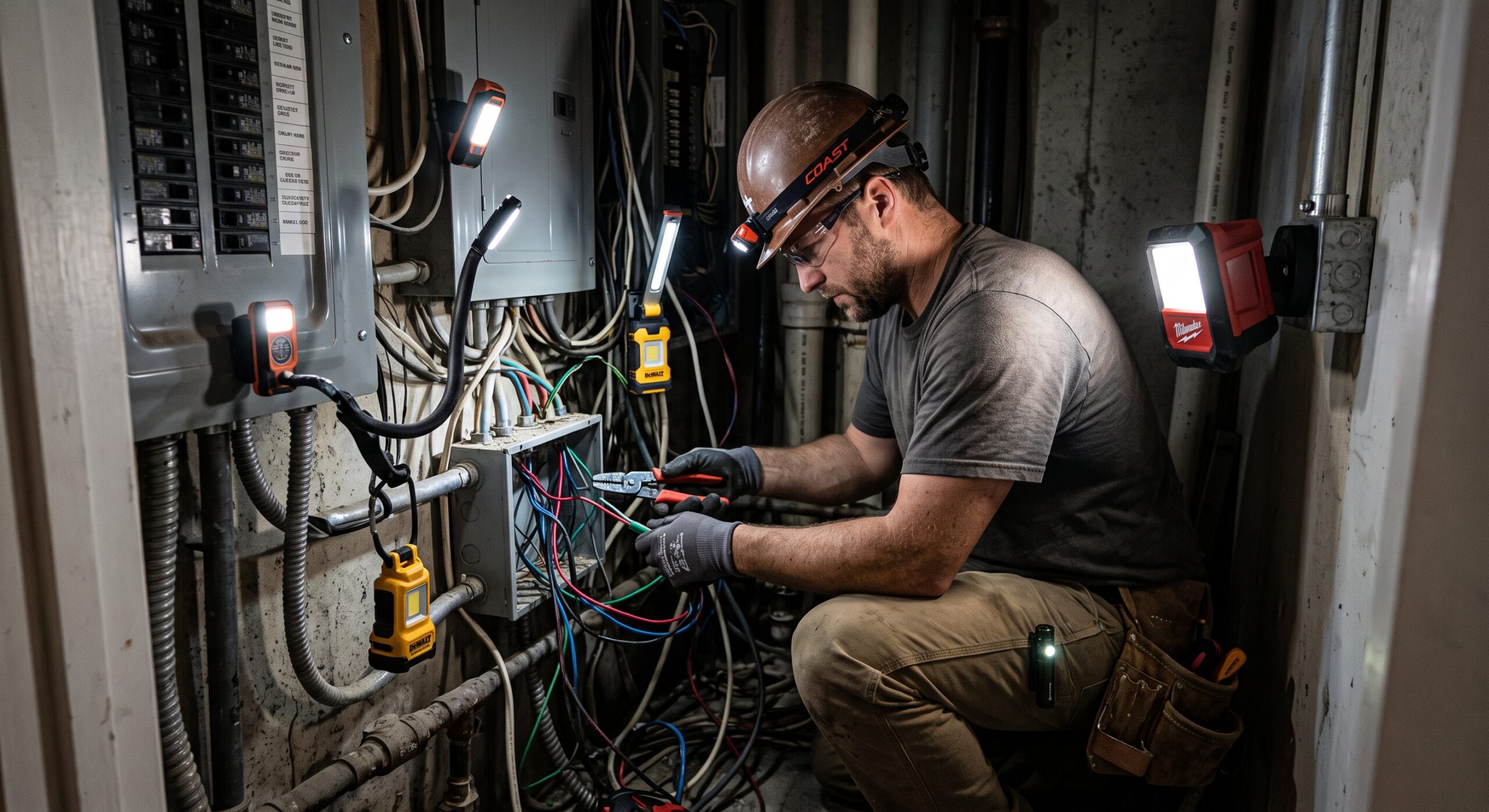
I’ve walked a lot of job sites after dark, from 6:00 AM crawlspaces to pitch-black attics in July. After close to two decades in residential and light commercial site safety, I can tell you that investing in a reliable rechargeable work light for contractors is the single most overlooked safety upgrade on any site. Most crews treat lighting as an afterthought, relying on a bare bulb hanging from a joist wired back in 1987 or whatever dying battery flashlight is sitting on the floor. But adequate lighting isn’t a luxury—it’s your crew’s first line of defense against preventable accidents.
Every contractor I know trusts his drill. He trusts his level. He probably overpaid for his laser level and loves it anyway. Yet lighting rarely gets that same respect. Guys grab whatever is closest: a headlamp with dying batteries, a shop light with a cord taped in four places, or a phone flashlight clenched in their teeth while trying to read a panel schedule. Stop relying on phone flashlights and frayed cords. Choosing a quality rechargeable work light for contractors is one of the easiest ways to keep your crew safe, productive, and compliant.
I’ve written up more near misses tied to bad lighting than almost any other cause, and most of them never had to happen. A decent rechargeable unit sitting in the truck would have stopped them cold. This isn’t a gear review; it’s what I’d tell any crew I was responsible for. I’ve had to explain to a general contractor why a worker sprained an ankle stepping off a ladder into a dark hallway, and I never want to have that conversation again.
The Job Site After Dark Isn’t a Rare Situation
Where the Real Work Happens
People picture construction as a daytime job, and mostly it is. But so much of the actual work happens in low light conditions that have nothing to do with the clock. An electrician works inside a wall cavity. A plumber crawls under a cabinet. An HVAC tech spends the whole day in a crawlspace that never sees natural light, no matter the hour. A roofer starts before dawn in winter to beat the weather. A punch list crew finishes a basement remodel before anyone has wired the permanent fixtures.
What OSHA Actually Requires
OSHA addresses this directly. Under 29 CFR 1926.56, OSHA requires employers to light construction work areas adequately, with minimum foot candle levels that depend on the task. General construction areas need at least 3 foot candles. Detailed work like inspection or fine bench work needs up to 30 foot candles (see the full standard in the references below). That’s not a suggestion. It’s a regulatory floor, and solid data backs it up. Poor lighting causes slips, trips, falls, and contact injuries, because someone simply didn’t see the hazard in time. The Laborers’ Health and Safety Fund of North America has written about this too. Inadequate lighting drives a meaningful share of job site incidents that people otherwise chalk up to carelessness.
It’s Rarely Carelessness
Here’s what I try to get across to younger guys on a crew. It’s rarely carelessness. Usually the crew just doesn’t have enough light to see the extension cord, the rebar, the open floor joist, or the step that wasn’t there yesterday. You cannot follow a safety procedure you cannot see.
What’s Wrong With Corded and Disposable Lighting
For years the standard setup was a corded halogen work light, or a string of shop lights running off a generator or a live panel. That setup has obviously worked for decades. I’m not pretending otherwise. But as someone who signs off on site conditions, I have a long list of problems with it.
Cords Create New Hazards
Cords are trip hazards, full stop. Run a hundred feet of extension cord across a floor already covered in debris, tools, and staged material, and you’ve just created a hazard to fix a hazard. I’ve stopped work more than once because someone ran a cord straight through a walking path instead of routing it along a wall. Usually that happened because the light wasn’t bright enough to reach the work area from a safer spot.
Halogen Bulbs Run Hot and Break Easily
Halogen bulbs run hot enough to burn skin, and in the wrong conditions they can ignite nearby combustible material. That’s a real concern around insulation, sawdust, and drop cloths. The bulbs are also fragile. Drop one off a ladder and you need a replacement, assuming the truck even has one. If you want the fuller side by side, we’ve laid out the LED work light vs halogen comparison in detail elsewhere, but the short version is that LED wins on heat, durability, and running cost.
Disposable Batteries Aren’t a Real Solution
Disposable battery lights, the kind that take a handful of AAs, work fine for a glove box emergency. They’re not a serious tool. Battery life is unpredictable. Light output fades as the batteries drain, so the crew ends up working in progressively worse conditions without noticing. And you’re generating battery waste constantly. I don’t want a crew relying on that for real work.
Why Rechargeable LED Work Lights for Contractors Are Winning
The shift over the last several years has actually mattered here. It’s not just a marketing angle, it’s a genuine improvement in field conditions. A quality rechargeable work light for contractors solves most of these problems at once.
LED Technology Runs Cooler and Lasts Longer
LED technology drives a lot of this. LEDs run cool compared to halogen or incandescent bulbs, which cuts burn risk and makes them safer to use near flammable material. They’re also far more efficient, so you get more usable light from the same battery capacity. And they survive drops and vibration much better, since there’s no filament or gas to break.
No Cord Means the Light Goes Where You Need It
The rechargeable battery changes how a crew actually works. No cord means no trip hazard, and no dependence on a live circuit or a generator running somewhere. That matters enormously in a partially built structure where you don’t want power live yet, or in an older home where you don’t trust the wiring until someone inspects it. The light goes exactly where the work is: under a sink, inside a duct, up in a truss space, wherever, without anyone holding a cord or fighting for reach. That freedom is the core advantage a rechargeable work light for contractors has over anything tethered to a cord.
Battery Technology Has Caught Up
Battery technology has finally caught up to the job. Most quality units now run lithium ion packs that hold a charge through a full shift. They take a reasonable time to top off overnight, and skip the memory effect that made older rechargeable tools annoying to manage. Some units even take swappable packs that share a platform with other cordless tools your crew already owns, and a few newer models add app based dimming or remote control — we’ve put a few of these smart LED work lights compared side by side if that’s a feature you actually want.
None of this means every rechargeable light on the shelf is worth buying. I’ll get into what separates a good one from a bad one shortly. But as a category, a rechargeable work light for contractors beats what most crews used ten years ago. The safety case for switching is strong enough that I bring it up on every site walk I do.
The Safety and Compliance Side, Explained Plainly
I want to walk through a few technical terms here. Contractors get sold on lumens numbers without understanding what actually matters when picking a rechargeable work light for contractors that’s genuinely safe and durable. I’d rather you understand it than just trust a label.
Lumens and the ANSI FL1 Standard
Lumens measure total light output. Manufacturers don’t always test it consistently or honestly. That’s why the ANSI FL1 standard exists. It’s an industry agreed testing protocol, originally built for flashlights, that standardizes how manufacturers measure and report brightness, runtime, beam distance, and impact resistance. A light rated at 1,000 lumens under FL1 testing is genuinely comparable to another light tested the same way. Look for the FL1 rating on the packaging or spec sheet. If a light skips it entirely, treat the printed numbers with some skepticism.
IP Ratings for Dust and Water
IP ratings describe how well a device resists dust and water, using two digits, like IP65 or IP67. The first digit, on a scale of zero to six, covers solid particle protection. The second, on a scale of zero to nine, covers moisture. An IP65 rating means the light is dust tight and can handle low pressure water jets from any direction, which covers most job site conditions including rain and hose down cleanup. IP67 adds real protection against temporary submersion. Anyone doing exterior work, plumbing, or work near standing water needs this rating. It’s the difference between a tool that survives the season and one that dies the first time rain or a puddle finds it.
Drop Ratings Matter More Than People Think
Job sites are not gentle environments. A light rated only for a one meter drop onto carpet was never built for a ladder or scaffold environment. Look for units that manufacturers test to a meter and a half or two meters onto concrete. Several brands now publish that number directly.
None of this replaces your obligation to meet OSHA’s illumination minimums under 1926.56. But a properly rated, sufficiently bright rechargeable unit gives you one of the most straightforward paths to compliance, especially in interior spaces that still lack permanent lighting.
What to Look For in a Rechargeable Work Light for Contractors
If you’re the one making the purchasing decision for a crew, here’s what I actually tell people to prioritize, roughly in order of how often it matters in the field.
Battery Life That Matches Your Workday
Look past the marketing claim and think about your actual workday. If your crew runs ten hour days, a light claiming eight hours at maximum brightness will probably give you five or six in real conditions. Factor in temperature and how often someone runs it at full power, and that gap grows. Pick a unit with a lower output mode. That extra mode stretches runtime through the long stretches where you don’t need maximum brightness.
Weather and Drop Protection
Get an IP65 rating at minimum, and IP67 if the work involves exterior conditions, plumbing, or regular contact with water. Match the drop rating to your actual site conditions too. Look for at least a meter and a half onto a hard surface, and make sure the manufacturer actually publishes that number instead of implying it.
Mounting and Charging Compatibility
Mounting versatility covers most situations a crew runs into. A magnetic base, a folding hook, and a tripod mount let you clip to a stud, sit flush on a metal duct, or stand a light on the floor for area coverage. Hands free lighting isn’t a luxury. It lets someone use both hands for the actual work instead of holding a light in their teeth. Charging compatibility matters too. If your crew already runs one battery platform for drills and saws, a work light that shares that battery removes one more charger cluttering the truck. Finally, match weight and size to where the light will live. Keep it small enough to belt clip or headlamp mount for an attic or crawlspace. A larger, self standing light works better for a garage or basement.
Real Job Site Applications Across the Trades
This category isn’t a one size fits all tool. The right rechargeable work light for contractors changes depending on the trade and the application.
Electricians and Plumbers Need Compact, Hands Free Light
Electricians working inside panels or wall cavities need something small, focused, and ideally hands free, since both hands stay busy with wire while they read terminal markings. A headlamp or a magnetic light clipped to the panel solves this better than any large area light — we’ve gone into more depth on that setup in our roundup of the best work lights for electricians in tight spaces. Plumbers under sinks or in crawlspaces need something just as compact. A strong hook or magnetic mount that hangs from a joist or pipe frees up both hands for the actual plumbing.
HVAC Techs and Roofers Face the Toughest Conditions
HVAC technicians in attics and crawlspaces deal with some of the worst lighting conditions on any job site, often paired with heat, insulation dust, and barely any clearance. A rugged, high output light with a wide beam and a strong IP rating earns its keep here more than almost anywhere else. Roofers and exterior crews working early or late need weather resistant lighting that can survive a wet surface or a sudden rain shower mid task. That’s exactly where the IP67 rating pays for itself.
General Contractors Need Whole Room Coverage
General contractors and punch list crews doing final walkthroughs in homes without finished electrical need portable area lighting that lights an entire room well. That kind of coverage catches cosmetic defects, nail pops, and paint issues that a dim room would otherwise hide, and that would otherwise turn into a callback.
I’ve watched crews try to make one single light do all of these jobs, and end up unhappy with it everywhere. It’s usually smarter to carry a small hands free unit for tight spaces and a larger area light for whole room coverage, rather than expecting one tool to handle both.
Common Mistakes I See Contractors Make With Work Lighting
Chasing Lumens Numbers Alone
Buying based on lumens alone is a mistake, and it’s one of the most common ones I see when a crew picks out a rechargeable work light for contractors. A 3,000 lumen light with a narrow, harsh beam and no diffusion can actually work worse for close detail tasks than a well designed 800 lumen unit with even, wide coverage. Raw brightness numbers on a box tell you nothing about beam quality, color temperature, or how evenly the light spreads across the work area.
Ignoring Color Temperature
A very cool, blue tinted light can cause eye strain over a long shift. It also makes it harder to judge true colors, which matters for paint, wood tone, or wire color coding. Something closer to daylight white, generally in the 5,000 to 6,000 kelvin range, tends to be easier on the eyes for extended use.
Poor Battery Habits and Cheap Units
Don’t let batteries fully drain and then sit dead. Lithium ion batteries last longer when you don’t run them all the way to zero and leave them that way in a cold truck overnight. A five minute habit of topping off chargers at the end of a shift adds real years to battery life. Don’t treat a work light as an emergency backup either. Crews that get the most value out of rechargeable lighting plan for it the same way they plan for having enough fasteners or tape measures on site.
And don’t buy the cheapest option just to save a few dollars up front. I understand budget pressure is real, especially for smaller outfits and one person operations. But then the housing cracks on the first real drop, or the battery swells after a few charge cycles. That cheap light ends up costing more than a properly built unit would have, once you count the replacement and the lost time.
The Bottom Line From Someone Who Has to Sign Off on Safety
I’m not paid to sell work lights. I’m paid to walk a site, look at conditions, and decide whether the work happening there is safe enough to continue. When I see a crew relying on cell phone flashlights or a single bare bulb, that tells me something about how the whole operation handles risk. It’s rarely a good sign.
A good rechargeable work light for contractors is one of the cheapest ways to cut real risk on a job site. It’s not a compliance checkbox. It’s not an upsell. And it’s not optional if you’re serious about running a safe crew. Check the FL1 rating. Match the IP rating to your actual work environment. Confirm the drop rating fits how your crew will actually treat the light. And buy enough units that nobody on your crew ever works in the dark because the one good light ended up somewhere else on the site.
Your crew’s eyes are the first line of defense against almost every hazard on a job site. Give them something worth trusting.
Frequently Asked Questions
What does OSHA actually require for job site lighting?
Under 29 CFR 1926.56, OSHA sets minimum illumination levels for construction work areas. General construction zones and access areas need at least 3 foot candles. Tasks requiring fine detail, like inspection work, need up to 30 foot candles. Employers must provide lighting that meets these minimums wherever natural or existing lighting falls short.
What’s the difference between IP65 and IP67 ratings on work lights?
Both ratings mean the light is fully dust tight, since the first digit, 6, matches in each. Water resistance is where they differ. IP65 handles low pressure water jets from any direction, which covers rain and hose down cleaning. IP67 adds resistance to temporary submersion, typically up to one meter for around thirty minutes. IP65 covers most general job site use. Exterior or plumbing heavy work benefits from the extra margin IP67 offers.
What is the ANSI FL1 standard and why does it matter?
FL1 is an industry standard testing protocol. It standardizes how manufacturers measure and report lumens, beam distance, runtime, water resistance, and impact resistance for portable lighting. A light that passes FL1 testing gives you a number you can actually compare against a competing product, instead of trusting an unverified figure a manufacturer chose to print.
How long should a rechargeable work light actually last on a charge?
This depends heavily on which brightness mode you use. Most quality units advertise anywhere from four to twelve hours depending on output level, but real world runtime usually falls short of the top advertised number, especially at maximum brightness. Choosing a unit with a lower output mode for extended tasks gives you the most reliable way to stretch a single charge through a full shift.
Are solar rechargeable work lights a practical option for a job site?
They can be, mostly as a backup rather than a primary light. A panel-charged unit is genuinely useful for an exterior site with no power run yet, or for topping off a battery between shifts when a wall outlet isn’t nearby. Where they tend to fall short is fast, reliable charging on a cloudy day or inside a structure with no direct sun. We weigh that trade-off in more detail in Solar Rechargeable Work Light: Worth It? if you’re deciding whether it’s worth adding one to the truck.
Can poor lighting really cause job site injuries, or is that overstated?
It’s not overstated. Groups including the Laborers’ Health and Safety Fund of North America have documented lighting as a contributing factor in slip, trip, and fall incidents on construction sites. OSHA’s own illumination standard exists precisely because inadequate lighting carries a measurable, documented connection to workplace injury rates.
Are rechargeable work lights actually durable enough for daily job site use?
Quality matters enormously here. A properly built unit can handle daily job site abuse without trouble. Look for a documented drop rating of a meter and a half or more, an IP65 rating or higher, and a reputable lithium ion battery pack. The failures people remember almost always trace back to budget units that skip these specifications, not to the category itself.
References
Occupational Safety and Health Administration, 1926.56, Illumination
Occupational Safety and Health Administration, Requirements for Minimum Illumination at Construction Sites, Standard Interpretation
Laborers’ Health and Safety Fund of North America, Let There Be Light (on Your Site)
For Construction Pros, Should LED Lights Be Part of Your Rental Inventory?
US Made Supply, ANSI/NEMA FL1 Flashlight Performance Standard
Federal Signal, IP Ratings Explained, IP65, IP67, IP68 and IP69K Guide