
IP65 vs IP67: What Waterproof Ratings Mean for Outdoor Work Lights
A roofing contractor called me last spring, annoyed and a little embarrassed. He had bought his crew a pair of expensive IP67 LED floods, each one sold as a heavy duty waterproof work light, and one of them died after a single afternoon. Nobody had dropped the light in a puddle, and it had never gone underwater. Instead, the cause was far simpler: at the end of a tear off, one of his guys blasted the mud off everything on the trailer with a gas pressure washer, including the light. By the next morning, the lens had fogged from the inside and the driver was dead.
His question was fair. “It’s rated for being underwater. So how does a hose kill it?”
That question is the whole reason I’m writing this. After years of working on lighting design and electrical safety for residential and light commercial jobs, I’ve learned that most people treat the two digits on a waterproof work light as a ranking, where a bigger number simply means a tougher light. However, it doesn’t work that way. IP65 and IP67 describe two different tests, aimed at two different kinds of water, and the right choice depends on how your light actually lives on the job.
In this article, I’ll walk you through what those numbers mean, where each rating makes sense on home service work, and the failure modes I see that no rating on the box will warn you about.
What an IP Code Tells You About a Waterproof Work Light
IP stands for Ingress Protection. The International Electrotechnical Commission publishes the standard behind it, IEC 60529, and Europe uses an equivalent version called EN 60529. Most ratings combine two digits: the first covers solid objects such as dust, while the second covers liquids.
The first digit runs from 0 to 6. Meanwhile, the second runs from 0 to 8, with a special 9K test sitting off to the side for high pressure, high temperature washdown. If a manufacturer only tested one of the two, you’ll see an X in place of the missing digit, as in IPX4. In other words, that X doesn’t mean “excellent.” It means “not tested.”
One small detail I like to point out: a standard IP code contains no hyphens at all, so a marking with a dash in it isn’t a valid code. Whenever I see sloppy formatting like that on a spec sheet, I start to wonder whether the manufacturer took the same shortcuts with the testing itself.
Above all, remember that the code describes how the enclosure performed under a defined laboratory test, on the day the lab tested it, when it was new. It says nothing about a light that has fallen off a ladder twice, baked in a truck through a summer, or sat with its charging port cover hanging open for a week.
The First Digit: Both Ratings Are Equal Here
In IP65 versus IP67, the first digit is the same: 6. That is the top of the solids scale, and it means no dust gets in at all.
For a waterproof work light on drywall jobs, attic insulation work, concrete cutting, or deck sanding, that 6 matters as much as anything on the water side. After all, fine dust is abrasive, and it conducts electricity when it’s damp. It also loves to pack itself around switch membranes and heat sink fins. So when you compare IP65 and IP67 fixtures, you can stop worrying about dust, because both seal it out completely. As a result, the entire difference lives in the second digit.
The Second Digit: Where IP65 and IP67 Split
Here is where most of the confusion comes from. People assume the 7 contains everything the 5 does, plus more. Under IEC 60529, though, the numerals from 1 through 6 build on each other, while 7 and 8 form a separate family of immersion tests. Passing the immersion test does not automatically mean a product passed the jet test. That’s why you’ll sometimes see a light marked “IP65/IP67” or “IP66/IP67.” Those dual markings tell you the manufacturer paid for both tests and passed both. On the other hand, when a light carries only “IP67,” assume the manufacturer only proved it against immersion.
What the IP65 Jet Test Involves
For the 5 rating, the lab sprays the enclosure from every practical direction with a nozzle. Specifically, the test runs one minute per square meter of surface for at least three minutes, delivering 12.5 litres per minute at 30 kPa of pressure from a distance of about 3 meters. The nozzle opening measures 6.3 mm.
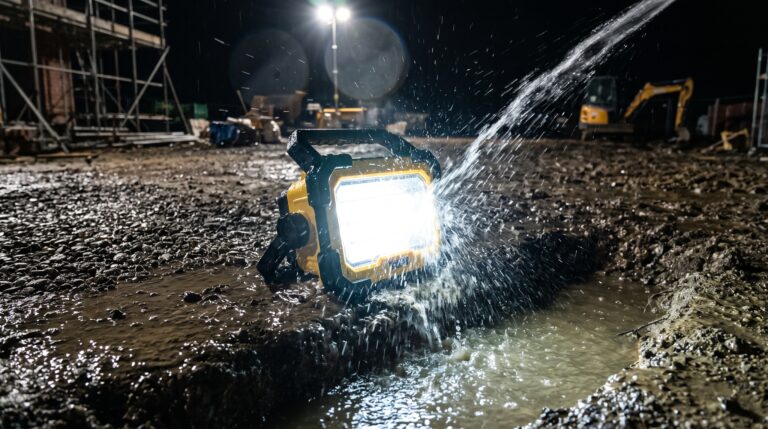
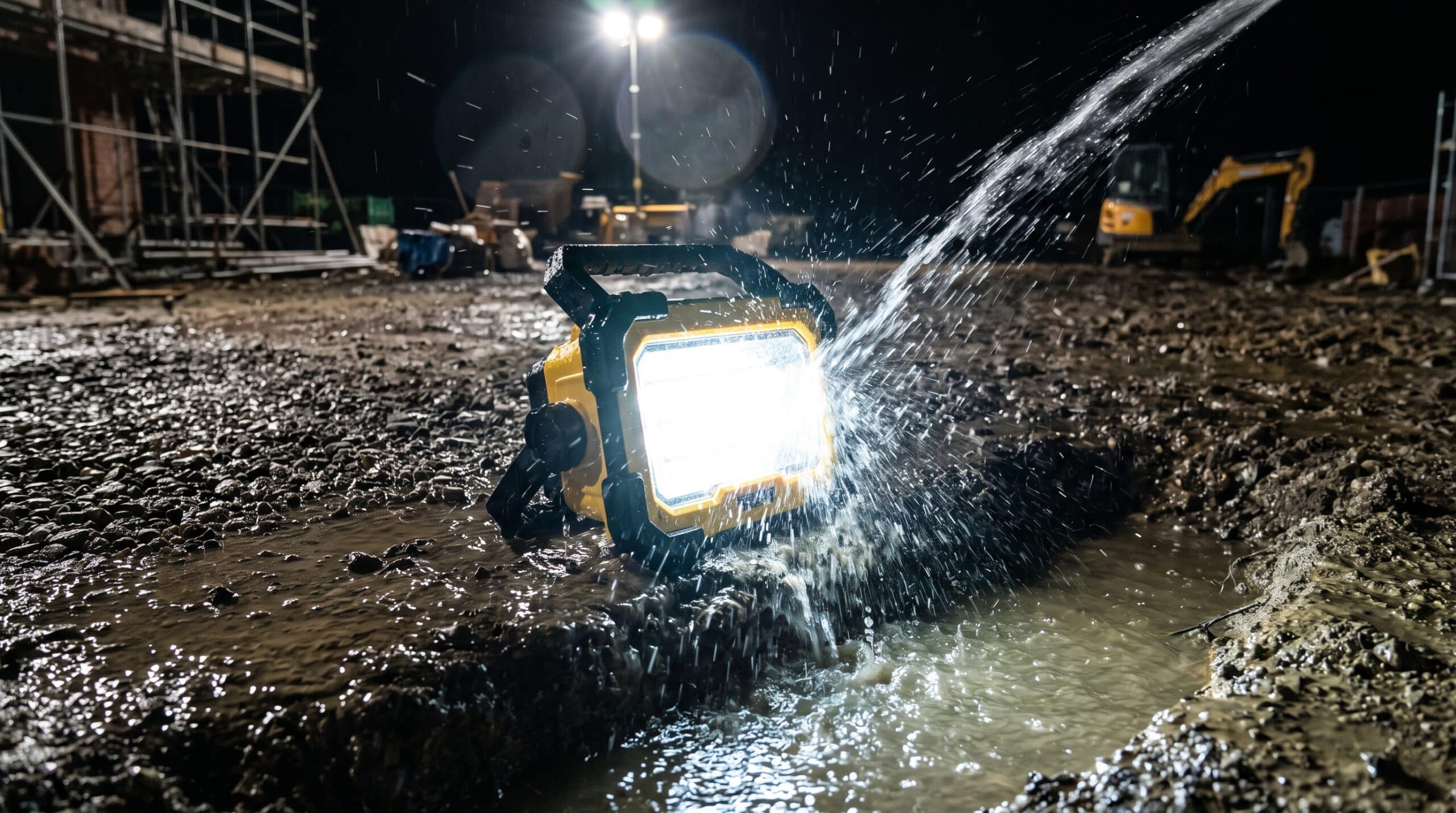
Picture what that looks like in real life. Basically, you’re looking at a garden hose with a thumb over the end, aimed at the light from across a room. The test simulates driving rain, a gutter overflow dumping onto the fixture, or someone rinsing it off at the end of the day. A pressure washer, by contrast, is a completely different animal. 30 kPa works out to about 4.4 psi, whereas a typical consumer pressure washer starts somewhere around 1,500 psi, and contractor units go well past that. Nobody designed a rating in the 5 or 6 range to survive that kind of stream at close range.
What the IP67 Immersion Test Involves
For the 7 rating, the lab dunks the light. The enclosure has to withstand immersion between 15 cm and 1 meter below the surface for 30 minutes. Afterward, technicians open it and check whether a harmful amount of water got inside.
That is a very different stress. Immersion pushes water at the seals with gentle, steady, even pressure from all sides. A jet, however, hits one spot hard, with a fluctuating force that can momentarily lift a gasket lip or drive water past a button membrane. Consequently, a fixture designed around static immersion can pass the dunk tank perfectly and still let water in under a spray. Several product guides say this plainly; for example, one camera manufacturer notes that IP67 and IP68 testing does not cover high pressure jets.
So back to my roofing contractor. His lights did exactly what IP67 promises. They just faced a job that IP67 never tests for.
Why an IP67 Waterproof Work Light Is Not Automatically “Better”
I get some pushback on this point, so let me be fair to IP67. If there is any real chance your light will end up underwater, IP67 is the minimum I want to see. For instance, a light knocked into a flooded excavation, a sump pit, a pool during a resurfacing job, or a basement that took on water overnight faces an immersion problem, and a jet rating won’t save it.
For most home service crews, however, immersion is the rare event and spray is the daily event. Rain hits lights on tripods. Gutters dump water on lights clamped to a fascia board. Crews rinse their gear. In those conditions, a properly built IP65 or IP66 fixture carries the more relevant rating.
Cost and Heat Matter Too
Cost plays into this as well. One B2B sourcing guide estimates that IP67 products typically carry a 15 to 25 percent price premium over IP65 equivalents, because the sealing and manufacturing tolerances are more demanding. In practice, you could put that money toward a better light with a dual rating, or toward GFCI protection, which I’ll get to shortly.
There’s also a thermal angle that doesn’t get enough attention. A fully sealed, potted IP67 housing has nowhere to vent heat except through its metal body. High output LED drivers run hot, and heat shortens their lives more than anything else. For that reason, some lighting engineers argue that a well vented fixture with a lower rating can outlast a fully potted IP67 unit of the same size in hot, humid work. I wouldn’t go that far in every case, but I do study heat sink design as carefully as I read the IP marking.
Matching Your Waterproof Work Light to Real Home Service Work
Here’s how I break it down when contractors ask me which waterproof work light to buy.
| Job situation | What the light faces | Rating I’d look for |
|---|---|---|
| Exterior painting, siding, window installs | Rain, drizzle, occasional splash | IP65 or better |
| Roofing and gutter work | Heavy runoff, hose rinsing | IP65 minimum, IP66 preferred |
| Landscape and irrigation work | Puddles, trench water, sprinkler spray | Dual rated IP65/IP67 or IP66/IP67 |
| Flooded basement cleanup and water damage restoration | Possible submersion, standing water | IP67 minimum |
| Pool and spa service | Drops into water are realistic | IP67 or IP68 |
| Plumbing work in crawlspaces | Leaks, dripping pipes, damp soil | IP65 at least, plus low voltage where possible |
| Equipment that crews clean with a pressure washer | High pressure jets | IP69K, or keep the pressure washer off the light |
For most HVAC, electrical, plumbing, and general remodeling crews, the sweet spot is a light carrying both marks, IP65/IP67 or IP66/IP67. That way, you get proven jet resistance for daily rain and rinsing, plus proven survival if it ever goes into a puddle or a flooded pit.
Failure Modes No IP Rating Covers
This is the part of the job I find most interesting, because it’s where lab ratings and field reality drift apart.
The Breathing Problem Inside a Waterproof Work Light
Every LED work light heats up while it runs and cools down when you switch it off. As a result, the sealed air inside the housing expands and contracts with that cycle. When cold rain hits a hot light, or the evening temperature drops right after you switch it off, the air inside contracts quickly and creates a slight vacuum. That vacuum then pulls moist air in through any microscopic path it can find. Finally, the moisture condenses on the coldest internal surface, which is usually the lens or the LED board itself.
That’s why I see fixtures with excellent IP ratings come back with corroded boards and cloudy lenses. Water never poured in. Instead, the lights breathed. Over dozens of cycles, a little vapor at a time adds up to droplets on the circuit board.
Better designs handle this with a pressure equalizing vent, usually a small membrane patch that lets air pass but blocks liquid water. If you see a little round vent plug on the back of a quality waterproof work light, that’s its job. So don’t cover it with tape or paint over it.
Charging Ports, Battery Doors, and Cable Glands
Labs run the IP test with every cover closed, every gland properly tightened, and the cord installed the way the manufacturer intended. On the job, however, rubber charging port flaps tear, battery doors close on a strand of grit, and workers yank cords until the jacket pulls back from the gland. Each of those turns an IP67 light into something closer to an IP44 light.
Water That Isn’t Plain Water
The standard tests use fresh water. Your light, on the other hand, might sit in pool water with chlorine, a basement full of muddy runoff, or a splash zone of concrete slurry and cleaning chemicals. Those liquids can attack gasket compounds and cause swelling, cracking, or hardening over time. Generally, silicone gaskets hold up better than cheaper rubber blends, but no IP number tells you which one you’re getting.
Age and Abuse
A gasket is a spring. It works because something compresses it, and every compression cycle, every hot day in the truck bed, and every cold winter morning takes a little of its spring away. For this reason, I treat the IP rating as a statement about a new light. A three year old light with a cracked lens frame has whatever rating its weakest seal now gives it.
The Rating Protects the Light, Not the Worker
I want to be clear about something, because it’s the point I care most about as someone who works in electrical safety. An IP rating describes how well the enclosure keeps water away from the electronics. However, it does not make the circuit feeding the light safe to use in a wet area. A perfectly sealed IP67 fixture plugged into a damaged extension cord sitting in a puddle can still put a worker in danger.
Ground Fault Protection Comes First
That’s where ground fault protection comes in. OSHA’s construction rules, which we cover in our guide to job site lighting requirements, require GFCI protection for personnel in job locations where workers are likely to contact or get drenched with water or conductive liquids. Therefore, if you’re running corded lights in rain, a wet crawlspace, or a flooded basement, every one of them should sit on a GFCI, whether that’s a GFCI breaker, receptacle, or portable GFCI cordset. Test it before you trust it. In fact, one university construction safety standard calls for monthly inspection of temporary GFCI receptacles and breakers, and I’d encourage a quick press of the test button at the start of any wet day.
Low Voltage for Tight, Wet Spaces
For really confined, conductive spaces, the rules get stricter. Portable lighting used in wet or conductive locations such as drums, tanks, vessels, and sumps must operate at 12 volts or less. In home service work, that might mean the inside of a large cistern, a septic tank, or a big metal water heater enclosure. In those spots, a 12 volt battery powered waterproof work light with a good IP rating is the right tool, not a 120 volt flood on a cord.
Two Habits Worth Building
Beyond that, I push two more habits on every crew I work with.
First, keep lighting on its own circuit. A common toolbox talk points out that wiring temporary lights into a circuit that also runs power tools leaves someone in the dark when the breaker trips. Losing light in a wet basement at the exact moment a tool faults is a bad combination.
Second, use cords rated for the conditions. Hard usage or extra hard usage cords, with intact jackets and molded plugs, are the minimum for wet work. After all, a waterproof work light at the end of a cheap indoor extension cord is only as waterproof as the weakest connection on that run.
How to Read a Waterproof Work Light Spec Sheet
Over the years, I’ve developed a few quick checks that save people a lot of frustration.
Checking the Rating Itself
Look for the actual code, not marketing words. Terms like “waterproof,” “weatherproof,” and “rainproof” have no defined meaning under IEC 60529. If the box says “waterproof” with no IP code anywhere, assume nobody ever formally tested the light.
Check for dual ratings. As I explained above, IP67 alone does not prove jet resistance. So if you need both, look for IP65/IP67 or IP66/IP67 printed together.
Watch for an X. IPX5 or IPX7 means nobody tested dust protection. On a dusty remodel or a sanding job, that matters.
Checking the Testing and the Build
Ask who did the testing. Reputable manufacturers can tell you whether a third party lab tested the product. Independent labs such as Kiwa and Eurofins run these tests to the standard, and a manufacturer who can name its lab usually did the work.
Read the fine print on battery models. Some cordless lights list an IP rating that only applies with the battery installed and the port cover sealed. Others rate the light head separately from the battery pack. In either case, make sure the rating covers the light the way you’ll actually use it.
Compare heat sink design. Two IP67 lights with the same lumen output can have very different lifespans depending on how well they shed heat. Typically, generous metal fins and a body that feels substantial beat a slim plastic housing.
A Simple Maintenance Routine for Your Waterproof Work Light
A good waterproof work light will last for years if you give it a few minutes of attention now and then. Here’s the routine I suggest to crews:
- Wipe the light down with a damp cloth or a gentle hose rinse instead of a pressure washer. If something’s caked on, let it soak and wipe it off.
- Every month or so, open the battery door or charging port cover and look at the gasket. Brush out grit, check for cracks, and make sure it seats flat.
- Inspect the cord where it enters the housing. If the outer jacket has pulled back and you can see inner conductors, retire the cord or send the light for service.
- Don’t store hot lights in sealed bins with wet gear. Instead, let them cool and dry in open air first so you don’t trap humidity right as the housing contracts.
- If a lens fogs from the inside, take the light out of service. Internal condensation means a seal or vent has failed, and corrosion has already started.
My Bottom Line
If you remember one thing from this article, let it be this: IP65 and IP67 are not a ladder where 7 sits above 5. Rather, they answer two different questions. IP65 asks whether the light can take a spray of water from any direction, while IP67 asks whether it can survive a short dunk. Most home service work puts lights in the first situation every day and the second situation only occasionally.
For general outdoor contracting, a dual rated IP65/IP67 or IP66/IP67 waterproof work light covers both bases, and it’s what I’d buy for my own truck. Pool work, flood cleanup, or anywhere a light could realistically land underwater calls for IP67 as your floor. Finally, for anything that gets pressure washed, either buy IP69K equipment, as we recommend for any truck mounted work light that goes through a wash bay, or keep the wand away from the light.
And no matter what number the housing carries, plug it into GFCI protection when the ground is wet. The rating keeps water out of the light. Ground fault protection, meanwhile, keeps current out of the people holding it.
Frequently Asked Questions
Is IP67 better than IP65 for a waterproof work light?
Not across the board. IP67 proves the light survived temporary immersion, while IP65 proves it survived water jets. Since these are separate tests, passing one does not guarantee the other. If you want both, look for a dual marking like IP65/IP67. The IP code overview on Wikipedia lays out both test conditions side by side.
Can I use an IP65 work light in the rain?
Yes. Rain, snow, and runoff are exactly what the 5 rating addresses, since the test sprays water at the light from every direction. Still, keep charging port covers closed and make sure the power source has GFCI protection. See Leviton’s personnel protection checklist for the OSHA requirements in wet locations.
Can I pressure wash an IP67 waterproof work light?
I wouldn’t. Jet tests for IP65 use about 4.4 psi of pressure, whereas pressure washers run hundreds of times higher. Only IP69K covers high pressure, high temperature spray. The Eurofins ingress protection testing overview describes the IPX9 washdown test.
How long can an IP67 light stay underwater?
The test covers depths up to 1 meter for 30 minutes. However, it does not promise continuous submersion, deeper water, or water containing chemicals. For permanent underwater use, you need IP68 with the manufacturer’s stated depth and duration. Kiwa’s ingress protection testing page summarizes each water level.
Why does my waterproof work light fog up on the inside?
Usually, condensation from thermal cycling causes it. As the housing heats and cools, it can draw in humid air, which then condenses on the cold lens. A failed vent membrane or a worn gasket is the usual culprit. Ulanzi’s article on moisture inside sealed LED housings explains the mechanism well.
What lighting is required in tanks or confined wet spaces?
Portable lighting inside drums, tanks, vessels, and sumps should run at 12 volts or less. For that reason, a battery powered IP67 light is a sensible choice there. OSHA’s interpretation on portable lighting in moist and hazardous locations covers standard 1926.401.
References
- IP Code, Wikipedia
- IEC 60529 Degrees of Protection Provided by Enclosures, VDE Verlag Preview
- Ingress Protection Testing, Kiwa
- Ingress Protection Testing Services, Eurofins
- Protection Index Table, LEDCO
- Standard Interpretations for 1926.401, OSHA
- Personnel and Facility Protection Checklist, Leviton
- Temporary Wiring and Lighting Under EM 385, OSHAcademy
- Toolbox Talk on Temporary Lighting, ISHN
- Construction Environmental Health and Safety Exhibit: Electrical Safety, Harvard EHS
- IP65 vs IP67 Differences Explained, Reolink
- IP Ratings Explained: IP65, IP66, IP67 and IP68, Tapo
- IP65 vs IP67 Waterproof Rating Guide, Alibaba Seller Blog
- Moisture Management in Sealed LED Housings, Ulanzi
- Managing Heat in IP Rated Lighting Systems, Ulanzi