
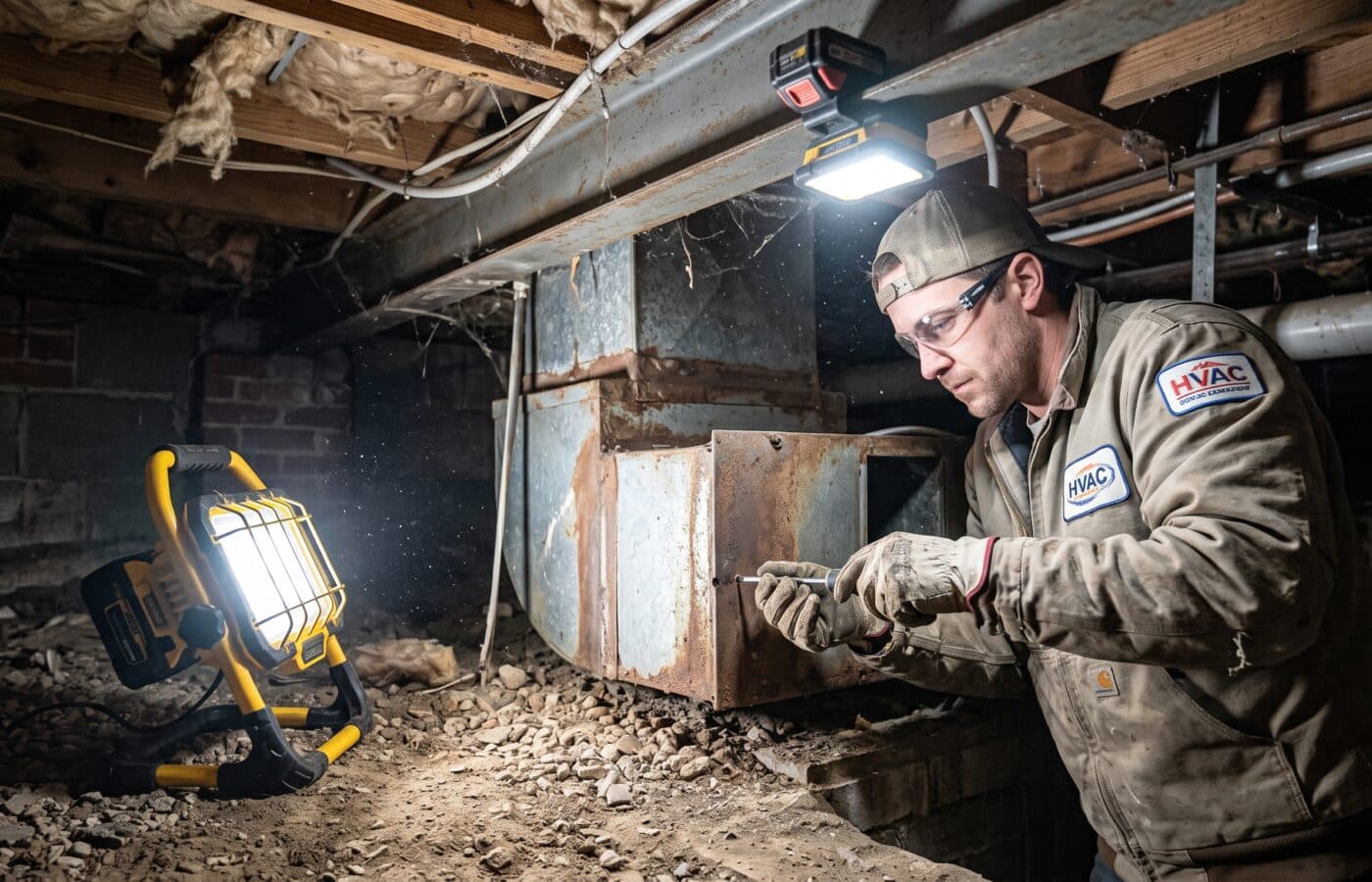
Best LED Work Lights for HVAC Techs Working in Crawl Spaces

Two summers ago, I was on my belly under a 1960s ranch house with maybe 20 inches of clearance, chasing a condensate leak on a horizontal furnace that somebody had shoved as far back from the access hatch as physically possible. Unfortunately, my cheap pocket light died about halfway there. As a result, I finished the call with my phone flashlight clenched in my teeth, and I still remember the taste of red clay and vapor barrier. That was the day I stopped grabbing whatever was at the checkout counter and started choosing LED work lights for HVAC calls the same way I choose any other tool on the van.
I have been running service in residential and light commercial for a long time now. Even so, crawl spaces are still the place where a bad light costs you the most. Below, I will walk through what I have learned about picking LED work lights for HVAC techs who spend real hours under houses. In particular, I will cover the specs that matter, the ones that are mostly marketing, and how I actually set up light in a crawl so I can read a data plate, check a flame sensor, or trace a line set without guessing.
Why Crawl Spaces Demand Better LED Work Lights for HVAC
First of all, a crawl space is not a basement, and it is certainly not a distribution center floor lit by a properly specified warehouse work light. You cannot stand up, you cannot set a light on a workbench, and the floor is dirt, gravel, or a torn poly barrier that reflects almost nothing back at you. Furthermore, everything is horizontal. Your equipment is often a furnace or air handler lying on its side, with the panel facing the one direction you cannot comfortably reach.
On top of the darkness, you are also dealing with hazards that have nothing to do with HVAC. For example, Massey Services’ safety manual for pest technicians lists cuts from broken glass and debris, cramps and strained backs from moving in a tight space, soil contaminated by old sewage spills, and shock hazards from electrical lines, especially in wet crawl spaces. Every one of those applies to us too. Moreover, every one of them gets worse when you cannot see well.
Similarly, ACHR News has pointed out that technicians working on filters, ducts, air handlers, and unitary equipment in confined spaces can be exposed to dust, mold, allergens, and harmful materials like asbestos. In other words, you want to see what you are crawling through before you put your hands and knees in it. For that reason, dependable LED work lights for HVAC crawl work are the first line of defense, not a nice extra.
What I Look For in LED Work Lights for HVAC
There is a lot of noise in this market. After all, every box claims thousands of lumens and “military grade” something. So before I buy LED work lights for HVAC jobs, here is how I filter it down.
Real Light Output, Measured Honestly
Lumens matter, but only if the number is real. That is why the first thing I look for on the packaging is the ANSI FL1 icon set. That standard defines specific testing and reporting methods for portable lights, so when the icons are printed on the box, you can trust the claims and compare one brand against another fairly. In addition, it explains why wattage is a useless spec on an LED. Wattage tells you how much power the light draws, not how much light it puts out, so a lower wattage LED can easily outshine a higher wattage one. That same gap is the heart of the LED work light vs halogen comparison.
Runtime and Turbo Modes
Runtime, however, is the other half of the story. Under the FL1 standard, runtime is counted from 30 seconds after you switch the light on with fresh batteries until the output drops to 10 percent of that starting level. Therefore, a light rated for six hours is not giving you full brightness for six hours. For a deeper look at how those numbers are measured, see our guide to LED work light battery life.
Likewise, watch out for “turbo” modes. Olight notes that real brightness often differs from advertised lumens because of thermal step down, battery voltage, and losses in the optics, and the updated ANSI/PLATO FL 1 2025 standard now includes testing for short duration boost modes. Consequently, in a hot summer crawl space, a small light running at its peak setting is going to throttle itself fast. Personally, I would rather have a bigger light running comfortably at 60 percent than a tiny one cooking itself at 100.
How Many Lumens Do LED Work Lights for HVAC Need?
On one hand, Wexford Insurance’s guide for plumbers suggests roughly 600 to 1,200 lumens for crawl spaces. On the other hand, their guide for electricians says most find 1,000 to 3,000 lumens is enough for crawl space and attic work, depending on how big the area is. In my experience, around 1,000 lumens of flood from your main area light, plus a dedicated task light, covers almost every residential crawl. Beyond that, extra output in a tight space just bounces off the joists and the white duct wrap and blinds you.
Beam Pattern Over Brute Force
Next comes the spec nobody puts on the front of the box. In a crawl, a tight spot beam is almost useless for your main light. Instead, you need a wide, even flood that fills the work zone without hot spots. For instance, COB (chip on board) style panels and bar lights do this well. Spot beams, by contrast, are for one job: looking down a long, low run to see what is at the far end before you commit to crawling there.
Battery Platform and Runtime
If you already run a cordless tool brand on the van, buy that brand’s area light. Seriously. After all, you already have the batteries and the charger in the truck, so your LED work lights for HVAC calls will never leave you stuck with a dead proprietary pack. Besides that, Wexford points out that rechargeable LED work lights cost less over time, run longer, and hold brightness more consistently than disposable battery models, and I agree with that completely.
Mounting Options, Because Your Hands Are Busy
In a crawl, a light you have to hold is a light that is pointing at the wrong thing. Because of that, these are my non negotiables:
- A strong magnet. After all, duct, furnace cabinets, metal straps, and steel beams are everywhere down there, which is why a good magnetic work light earns its place in every HVAC kit.
- A hanging hook. This one is for joists, nails, and the occasional wire hanger left by the original installer.
- A pivoting head. Specifically, HVAC Pro Sales describes rechargeable LED lights with magnetic bases and rotating heads as the way to get hands free light inside air handler cabinets, attics, and equipment rooms. That is exactly the setup I want.
Ingress Protection Rating
Crawl spaces are wet, dusty, or both. Fortunately, an IP rating tells you what the light can actually survive. The first number in an IP code covers protection against solids like dust and debris, while the second covers moisture, from drips and sprays up to full submersion.
IP54 vs IP65 vs IP67
The ratings you will see most on work lights break down like this. IP54 means limited dust protection and resistance to water spray from any direction, whereas IP65 means fully dust protected plus resistance to low pressure water jets. Meanwhile, IP67 goes further by surviving temporary immersion, specifically 30 minutes in still water at a depth of 1 meter.
For wet crawl spaces and outdoor work, HVAC Pro Sales recommends IP65 or better, and that matches my experience. In fact, I have dropped lights into standing water under a house after a condensate pump failed. An IP54 light did not come back from that. My IP65 and IP67 lights, on the other hand, did.
One more note on durability. IP and IK are two separate ratings: IP covers solids and water, while IK, under EN 62262, covers impact resistance on a scale from IK00 to IK10. Therefore, if a manufacturer lists an IK rating, that is a good sign they actually tested for drops.
Color Rendering on LED Work Lights for HVAC
This one took me years to appreciate. Simply put, a light with poor color rendering makes wire colors look the same, hides the green tint of corrosion, and turns a slightly burnt terminal into “looks fine to me.” On the usual color rendering scale, 80 to 90 is considered good and 90 to 100 is excellent, though most LED lights do not reach 90.
So when I am reading thermostat wire colors at a furnace control board, or looking at a flame through a sight glass, I want a CRI of at least 80, and preferably 90. Similarly, JourneymanHQ warns buyers to watch out for lights that deliver high lumens but poor color rendering. After all, a blue tinted 6500K light can look bright and still make you misread a wire.
Size and Profile
Some crawl spaces give you two feet. Others give you 14 inches under a beam. Naturally, a big tripod light is worthless down there. Instead, I want my area light to sit low, maybe five or six inches tall, with a base wide enough that it will not tip over on uneven dirt.
Why Cordless LED Work Lights for HVAC Beat Corded
I want to be blunt about this, because it is a safety issue. Admittedly, I keep a corded light on the van for basements and long installs. Still, I do not run a corded trouble light into a damp crawl space. To illustrate why, a 1987 NIOSH investigation describes an electrician installing HVAC ductwork in a 30 inch crawl space on damp ground. His coworkers above had passed a trouble light through a hole in the floor, and when it snagged, they asked him to free it. He apparently contacted one of several unguarded electrical connections nearby and died. The light was not necessarily the cause; nevertheless, it put him right where the hazard was. That is why every one of my LED work lights for HVAC crawl spaces is cordless.
In addition, OSHA has long treated portable battery lights differently from temporary wired lighting, a distinction that also shapes broader job site lighting requirements. In a 1976 interpretation letter, OSHA described portable lighting as battery operated equipment limited to 12 volts. Granted, modern cordless tool batteries run higher than that. Even so, the principle carries over: keep line voltage cords out of wet, conductive, cramped spaces whenever you can.
The LED Work Lights for HVAC I Actually Carry
Honestly, I do not believe in a single “best” light. Instead, the guys who work fastest in crawl spaces carry a small system. In the same way, JourneymanHQ notes that efficient pros often carry two or three different lights rather than compromising on one. So rather than relying on one light, here is how I break up my LED work lights for HVAC calls.
The Area Light: The Anchor of My LED Work Lights for HVAC
This is the one that lights the whole work zone. For that reason, it needs to be flat, wide, rugged, and run on the batteries I already own.
Wexford calls the Milwaukee M18 Rover one of the most popular professional work lights among contractors, and I see them on a lot of vans for good reason. To begin with, the flat flood panel sits low, it has a magnet and hanging options, and it runs on the same packs as your drill and impact. Likewise, DeWalt and Ryobi users have equivalent options. For example, JourneymanHQ describes the Ryobi 18V ONE+ cordless LED light as a compact unit made to tuck into small corners or hang from exposed rafters, which is exactly the job description in a crawl.
So my advice is this: buy your LED work lights for HVAC in whatever battery brand you already own. In other words, do not switch platforms for a light.
The Task Light: A Compact Magnetic Pivot Light
This is the light that goes right on the job. Typically, it lives stuck to the furnace cabinet, pointed at the inducer, or clamped near the coil while I am checking a drain pan. Ideally, it should be small enough to fit in a pocket, with a strong magnet, a rotating head, and a USB rechargeable battery.
Brands like Klein, NEBO, Unilite, and NAVAC all make lights in this style. In fact, TruTech Tools stocks rechargeable lights from all four of those makers aimed at daily HVAC/R work. Furthermore, Wexford notes that Klein Tools focuses heavily on electricians and HVAC technicians and recommends it for tight spaces and panel work. Many of the same picks show up among the best work lights for electricians in tight spaces.
The Headlamp: Always On, Always Pointed Where I Look
A headlamp is what gets me from the access hatch to the equipment. Along the way, it lights the path, shows me the wire running along the joist six inches from my face, and keeps working when my other lights are set up behind me. Wexford suggests most HVAC techs are better off owning one premium headlamp and a backup. To that, I would add one thing: pick one with a flood setting and a red mode. That way, red light preserves your night vision and does not blind the homeowner peering through the hatch.
That said, a headlamp alone is not enough for a crawl. Every time you turn your head, the light moves, and as a result you lose the shadows that tell you depth. Therefore, use it to travel and as a fill light, not as your main work light.
The Inspection Penlight: For Leaks and Data Plates
You cannot read a faded rating plate on a horizontal furnace with a flood light. Instead, you need a narrow, bright, high color rendering beam that you can angle across the plate to raise the lettering.
I also carry a UV light for leak searches. For instance, JourneymanHQ highlights the Streamlight Stylus Pro UV for finding refrigerant leaks, notes that it slides into tight spots around line sets and evaporator coils, and points out that most versions also include a standard white LED. So if your shop uses UV dye, a slim UV penlight earns its spot in your shirt pocket.
The Bar Light: For Long Horizontal Runs and Furnace Cabinets
This one surprised me. As it turns out, an underhood style LED bar, the kind mechanics use on car hoods, is fantastic for lighting the full length of a horizontal furnace or a long section of trunk line. In fact, JourneymanHQ picked the NEIKO 40447A underhood light as its best option for HVAC work, specifically because techs often need to light long horizontal spaces inside furnace cabinets and utility closets. Simply hook it across two joists, and the whole unit is lit from end to end without a single shadow.
The Staging Light: At the Access Point
Whatever you do, light your way out. Personally, I set a cheap but reliable light just inside the crawl access, pointing back in. That way, if my main light dies or something goes wrong, I can always see the exit. Some guys also use a self righting light for this in basements and mechanical rooms. For example, JourneymanHQ notes that the Wobblelight resists being knocked over, which saves you from constantly resetting tipped lights in busy work areas. In homes where the mechanical room already has a motion sensor work light, at least the walk to the hatch is lit before you even reach for a switch.
How to Position LED Work Lights for HVAC in a Crawl Space
Owning good LED work lights for HVAC is only half of it. Placing them right, however, is the other half. So here is my routine on almost every crawl call.
- Scout with the headlamp. Before I pull any equipment in, I look in from the hatch first, checking for standing water, damaged wiring, animals, and anything that smells like gas or sewage. If something looks wrong, then I am not going in yet.
- Light the exit. Next, the staging light goes at the access point, aimed in.
- Place the area light at an angle. After that, I set up the main light. JourneymanHQ recommends putting your main light at about a 45 degree angle to the work, or better yet, using two lights from opposite sides to cancel out shadows. That is exactly how I do it: one flood off to the side and slightly behind me, plus one task light on the equipment from the other direction.
- Keep the light low. Since you are lying down, set the flood flat on the ground and tilt the head up. As a result, glare stays out of your eyes and the underside of the equipment gets lit.
- Avoid reflective surfaces. Foil faced duct wrap and white vapor barrier throw glare right back at you, so aim around them.
- Never stare into the panel. Finally, JourneymanHQ warns that looking straight into high output LED arrays can cause temporary flash blindness.
What a Light Cannot Fix: Crawl Space Safety
I want to spend a minute on this, because even the best LED work lights for HVAC make you faster, and speed can make you careless.
The Confined Space Question
Most residential crawl spaces are not permit required confined spaces. However, some can be. OSHA has stated that attics, basements, and crawl spaces in homes do not usually trigger most of the confined space standard’s requirements, but if the space is a confined space and contains a physical hazard that is not isolated, the permit required rules do apply. As for lighting specifically, OSHA says limited lighting alone does not make a space permit required, as long as the poor lighting could not stop someone from getting out without help. That is exactly why I light the exit.
Moreover, OSHA makes clear that the decision depends on the actual space. In one interpretation, the agency said whether a crawl space counts as a confined space depends on its size, layout, ventilation, and hazards from utility lines or the work itself, such as refrigerants or a torch. For example, brazing a line set in a crawl is a very different job from swapping a filter.
Electrical Hazards
The case every HVAC tech should read is a 1994 NIOSH investigation from North Carolina. An employee was driving screws through aluminum straps into floor joists in a 38 inch crawl space when the strap’s sharp edge damaged the insulation on house wiring. The drill bit and strap became energized, and current passed through him to ground through nearby pipes. The contractor entered and grabbed him, and both men died.
Clearly, lighting matters in that story. If you can see the wiring stapled to the joist you are about to drill into, then you change where you put the screw. Indeed, NIOSH’s recommendations included surveying the job site for hazards before starting work and giving workers more electrical safety training, including how to perform a rescue safely. Good light, in turn, makes that survey possible.
The Air You Breathe
Lastly, think about the atmosphere. An HVAC exam prep guide puts it plainly: before entering a space that might collect combustion gases, have low oxygen, or hold another hazardous atmosphere, test the air for oxygen, flammability, and toxic gas instead of assuming it is fine. So if you service gas furnaces in crawl spaces, a personal CO monitor clipped to your shirt is just as important as any light in this article. If your monitor picks up a flammable gas reading, ordinary lights become potential ignition sources. At that point the answer is to get out and ventilate, and any lighting used afterward should be a certified explosion proof work light.
Mistakes Newer Techs Make When Choosing LED Work Lights for HVAC
Buying one giant light. A huge tripod work light is great for a garage install, and a mounted industrial LED flood light is great on a commercial rooftop at night. Under a house, however, neither does anything for you.
Using the phone flashlight. I have done it, and you have done it. Still, it ties up a hand, drains the device you need for calls and photos, and is barely brighter than a candle in a dirt crawl.
Ignoring charging. A light is only as good as its last charge. For that reason, I charge everything on the van every night. Some smart LED work lights show exact battery percentage, which takes the guesswork out of it. In addition, I keep one spare USB light in the glove box that never comes out unless something else dies, and a solar rechargeable work light on the dash makes a decent last resort backup.
Picking the bluest, brightest light on the shelf. Cool white light at high output looks impressive in the store. Yet it becomes miserable after 30 minutes on your back. Instead, something closer to neutral white with decent color rendering is easier on the eyes and better for reading wire colors.
Not cleaning the lens. Wexford’s guide reminds technicians to clean lenses after muddy crawl spaces. Otherwise, a film of red clay can cut your output noticeably, and you will not realize it until you wonder why your new light seems weak.
My Buying Checklist for LED Work Lights for HVAC
If you only remember one section, make it this one. In summary, solid LED work lights for HVAC techs working in crawl spaces should have:
- ANSI FL1 rated output, with a wide flood beam of roughly 1,000 lumens for your main area light.
- A battery that matches your existing cordless tool platform, or alternatively USB charging for smaller task lights.
- A strong magnet, a hook, and a head that pivots.
- At least IP65 for crawl work, plus a stated drop or IK rating.
- Color rendering of 80 or better, and ideally 90 or higher for task and inspection lights.
- A low profile that sits stable on uneven dirt.
- Cordless operation in any damp space.
Frequently Asked Questions
What are the best LED work lights for HVAC techs working in crawl spaces?
Generally, the best LED work lights for HVAC crawl work are a low profile, cordless flood light with a magnet and pivoting head, paired with a smaller task light and a headlamp. In fact, Wexford’s crawl space guidance favors slim rechargeable lights with magnetic bases, wide flood beams, and long battery life. Since one light rarely covers everything, think in terms of a small kit.
How many lumens should LED work lights for HVAC crawl spaces have?
For your main area light, around 1,000 lumens of flood output is plenty for most residential crawls. Similarly, Wexford suggests 600 to 1,200 lumens for crawl space work. Task and inspection lights, on the other hand, can be lower because they sit close to what you are looking at.
What IP rating should LED work lights for HVAC have?
IP65 or higher. Specifically, HVAC Pro Sales recommends IP65 or above for wet crawl spaces and outdoor work. Furthermore, if you regularly work around failed condensate pumps or flooded crawls, IP67 adds protection against temporary immersion up to 1 meter for 30 minutes.
Is a dim crawl space automatically a permit required confined space?
No. According to OSHA, limited lighting alone does not make a space permit required, provided it would not keep someone from getting out on their own. However, other hazards, like exposed energized wiring, gas leaks, or sewage, can change that classification.
Are rechargeable LED work lights for HVAC worth it?
For daily service work, yes. Rechargeable LED work lights for HVAC service cut battery costs, hold brightness more consistently, and are more convenient for techs running several calls a day. Just make sure to build a charging habit, so you are not crawling in with a half dead light. See Wexford’s HVAC work light guide for more.
Why does color rendering matter for HVAC work?
Because you are reading wire colors, spotting corrosion, and judging flame color. In particular, a higher CRI means colors, details, and textures appear more accurately to your eye. Conversely, a low CRI light can make similar wire colors look identical under a furnace.
Should I use a headlamp or a work light in a crawl space?
Both, ideally. The headlamp gets you in and out and also gives you a moving fill light. Wexford suggests a wide flood beam for attic work and a higher output focused beam for crawl spaces. Even so, in my experience a headlamp with both modes, backed up by a fixed area light, works better than relying on either one alone.
Final Thoughts on Choosing LED Work Lights for HVAC
Ultimately, the best LED work lights for HVAC are not the ones with the biggest number on the box. Rather, they are the ones that are charged, sit low, stick to metal, survive a puddle, and show you the true color of what you are looking at. So build a small kit around your battery platform, light your exit before you light your work, and use cross lighting so you can see depth instead of guessing.
After all, a crawl space is going to be uncomfortable no matter what. It does not also have to be dark.
References
Trade Guides and Lighting Standards
- Wexford Insurance. Best Work Lights for HVAC Service Calls (Top Picks for Technicians in 2026).
- Wexford Insurance. Best Work Lights for Plumbers (Under Sink and Crawl Space Guide).
- Wexford Insurance. Best Attic and Crawl Space Lights for Electricians.
- Wexford Insurance. Best Headlamps for HVAC Contractors (2026 Buyer’s Guide).
- Wexford Insurance. Best Work Lights for Appliance Repair.
- HVAC Pro Sales. Professional Jobsite Lighting and Work Lights.
- TruTech Tools. Work Lights.
- JourneymanHQ. 6 Best Utility Lights for Dark Internal Work.
- JourneymanHQ. 6 Best Inspection Flashlights for HVAC Systems.
- Pelican. Flashlight ANSI Standards.
- Nitecore. ANSI/PLATO FL 1 2019 Standard.
- Bayco Products. Understanding the ANSI FL1 Standard.
- Olight. Flashlight Lumens Measurement: ANSI FL1 and Real Brightness.
- AMC. IP65 Rating Explained.
- Two Way Direct. IP Enclosure Ratings and Standards Explained.
- Apollo Satellite. What Is an IP Rating (Ingress Protection).
- Delvalle. IP Rating Guide: IP65, IP66, IP67, IP68 Explained.
- Any Lamp. CRI Color Rendering Index.
- LED Lighting Supply. Color Rendering Index Explained.
Safety and Regulatory Sources
- OSHA. Confined Spaces Litigation Settlement Memo, May 24, 2016.
- OSHA. Standard Interpretation: Fall Protection, HVAC, Confined Space (September 13, 2001).
- OSHA. Standard Interpretation: Temporary Versus Portable Lighting (April 6, 1976).
- NIOSH (CDC). HVAC Contractor and Employee Electrocuted in Crawlspace, North Carolina.
- CDC Stacks. HVAC Contractor and Employee Electrocuted in Crawlspace, North Carolina (summary).
- CDC Stacks. Electrician Electrocuted in Indiana.
- ACHR News. Safety Concepts for HVAC Contractors and Technicians.
- Open Exam Prep. Combustion Venting, Carbon Monoxide and Confined Space Safety.
- Massey Services. Attics and Crawlspaces Safety Training.