
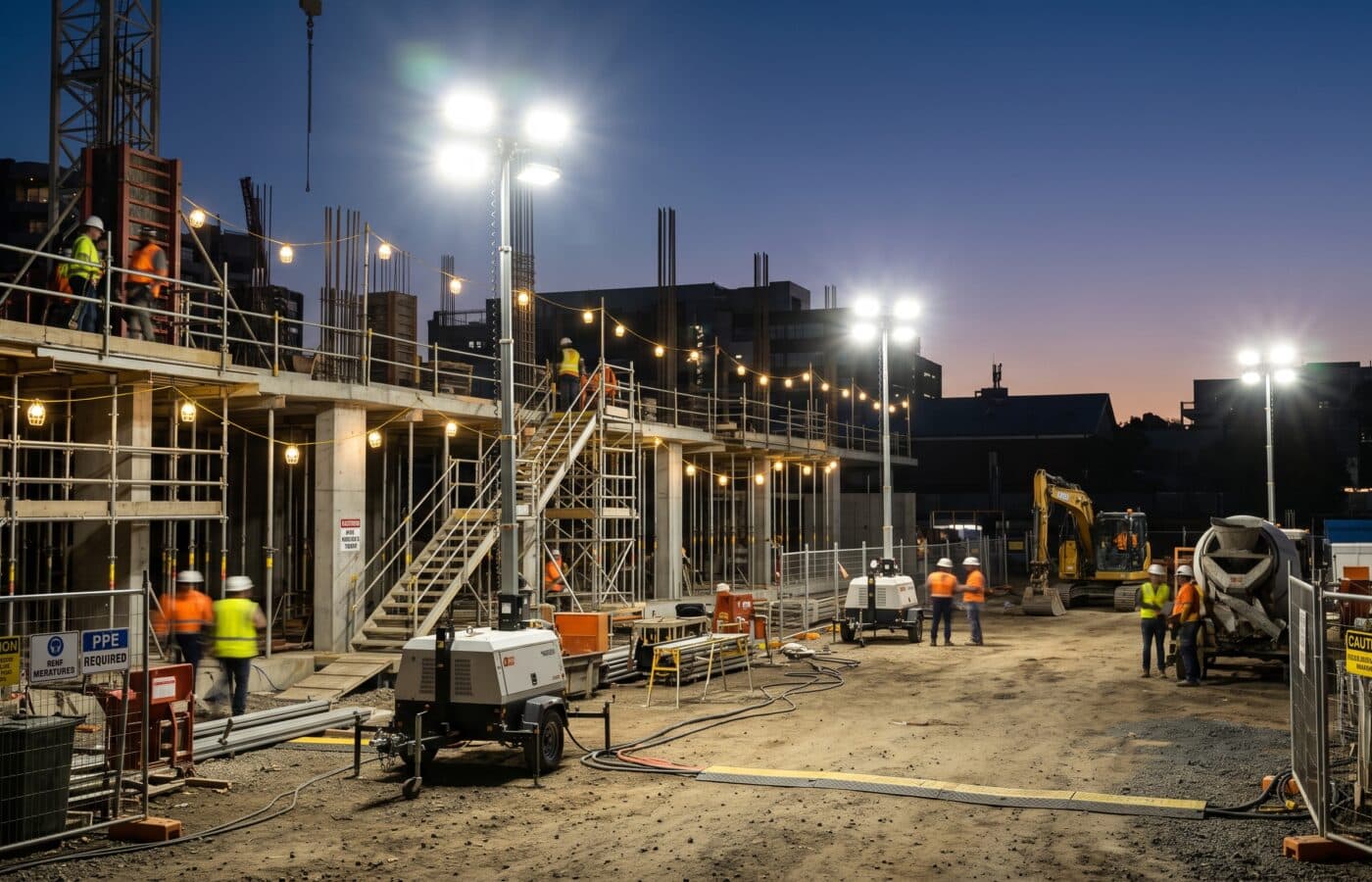
Job Site Lighting Requirements Every Contractor Should Know

Job site lighting requirements rarely get the attention they deserve, and I learned that by walking a lot of job sites at the wrong time of day. For example, I have stood on early winter mornings when the crew was already framing and the sun had not cleared the tree line. I have also seen late afternoons when a drywall crew raced to finish a basement with only one halogen stand somebody brought from home. And I have crawled into spaces where the electrician worked by phone flashlight because the drop light died an hour earlier.
In almost every one of those situations, the crew did not think they had a lighting problem. Instead, they thought they had a schedule problem, a budget problem, or a “we’re almost done” problem. As a result, lighting stayed in the background until somebody tripped over a coil of hose, missed a step on a ladder, or put a nail gun through a hand.
That is why I want to walk through job site lighting requirements the way I actually explain them to superintendents and foremen. First, I will cover what the rules say. Then, I will explain what an inspector looks for and what I have seen go wrong on residential and light commercial jobs. So if you run a remodeling company, an HVAC outfit, a roofing crew, or any home services business that sends people into places nobody designed as work areas, this is for you.
Why Job Site Lighting Requirements Exist: Safety Control, Not Convenience
Most contractors think of lighting as a productivity tool. In other words, you put up lights so people can see what they are doing and keep working. That is true, but it only tells half the story.
From a safety standpoint, lighting is a hazard control. Specifically, it lets a worker see the open floor joist bay, the extension cord running across the stairwell, the rebar sticking out of a footing, or the rotted subfloor near the old toilet flange. When illumination drops, every other hazard on the site gets worse, because the worker loses the ability to recognize it in time.
I tell new supervisors to think about it this way: guardrails, covers, and housekeeping only work if people can see them. In short, ignoring job site lighting requirements quietly undoes the rest of your safety program.
What OSHA Job Site Lighting Requirements Actually Say
The federal rule that every contractor in the United States should know is 29 CFR 1926.56, the construction illumination standard. It is short, and that is partly why people underestimate it. Under this rule, employers must light construction areas, ramps, runways, corridors, offices, shops, and storage areas to at least the minimum intensities in Table D-3 whenever work is in progress.
Pay attention to those last words. These job site lighting requirements apply while any work is in progress, not just at night and not just indoors. Therefore, if your crew is working, the area has to meet the minimum, whether the light comes from the sun, a window, or a fixture you brought in. In addition, a broader rule, 29 CFR 1926.26, says you must light construction areas with natural or artificial illumination. However, 1926.56 is where the numbers live.
Here is Table D-3 in plain terms:
| Minimum Foot Candles | Area or Operation |
|---|---|
| 3 | General construction areas, concrete placement, excavation and waste areas, accessways, active storage areas, loading platforms, refueling, and field maintenance areas |
| 5 | General construction area lighting |
| 5 | Indoor warehouses, corridors, hallways, and exitways |
| 5 | Tunnels, shafts, and general underground work areas (10 at the heading during drilling, mucking, and scaling) |
| 10 | General construction plants and shops, such as batch plants, mechanical and electrical equipment rooms, carpenter shops, locker rooms, mess halls, and indoor toilets and workrooms |
| 30 | First aid stations, infirmaries, and offices |
For anything the table does not cover, the standard points you to ANSI A11.1, the Practice for Industrial Lighting, for recommended values. Permanent facilities follow different design targets altogether, which we cover in our guide to choosing a warehouse work light.
What a Foot Candle Means for Lighting Requirements on the Job Site
I get this question constantly. Simply put, a foot candle is the amount of light falling on one square foot of surface from a source one foot away, and it equals one lumen per square foot. In metric terms, one foot candle is roughly 10.76 lux, so 5 foot candles comes to about 54 lux and 10 foot candles to about 108 lux.
OSHA addressed this directly in a 1991 interpretation letter. In that letter, the agency stated that a light meter reading in lumens per square foot gives the best measure of illumination at any work surface. In other words, your eyes are not a measuring instrument. A space that feels fine to a worker who has spent two hours in it can still fall well under the minimum, because the human eye adapts. A meter, on the other hand, does not.
Job Site Lighting Requirements Are a Floor, Not a Target
Here is the part I want every contractor to hear. Five foot candles is not much light. It gives a worker enough light to walk through a space and spot obstacles. However, it does not give enough light to read a tape measure accurately, check a wiring connection, or inspect a weld. OSHA built these minimums for general visibility and movement, not task work.
So when I set up lighting on a site, I treat the Table D-3 values as the legal floor for the whole area. Then I add task lighting wherever people cut, fasten, measure, or inspect. For example, your general area might sit at 5 or 10 foot candles while the miter saw station runs at 30 or more. That approach meets job site lighting requirements with room to spare, and it also helps you avoid an argument with an inspector who takes a reading right at the work surface.
Electrical Job Site Lighting Requirements: Where Most Citations Come From
In my experience, inspectors rarely write up contractors for falling two foot candles short. Instead, they write them up for how the crew installed the temporary lighting. Those job site lighting requirements live in OSHA’s electrical standards for construction, mainly 1926.405, and that is where I see the same mistakes over and over.
Guarding the Lamp
Under 1926.405(a)(2)(ii)(E), you must protect all lamps used for general illumination from accidental contact or breakage. That means you need a cage, a guard, or a fixture design that recesses the bulb deeply. A bare bulb hanging in a stud bay breaks the rule, and it also burns people or sends glass into their eyes.
With LED string lights and puck style fixtures, safety professionals still debate whether a sealed plastic or epoxy housing counts as protection. Some argue that when a manufacturer builds in a cage or designs the light so it needs no guard, those systems can meet the 1926.405(a)(2)(ii)(E) requirement. Still, my advice stays simple: buy lighting that a testing lab has listed and rated for construction use, and keep the manufacturer documentation on site. That way, if an inspector asks, you can hand them a spec sheet instead of an opinion.
Do Not Hang Lights by Their Cords
OSHA 1926.405 prohibits hanging temporary lights by their cords unless the manufacturer designed the cords and lights for that purpose. Even so, I still see drop lights hooked over a joist by the cord, or string lights draped over a ductwork hanger with the weight on the conductor. Instead, use the hanging hooks, zip tie the lights to the supports, or choose a light with a proper bail. After all, the cord is not a rope.
Cords and Grounding
Training materials built around OSHA’s illumination and electrical standards sum it up well. Temporary lights need heavy duty cords, must not hang by those cords, need splices that match the cable’s insulation, and must have exposed metal parts grounded. In addition, they need overcurrent protection such as fuses or breakers.
On cords specifically, OSHA has stated that cords supplying temporary lighting must carry approval for hard usage, such as types S, SO, ST, and STO. Consequently, that flat, thin household extension cord someone grabbed from the garage does not qualify.
Lighting Strings and Changing Conditions
OSHA has also said that temporary lighting strings without heavy duty cord can be acceptable if they are installed, maintained, and used in a way that poses no hazard to employees. However, the agency stressed that construction sites change constantly and the strings must keep posing no hazard as conditions change. That last point matters. A string that worked fine on Monday may sit pinched under a door, crushed by a crew, or soaking in water by Thursday.
Ground Fault Protection
Finally, do not forget ground fault protection. Under 1926.404(b)(1), any receptacle on a construction site that is not part of the permanent wiring needs ground fault circuit interrupter protection or an assured equipment grounding conductor program. Your temporary lighting plugs into those same circuits. So in basements, crawl spaces, and anywhere near water, a GFCI makes the difference between a tripped breaker and a fatality.
Job Site Lighting Requirements for Home Services Work
Big commercial projects usually have a temporary power plan and an electrician whose job is to keep lights up. Home services work, by contrast, looks very different. Your crew works in an occupied house, an attic in July, a crawl space under a 1950s ranch, or a gutted bathroom where the homeowner shut off the breaker. Yet the same job site lighting requirements still apply. Below are the spaces where I find the worst conditions.
Attics
Attics are tight, hot, and full of hazards you cannot see without good light. For instance, you will find ceiling joists with nothing but drywall between them, exposed nails through the roof deck, old knob and tube wiring, and insulation that hides everything. Meanwhile, HVAC installers and insulation crews work up there constantly, which is why we wrote a separate guide on the LED work light for HVAC technicians. A headlamp alone will not do the job. Instead, run a guarded LED work light or string light along the path to the work area so the worker can see where to step, and keep a second light at the task itself.
Crawl Spaces and Basements
Crawl spaces combine low light, moisture, and electrical work, which makes a bad combination. Therefore, use lights rated for damp locations, keep every connection off the ground, and run everything through a GFCI. Compact, low profile lights like the best work lights for electricians in tight spaces fit where a stand never will. In unfinished basements, meanwhile, stairwells cause the most trouble. A basement stairwell counts as an exitway and an accessway, which puts it squarely in Table D-3, and it is also where people carrying materials fall.
Gutted Interiors
When you remove fixtures during a remodel, you also remove the lighting. As a result, bathrooms and kitchens go dark the minute demolition starts. So plan temporary lighting the same day as the demo, not after someone complains.
Exterior and Roof Work
Roofers and siding crews in winter often start before full daylight and finish after sunset. Because of that, ladders, roof edges, and the ground around the house where debris collects all need light. Fortunately, a couple of tripod mounted LED floods pointed at the ladder base and the dump zone take care of the two places where I see the most injuries.
Night Work Job Site Lighting Requirements
If your crew ever works on or near a roadway at night, for example on driveway paving, curb work, or utility connections, you also need to know the highway guidance. NCHRP Report 498, Illumination Guidelines for Nighttime Highway Work, sets three levels: Level I at 5 foot candles (54 lux), Level II at 10 foot candles (108 lux), and Level III at 20 foot candles (215 lux).
Level I covers general work areas, while Level II applies around moving equipment and flagging. Level III, meanwhile, covers precision tasks. Many state DOTs write these levels into their contract specifications, so check yours before you bid night work.
Controlling Glare
At night, though, glare causes the bigger problem. In fact, the NCHRP research identifies hazard glare control as a critical issue in lighting highway work zones. A light that blinds a passing driver or a flagger creates a hazard rather than controlling one. For that reason, common practice is to raise portable light towers to at least 20 feet so the light points down rather than out horizontally. Similarly, I apply the same thinking in residential neighborhoods. Aim floods down and in, toward the work, and away from the street or the neighbor’s bedroom window. The same aiming discipline applies to a permanently mounted industrial LED flood light.
State Job Site Lighting Requirements Can Be Stricter
Federal OSHA sets the minimum, but some states set higher numbers. New York offers a good example. Under New York State regulations, any area where people may have to work needs at least 10 foot candles, while passageways, stairways, landings, and similar areas need at least 5 foot candles. In other words, New York doubles the federal general area minimum.
So if you work in a state plan state such as California, Washington, Oregon, or New York, look up the state’s construction safety orders before you assume the federal table covers all your job site lighting requirements. Likewise, when I consult for contractors who work across state lines, I tell them to design to the strictest rule they work under. Ultimately, that approach is simpler than swapping equipment from job to job.
How I Meet Job Site Lighting Requirements on a New Job
Here is the process I use. It is not complicated, but it works because it happens before the problem shows up.
Planning the Layout
- Walk the site at the time of day the crew will work. If the crew starts at 6:30 in November, then walk it at 6:30 in November. After all, a site that looks fine at noon becomes a different place at dawn.
- Map the zones. Next, separate accessways and stairs, general work areas, task stations, storage, and any electrical or mechanical rooms. Each one has a different target.
- Assign a light level to each zone. Start with the Table D-3 minimum (or your state’s number), and then add task lighting where detailed work happens.
- Plan the power. Know where temporary power comes from, how many circuits you have, and where the GFCI protection sits. Also, keep lighting off any circuit shared with a compressor or a table saw that will trip it.
Installing and Maintaining It
- Choose equipment rated for the job. In particular, look for guarded fixtures, hard usage cords, damp or wet location ratings where needed, and a listing from a recognized testing lab.
- Measure it. Take light meter readings at the work surface and along the walking paths. Then write the readings down with the date and time. That record becomes valuable proof that you met job site lighting requirements if anyone ever questions your setup.
- Assign ownership. Give one person on the crew responsibility for lights every day. That person checks that every fixture works, guards stay in place, cords remain intact, and nothing hangs by its cord.
- Recheck when the site changes. As new walls go up and rooms close in, the light layout that worked last week can leave a hallway dark. For this reason, treat every phase change as a lighting check.
Choosing Equipment That Meets Job Site Lighting Requirements
I will not recommend a brand. However, I will tell you what I look for.
LED over halogen. Halogen work lights run extremely hot and can burn skin or ignite dust, sawdust, and insulation. In contrast, LED fixtures run cooler and use less power, which matters when you rely on a generator or limited temporary circuits. They also resist vibration and impact better. For a full comparison, see LED work light vs halogen.
Color and quality of light. A higher color rendering index helps workers distinguish wire colors, spot rot in framing, and read labels. On the other hand, cheap lights with a harsh blue cast make detail work harder than it needs to be.
Ratings that match the environment. Look for IP ratings that fit the dust and water exposure on your site. This matters most in crawl spaces, around pressure washing, and outdoors. Where flammable vapors or combustible dust are present, ordinary ratings are not enough, and you need a certified explosion proof work light.
Mounting options. Tripods, magnetic bases, hooks, and clamps let you put light where your crew needs it. As a result, nobody has to improvise with cords and nails.
Battery backup or emergency lighting. If the generator quits or a breaker trips, no worker in an attic or basement should end up in total darkness. Moreover, in dark areas without permanent or temporary lights, you must provide portable lighting such as flashlights, and workers should never enter dark spaces without a suitable portable light. That is why I like to stage a rechargeable work light at each stairwell and exit, and to check its battery life as part of the daily light check.
Common Mistakes With Job Site Lighting Requirements
- Relying on daylight that is not there. Projects often start in summer and run into winter, so the lighting plan has to change with the season.
- Using one big flood for everything. A single bright light creates harsh shadows and glare, and workers end up standing in their own shadow. Instead, two or three smaller lights from different angles almost always perform better.
- Household equipment. Garage extension cords, clip lights with no guard, and lamps borrowed from the homeowner have no place on a site.
- Daisy chaining too far. When crews string too many lights together, they overload cords and connectors. So follow the manufacturer’s maximum run.
- Ignoring the walking path. Crews often light the task but forget the route to it. In fact, most of the lighting related injuries I have investigated happened on the way to the work, not at the work.
- Forgetting the homeowner. In occupied homes, the family still walks through. Therefore, lighting at the edge of your work zone protects them too, and it falls under your general duty to keep the site safe.
Lighting and Site Security
I also do not want to skip one more benefit. A well lit site makes a less attractive target for theft and trespassing. For example, perimeter lighting after hours protects your tools and materials, and it also keeps curious kids or neighbors from wandering into an open excavation or an unfinished second floor. A motion sensor work light at the entry points does this without burning power all night, smart LED work lights let you schedule or check lights remotely, and a solar rechargeable work light can cover corners where temporary power doesn’t reach. However, if you leave lights on overnight, make sure the manufacturer rates them for unattended use and protect the cords from weather.
Training Your Crew on Job Site Lighting Requirements
Rules only work when the crew understands them. So in your toolbox talks, cover:
- Why lighting works as a safety control and not just a comfort issue
- How to inspect a work light before use (guard, cord, plug, housing)
- Why you never hang a light by its cord
- How to report a dark area or a failed fixture
- What to do if the lights go out (stop, stay put, use the backup light)
In my experience, a five minute talk once a month does more than any written program sitting in the truck.
Final Thoughts
On paper, job site lighting requirements look simple: a short table of numbers and a handful of electrical rules. The difficulty, however, is that sites change every day, and crews tend to plan lighting last. In home services work especially, you constantly work in spaces nobody built as job sites, and the lighting you need is never already there.
So treat the OSHA minimums as your floor. Then add task lighting where people do detailed work, and install everything the way the electrical standards require. Finally, measure what you have, assign someone to check it daily, and revisit it every time the site changes. If you do that, you will not just pass an inspection. More importantly, you will send your crew home with every finger they brought to work.
Frequently Asked Questions About Job Site Lighting Requirements
What are the OSHA job site lighting requirements?
Under 29 CFR 1926.56, general construction area lighting must reach at least 5 foot candles. Some areas, such as excavation, concrete placement, and accessways, have a 3 foot candle minimum. Meanwhile, shops and mechanical rooms require 10, and first aid stations and offices require 30. See the full table at OSHA 1926.56.
Do job site lighting requirements apply during the day?
Yes. The standard applies whenever work is in progress. So if natural light falls short of the minimum, such as inside a gutted interior, attic, or basement, you must add artificial lighting. See OSHA 1926.56.
How do I measure foot candles to meet job site lighting requirements?
Use a light meter at the work surface. In fact, OSHA has stated that a meter reading in lumens per square foot gives the best measure of illumination. See OSHA’s 1991 interpretation letter.
Do temporary lights need guards?
Yes. You must protect lamps used for general illumination from accidental contact or breakage, either with a guard or a deeply recessed bulb. See Safety Resources on 1926.405 and LED lighting.
Can I hang work lights by their cords?
No, unless the manufacturer specifically designed the cords and lights for suspension. See OSHAcademy’s illumination summary.
What type of extension cord does temporary lighting require?
Temporary lighting needs cords approved for hard usage, such as types S, SO, ST, and STO. See OSHA’s interpretation on temporary wiring and lighting.
What lighting levels apply to nighttime road work?
NCHRP Report 498 recommends 5, 10, and 20 foot candles depending on the task. See the ATSSA Nighttime Lighting Guidelines for Work Zones.
Are state job site lighting requirements stricter than OSHA?
Some are. For example, New York requires 10 foot candles in work areas and 5 in passageways and stairways. See Hofmann Law Firm on New York construction lighting.
References
- Occupational Safety and Health Administration. 29 CFR 1926.56, Illumination.
- Occupational Safety and Health Administration. Standard Interpretation: Requirements for Minimum Illumination at Construction Sites (1991).
- Occupational Safety and Health Administration. Standard Interpretation: Temporary Wiring and Temporary Lighting in Heavy Construction (1979).
- Occupational Safety and Health Administration. Standard Interpretation: Temporary Lighting Strings and Heavy Duty Cord (1981).
- National Academies of Sciences, Engineering, and Medicine. NCHRP Report 498: Illumination Guidelines for Nighttime Highway Work.
- American Traffic Safety Services Association. Nighttime Lighting Guidelines for Work Zones.
- EHS Daily Advisor. Is Your Worksite Lighting Meeting OSHA Standards?
- SafetyIQ. OSHA Lighting Standards and Requirements Every Facility Manager Should Know.
- J. J. Keller Compliance Network. Lighting — Construction.
- EC&M. Lamp Protection for Temporary Lighting.
- Safety Resources. LED Lights and Protecting Temporary Lights Against Accidental Contact or Breakage.
- OSHAcademy. Illumination: OSHA Standards 1915.82, 1926.26, and 1926.56.
- OP Traffic. Navigating Jobsite Lighting Standards: A Checklist for Construction Compliance.
- Hofmann Law Firm. New York State and Local Laws for Lighting on Construction Sites.