
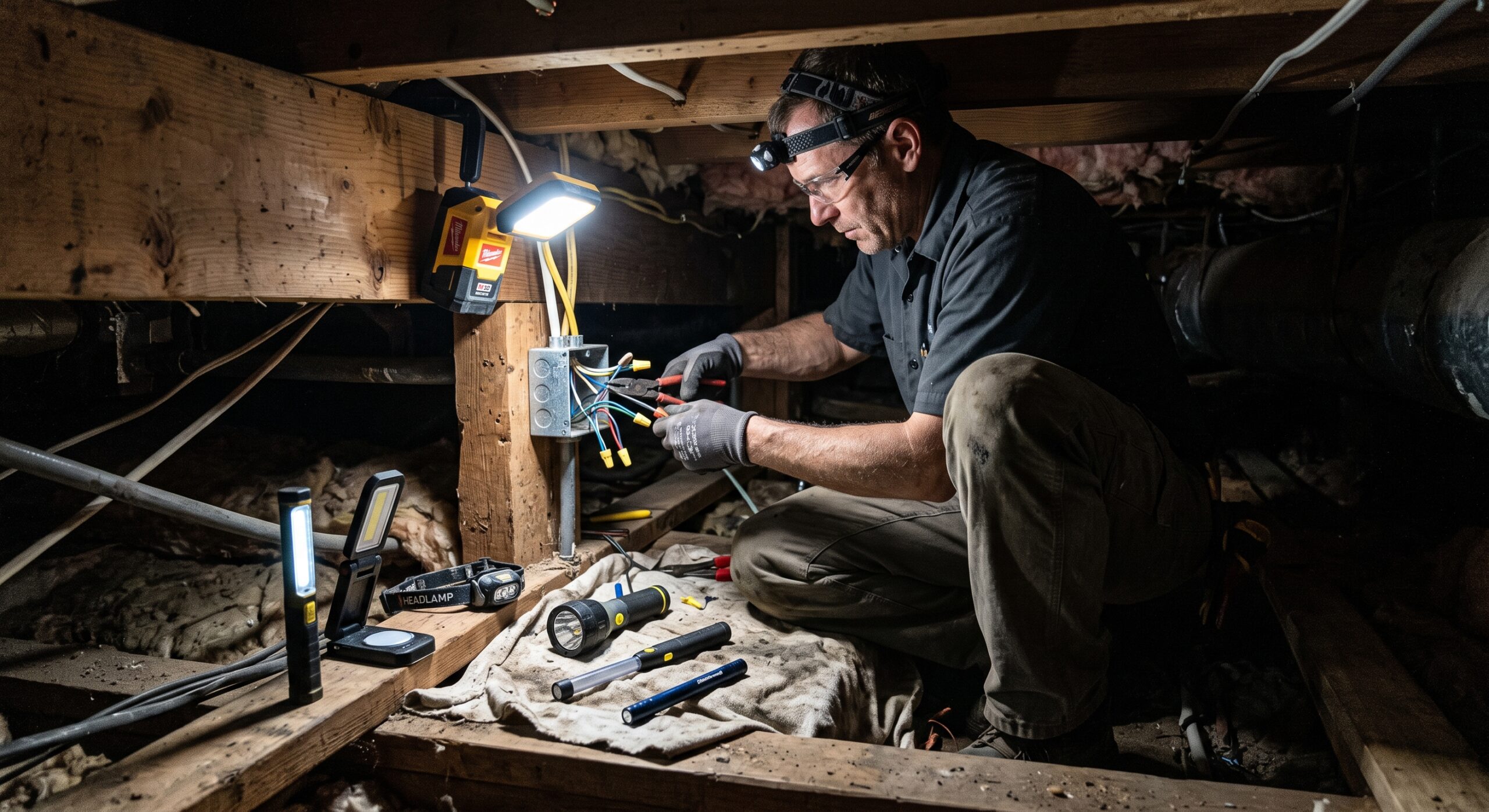
I’ve spent more than two decades of my career with my knees in crawlspace mud and my shoulder wedged against a rafter. More than once I’ve had a flashlight clenched in my teeth because both hands were busy pulling wire. If you’ve ever tried to land a wire nut on a splice while balancing a light in one hand, you already know why. Finding the best work lights for electricians isn’t some minor accessory decision. It’s the difference between a clean, safe job and a mess you’re still fixing an hour after you should have gone home.
Attics, crawlspaces, meter bases, panel interiors, and wall cavities were never built with visibility in mind. Most consumer grade lights weren’t built with electricians in mind either. They’re too bulky, too dim where it counts, or they run on batteries that die halfway through a service call. I’ve gone through plenty of trial and error, plus a fair number of lights that ended up in the truck’s junk drawer. That process narrowed the field down to seven lights that actually earn a spot on my belt or in my bag.
This list covers headlamps for hands free work in cramped cavities and magnetic task lights for panels and junction boxes. It also covers a couple of bigger units for lighting up a whole attic or basement before you climb in. First I’ll walk through what actually matters when you’re shopping for one of these. Then I’ll get into the picks themselves, along with an honest gripe about each one.
What Actually Matters When You’re Choosing a Work Light for Tight Spaces
Before I get to the list, it’s worth explaining how I judge the best work lights for electricians. I picked these seven over dozens of other lights on the market. A lot of buying guides just repeat the lumen count off the box and call it a day. That number matters, but it isn’t the whole story.
Lumens Are Only Half the Picture
A 1000 lumen flood beam and a 1000 lumen spot beam behave completely differently inside a stud bay or a panel can. Flood beams wash a whole area in usable light. That’s what you want when you’re trying to read a panel schedule or find a stray staple in old knob and tube wiring. Spot beams throw light further. That helps when you’re staring down a long joist bay trying to find a cable you fished twenty feet away.
Size and Weight Decide Whether You’ll Actually Use It
I don’t care how bright a light is if it’s too bulky to fit through a small attic access hatch. Same goes for a light that’s too heavy to wear on my head for an hour without giving me a neck ache. Some of the lights below earn their spot specifically because they fit into cavities bigger units simply can’t reach.
Battery Life and Charging Matter More on a Service Call
On a rough in, you can usually run an extension cord to a work light. On a service call in someone’s attic in July, you don’t always have that option. The last thing you want is a light dying while you’re mid splice, the breaker’s off, and the clock is running. I’ve tried a few solar rechargeable work lights over the years hoping to solve this on days when I can’t get back to a truck charger, and whether that’s actually worth it depends a lot on how you work — it’s a fair question if your charging routine is inconsistent.
Mounting Options Save You a Hand
Magnets, hooks, and headbands all do the same job. They free up your hands for actual electrical work instead of holding a flashlight. A light that only works handheld tends to end up on the floor of a crawlspace more often than you’d like.
Durability and a Real IP Rating Aren’t Optional
Attics run hot. Crawlspaces are damp, sometimes flooded. Basements get dusty during demo. A light without at least an IP54 rating for dust and water resistance is a light you’ll be replacing every year. It’s also part of why I stopped carrying halogen trouble lights on the truck. If you’re still deciding between an LED work light vs halogen unit, the heat, bulb life, and battery efficiency aren’t close.
With all that in mind, here are the seven lights I actually reach for.
The 7 Best LED Work Lights for Electricians in Tight Spaces
Here’s my hands on rundown of the best work lights for electricians working in cramped attics, crawlspaces, and panels.
1. Milwaukee M12 ROVER Service and Repair Flood Light (2367 20)
If I had to keep exactly one light on my belt, it would be this one. The M12 ROVER puts out 700 lumens of flood light from a head about the size of a deck of cards. It pivots 120 degrees, too. That lets you aim it at a panel interior, a ceiling box, or straight down into a floor cavity without repositioning your whole body.
The rear magnet is strong enough to stick to a panel door or a piece of unistrut. It holds the light’s weight without sliding, which matters when you’re working one handed inside a service panel. There’s also a keyhole slot in the housing for hanging it on a screw or nail when there’s no metal around to grab onto. On a full charge with the M12 XC4.0Ah battery, Milwaukee rates it for up to 24 hours of runtime on the low setting. That’s plenty for a full day of service calls.
What I like most for tight space work is the size. It fits into places a lot of “compact” work lights still can’t. The IP54 rating means I don’t think twice about using it in a damp crawlspace or a dusty attic. For a single light that handles both flood and detail work, it’s one of the best work lights for electricians I’ve carried.
The honest gripe: it runs on the M12 battery platform. If you don’t already carry Milwaukee M12 tools, you’re buying into a whole battery ecosystem just for a work light. The bare tool version also doesn’t come with a battery, so factor that into the real cost.
2. DeWalt DCL182 Rechargeable LED Task Light
This is the light I reach for when I’m working inside a panel or a junction box. I need light exactly where my hands are, nowhere else. It puts out up to 1000 lumens on high, more punch than you’d expect from something this small. The head pivots, too, so you can angle the beam without moving the base.
Two strong magnets on the back let you stick it to a panel can, a metal stud plate, or the side of an electrical box. A built in carabiner clip lets you hang it off your tool bag or belt instead. It charges over USB, which is exactly what you want from a rechargeable work light built for contractors who need to top it off from a truck charger or a portable battery pack instead of hunting down a specific dock. DeWalt rates the low setting for up to 12 hours per charge, which covers most service calls without needing a recharge mid job.
For tight space work, the compact head is the real selling point. I’ve stuck this thing to the inside of a meter base more times than I can count. Same goes for the metal frame of an attic hatch.
The honest gripe: on high, runtime drops off fast. The battery is built in rather than swappable, too. A dead unit means waiting out a full recharge instead of just popping in a spare.
3. Streamlight Twin Task USB Headlamp
Headlamps earn their keep the moment you need both hands free. That’s exactly why they show up so often on lists of the best work lights for electricians. This one is the most versatile I’ve used, because it gives you two different beams in a single unit. Flip to a 375 lumen spot LED for throwing light down a long joist bay. Or flip to a 250 lumen flood LED for washing out a whole panel with soft, even light that won’t blind you off a shiny surface.
The head tilts up to 120 degrees. The battery pack sits at the back of the strap to balance the weight instead of loading it all onto your forehead. It’s rechargeable over USB with a swappable battery pack if you want to carry a spare. It’s rated for up to 9 hours on the flood beam’s low setting, and up to 20 hours on the spot beam’s low setting. A single charge realistically covers more than one job.
In a tight crawlspace or attic, switching from flood to spot without swapping tools is genuinely useful. I’ll flood the area first to get oriented, then switch to spot to trace a specific run.
The honest gripe: at just over six ounces with the battery installed, it’s noticeably heavier than a stripped down headlamp. You’ll feel it after a couple hours of continuous wear.
4. Ledlenser MH8 Headlamp
This is the headlamp I grab when I need to see all the way down a long attic run. It’s also my pick for spotting a cable staple from fifteen feet away. It’s rated for 600 lumens and a 200 meter beam distance, well beyond what most work lights in this category manage. Its focus system lets you twist the head to shift between a tight spot beam and a wider flood without switching lights.
At about 139 grams, it’s one of the lighter rechargeable headlamps on this list. A magnetic USB charging cable means you don’t have to line up tiny charging pins in the dark. Runtime ranges from roughly 3 hours on the highest setting up to 40 hours on low. That range lets you dial brightness against how long the job is going to take.
The lamp head also detaches from the strap and works as a standalone handheld light. That’s a nice option if you’d rather set it down and point it at something specific.
The honest gripe: like most headlamps in this class, the IP54 rating means it handles dust and splashes fine. I wouldn’t trust it face down in standing water the way I would a fully sealed flashlight.
5. Streamlight Bandit
Some crawlspaces are so tight that even a normal sized headlamp catches on floor joists. Others scrape the top of your head against the subfloor. That’s exactly where the Bandit earns its spot on this list. It weighs about 1.3 ounces, lighter than a phone charger. The low profile housing sits close enough to your head that it doesn’t snag on framing the way bulkier headlamps do.
Output tops out at 180 lumens on high with roughly a 2 hour runtime. On low it drops to 35 lumens for over 9 hours, enough to work by without draining the small internal battery too fast. It charges through a built in USB port, so there’s no separate cable to lose in your bag. A low battery indicator gives you a heads up before it dies mid task.
I keep this one specifically for the tightest crawlspaces and attic soffits, where every extra ounce and every extra bit of clearance actually matters.
The honest gripe: 180 lumens is on the dim side compared to everything else on this list. Treat it as a specialist tool for tight spaces, not a light you’d want for a whole panel change or an open basement.
6. Milwaukee M12 Trouble Light with USB Charging (2362 20)
Not every tight space problem is solved by wearing a light on your head. Sometimes you need a light hanging in the space while you work with both hands free somewhere else entirely. Think stringing new cable through a joist bay, or troubleshooting a run inside a finished wall cavity. That’s the job this trouble light handles better than anything else on this list.
It puts out 400 lumens, and a rotating collar lets you swing the beam through 180 to 360 degrees. Two stainless hooks let you hang it from a joist, a pipe, or a stud. That lights the whole work area instead of just wherever you happen to be pointing your body. Runtime stretches up to 67 hours on low with an M12 battery. You can leave it hanging for an entire job without worrying about it dying.
For tight, awkward spaces like crawlspaces or finished wall cavities you’re fishing wire through, hanging a light instead of wearing one changes how much you can get done.
The honest gripe: again, it’s tied to the M12 battery platform. It also isn’t built to be worn or handheld for extended stretches. Treat it as a complement to the other lights on this list, not a replacement for a headlamp.
7. DeWalt DCL074 20V Max LED Work Light
This one isn’t coming into the tight space with you. It’s for lighting up the space before you go in. At up to 5000 lumens, it’s the brightest light on this list by a wide margin. I use it to flood an entire attic, crawlspace, or basement from the access point before I ever climb in. That way I already know where the joists, the old wiring, and the wasp nest are before I’m on my hands and knees.
It runs on the 20V Max battery platform and offers up to 11 hours of runtime. You can also control it remotely through a phone app, which puts it closer to a smart LED work light than a standard flood unit, so you can adjust brightness without walking back over to it. The unit stands freely on its own base, but it also works on a tripod, or hangs from a hook if you need it elevated.
Think of this as the light that keeps you from getting surprised. That’s especially true once you’re already squeezed into a spot you can’t easily back out of.
The honest gripe: it’s a big, heavy unit compared to everything else on this list. It isn’t something you’re bringing into the crawlspace with you. It’s a staging light, not a personal one.
How I Actually Use These Together on a Job
On a typical attic or crawlspace call, I’ll set the DCL074 up at the access point first. That floods the space so I can see the layout before I commit to squeezing in. Once I’m in, I’m usually wearing either the Bandit or the MH8, depending on how tight the space actually is. I’ll also keep the ROVER or the DCL182 clipped to my belt. That’s for when I need to set a light down and work with both hands on a splice or a panel. If I’m running a long fish through a joist bay, the M12 trouble light gets hung at the far end. That way there’s light waiting for me when I get there, instead of working blind toward it.
None of these lights does everything, and that’s kind of the point. There’s no single one of the best work lights for electricians that covers every situation, because the job changes shape every day. What matters is building a small kit that covers flood, spot, handheld, and hands free work. That way you’re never stuck in a dark panel wishing you’d grabbed a different light off the truck.
Frequently Asked Questions
What is the minimum lighting requirement for electrical work areas?
OSHA’s construction illumination standard, 29 CFR 1926.56, sets minimum foot candle requirements for different types of work areas on a job site. It’s a baseline for general visibility rather than a spec written specifically for electricians. Still, it’s worth knowing if you’re setting up temporary lighting for a crew. You can read the full standard on OSHA’s website.
Do electricians need special lighting for arc flash risk areas?
NFPA 70E doesn’t set a specific lumen requirement. It does expect workers to clearly see equipment labels, meter readings, and working conditions before performing energized work. Poor visibility raises the odds of contact with live parts. A good work light isn’t a substitute for proper lockout tagout procedure and PPE. It does, however, cut down on mistakes caused by working half blind. NFPA has more detail on its 70E standard page.
How many lumens do I actually need for attic or crawlspace work?
When you’re comparing the best work lights for electricians, lumens are just one factor to weigh against beam pattern and battery life. For general visibility while moving through the space, 300 to 700 lumens of flood light is usually plenty. For spotting something far down a joist bay, a spot beam with good beam distance does a better job than raw brightness alone. The Ledlenser MH8’s 200 meter range is a good example. More lumens isn’t automatically better if the beam pattern is wrong for the task at hand.
Is a headlamp or a handheld light better for electrical work?
Both, honestly, which is why a kit built from the best work lights for electricians usually includes at least one of each. A headlamp keeps your hands free for splicing, stripping, and running wire, which is most of the job. A handheld or magnetic mounted light is better when you need to set light on a specific spot, like a panel interior or a junction box. You can leave it there while you work with both hands nearby.
How do I keep a work light from dying mid job?
Charge it the night before, not the morning of, and know your actual runtime on the setting you use most. A light rated for 24 hours on low might only give you 2 hours on high. If you do a lot of service work where charging between jobs isn’t guaranteed, carrying a second light as backup is cheap insurance. It beats getting stuck without light in the middle of a panel.
What IP rating should a work light have?
Look for at least IP54, which covers protection against dust and splashing water from any direction. Attics get dusty and crawlspaces get damp. A light without decent ingress protection tends to fail faster than the rest of your tools. That’s one more reason the best work lights for electricians tend to carry at least an IP54 rating out of the box. Electrical Contractor magazine, published by the National Electrical Contractors Association, has covered LED work light durability and selection in its tool coverage. See their Cool Tools: LED Work Lights roundup for background.
References
Occupational Safety and Health Administration, “1926.56, Illumination,” osha.gov
National Fire Protection Association, “NFPA 70E Standard Development,” nfpa.org
Milwaukee Tool, “M12 ROVER Service and Repair Flood Light w/ USB Charging, 2367 20,” milwaukeetool.com
Milwaukee Tool, “M12 Trouble Light w/ USB Charging, 2362 20,” milwaukeetool.com
DeWalt, “DCL182 Rechargeable LED Task Light,” dewalt.com
DeWalt, “20V Max Lighting Lineup, including DCL074,” dewalt.com
Streamlight, “Twin Task USB Headlamp,” streamlight.com
Streamlight, “Bandit Rechargeable LED Headlamp,” streamlight.com
Ledlenser, “MH8 Headlamp,” ledlenser.com
Electrical Contractor Magazine, National Electrical Contractors Association, “Cool Tools: LED Work Lights,” ecmag.com