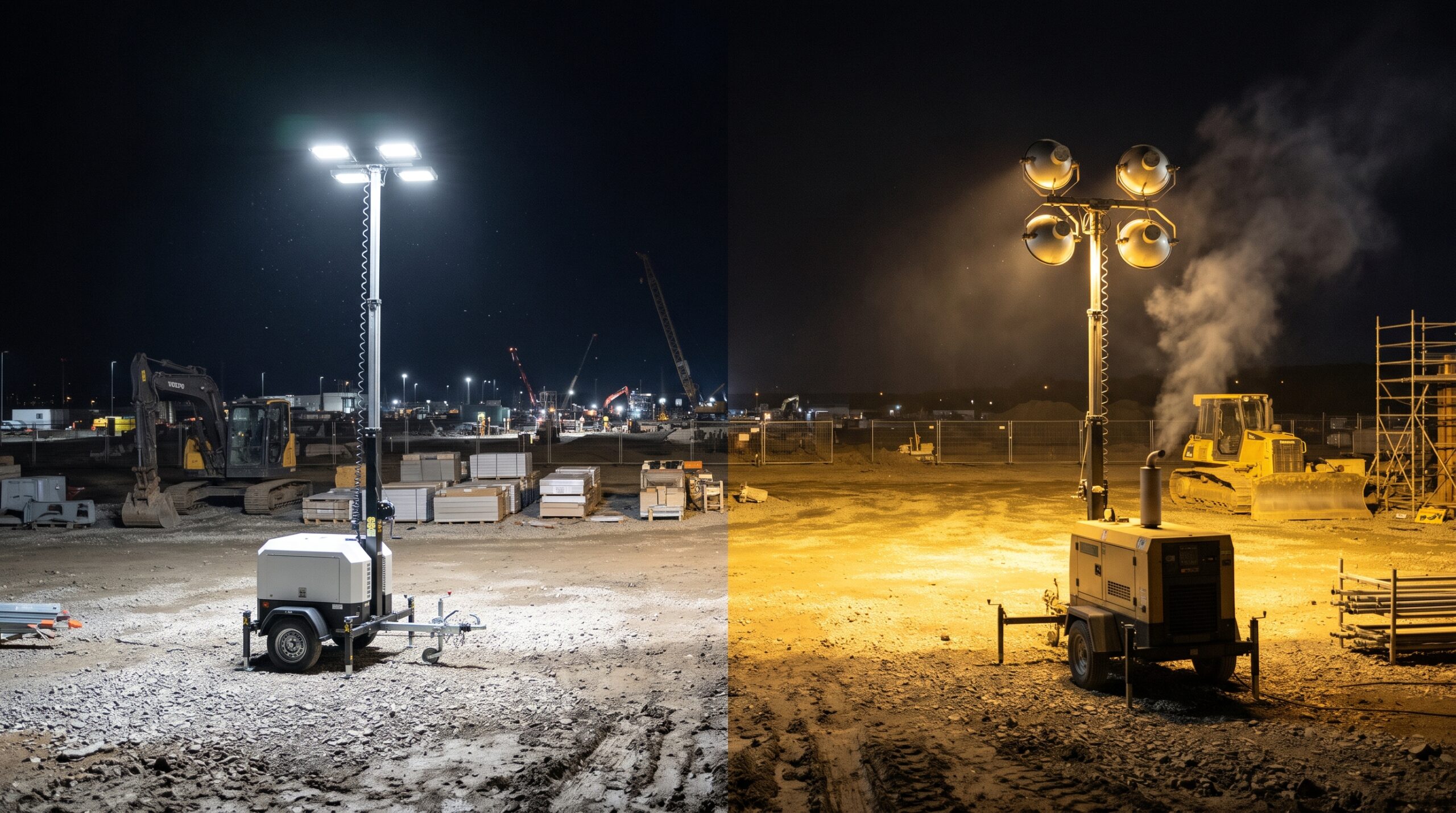
LED vs Diesel Light Towers for Industrial Night Operations
I have spent a good part of my career standing in dark yards at two in the morning. Usually I am deciding whether a diesel unit or an LED light tower fits the job. Over the years I have lit pipeline tie ins, plant shutdowns, highway resurfacing, storm cleanup, and warehouse slab pours.
Back then, the lighting question on those jobs was simple. First, you called the rental house. Next, they dropped off a few diesel towers with four big metal halide heads. After that, somebody fueled them every day or two, and that was lighting.
However, that picture has changed a lot. As a result, I get asked the same question on almost every project. Should we go LED or stay with diesel?
Fixing the Question First
Before I answer, I want to fix the question, because most people phrase it a little wrong. In fact, “LED vs diesel” mixes up two different things. LED is a light source, whereas diesel is a power source.
For example, plenty of units today are diesel engines running LED fixtures. Others are battery or solar hybrid towers with LED heads and no engine running most of the night. Meanwhile, a large fleet of diesel towers still runs metal halide lamps. That last group is what most people mean when they say “diesel light tower.”
So in this article, I compare the traditional diesel metal halide tower against the modern LED light tower. That LED unit might run on a small diesel engine, a battery bank, solar panels, or site power. After all, that is the decision crews actually face, and it is worth getting right.
What Any LED Light Tower or Diesel Unit Has to Do
Most people judge a tower by how bright it looks when they drive past. Unfortunately, that is the least useful measurement there is.
In reality, a light tower has three jobs. First, it must put enough light on the work surface so people can see hazards and do the task. Second, it must do that without blinding anyone. That includes the excavator operator, the flagger, and the driver passing your site. Finally, it must keep doing it all night, every night, without becoming a fuel and maintenance headache.
Brightness in a passerby’s eye, then, has almost nothing to do with those three jobs. Instead, what matters is illuminance on the task, measured in foot candles or lux. Equally important is how evenly that light spreads, how much goes where you do not want it, and what it costs per hour.
Keep that framework in mind. After all, it is where the LED light tower tends to win, and also where it sometimes gets oversold.
The Metal Halide Diesel Tower: Why It Lasted So Long
To be fair, I do not want to bash metal halide. It earned its place. For decades the standard setup was four 1000 watt lamps on a telescoping mast. Over that time, the industry got very good at building and servicing those towers.
An Allmand marketing director quoted in For Construction Pros called the 1000 watt metal halide lamp the industry standard. Each lamp is rated at around 110,000 lumens. Therefore, a four lamp tower puts a huge amount of raw light into the air.
That raw output is the real strength of metal halide. A well placed tower throws a broad, wide wash of light. In other words, it lights the work zone and the surrounding area too. On a big open site with nothing nearby to bother, that spill can actually be useful.
Where Metal Halide Falls Short
The weaknesses, however, show up over time.
The first is lamp life and depreciation. According to the same source, a 1000 watt lamp lasts about 10,000 hours. Meanwhile, a 1250 watt lamp drops to around 7,000 hours. Even worse is how fast the output falls. A metal halide lamp is brightest on day one and then declines steadily. Consequently, the tower you measured at the start of a long job is not the tower you have six months later.
The second is the restrike problem. If a metal halide lamp goes out, it will not come right back on. For instance, a generator hiccup, a tripped breaker, or a bumped switch can all cause it. The lamp must cool and then warm back up. In my experience that means ten to fifteen minutes of reduced or no light. On an active night site, that is not a small thing.
The third is fuel. Four 1000 watt lamps plus ballast losses need a big generator. As a result, that engine burns fuel all night, whether the crew is working hard or on a break.
What Changed With the LED Light Tower
The LED light tower took over for a few concrete reasons. Of these, fuel is the one everybody leads with.
LED Light Tower Fuel Savings Backed by Real Numbers
On this point, manufacturers and independent sources line up fairly closely. For example, a Doosan product manager quoted in For Construction Pros said LED towers use about 50 percent less diesel than metal halide towers.
The US Forest Service, by contrast, has no product to sell, and it looked at the same swap for its fire camps. Its light tower best management practice sheet found a clear result. Replacing a diesel metal halide tower with a diesel LED unit in all night use cut fuel by 39 percent. Overall cost, meanwhile, dropped by 6 percent.
That 6 percent figure tells you something honest. Yes, the fuel saving is large. But once you add the higher price of the LED unit, the overall saving on a short job is modest. In contrast, the big money shows up with long hours, many towers, and long projects.
Similarly, Australian rental company Coates published a lighting comparison that shows the spread clearly. Their mine spec metal halide tower burns about 2.8 litres per hour. By comparison, their LED tower burns about 0.7 litres per hour. A hybrid unit drops to roughly 0.11 litres, and a solar unit burns none. Since these are rental figures, treat them as best case. Still, the ratio matches what I have logged in the field.
Lower Power Draw, Instant Light, Tougher Fixtures
The second reason is the power draw. Atlas Copco gives a useful comparison in their article on LED vs metal halide light towers. In their example, four 350 watt LED lamps light about 5,000 square metres at an average of 20 lux. On the other hand, four 1000 watt metal halide lamps cover only about 4,000 square metres.
Moreover, the metal halide setup needs a 6,000 watt power pack. The LED setup, however, needs only about 2,700 watts. Less load means a smaller engine. In turn, a smaller engine means less fuel, less noise, and less exhaust.
The third reason is instant on. An LED light tower reaches full output the moment you switch it on. Likewise, it comes right back after a power interruption. There is no warm up and no restrike delay. Anyone who has watched a crew wait in the dark for metal halide lamps knows what that is worth.
The fourth is durability. Because LEDs have no filament and no arc tube, there is nothing fragile to shatter. Atlas Copco also points out that this makes them more resistant to vibration and impact. That matters on equipment towed down gravel haul roads and dropped on uneven ground.
Lumens Can Lie: Read the LED Light Tower Coverage Map Instead
At this point I get a little technical, because this part trips up buyers and rental coordinators most often.
Put a metal halide spec sheet next to an LED spec sheet. Almost always, the metal halide tower shows a bigger lumen number. Naturally, people assume that means it is brighter. Unfortunately, it is not that simple.
Bare Bulb Lumens vs Fixture Lumens
Generac makes this point in their LED vs metal halide white paper. Most metal halide towers are rated in bare bulb lumens. That is, the output of a brand new bulb in open air. Once the bulb sits inside a reflector and lens, though, you can lose up to half of that output. LED fixtures, in contrast, are usually rated in fixture lumens, which is light actually leaving the fixture.
In their comparison, a 320 watt LED tower produces about 188,000 total lumens. Meanwhile, an 1100 watt metal halide tower produces about 281,424 total lumens with new bulbs. On paper, therefore, metal halide wins by a wide margin.
Yet the same paper shows the LED light is more focused and directional. As a result, less of it spills off to the sides. In practice, more LED output lands on the work area. Less of it, then, lights up the sky, the tree line, and the neighbours.
For that reason, I ask for photometric coverage maps, not lumen ratings, whenever I spec towers. A good coverage map shows the area inside each foot candle contour. For example, you see the area at 5 foot candles, at 3, at 1, and so on. That tells you how many towers you need and where to put them. The lumen number, by contrast, tells you almost nothing about either.
Two Terms to Know Before You Rent an LED Light Tower
L70. An LED does not usually burn out the way a metal halide lamp does. Instead, it fades slowly. Atlas Copco explains the industry convention. Specifically, an LED luminaire counts as failed when it drops to 70 percent of its original output. So when a manufacturer quotes a long LED life, ask if it is an L70 figure. Ask for the test data too. For reference, Atlas Copco quotes heavy duty LED life above 30,000 hours, roughly ten years of use.
CRI. Colour Rendering Index tells you how accurately light shows colours. In fact, that matters more than people think. Electricians read wire colours. Inspectors check weld quality. Meanwhile, everyone on site reads colour coded tags and hazard markings. Fortunately, many LED light tower fixtures now offer a CRI above 85, which is close to natural light.
Glare: The LED Light Tower Problem Nobody Puts on the Invoice
Honestly, I wish more site managers would read this section. Glare is where I see the most avoidable risk on night jobs.
A brighter, more directional LED light tower is a great tool. Aimed badly, however, it is also a great way to blind a truck driver. Most of the research comes from highway work zones. Even so, the findings carry straight over to industrial yards, mine pits, and plant turnarounds.
What the Research Shows
The Virginia Transportation Research Council studied night work zone lighting in a report published through the US DOT. Notably, aiming towers toward drivers lowered their visual performance. Therefore, the authors recommended aiming towers away from traffic or perpendicular to it. They also found that keeping vertical illuminance under about 17 lux at the observer reduced perceived glare.
Likewise, a Purdue study for the Indiana DOT, Workzone Lighting and Glare on Nighttime Construction and Maintenance Activities, tested 49 lighting arrangements. Both LED and metal halide equipment were used. To begin with, raising the mounting height lowered disability glare. In contrast, turning towers toward traffic at 45 degrees increased glare significantly. Tilting the LED fixtures upward also increased glare.
That last finding matches what I see. Crews love to tip LED heads up to “throw” light farther. Unfortunately, all that does is put the brightest part of the beam into people’s eyes.
More recently, a December 2025 study for the Smart Work Zone Deployment Initiative went further. The Effect of Nighttime Lighting Systems on Workers’ Visibility and Safety tested 126 lighting setups. In short, glare and uneven coverage came mainly from poor configuration, not a shortage of light. Above all, rotation angle and mounting height mattered most.
My LED Light Tower Setup Rules for Crews
These are the rules I give every crew lead:
Raise the mast fully unless wind or overhead lines prevent it. After all, height is your best glare control.
Aim fixtures down at the work, not out at the horizon. If an operator can see the bright face of the fixture, then it is aimed wrong.
Point towers away from traffic and haul roads, or across them. Never point them toward traffic.
Light from more than one side where you can. Two towers at moderate output, for example, beat one tower tilted up.
Walk the site at night from the operator’s seat and the driver’s lane, not just the work area.
None of that costs money. Instead, it just takes ten minutes of attention at setup.
How Much Light Is Enough? Compliance in Plain Terms
For US construction work, the familiar reference has been OSHA 29 CFR 1926.56. Essentially, it sets minimum illumination levels in foot candles. These are the numbers most night crews care about:
5 foot candles for general construction area lighting.
3 foot candles for concrete placement, excavation, access ways, active storage, refueling, and field maintenance.
10 foot candles for shops, batch plants, and equipment rooms.
30 foot candles for first aid stations and offices.
The Proposed Rescission
However, OSHA published a proposed rule on July 1, 2025 to rescind 1926.26 and 1926.56 entirely. Its reasoning was that the need for lighting is obvious. In addition, OSHA said it can still enforce adequate lighting through the General Duty Clause. On the other side, contractor groups including AGC and ARTBA pushed back and asked OSHA to keep the standard. For that reason, check the current status before you rely on it in a site plan.
Designing an LED Light Tower Layout Above the Minimum
Either way, my advice as an engineer does not change. Those numbers are minimums, not design targets. A crew providing exactly 5 foot candles, for instance, has no margin. Dirty lenses, fading lamps, and shadows behind equipment all eat into it.
Instead, I design to roughly double the minimum on the actual task surface. Then I verify with a meter after setup. Inspectors, insurers, and attorneys all understand a meter reading. On the other hand, nobody understands “it looked bright enough.”
This is another quiet advantage of the LED light tower. Because LED output fades very slowly, the level you measure in week one is close to what you have in month six. With metal halide, by contrast, you either overdesign at the start or remeasure as the lamps decline.
Wet Stacking: The Diesel Problem Lighting Can Make Worse
This one surprises people. Oddly enough, switching from metal halide to LED can create an engine problem in the wrong setup.
Why Diesel Engines Need Load
Simply put, diesel engines want load. At light load for long periods, combustion temperatures stay low. As a result, fuel does not burn completely, and unburned fuel and soot build up in the exhaust. That is wet stacking. Consulting Specifying Engineer explains the mechanism well. In short, at light load the cylinder walls stay too cool for complete combustion.
In fact, this already happened with metal halide towers that had oversized generators. A practical guide on preventing wet stacking in light towers gives the classic example. A 20 kW tower with four 1,000 watt lamps draws only about 4,000 watts. That leaves roughly 16,000 watts unused. Accordingly, the guide’s general rule is to keep the generator around 70 to 80 percent loaded.
The Retrofit Trap: Why an LED Light Tower Needs a Matched Engine
Now imagine bolting LED heads onto that same oversized engine. Suddenly your lighting load drops by more than half. Consequently, the engine runs even lighter, and wet stacking gets worse.
That is why I call a proper LED light tower a matched system. It has a small engine sized to the LED load. In other words, it is not an old tower with new heads bolted on. Atlas Copco says it plainly: you cannot just drop an LED lamp into a standard light tower.
If you run an older tower with spare capacity, though, use the auxiliary outlets. For example, power a site trailer, heaters, or pumps so the engine works hard enough to stay clean. Some newer diesel LED towers also include automatic load management for this.
Real Operating Cost: Where the Money Actually Goes
Every manufacturer has a savings calculator, and they all say much the same thing. So here is how I think about it when I build a lighting budget.
The Five Cost Lines
Fuel. This is the biggest line item and also the easiest to estimate. Start by multiplying hours per night by nights per month. Then multiply by fuel burn per hour and your delivered fuel price. Keep in mind that delivered price matters. Fuel trucked to a remote site costs far more than pump price.
Refueling labour and logistics. This, by contrast, is the hidden cost. You pay for a fuel truck, a driver, and someone walking the site to top off towers. On top of that, you carry spill risk and the chance a tower runs dry. The Forest Service lists reduced refueling traffic as a safety benefit of solar and hybrid towers. They are right, because fewer fuel runs means fewer vehicles moving in the dark.
Lamp replacement. Metal halide lamps need regular replacement. Usually that means lowering the mast or bringing a ladder. LED heads, on the other hand, last the life of most projects for practical purposes.
Engine service. Oil changes, filters, and engine hours add up. A smaller engine at steady load, however, reduces all of that. Battery and solar units with no engine running reduce it even further.
Rental or ownership cost. Admittedly, LED and especially hybrid units cost more up front. That gap has narrowed as LED fixtures got cheaper. Even so, it still exists.
When the LED Light Tower Pays Back
When I run the numbers for clients, the pattern is consistent. On a short job with a few nights of use, the LED light tower saves a bit but not dramatically.
On a long project, however, the picture changes. Picture ten or twelve hour nights, five or more nights a week, and several towers. In that case, the LED fleet pays back its higher rental rate quickly and keeps saving after that.
Similarly, an equipment specialist quoted in For Construction Pros made the same point years ago. If a contractor only uses towers occasionally, the fuel savings take much longer to show.
Where Diesel Metal Halide Still Makes Sense
I promised this would be honest, so here is the other side.
Some jobs still suit a diesel metal halide tower. Say, for example, you need a wide flood of general light over a huge open area for a short time. In that case, a metal halide tower’s broad spill can cover ground that would take two focused LED towers. Or say the job is a week long and the rental house offers an idle metal halide unit at a big discount. Then the math may favour it. Besides, some very cold sites still run older fleets because that is what is available.
What I would not do, however, is choose metal halide for a long project. Likewise, I would avoid it near traffic, near homes, or anywhere power interruptions are likely. Over time, the restrike delay, falling output, and fuel burn all add up against you.
Battery, Solar, and Hybrid LED Light Tower Options
This part of the market has grown fastest, and for good reason.
A solar LED tower charges by day and then runs from its battery at night. A hybrid tower, meanwhile, adds a small diesel or propane engine that starts only when the battery runs low. The Forest Service’s light tower BMP describes typical units. For instance, they have four LED lights, two to four solar panels, a battery bank, and a 20 foot mast. The main benefits it lists are silent operation, no fumes, and fewer refueling trips.
In addition, their earlier sheet gave a useful estimate. Replacing one diesel tower with one solar tower in all night use could save up to $73 and 7 gallons of fuel per day.
Why Silence Matters
Silence is underrated. On night jobs near hospitals, apartments, or hotels, a silent tower can keep you working. A noisy one, on the other hand, can get you shut down by complaints. Silence helps on site too, since crews can hear backup alarms, radios, and each other.
Know the Limits
Still, the limits are real. Short winter days, northern latitudes, and long cloudy stretches reduce solar charging. Similarly, dust on panels cuts output. Batteries also lose capacity in deep cold.
For these reasons, I usually recommend hybrid over pure solar for winter or northern work. That way, you get quiet, low fuel operation most of the time. At the same time, you get engine backup for nights the battery cannot carry the load.
Why the LED Light Tower Suits Contractors and Smaller Crews
Of course, not everyone reading this runs a mine or a refinery turnaround. A lot of night work is done by smaller outfits. Think of utility crews restoring power after a storm, or roofers racing the weather. Similarly, HVAC contractors swap rooftop units on commercial buildings after hours. Paving crews work parking lots, while plumbing crews fix water mains at night.
For those crews, the LED light tower has extra benefits. To start, smaller LED units are easy to tow with a pickup. They also light instantly, which helps when you set up and tear down several times a night. In residential areas, where night work gets noticed fast, they run much quieter. Finally, some compact units draw so little power they can run from site power or a generator you already own.
If your crew needs night lighting only a few times a month, then renting LED makes more sense. However, if you light jobs regularly, owning one or two compact LED towers usually wins over a few years.
How I Would Choose an LED Light Tower, Step by Step
When someone asks me which tower to use, I work through this order:
First, define the task area and the light level it needs. Use the OSHA table as a floor and your actual task as the target.
Next, get photometric coverage maps for each tower you are considering. Ignore bare bulb lumen ratings.
Then count towers based on the coverage maps. Plan positions with glare in mind: height, aim, and direction.
After that, estimate total operating hours for the project. Calculate fuel, refueling labour, and service costs for each option.
Also check whether the site is noise sensitive or near the public. If so, lean toward battery or hybrid LED.
In addition, confirm the engine on any diesel LED unit is sized for LED load, to avoid wet stacking.
Finally, walk the site at night after setup and take meter readings on task surfaces. Adjust aim before work starts.
Overall, that process takes an afternoon of planning and one night walk. In return, it saves weeks of fuel and a lot of complaints.
The Bottom Line on the LED Light Tower
For most industrial night operations today, the LED light tower is the better tool. Compared with a diesel metal halide tower, it uses roughly 40 to 50 percent less fuel. On top of that, it comes on instantly and holds its output for years. Its colour rendering is also more accurate. With good optics, moreover, it puts more of its light where the work is.
Battery and hybrid LED towers push those advantages even further. In particular, they shine on long jobs and noise sensitive sites.
In short, diesel metal halide is not dead, but it is now the special case rather than the default. Whichever tower you pick, remember that most of the safety outcome is set at setup. Ultimately, height, aim, and a light meter will do more for your crew than any spec sheet.
Frequently Asked Questions
Is an LED light tower really brighter than a metal halide tower?
Not always in raw lumens, but usually in useful light. That is because metal halide towers are often rated in bare bulb lumens, while LED towers are rated in fixture lumens. As Generac’s comparison explains, a metal halide bulb can lose up to half its output inside a fixture. Therefore, compare coverage maps, not lumen ratings.
How much fuel does an LED light tower save?
Most sources put it at about 40 to 50 percent compared with a diesel metal halide tower. For example, the US Forest Service measured a 39 percent cut in all night use. Solar and hybrid towers, meanwhile, can cut fuel use far more.
How long do LED light tower lamps last?
Quality LED fixtures are commonly rated above 30,000 hours, according to Atlas Copco. In that rating, failure means dropping to 70 percent of original output. By comparison, a 1000 watt metal halide lamp typically lasts around 10,000 hours, as reported by For Construction Pros.
What light level does OSHA require for night construction work?
29 CFR 1926.56 sets 5 foot candles for general construction areas and 3 for areas like excavation and refueling. In addition, shops and plants need 10, and first aid stations and offices need 30. However, OSHA has proposed rescinding the standard, so confirm its status. Even so, adequate lighting stays enforceable under the General Duty Clause.
Can I just put LED heads on my old diesel light tower?
It is not recommended. Because LED heads draw far less power, an oversized engine ends up running at very light load. As a result, that can lead to wet stacking. Consulting Specifying Engineer explains why light loading damages diesel engines. Instead, a purpose built LED light tower pairs the fixtures with a correctly sized engine.
How do I reduce glare from an LED light tower at night?
Start by raising the mast fully and aiming fixtures down at the work. Also, avoid tilting heads upward, and point towers away from or across traffic. Research from Purdue University and the Virginia Transportation Research Council shows height and aiming are the biggest glare factors.
Is a solar LED light tower reliable in winter?
It can be. However, short days, cloud cover, and cold reduce battery performance. For winter or northern sites, therefore, a hybrid LED light tower with a small backup engine is usually safer. The Forest Service light tower guide describes how these units work.
References
Occupational Safety and Health Administration. 29 CFR 1926.56, Illumination.
Federal Register. Construction Illumination, Proposed Rule, Docket OSHA 2025 0040. July 1, 2025.
Atlas Copco. LED vs Metal Halide Light Towers: Five Key Considerations.
Generac Industrial Power. LED vs Metal Halide White Paper.
Generac Industrial Power. Light Tower Fact Sheet.
For Construction Pros. Light Tower Lamp Options: What Contractors Should Know.
For Construction Pros. Should LED Lights Be Part of Your Rental Inventory.
USDA Forest Service. Best Management Practice: Solar Light and Power.
USDA Forest Service. Light Towers Best Management Practice.
Coates. Greener Choices Lighting Comparison.
Virginia Transportation Research Council. Examination of the Current Practice of Lighting in Virginia: Nighttime Work Zones.
Purdue University Joint Transportation Research Program. Workzone Lighting and Glare on Nighttime Construction and Maintenance Activities.
Smart Work Zone Deployment Initiative. The Effect of Nighttime Lighting Systems on Workers’ Visibility and Safety. December 2025.
Consulting Specifying Engineer. Preventing Wet Stacking.
MFG Robots. Preventing Wet Stacking in Light Towers: A Practical Guide.