




How Many Lumens Do You Need in a Work Light? A Room-by-Room Guide
Most people choose work light lumens by gut feeling, and that habit causes more mistakes than you would think. A few years ago, a contractor called me about a kitchen job. His crew was halfway through installing a run of shaker cabinets. By then, the doors were hung and the hardware was on. Everything looked perfect at 3 in the afternoon. However, the next morning the homeowner spotted a problem. Two of the upper doors were visibly out of line. In fact, they were off by maybe an eighth of an inch. Still, once you see that kind of flaw, you can never unsee it.
Why the Right Brightness Matters
As it turned out, the crew had done the final adjustments late in the day. They used a single clamp light hanging off a ladder. The light was bright enough to see by. However, it threw hard shadows across every reveal, so nobody could read the gaps properly.
That is exactly the problem I want to help you avoid. Most people shopping for a work light ask one question: how bright is it? In my experience, the better question is different. How bright does it need to be for this room and this task?
After years of specifying lighting for homes, renovation crews, and small workshops, I have learned one thing. Work light lumens only mean something when you connect them to distance, beam spread, surfaces, and eyesight. For that reason, this guide walks through all of it, room by room. That way, you can buy once and buy right.
Lumens, Foot Candles, and Lux Without the Jargon
First, let me clear up three terms you will run into. Mixing them up is where most bad buying decisions start.
A lumen is the total amount of visible light a source puts out. In other words, it measures the light leaving the fixture in every direction. Fortunately, the U.S. Department of Energy offers a handy anchor point. To replace a 100 watt incandescent bulb, look for roughly 1,600 lumens. Similarly, a 60 watt equivalent sits around 800 lumens. Keep those two numbers in your head, since they are useful mental benchmarks.
A foot candle, on the other hand, is what actually lands on your work surface. Specifically, one foot candle equals one lumen spread evenly over one square foot. Likewise, lux is the metric version, measured per square meter. One foot candle is a little under 11 lux. Lighting designers almost always talk in foot candles or lux. After all, what matters is the light on the countertop, the wall, or the engine block.
Meanwhile, watts tell you none of this. For example, the FTC notes that an LED can deliver 800 lumens while drawing only about 9 watts. An old incandescent needed 60 watts for the same light, which is why LED work lights beat halogen on efficiency. Therefore, if a box leads with wattage, flip it over and check the work light lumens instead.
Why Work Light Lumens Are Only Half the Story
Here is the part most buying guides skip. A 2,000 lumen work light does not put 2,000 lumens on your task. Instead, several things eat into that number before it reaches your hands.
Distance
Light from a compact source follows the inverse square law. As a result, doubling the distance leaves roughly a quarter of the light on the surface. For instance, move a light from three feet away to six feet away. You have not lost half your brightness. Rather, you have lost about three quarters of it.
Beam Spread
A narrow spot beam concentrates lumens on a small area. In contrast, a wide flood spreads the same lumens across a big wall. Consider a 2,000 lumen flood with a wide 100 degree beam. At six feet, it gives you roughly 25 foot candles. However, pull it in to three feet and you are near 100 foot candles. In short, the same light delivers four times the usable brightness.
Surfaces
White drywall bounces light back into the room. On the other hand, bare plywood, dark cabinets, raw concrete, and insulation soak it up. Consequently, I plan for more output in dark basements and attics.
Real World Light Loss
Dust on the lens reduces output. Similarly, a lamp aimed slightly off target wastes light. Even your own body can block the beam. Because of this, I add about a third more output than the calculation says.
That is why I tell clients to treat work light lumens as a budget. You need enough output to hit your target at the distance you actually work. On top of that, you want some margin left over.
The Simple Math I Use on Every Job
Fortunately, you do not need lighting software to size your work light lumens. Instead, you need a tape measure and two numbers.
First, find the recommended light level for the task. The Illuminating Engineering Society publishes these figures. Penn State’s energy course notes summarize the residential numbers neatly. For example, kitchen task areas call for 50 to 100 foot candles. Bathrooms and home offices need 20 to 50. General garage space needs 30, while a garage workbench needs 100.
Next, measure the area you need to light. Then multiply the square footage by the recommended foot candles. The result is the lumens you need.
Let me give you a quick example. Say you are retiling a 6 by 8 foot bathroom floor. That comes to 48 square feet. Tile layout deserves the top of the bathroom range, so call it 50 foot candles. Forty eight times 50 gives you 2,400 lumens. After adding a third for losses, you land around 3,200 lumens. Ideally, split that between two lights so you are not fighting your own shadow. Ultimately, this one calculation will steer you better than any product review.
Room by Room: How Many Work Light Lumens You Actually Need
Keep in mind that these numbers are for portable work lighting during a project. They do not cover the permanent ceiling fixtures. In other words, think of it as what to bring into the room to do the job well.
Work Light Lumens for the Kitchen
Kitchens cause the most frustration, because the tasks are precise and the spaces are awkward. For example, cabinet installation, countertop templating, and backsplash tile all demand clear sight lines.
For general work across a typical kitchen, plan on 3,000 to 5,000 lumens total. Usually, a tripod flood aimed at the ceiling works best. In fact, bouncing light off a white ceiling is one of my favorite tricks. It turns one harsh source into a big, soft one and kills most shadows.
For detail tasks like setting hinges, add a compact light of 300 to 800 lumens. A magnetic base or clamp helps here. Under the sink, however, 200 to 500 lumens is plenty. That light often sits less than two feet from the work. Beyond that, glare off stainless steel becomes its own problem.
Work Light Lumens for the Bathroom
Bathrooms are small, which works in your favor. At the same time, they are full of reflective surfaces. Glossy tile, mirrors, and chrome bounce strong light straight back into your eyes.
For tiling, grouting, and vanity work, 1,500 to 3,000 lumens covers most bathrooms. Moreover, place one light low and to the side when setting large format tile. That raking light grazes across the floor. As a result, it reveals lippage long before your hand can feel it. Lippage is the slight height difference between neighboring tiles.
For plumbing behind a toilet, a 300 to 600 lumen compact light or headlamp does the job. Here, though, diffused output matters more than raw power. A bare, pinpoint LED bouncing off white porcelain is miserable to work under.
Work Light Lumens for Living Rooms and Bedrooms
In living spaces, the work is usually painting, drywall repair, trim, or flooring. Because these are wall and floor jobs, you need broad coverage rather than a tight beam.
For a standard 12 by 14 foot room, I recommend 4,000 to 6,000 lumens. That may sound like a lot at first. However, ambient levels for these rooms are only 10 to 20 foot candles. That level is fine for watching a movie. Unfortunately, it is terrible for spotting a missed patch in fresh paint.
Painting Tip: Use Raking Light and the Right Color Temperature
The most valuable technique in these rooms actually has nothing to do with lumens. Simply set a light on the floor and aim it up the wall at a steep angle. As a result, every ridge, scratch, and nail pop casts a visible shadow. Painters and drywall finishers have done this for decades. It still remains the best quality control tool on any job site.
Likewise, color temperature matters a lot here. A daylight balanced light around 5,000K shows colors close to afternoon sunlight. In contrast, a warm 3,000K light makes every beige look a little more golden.
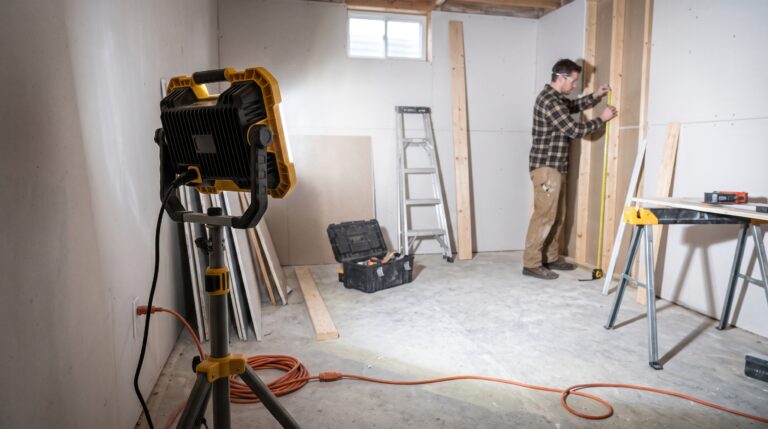
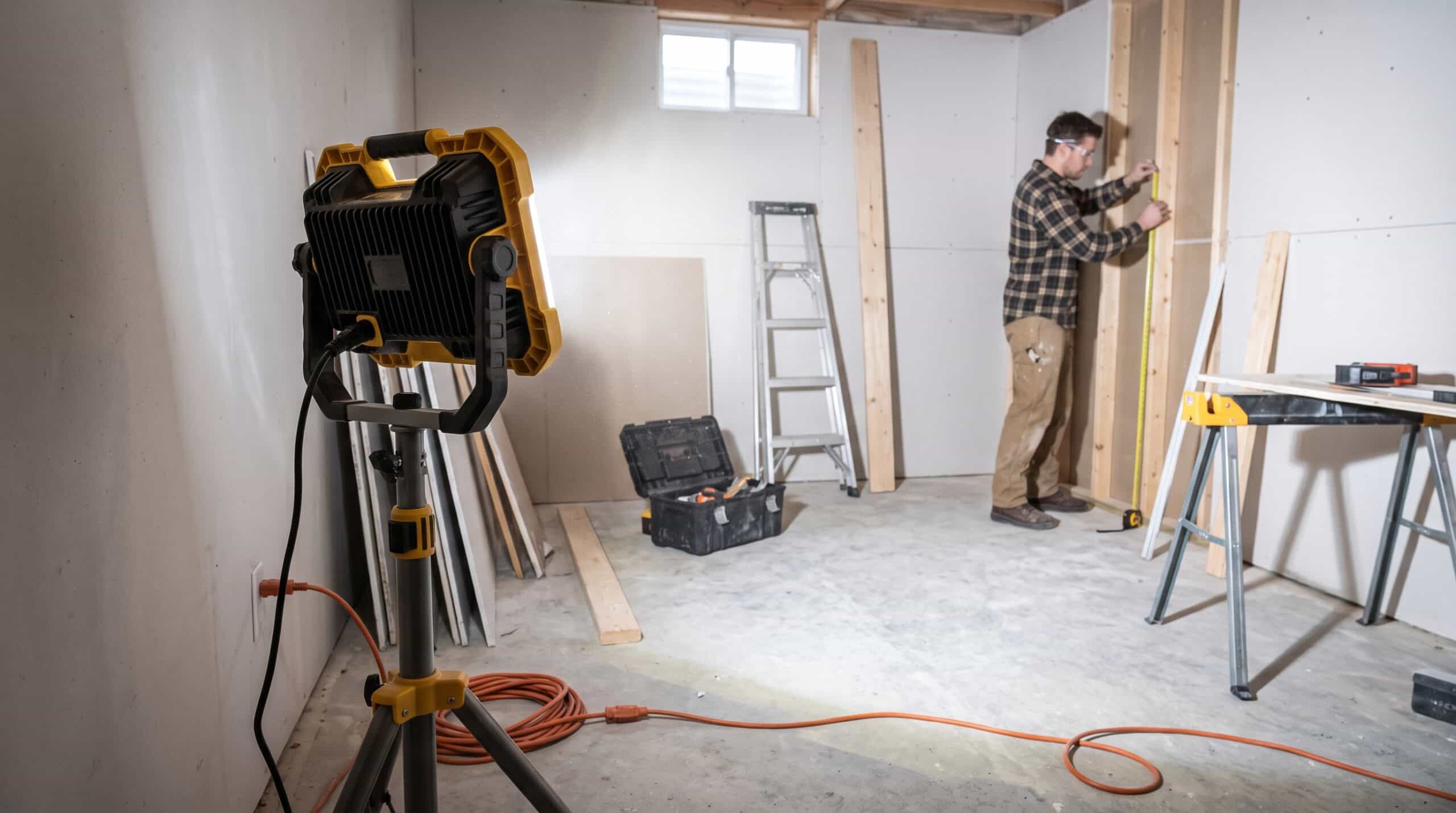
Work Light Lumens for the Basement and Crawl Space
People underestimate basements more than any other room. After all, you have dark surfaces, little natural light, and a low, cluttered ceiling. Ducts, joists, and wiring all block light from spreading.
For unfinished basement work, plan for 5,000 to 10,000 lumens across the area. Additionally, split that output between at least two lights on opposite sides. A crawl space, by comparison, is too small for big floods. Instead, a 500 to 1,000 lumen compact light plus a headlamp works well.
Beyond brightness, two things deserve attention. First, basements can be damp, so look for an IP54 rating or higher. Second, a cordless light removes a real shock hazard near a sump pit or wet floor.
Work Light Lumens for the Attic
Attics combine the worst conditions: heat, dust, poor footing, and light absorbing insulation. For this reason, visibility here is a safety issue. Stepping between joists onto drywall is how ceilings get holes.
I therefore suggest a 1,000 to 2,000 lumen attic work light that hangs from a rafter. Pair it with a 300 to 500 lumen headlamp. The hanging light helps you see your path. Meanwhile, the headlamp follows your eyes for close work like running cable. Above all, battery lights win in attics, because extension cords become trip lines.
Work Light Lumens for the Garage and Home Workshop
This room generates the most questions about work light lumens. Honestly, the answer depends on what you do there.
Bob Vila’s guide cites the IES Lighting Handbook for garage numbers. It recommends 50 lumens per square foot for residential garages. For workshop areas, the figure rises to 300 lumens per square foot. Furthermore, the guide gives a useful example. A nine square foot workbench needs about 2,700 lumens at that rate.
Workbench and Automotive Lighting
Here is how those numbers play out in practice. A typical two car garage covers roughly 400 square feet. Therefore, it needs 20,000 or more lumens of ambient light, usually from ceiling fixtures. On top of that, a workbench deserves its own 2,500 to 3,000 lumens. For engine bays and undercar work, a 500 to 1,000 lumen magnetic light works best. In fact, it beats another overhead flood every time.
Similarly, fine woodworking and electronics call for good color rendering. According to Ledlenser, CRI above 90 is recommended for paint shops and quality control work. Consequently, color coded wires and stain samples become far easier to read.
Work Light Lumens for the Laundry and Utility Room
These rooms tend to be cramped. Appliances sit against walls, and connections hide behind them. For example, replacing a dryer vent hose is a common job.
In most cases, one 1,000 to 1,500 lumen flood handles it. Simply set it on top of the appliance and aim it at the wall behind. In addition, a small 200 to 400 lumen magnetic light helps with close work on fittings. Since water and electricity share this room, use cordless or GFCI protected lights only.
Work Light Lumens for Decks, Fences, and Exterior Work
Outdoor night projects need the most work light lumens of any space in this guide. The reason is simple: nothing bounces light back toward you. As a result, every lumen that misses the work is gone.
For deck building or fence work after dark, plan on 10,000 to 20,000 lumens. Mount the floods high and aim them down to reduce glare. Also, two lights from different angles always beat one bigger light. A single source throws long shadows from every post and board. Finally, weather resistance is essential, so look for at least IP65.
Quick Reference: Work Light Lumens by Room
Use these as starting points. Then adjust for distance, surfaces, and your own eyes.
- Under sink and inside cabinets: 200 to 500 lumens
- Small bathroom tiling and fixtures: 1,500 to 3,000 lumens
- Attic general lighting: 1,000 to 2,000 lumens plus a headlamp
- Laundry and utility rooms: 1,000 to 1,500 lumens
- Kitchen remodel, whole room: 3,000 to 5,000 lumens
- Living room or bedroom painting and drywall: 4,000 to 6,000 lumens
- Garage workbench task light: 2,500 to 3,000 lumens
- Unfinished basement projects: 5,000 to 10,000 lumens
- Outdoor night work: 10,000 to 20,000 lumens
Factors That Change Your Work Light Lumens
Your Age
Product packaging never mentions this factor. Yet it is one of the biggest. Our eyes let in less light every decade. For instance, the American Lighting Association cites research on this. A 60 year old needs twice the light of a 30 year old to see equally well. The Lighting Research Center goes even further. It recommends at least triple the usual task lighting for older adults.
In practical terms, then, a light that feels dim after 50 probably is. So raise your work light lumens rather than squint.
Color Rendering
Brightness and color accuracy are separate qualities. As Ledlenser explains, CRI has no direct link to color temperature or lumens. In other words, a very bright light can still make stain and paint look washed out. For general construction, CRI 80 is acceptable. However, for painting or electrical work, look for CRI 90 or better.
Color Temperature
Most work lights fall between 4,000K and 6,500K. Generally, neutral white around 4,000K is easier on the eyes over long sessions. Daylight white around 5,000K to 5,700K, on the other hand, reveals detail well. Meanwhile, light above 6,000K can look harsh and slightly blue. Personally, I find it tiring after a couple of hours.
Glare and Placement
Surprisingly, more lumens aimed poorly can make things worse. A light pointed toward your eyes shrinks your pupils. Therefore, the work surface actually looks darker. For that reason, keep lights above or beside your line of sight. Also, favor diffused lenses for close work.
Common Mistakes With Work Light Lumens
Buying One Huge Light Instead of Two
A single 10,000 lumen flood creates deep, hard shadows. By contrast, two 5,000 lumen lights from different angles fill those shadows in. As a result, you get far better visibility for the same output.
Trusting Inflated Lumen Claims
Some budget lights advertise numbers their batteries simply cannot deliver. So if a palm sized light claims 20,000 lumens, be skeptical. Reputable brands, on the other hand, test their work light lumens to recognized standards, publish effective rather than raw lumens, and list runtimes.
Ignoring Runtime
Some cordless lights hold full brightness for only 20 minutes. After that, they drop to half. Therefore, check the runtime chart, not just the headline number.
Forgetting Distance and the Bounce
People often hang a light across the room and then wonder why the work looks dim. Instead, bring it closer. Halving the distance roughly quadruples the light on the task. Likewise, aim floods at a light ceiling for softer, more even coverage.
Final Thoughts
To sum up, work light lumens matter, but they are a starting point. First, figure out the task and measure the area. Then aim for the right foot candles. After that, account for distance, surfaces, and your own eyes. If you do that, you will choose a light that makes the work easier and safer.
And if you ever adjust cabinet doors under a single clamp light, do yourself a favor. Bring in a second light and bounce it off the ceiling. Then look again. In the end, your clients will notice the difference, even if they never know why.
Frequently Asked Questions
How many lumens is a good work light?
Across most home projects, 1,500 to 3,000 lumens covers most tasks in a single room. For example, Home World Design notes that 1,500 to 2,500 lumens suits general workshop tasks. Cabinet and under sink jobs, however, need far less. Outdoor work, by contrast, needs far more. See Home World Design’s guide to choosing a work light for more detail.
How do I convert foot candles into lumens for a room?
Simply multiply the square footage by the recommended foot candles for the task. As a result, you get the minimum lumens before accounting for losses. Super Bright LEDs walks through this formula with room examples.
Are 10,000 lumens too bright for indoor work?
In a small room, often yes, especially if the light points toward you. On the other hand, it can suit a large garage or unfinished basement. In short, placement and diffusion matter more than the raw number. Bob Vila’s garage lighting guide also covers how to layer ambient and task lighting.
Do older people need brighter work lights?
Yes. Aging eyes admit less light and are more sensitive to glare. Therefore, older workers need more output with less glare. The Oklahoma State University Extension fact sheet on aging eyes explains this in detail.
Should I choose a work light by watts or lumens?
Always choose by lumens. After all, watts only measure energy use, while lumens measure light output. The U.S. Department of Energy explains why lumens are the right comparison.
What CRI should a work light have?
CRI 80 handles general construction. However, for painting, staining, and electrical work, choose CRI 90 or higher. Ledlenser’s explanation of the color rendering index covers what the numbers mean in practice.
References
- Penn State EGEE 102: How Much Lighting is Needed
- Super Bright LEDs: Home Lighting Guide, IES Residential Recommended Lighting Levels
- Bob Vila: 10 Ways to Improve Your Garage Lighting
- U.S. Department of Energy: Lumens and the Lighting Facts Label
- FTC Consumer Advice: Shopping for Light Bulbs
- Lighting Research Center at Rensselaer: Lighting Guidance for Older Adults
- Oklahoma State University Extension: Electric Lighting, Vision, and Aging Eyes
- Landscape Architect Magazine: Lighting for Aging Eyes (American Lighting Association)
- Ledlenser: CRI, An Explanation of the Colour Rendering Index
- The Home Depot: How to Choose the Best Lighting for Your Garage Workshop
- Home World Design: How to Choose the Right Work Light for Your Garage or Workshop