


Work Lights That Run on Your Power Tool Batteries: Brand Compatibility Guide
The worst lighting setup I ever worked under was in a crawlspace in February, and it is the job that turned me into a believer in the power tool battery work light. Three of us, one extension cord, an old halogen lamp that kept tripping the outlet, and a bucket of fully charged cordless batteries sitting by the access hatch doing absolutely nothing. The plumber on that job finally said what everybody eventually says: why are we fighting this cord when we have a dozen batteries right here?
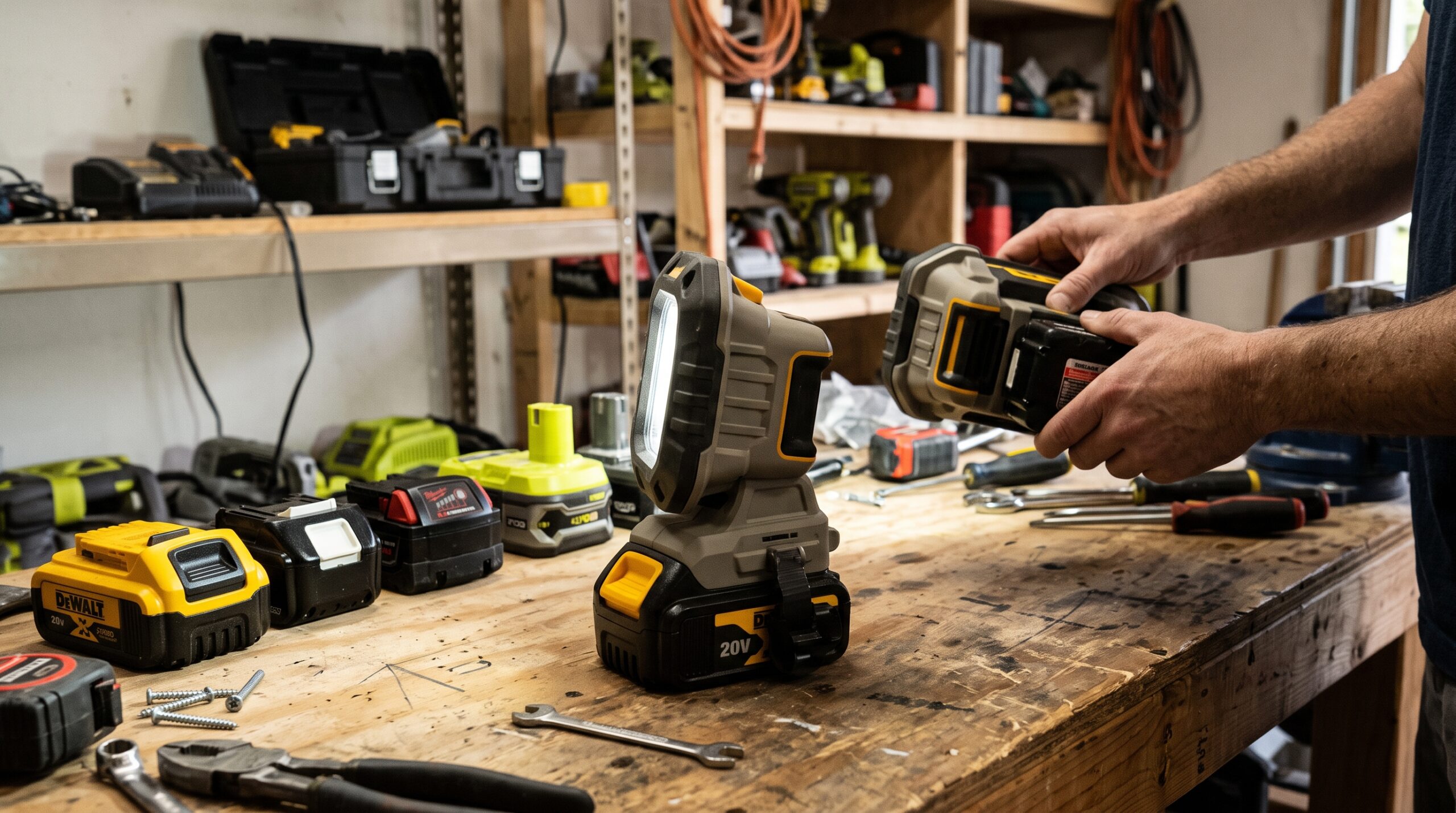
That question is the whole reason a power tool battery work light exists. You already paid for the batteries, and the charger is sitting in your truck. The light simply borrows energy you have on hand. The catch is that battery platforms are closed systems. A yellow pack will not click into a red light, and in a few cases a pack will not even fit a light from its own brand.
I have spent a long time testing lights, sending some back, and fielding the same questions from contractors and homeowners over and over. This guide sorts out what actually fits what, how to read voltage labels without getting fooled, where adapters fit into the conversation, and how to pick a light that suits real home service work instead of a store display.
Why a Power Tool Battery Work Light Beats a Standalone Rechargeable
Standalone rechargeable work lights have their place. They are cheap and they come with their own built in pack. The problem shows up around year two, when that sealed cell starts holding half the charge it used to and there is no way to swap it. You end up throwing away a perfectly good LED head because the battery inside it wore out.
A light that runs on your tool packs avoids that trap. When a battery gets tired, it moves to the junk drawer and a fresh one takes its place. The light itself can easily outlive several generations of packs. Runtime becomes your choice on the day, too. A compact 2Ah pack keeps the light small enough to wedge behind a toilet tank, while a big 8Ah pack will carry a flood light through a full evening of drywall finishing.
There is a cost argument as well. Most of these lights are sold as bare tools, without a battery or charger, which keeps the price down. DeWalt states plainly on its handheld model that the light ships alone, with the battery and charger purchased separately. If you already own the platform, that is exactly what you want.
The real win, though, is simplicity on the truck. One charger, one battery type, one set of habits. Every crew lead I know who has standardized on a single platform says the same thing: fewer dead tools, fewer forgotten chargers, and fewer arguments about whose battery is whose.
Reading the Voltage Label Before You Buy a Power Tool Battery Work Light
Before we go brand by brand, you need to understand the single biggest source of confusion in this whole category. The number printed on the battery is not always the same kind of number.
Peak Voltage vs Working Voltage
Lithium ion cells sit at roughly 3.6 volts each under normal use and peak a little higher right off the charger. Stack five of them and you get a pack that measures about 20 volts fresh off the charger and settles around 18 volts while working. Some brands print the peak figure. Others print the working figure.
DeWalt is the classic example. Pro Tool Reviews explains that both 18V and 20V Max packs use five cells, reading 20 volts at full charge and dropping to 18 volts once the battery is under use. ToolGuyd puts it even more bluntly, noting that a US 20V Max pack and a European 18V XR pack are practically the same battery with different labels.
The same pattern runs across other systems. According to SlashGear, DeWalt’s other MAX battery families follow the same peak versus nominal labeling. Milwaukee prints the working voltage on M18 and the peak style figure on M12, while Makita uses 18V for LXT and “40V max” for XGT.
Why the Label Matters When Buying a Light
This matters for a work light in two ways. First, if you buy a light overseas or from an international seller, the label may not match what you see at your local store even though the battery is identical. Second, never assume two batteries are compatible just because the numbers look close. Voltage tells you almost nothing about fit. The slide rail, the latch, the terminal layout, and the communication pins decide whether a battery seats in a light, and those are unique to each brand.
Power Tool Battery Work Light Compatibility by Brand
Here is where most people actually need help. I have grouped this by platform, because that is how you should shop. Decide what battery you already own, then look at what lights that battery can run.
DeWalt: 20V MAX, 18V XR, and FLEXVOLT
DeWalt users have it fairly easy, as long as they stay on the slide style lithium packs. The current 20V MAX lights accept the full range of DeWalt slide packs, including the larger FLEXVOLT batteries. Home Depot’s listing for the long running DCL040 handheld notes that it works with every DeWalt 20V and 60V MAX battery and puts out 110 lumens through a head that pivots 120 degrees. That means a FLEXVOLT pack you bought for a circular saw will happily run your light for a very long time.
The DCL044 handheld is the one I recommend most often for service calls. DeWalt rates it at 160 lumens with a strong magnet for hands free mounting and a head that rotates 360 degrees and pivots. On a furnace cabinet or a steel electrical panel, that magnet is worth more than an extra few hundred lumens.
Area lights that run on more than one pack style are also part of the lineup. When ToolGuyd covered the DCL060 and DCL061, it noted that their multi port design accepts both DeWalt 20V Max and the older 18V batteries, with the DCL061 adding AC power as an option. That is useful if you still have a few old stem style packs floating around.
The one trap: older 18V NiCad tools and newer 20V MAX packs do not physically mate. SlashGear confirms that the newer 20V MAX batteries will not fit DeWalt’s older 18V tools directly, which is why DeWalt sells its own first party adapter for that transition. Note the words “its own.” That matters later.
Milwaukee: M12 and M18 Are Separate Worlds
Milwaukee is arguably the deepest lighting catalog in the trades, but M12 and M18 are completely separate platforms. An M12 pack will not run an M18 light and the reverse is also true. Chargers are the exception: Milwaukee sells multi voltage chargers that handle both, but the lights themselves are locked to one system.
Milwaukee M12 Lights for Tight Service Work
For home service work, the M12 ROVER service and repair flood light is one of the best small lights on the market. Milwaukee says it delivers 700 lumens and can light a workspace for up to 24 hours, with a head that pivots 110 degrees and a rear magnet for steel studs, beams, and job boxes. That 24 hour claim is tied to an M12 XC 4.0 battery pack, so expect less from a compact 2Ah pack. It also carries an IP54 rating against dust and water and is built to survive drops up to 9 feet, which matters when it is balanced on a ladder shelf.
Milwaukee M18 Lights for Bigger Rooms and Job Sites
On the M18 side, the ROVER mounting flood light has been the workhorse I see on most remodeling sites. Milwaukee rates it at 1,500 lumens, with up to 20 hours of runtime on its lowest setting from an M18 XC 5.0 battery. However, Milwaukee now lists it as discontinued. Its successor, the M18 ROVER Clamping Flood Light, steps through 2,000 lumens for 6 hours, 1,000 lumens for 12 hours, and 500 lumens for 24 hours on the same battery. Those three steps tell the honest story of every power tool battery work light: brightness and runtime trade off against each other in a nearly straight line.
For bigger spaces, Milwaukee’s lineup scales up fast. The M18 ROCKET tower light/charger delivers 3,000 lumens, and a higher output version reaches 6,000 lumens. Those are overkill for a bathroom, but they make sense for a basement finish or an exterior job that runs past sunset.
Makita: LXT and XGT, With Real Crossover
Makita is the brand where the crossover story gets interesting. Its 18V LXT and 40V max XGT batteries do not share a slide rail, but several Makita lights are designed to accept both.
Makita Dual Platform Flood Lights
The ML003G is a good example. Makita lists it as compatible with both 40V max XGT and 18V LXT batteries, and Toolnut’s listing rates it at 1,100 lumens on high and 450 on low, with up to 10 hours on high from a 4.0Ah XGT pack.
The ML009G goes further with a two pack bay. According to Makita, it holds two XGT batteries or two LXT batteries but only draws from one at a time, using the second pack to extend runtime. I like this design for long jobs because you can swap the dead pack without the light ever going out.
Makita Tower and Under Hood Options
At the top end, the ML014G tower light is a different animal. The Paul B. Hardware listing describes output up to 15,000 lumens from three rotating heads on a tower that extends to 8 feet, and Pro Tool Reviews notes that its battery compartment includes one XGT slot and one LXT slot, so you can power it from either system. For an outdoor deck build or storm cleanup, that kind of flexibility is gold.
On the smaller side, Makita released dedicated under hood lights for each platform in 2024. Makita says the LXT version runs up to 31 hours on low and 6 hours on high with a 4.0Ah battery. Even though it was built for mechanics, I have seen HVAC techs use it across the top of an air handler.
Ryobi ONE+: The Gold Standard for Backward Fit
If you are a homeowner or a value focused pro, Ryobi deserves credit for something no other big brand has matched. Ryobi says its ONE+ battery platform has stayed compatible since 1996, so every ONE+ tool, now more than 200 products, works with every ONE+ battery.
That consistency carries straight into lighting. Any ONE+ power tool battery work light you buy today will run on that battery you have had in the garage for a decade. Ryobi’s lights tend to be affordable, which makes it easy to keep a couple in the truck and one in the kitchen drawer for power outages.
The one exception to know: Ryobi also sells a higher voltage line. A UK tool retailer’s guide points out that Ryobi 36V MAX POWER batteries are not compatible with ONE+ tools. Check the label before you buy a light if you own both.
Bosch: Green and Blue Are Not the Same
Bosch causes more confusion than any other brand I deal with, because it runs two 18V families. The green Home and Garden line belongs to the Power for All Alliance, while the blue Professional line is its own system.
On the green side, Bosch says its Power for All 18V battery has been fully forwards and backwards compatible with all green Bosch 18V tools since 2007. The alliance also includes brands such as Gardena, Gloria, Wagner, Flymo, Rapid, and Steinel. That means a green Bosch battery can potentially run lighting and garden products from several companies.
Blue Professional tools use a different interface, so a green pack is not a drop in for a blue light. If you are a tradesperson shopping Bosch lighting, make sure the light and battery are the same color family before you check out.
Metabo and the Cordless Alliance System
Metabo built the most ambitious cross brand system in the industry. The company describes CAS as a shared platform where more than 45 brands have combined forces so their tools, battery packs, and chargers are fully compatible. A German retailer that carries the line notes that CAS covers power tools, construction site lights, and specialty machines on one 18V battery system.
For a pro who uses specialist equipment like pipe tools, mixers, or dust extractors from several European makers, CAS can mean a site light from one brand running on a pack bought for another brand’s tool. It is the closest thing the trades have to an official universal battery.
One caution here: voltage still matters. CAS is built around the 18V class, so packs from other voltage classes will not fit CAS tools.
Everyone Else
Ridgid, Craftsman, Kobalt, Hart, Flex, Ego, and the rest each run their own closed platforms, and most of them offer at least one light. My advice is simple. Find the exact battery model number printed on your pack, then look at the light’s spec sheet for that model or family by name. Do not trust a marketplace listing that says “fits most 18V batteries.” That phrase almost always means a third party adapter is involved.
Using Adapters With a Power Tool Battery Work Light
Sooner or later someone asks me whether they can just buy an adapter and run a Milwaukee pack in a DeWalt light. They exist, they are cheap, and plenty of people use them. I still steer people away, and I am not alone.
What Adapters Bypass
Modern packs are not just cells in a box. They talk to the tool. The Power Tool Institute, writing in Hardwood Floors Magazine, explains that an adapter may stop the tool from communicating with the battery properly, which can prevent it from protecting the battery during discharge. That protection is what stops a pack from draining so deep that the cells are damaged.
Pro Tool Reviews makes the same point in plainer language: once you bypass that communication, all the built in protection that keeps the tool and battery from damaging themselves is gone. They also flag that you risk voiding a warranty if or when the manufacturer finds out.
Ryobi’s own warranty wording backs this up. SlashGear quotes it as excluding defects from misuse, abuse, neglect, alteration, or modification, and an adapter could easily fall into that category.
Why a Power Tool Battery Work Light Is a Special Case
A work light is a low draw tool, so the fire risk is lower than with a grinder pulling heavy current. But low draw creates its own problem. A light will happily sit on a pack for hours and drain it deeper than a drill ever would. Without the battery’s management system watching, you can wake up to a pack that will never charge again. Spend the money on a power tool battery work light that matches your platform. It is cheaper than replacing a 5Ah battery.
The one adapter I treat differently is a first party one, like the DeWalt unit mentioned earlier. When the battery maker builds the adapter, the protection logic is part of the design.
Matching a Power Tool Battery Work Light to Home Service Work
Lumens get all the attention on the packaging, but for home service jobs I rank features in a different order.
The Four Features That Matter, in Order
Mounting comes first. A magnet, a hook, a clamp, or a tripod socket decides whether the light works for you or you work for the light. Plumbers under a sink need something that sits flat or clamps to a pipe. An electrician at a panel wants a magnet. For painters, a stand that throws light across a wall at a low angle is what reveals holidays and roller marks.
Beam pattern comes second. A narrow spot is great for tracing a duct run in an attic but terrible for lighting a whole room. A flood pattern spreads light evenly with fewer harsh shadows. Many lights now offer both.
Runtime comes third. You can estimate runtime with some simple math. Multiply the battery’s voltage by its amp hours to get watt hours. An 18V 5Ah pack holds about 90 watt hours. A light drawing 15 watts on high will run roughly six hours from that pack, a little less once you account for conversion losses and the battery’s low voltage cutoff. Run it on medium and you might double that. Our guide to LED work light battery life goes deeper on the math.
Brightness comes last. For most indoor service calls, somewhere between 500 and 1,500 lumens is plenty. Above that, you start blinding yourself in small rooms and burning through batteries faster than you need to.
Suggested Setups by Trade
Here is how I would set up a few common trades:
- HVAC technicians: a compact magnetic light for cabinets and panels, plus a mid size flood for attics. Both on the same platform as the drill and impact driver.
- Plumbers: a low profile light that sits flat in tight cabinets and a stick or under hood style light for long crawlspaces.
- Electricians: a magnetic handheld for panels and a tripod mounted area light for rooms where the power is off for the whole job.
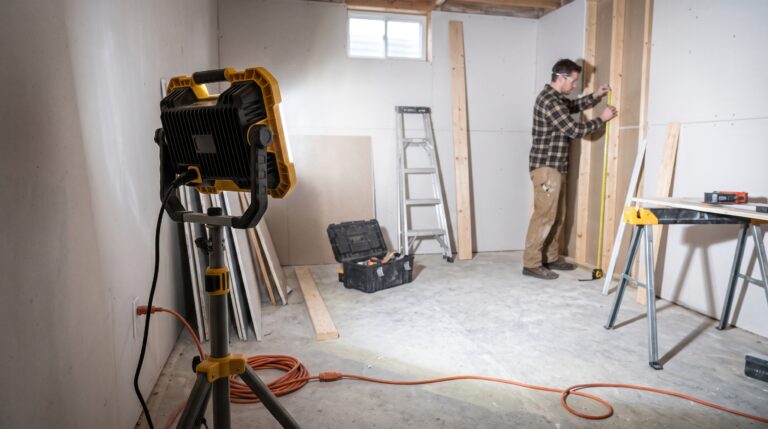
- Remodelers and painters: a tripod or stand light with a wide flood for low angle wall inspection, ideally one with a second battery bay.
- Homeowners: one versatile flood light that doubles as emergency lighting during outages, running on whatever battery the cordless drill already uses.
Battery Care Habits for Your Power Tool Battery Work Light
A power tool battery work light puts different stress on packs than a saw does. The draw is gentle but long, and lights often get left on. A few habits help.
- Pull the battery when the job ends. Some lights have a small standby drain even when switched off, and a pack left sitting in a light in a hot truck all summer ages quickly.
- Rotate packs. If you always grab the same battery for the light, it will wear out years before the others. Number your batteries with a paint marker and cycle through them.
- Avoid storing packs completely empty. Lithium ion cells are happiest stored partly charged. If a pack comes off the light dead, charge it before it goes back on the shelf.
- Keep packs out of freezing temperatures before charging. In winter, let a cold battery warm up in the cab before you put it on the charger. Most quality chargers will refuse to charge a frozen pack anyway, but it is better to build the habit.
- Retire swollen or cracked batteries immediately. A puffy pack does not belong in a light, a tool, or a toolbox. Take it to a battery recycling drop off point.
My Power Tool Battery Work Light Buying Checklist
When someone asks me which power tool battery work light to buy, I walk them through the same short list:
- Confirm your exact battery platform by model family, not just voltage.
- See whether the light accepts more than one pack family within the brand, like Makita’s LXT and XGT combo lights.
- Compare mounting options before lumens.
- Read the IP rating if the light will see rain, dust, or a wet basement.
- Pick a model with AC power input if you work on job sites with power available, so you can save the batteries.
- Choose one with a USB port if you need to charge a phone or a meter during long jobs.
- Skip universal adapters and stay inside the manufacturer’s system.
Follow those steps and you will end up with a light that runs for years on batteries you already own, which is exactly the point.
Frequently Asked Questions
Can I use any 18V battery in a power tool battery work light?
No. Fit depends on the brand’s slide rail and terminals, not the voltage number. Even within one brand, separate platforms like Milwaukee M12 and M18 do not cross. See Pro Tool Reviews on battery adapters for why mixing brands causes problems.
Are DeWalt 20V MAX and 18V XR batteries the same?
For practical purposes, yes. The difference is in how the voltage is labeled, not in the cells. ToolGuyd’s DeWalt 20V Max vs 18V explainer covers the history in detail.
Do FLEXVOLT batteries work in DeWalt 20V MAX lights?
They do. DeWalt’s 20V MAX lights accept FLEXVOLT packs, which gives you very long runtime. The DCL040 product listing at Home Depot confirms compatibility with 20V and 60V MAX batteries.
Can one Makita light run both LXT and XGT batteries?
Several can, including the ML003G and ML009G. Check the product page before buying, like Makita’s ML003G specifications.
Will an old Ryobi battery work in a new Ryobi light?
If both are ONE+ products, it will. Ryobi has kept the same battery interface since 1996. The Ryobi ONE+ history page walks through the timeline.
Are third party battery adapters safe for work lights?
They are risky. Adapters can bypass the battery’s protection electronics and may void your warranty. Read the Power Tool Institute’s guidance on choosing batteries before you buy one.
Is there a battery system shared by multiple brands?
Two of them, in fact. Metabo’s Cordless Alliance System and Bosch’s Power for All Alliance both let one 18V battery run products from several brands. See Metabo’s CAS overview and Bosch’s Power for All page.
References
- DeWalt DCL044 20V MAX Hand Held LED Work Light (DeWalt)
- Milwaukee Adds New M12 ROVER Flood Light (Milwaukee Tool)
- Makita ML003G 40V max XGT and 18V LXT Work Light (Makita)
- Home Depot Listing for the DeWalt DCL040 20V MAX LED Work Light
- M12 ROVER Service and Repair Flood Light Specifications (The Power Tool Store)
- ML003G Work Light Specifications and Runtime (Toolnut)
- New DeWalt 20V LED Work Lights (ToolGuyd)
- M18 ROVER Mounting Flood Light (Milwaukee Tool)
- M18 ROVER Clamping Flood Light (Milwaukee Tool)
- Makita ML009G 40V max XGT and 18V LXT Work Light (Makita)
- DeWalt 20V Max vs 18V: A Simple Answer and History Lesson (ToolGuyd)
- M18 ROCKET Tower Light/Charger (Milwaukee Tool)
- Tower Work Light for 40V XGT and 18V LXT Batteries (Pro Tool Reviews)
- DeWalt 20V Max vs XR: What’s the Difference? (Pro Tool Reviews)
- ML014G Tower Light Specifications (Paul B. Hardware)
- Why DeWalt Tools Are 20V in America but 18V Elsewhere (SlashGear)
- Makita Releases New XGT and LXT Underhood Work Lights (Makita)
- 18V ONE+ Platform History (Ryobi)
- Are Ryobi ONE+ Batteries Interchangeable? (Toolstop)
- Bosch Power for All 18V System (Bosch DIY)
- Metabo Cordless Tools and the Cordless Alliance System (Metabo)
- CAS Battery System: Cross Manufacturer and Future Proof (Toolbrothers)
- Should You Use Cordless Tool Battery Adapters? (Pro Tool Reviews)
- Choose Right, Be Safe When Selecting Batteries for Your Power Tools (Hardwood Floors Magazine)
- Ryobi Battery Adapters: What They Are and How They Work (SlashGear)