
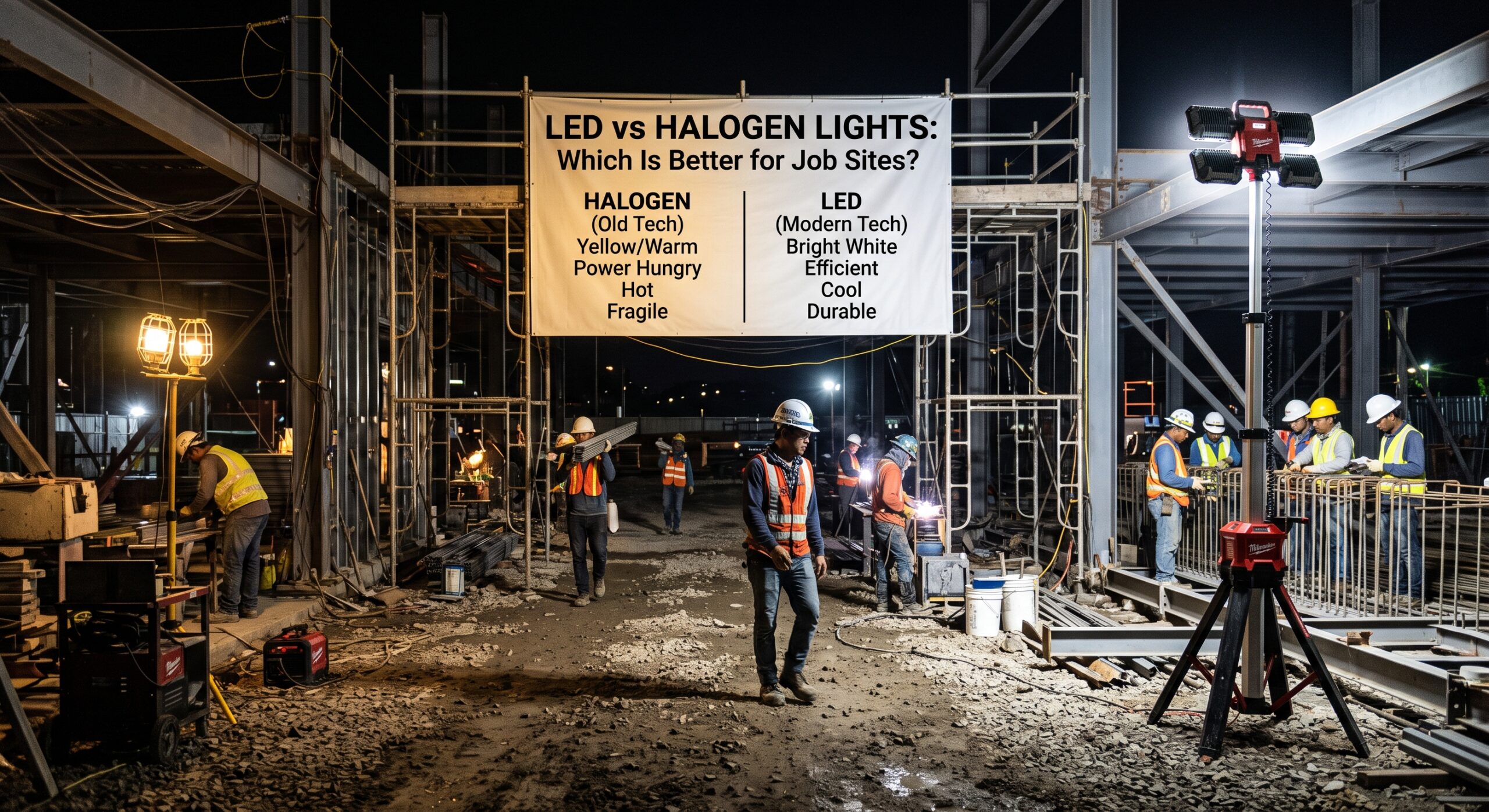
When choosing between LED vs halogen work lights for job sites, twenty years of walking sites before sunrise leads to a clear verdict: LED is the superior choice. Upgrading from halogen to LED is no longer just a preference—it is a fundamental safety and financial decision for modern site managers.
If there is one piece of equipment I get asked about more than any other, it is lighting. Not scaffolding, not fall protection, not even PPE compliance. Lighting. Everyone has an opinion on which work light to buy, but few ask the right questions before pulling the trigger.
This isn’t a marketing pitch, and brand doesn’t matter here. What matters is simple: Can your crew see clearly? Will that fixture start a fire near a stack of lumber? Are you burning generator fuel and cash you don’t need to burn? Let’s break down LED vs halogen work lights the way I would walk a new foreman through a Monday morning toolbox talk.
Why Lighting Is a Safety Issue, Not Just a Convenience
Most people think of work lights as a comfort item. Something you grab so the crew stops complaining about the dark. But on paper, that is not what it is.
Under 29 CFR 1926.56, OSHA sets minimum illumination levels for construction areas, and those numbers are not suggestions. General construction areas, excavation zones, storage areas, and loading platforms need at least 3 foot candles. Next, plants, shops, and mechanical rooms need 10. First aid stations and offices need 30. If an inspector walks your site with a light meter and you fall under those numbers, that is a citation. And citations are the least of your problems if someone gets hurt. Especially when they could not see a trip hazard or a live circuit.
I have investigated more near misses tied to poor lighting than I can count on both hands. For example, a laborer steps into a trench edge he did not see. A carpenter runs a saw blade through material he could not properly judge because of harsh shadows. An electrician misreads a panel label under a dim, flickering bulb. Still, none of these incidents make the news. All of them are preventable. Prevention starts with understanding what your light source is actually doing on that site. Not just how bright the box says it is.
That is where the led vs halogen work lights conversation turns from a shopping question into a safety question.
What a Halogen Work Light Actually Is
Halogen bulbs have stood as the standard on job sites for decades. There is a reason they stuck around so long. Indeed, they are simple. A tungsten filament sits inside a small quartz envelope filled with halogen gas. Run electricity through that filament and it glows white hot, throwing off a lot of light. Actually, the technology dates back to the 1950s. It is well understood, which is exactly why so many contractors trust it out of habit. That covers the halogen half of the led vs halogen work lights question.
The Heat Problem
Here is what “glows white hot” actually means in practice. A halogen bulb converts a huge share of its energy into heat rather than usable light. Roughly 80 percent or more of the energy going into that bulb comes back out as heat, not light. That quartz glass housing can reach surface temperatures well above 300 degrees Fahrenheit within minutes. I have seen guys grab a halogen work light bare handed out of habit, and regret it immediately.
Halogen lights also tend to be power hungry. For instance, a typical 500 watt halogen work light draws exactly what the name suggests. Run two or three of them off a generator along with saws, compressors, and heaters. So you will feel that load. The bulbs themselves are fragile too. Drop one while it is hot, even gently, and there is a real chance the glass shatters. On a site with dust, debris, and constant foot traffic, that fragility adds up fast.
What an LED Work Light Actually Is
LED stands for light emitting diode. Instead of heating a filament until it glows, an LED produces light through a semiconductor process. That process generates very little heat as a byproduct. That single difference explains almost every other difference on this list.
Because LEDs waste so little energy as heat, they produce far more usable light per watt than halogen. A modern LED fixture pulling 100 watts or less can outshine a 500 watt halogen fixture. It often wins on raw brightness while using a fraction of the power. Manufacturers now build portable LED fixtures that put out well over 10,000 lumens. Larger tower style units can exceed 100,000 lumens for big excavation or demolition sites.
LEDs also last longer, in some cases dramatically longer. A halogen bulb is typically good for somewhere under 3,000 hours before it needs replacing. Meanwhile, a quality LED fixture commonly runs for 30,000 hours or more. On a site running lights ten hours a day, that gap is huge. In short, it is the difference between swapping bulbs every few months and barely thinking about it for years. That covers the LED half of the led vs halogen work lights question.
LED vs Halogen Work Lights: The Head to Head Comparison
Let’s break this down the way I would justify a purchase order. Picture a project manager who wants numbers, not opinions.
Brightness and Visibility
First, LED wins this comparison on most modern fixtures. Lumen for lumen, an LED work light delivers cleaner, whiter light that renders colors more accurately. That matters when your crew needs to judge wire colors, material grades, or paint finishes. Halogen light runs warmer and yellower, which can actually help visibility in fog or heavy dust because it scatters less. But for general task lighting, LED wins out. Its higher color rendering index gives your crew a truer picture of what they are working on.
Heat and Burn Risk
This one is not close. Halogen fixtures run hot enough to cause skin burns on contact. They also run hot enough to ignite nearby combustibles, like tarps, insulation, sawdust, or paper products, if placed too close. I require a minimum clearance distance for halogen lighting on any site I run. So I treat it the same way I treat a space heater. LED fixtures run warm to the touch at most. That removes an entire category of fire and burn risk from your site.
Power Draw and Generator Load
LED fixtures typically use 50 to 90 percent less energy than halogen fixtures putting out comparable light. On a site running off generator power, that translates directly into fuel savings. It also means less strain on your electrical system. Also, fewer tripped breakers. Less risk of overloading a circuit that is also running tools.
Durability
Halogen bulbs use fragile glass envelopes under pressure and heat. That makes them vulnerable to breaking. Drops, vibration, or even rapid temperature swings like cold rain hitting a hot bulb can crack the glass. In contrast, LED fixtures use solid state components with no fragile glass filament to break. Most commercial LED work lights sit inside rugged, often rubberized or metal housings built for real drops and rough handling.
Weather Resistance
Quality LED work lights commonly carry IP65 or higher weatherproof ratings, sealed against dust and water jets. Halogen fixtures can carry weather ratings too, but the combination of high heat and moisture works against them. Rapid cooling from rain hitting a hot bulb is a common cause of bulb failure.
Lifespan and Replacement Cost
A halogen bulb lasting under 3,000 hours versus an LED lasting 30,000 hours or more is not a small gap. In fact, it is roughly a tenfold difference. Factor in labor time, downtime while someone tracks down a replacement, and the cost of the bulbs themselves. The LED advantage compounds fast.
Upfront Cost Versus Total Cost of Ownership
Halogen fixtures cost less to buy today. Say you need one light for a short job and never plan to use it again. That lower sticker price might make sense. But for any contractor running lights regularly across multiple jobs, the math flips quickly. Factor in energy use, bulb replacement, and generator fuel, and LED wins. Most of the contractors I work with recoup the price difference within the first year of regular use.
Instant On Versus Warm Up
LED fixtures reach full brightness instantly. Halogen bulbs also light instantly, to be fair. But they need time to cool before you can safely pack them up or move them. So that slows down teardown at the end of a shift. Most people do not think about it until they are standing there waiting.
Cold Weather Performance
This one surprises people. LED output can dip slightly in extreme cold right after startup. But the drop is minor, and the fixture stabilizes within seconds. Halogen bulbs are more prone to thermal shock failure in cold weather. The sudden jump from freezing air to a white hot filament puts real stress on that quartz glass envelope. I have watched a halogen bulb fail within a minute of switching on during a January pour. In short, the temperature swing alone did it.
Fixture Variety for Different Tasks
LED technology now covers nearly every form factor a site needs. Compact rechargeable flashlights and headlamps. Tripod stand lights. String lights for hanging along a corridor or scaffold. Full tower units for large excavation or demolition zones.
A growing share of these fixtures now add Bluetooth dimming and app control too, a shift we cover in our smart LED work lights compared roundup. Halogen still exists mostly in the tripod stand light category. As a result, that limits your options if you need something more specialized. Think a magnetic mount light for steel work, or a low profile string light for a finished space.
The Real World Safety Case I Make to Every Crew
As a safety officer, my job is to think about worst case scenarios. Here are a few I have personally dealt with. They explain why my sites default to LED unless there is a specific reason not to. That is my starting position on led vs halogen work lights.
Fire Risk Is Not Theoretical
I once had a halogen work light knocked into a pile of packing material on a renovation job. Within a minute there was visible scorching on the cardboard underneath. Nobody got hurt, and the fire never fully caught. But it was close enough that we changed our lighting policy on the spot. Actually, that is not a rare story among people in my field. Search any safety forum and you will find similar accounts. University environmental health and safety departments publish the same warning about halogen lamp fire risk near combustible material.
Glare Creates Its Own Hazards
There is also the simple ergonomic issue of glare and eye strain. Poorly diffused halogen light throws harsh shadows that can hide trip hazards and make depth perception harder. That matters most for finish work like tile setting, cabinetry, or detail painting. LED fixtures with good diffusion lenses spread light more evenly. Still, that sounds like a small thing. But plenty of falls and cuts trace back to someone simply not seeing what was in front of them clearly.
GFCI Protection Still Applies
Any temporary lighting setup on a job site needs to run through GFCI protection under OSHA’s temporary wiring requirements. Lower amperage draw from LED fixtures puts less strain on those circuits and extension cord runs. That reduces the odds of overheating cords or nuisance trips. Both can leave a crew working in the dark at the worst possible moment.
Make It Part of the Toolbox Talk
I bring this up in nearly every toolbox talk I run at the start of a new job. Lighting rarely gets the same attention as fall protection or trenching safety. But it touches almost every other hazard on a site indirectly. A crew that can see clearly makes fewer mistakes with tools, notices hazards sooner, and moves with more confidence. So I would rather spend ten minutes talking about where lights get placed. That beats spending an afternoon filling out an incident report because nobody thought lighting was worth discussing.
Where Halogen Still Has a Place
I try not to be dogmatic about this, because a good safety officer deals in real tradeoffs, not absolutes. Even so, halogen still shows up on my sites in a few specific situations.
Say a subcontractor needs a single disposable light for a one day job. They do not want to invest in equipment they will not use again. A cheap halogen work light off the shelf at a hardware store can be the pragmatic choice. On a site with no power run yet at all, some crews reach for a panel charged option instead of halogen entirely — we weigh whether that’s worth it in Solar Rechargeable Work Light: Worth It? Halogen’s warmer color temperature can also cut through heavy fog, smoke, or dust slightly better in certain conditions. That matters on some demolition or excavation sites.
But those are edge cases, not the default. For anyone running lights day after day, across multiple crews and multiple sites, the numbers point in one direction. Safety, cost, and durability all favor LED. On the led vs halogen work lights question, that is as close to settled as this industry gets.
My Recommendation
If you are setting lighting policy for a crew, here is my direct answer to every project manager who asks. So standardize on LED work lights for anything beyond a single throwaway job. Choose fixtures with an IP65 rating or higher and a metal or heavy duty polymer housing. Match the lumen output to the OSHA minimum for the area you are lighting. Then add a comfortable margin above that minimum. Meeting the bare legal number is not the same as meeting a safe, practical number.
Keep a couple of compact halogen or battery powered lights around for quick, short duration tasks. Still, use them where portability matters more than efficiency. But do not let halogen be your primary lighting source on an active site in 2026. The technology has simply moved past it. Technology that runs hot enough to burn skin and ignite debris is not a close call. Not in my line of work.
Whatever you choose, walk your site with a light meter occasionally. Do not assume your fixtures still hit the numbers they did on day one. Lenses get dirty, bulbs degrade, and battery powered units lose output as batteries age. A five minute check with a light meter costs you almost nothing. It can catch a problem before it becomes an incident report. That is my complete take on led vs halogen work lights for job site policy.
Frequently Asked Questions
Is LED actually brighter than halogen, or does it just seem that way?
For a given wattage, yes. In fact, LED produces significantly more usable light than halogen. A 100 watt LED fixture can match or exceed the output of a 500 watt halogen fixture. The LED simply loses far less of its energy as heat. The Department of Energy’s lighting efficiency research backs this up. So does independent product testing from outlets like Pro Tool Reviews, consistently across brands. That is the short version of the led vs halogen work lights brightness gap.
What does OSHA actually require for job site lighting?
Under 29 CFR 1926.56, general construction areas need a minimum of 3 foot candles. General construction plants and shops need 10. First aid stations or offices need 30. These are minimums, not targets, and a responsible site manager builds in a margin above them.
Can a halogen work light actually cause a fire on a job site?
Yes. Halogen bulbs run hot enough to ignite paper, cardboard, sawdust, insulation, and other common combustibles. That risk shows up if you place them too close or leave them resting against something flammable. University environmental health and safety programs publish specific guidance on halogen lamp fire hazards. Oregon State University’s EHS office is one example.
How much money can switching to LED actually save on a job site?
It depends on how many lights you run and how many hours a day you run them. Lower power draw, far fewer bulb replacements, and reduced generator fuel consumption add up fast. So most contractors recover the price difference within a year of regular use. The savings scale with usage. A crew running lights ten hours a day sees a faster payback than one running lights occasionally.
Do LED work lights need GFCI protection just like halogen lights?
Yes. GFCI protection requirements for temporary job site wiring apply no matter what type of bulb or fixture you plug in. LED fixtures draw less amperage, which reduces strain on circuits and extension cords. But it does not remove the requirement for proper GFCI protected temporary power.
Is it true that halogen lights are better in fog or heavy dust?
There is some truth to this. Halogen’s warmer, more yellow light scatters less in fog, smoke, and heavy dust. In contrast, many LED fixtures put out a cooler, whiter light that scatters more. That can make halogen marginally easier to see through in those specific conditions. Most contractors dealing with this issue now buy LED fixtures built with a warmer color temperature. That gets the best of both worlds.
What type of LED work light should a small contracting crew start with?
For most residential contractors and small crews, start with a rechargeable tripod or stand light. Something in the 10,000 to 20,000 lumen range covers most daily tasks. Add a couple of compact rechargeable flashlights or headlamps for detail work in tight spaces like crawl spaces or attics. Finally, larger crews working excavation, demolition, or multi story commercial builds add a tower style fixture for broad area coverage. They bring it in once the smaller fixtures stop being enough on their own.
References
Occupational Safety and Health Administration, 29 CFR 1926.56, Illumination
Occupational Safety and Health Administration, Requirements for minimum illumination at construction sites, Standard Interpretation
Pro Tool Reviews, LED vs Halogen Work Lights and Bulbs on Jobsites
Oregon State University Environmental Health and Safety, Halogen Lamp Hazards
J. J. Keller Safety, Illuminating OSHA’s Lighting Requirements