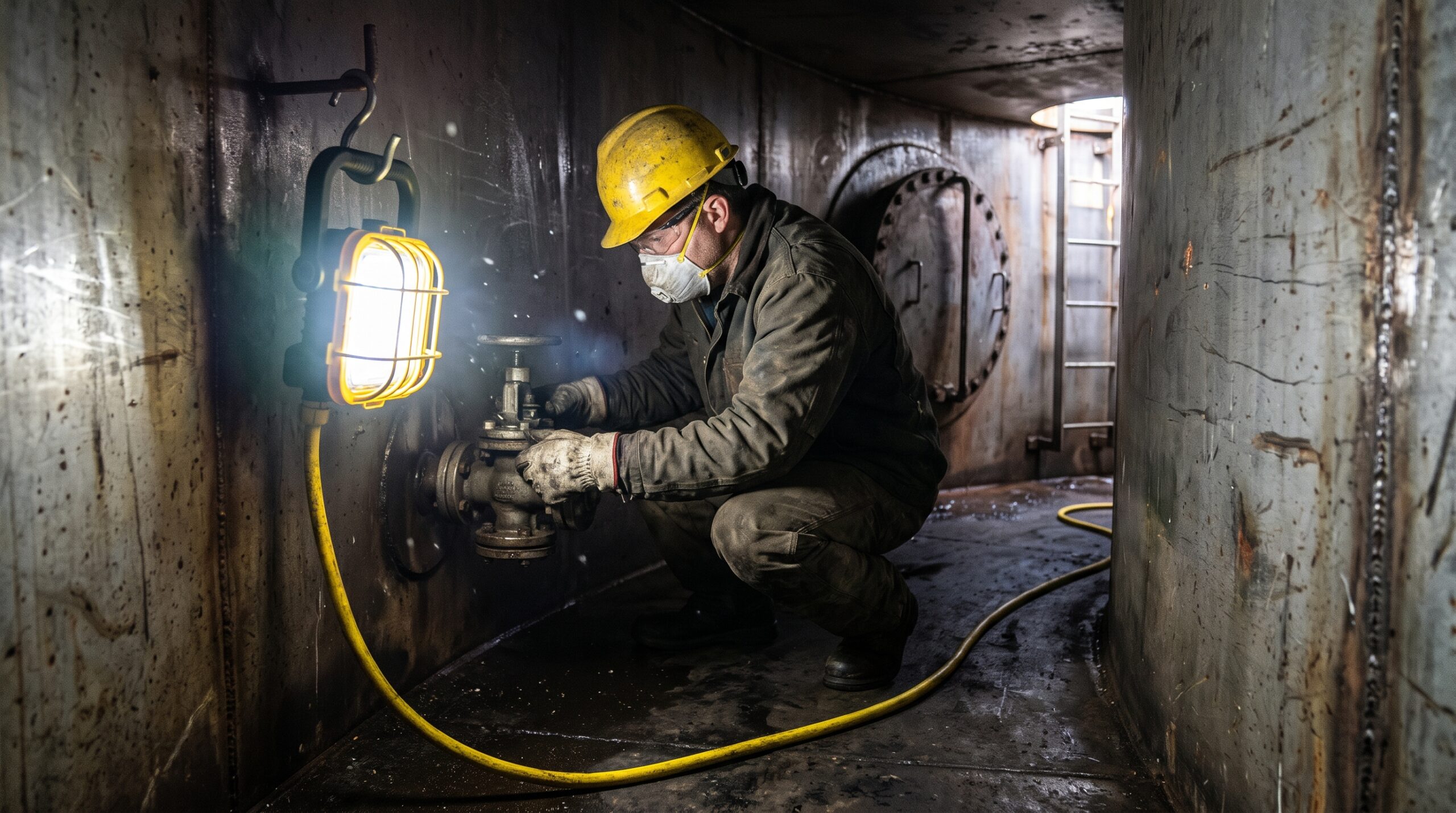
Low-Voltage LED Work Lights for Confined-Space Industrial Jobs
I have stood at the top of a lot of manways over the years. Some led into fuel tanks, some into wastewater wet wells, a few into boiler drums still warm from a shutdown the night before. Before anyone goes down, someone reads the gas meter. The second thing I check, almost every time, is the light going in with them. A confined space work light looks like the least interesting item on the permit. In my experience it is often the one most likely to hurt somebody.
That surprises people. They think of a work light as an accessory, something you grab off the truck because it is dark. But inside a steel vessel, a wet pit or a crawlspace full of standing water, your light is an electrical device sitting a few inches from a worker surrounded by grounded metal. It may also sit in air that can ignite. Pick the wrong one and you have brought a hazard into the space yourself, after spending an hour testing and ventilating to get the hazards out.
This article covers how I evaluate lighting for confined space entries. It is the same thinking I use when I review a contractor’s entry plan or walk a job before anyone signs the permit. I wrote it for industrial crews, and also for the home services contractors who take on more confined space work than they often realize.
Why a Confined Space Work Light Is a Hazard Control, Not an Accessory
The NIOSH research on confined space deaths has been around for decades, and the pattern has not changed much. One NIOSH analysis looked at 1983 through 1993 and counted 670 worker deaths in confined spaces. Roughly 80 percent of the incidents involved hazardous atmospheres, and more than a third of the victims died trying to rescue someone else. The NIOSH FACE investigations list electrical equipment, slippery surfaces and falling material among the physical hazards, alongside the atmospheric ones.
Poor lighting connects to almost all of those. If an entrant cannot see the floor of a tank, slips go up. An attendant who cannot see the entrant notices problems late. And a rescue that starts in a space that just went dark, because a cord got pinched or a breaker tripped, turns a bad situation into a worse one fast.
So I treat a confined space work light the same way I treat ventilation. It is an engineering control, and I plan, specify and inspect it like one. The questions are simple:
Could this light shock someone in this environment?
Can it ignite anything in this atmosphere?
Does it give enough even light to do the job and get out safely?
What happens if it fails?
Everything else in this article comes back to those four questions.
What the Regulations Say About Confined Space Work Light Use
There is a lot of folklore on job sites about confined space lighting rules. I have heard people say OSHA requires 24 volts in every tank, and I have heard the opposite. Here is what the text actually supports.
Construction Rules
29 CFR 1926.405. The construction electrical standard says portable electric lighting in wet or other conductive locations has to run at 12 volts or less, and it names drums, tanks and vessels as examples. It then allows 120 volt lights in those same places if a ground fault circuit interrupter protects them. That second sentence matters. That paragraph permits a 120 volt light on a GFCI. Whether it is a good idea in a given space is a separate question.
OSHA interpretations. An old but still useful OSHA interpretation letter from 1976 separates portable lighting from temporary lighting. It says crews may use temporary lighting in explosive atmospheres only if it meets the National Electrical Code, which means explosion proof, guarded fixtures with continuous wiring and no plug connections inside the space. I still use that letter in training, because it shows clearly how much changes once the atmosphere can burn.
General Industry and Hazardous Locations
29 CFR 1910.146. The permit required confined space standard does not set a voltage for lighting. It requires the employer to evaluate the space, identify the hazards and write the controls into the permit. EHS Daily Advisor answered a reader question on this exact point and confirmed that the confined space rules leave lighting details to the employer’s hazard evaluation. Their answer also noted that a policy requiring 12 volt lighting, with transformers and GFCIs outside the space, is a sound best practice.
29 CFR 1910.307. If the space is a classified location, the equipment must be intrinsically safe, carry approval for that location, or otherwise suit it safely. That rule applies to your work light just as much as to a pump motor.
Illumination Levels
29 CFR 1926.56. The construction illumination table sets 5 foot candles as the minimum for general construction areas and for tunnels, shafts and general underground work. The table requires ten foot candles at tunnel and shaft headings during drilling, mucking and scaling. OSHA proposed rescinding this standard in 2025, so check its current status. Either way, I would not plan around 5 foot candles inside a vessel where someone is grinding a weld. That number is a minimum for walking through, not for skilled work.
The takeaway is that the regulations set a floor and then hand the decision to you. That is why the hazard assessment matters so much. Nobody can tell you the right confined space work light for your job without knowing what is in the space.
Low Voltage Is Not the Same as Explosion Protection
This is the most common mistake I see, and it is a dangerous one. Someone reads that 12 volts is “safe,” buys a 12 volt LED confined space work light, and takes it into a tank that held gasoline last week.
Low voltage solves the shock problem. It does nothing on its own for the ignition problem. A 12 volt circuit can still make a spark when someone pulls a connector apart or a damaged cord shorts out. An LED driver can still run hot. Tuomas Seilo of Atexor, a hazardous area lighting supplier, makes this point clearly in his writing on confined space lighting. Ex certified equipment can be high or low voltage, and low voltage by itself is not explosion protection.
Two Separate Checks for Every Confined Space Work Light
So I treat these as two separate checks:
Shock protection comes from low voltage supply, GFCI protection, double insulation, sound cords and keeping the mains side of the system outside the space.
Ignition protection comes from a hazardous location rating that matches the atmosphere: Class I Division 1 or 2 under the North American system, or ATEX and IECEx zones elsewhere. That rating also needs the right gas group and a temperature code below the autoignition temperature of whatever might be present.
A light can pass one check and fail the other. For example, an intrinsically safe flashlight usually puts out too little light for a work area, but it makes a good backup. A bright 12 volt floodlight with no hazardous location rating works fine in a dry, clean, vented space but becomes a real problem in a solvent tank. You need to know which checks your space requires before you open a catalog.
My Permit Rule
My rule for permits is simple. If the atmospheric hazard assessment lists any flammable potential, even “residual,” even “only during cleaning,” the lighting needs a rating for that classification. Low voltage alone is not enough.
Choosing the Right Confined Space Work Light: My Field Checklist
When a contractor shows me their lighting, these are the things I look at, roughly in this order.
Voltage and Power Source
For wet or conductive spaces, I want a confined space work light running at 12 volts, or 24 volts where the space is dry and cool and the local rules allow it. Some jurisdictions are strict on this. Belgium, for example, allows 24 volt AC lighting in confined spaces that are dry and cool enough that workers will not sweat. Once the space is hot or humid, it requires 12 volts. I think that is sensible, because sweat lowers skin resistance and a wet hand on a steel wall conducts far better than a dry one.
Battery powered LED lights have changed this conversation a lot. A good rechargeable unit has no cord to pinch, no transformer to place and no supply side voltage at all. For short entries and inspections, they are often my first choice. For long shifts, like tank cleaning that runs through the night, a corded low voltage system from a properly placed transformer usually beats swapping batteries every few hours.
Hazardous Location Rating
Match the rating to the classification on the permit, not to what the space usually contains. Confirm the gas group as well as the class and division. The temperature code, often shown as T1 through T6, also has to suit the substances involved. A light rated T3 may be fine for one product and not for another.
Ingress Protection
Crews wash tanks. Pits flood. Crawlspaces drip. I want IP66 or IP67 at minimum on anything that goes into a space where water is likely. An LED fixture that lets in water can fail in ways that defeat the very low voltage protection you paid for.
Light Output and Beam Pattern
More lumens is not always better. In a small polished stainless vessel, a powerful spot beam bounces off every surface and creates glare that is almost worse than darkness. I would rather see two or three moderate flood fixtures spread around than one very bright one aimed at the work. For task work, a lower output light close to the job usually beats a bright light far away.
Color matters too. A neutral color temperature, somewhere around 4000 to 5000 Kelvin, makes it easier to read gauges, spot corrosion and see the difference between a stain and a crack. Very cool blue light tires the eyes over a long shift.
Heat
LEDs run much cooler than the old halogen and incandescent lights, which is one of the best reasons to switch. But “cooler” does not mean cold. Drivers and housings still warm up, and in a hot vessel that heat adds to the load on the worker. Check surface temperature ratings, especially for lights that someone may set down on insulation, rags or residue.
Mounting
Workers kick any confined space work light that ends up on the floor, bury it in sludge or turn it toward the wall. I look for magnetic bases rated for the application, manway mounts, hooks and stands that hold the light where the work needs it. A manway mounted fixture that lights the whole interior from the entry point keeps the cord run short and keeps the hardware out of the entrant’s way.
Cords and Connectors
Cords should carry a hard usage or extra hard usage rating, with no splices or taped repairs, and enough length to reach without strain. If you must use plugs and connectors, keep them outside the space. Inside a classified space, wiring should be continuous, as that 1976 OSHA letter describes.
Where the Transformer Goes Matters More Than People Think
This is a lesson I learned the hard way, and Atexor’s Tuomas Seilo describes almost the same situation in his writing. On a site visit, he found his company’s own Ex certified transformer sitting inside a confined space that required low voltage lighting. The equipment carried the right certification. The setup was still wrong, because the primary side of a step down transformer carries full mains voltage. Put it inside the space and you have brought line voltage back into the area you were trying to protect.
I tell every crew the same thing. The transformer, the GFCI and the disconnects stay outside. Only the low voltage side crosses the threshold. Sketch the layout on the permit. It takes thirty seconds and it removes the guesswork for the next shift.
I also want lights on their own circuit, apart from tools and ventilation. If a grinder or blower trips the circuit, the entrant should not lose their light along with it. I once watched an entrant lose all light because a fan and a light shared one GFCI. Nobody suffered an injury that day, but it was not something anyone wanted to repeat.
Home Services Crews Need a Confined Space Work Light Too
A lot of my consulting work these days is with home services companies: HVAC, plumbing, restoration, pest control and electrical contractors. Many of them do not think of themselves as confined space employers. Then I walk the jobs with them.
Attics with limited access and summer heat. Crawlspaces with standing water and a single small hatch. Commercial grease interceptors. Septic and holding tanks. Rooftop unit plenums and large ductwork. Boiler fireboxes. Lift stations and utility vaults on light commercial jobs. Many of these meet OSHA’s definition of a confined space, and some will need a permit depending on the hazards.
The lighting problems are the same as in an industrial plant, only smaller and less planned. The usual setup is a 120 volt clamp light on a household extension cord, run into a wet crawlspace, with nobody checking whether the outlet has GFCI protection. A tech lying on his back in an inch of water, holding a metal light housing, is exactly the wet and conductive situation that 12 volt rules target.
What I Recommend for Home Services Crews
For these crews, my recommendation is practical. Put a good rechargeable LED confined space work light on every truck, rated at least IP65, with magnetic or hook mounting, and make it standard issue. Keep a small intrinsically safe flashlight or headlamp in every tech’s kit as a backup. If the company does grease traps, septic or fuel related work, buy at least one properly rated hazardous location light and train people on when they have to use it. It is a modest cost compared with one serious incident.
Setting Up Your Confined Space Work Light Inside the Space
Once the right equipment is on site, where you place it matters just as much.
Placement Basics
Light the egress path first. Before anyone starts working, light the route out end to end, from the work area to the manway or hatch. If the entrant has to leave fast, they should not have to search for the exit.
Separate ambient light from task light. One fixture lights the space so people can move safely. Another, usually smaller, lights the actual work. Combining both jobs in one bright light almost always produces shadows exactly where the hands are.
Kill the shadows on the floor. Most slips I have investigated happened where equipment or the worker’s own body shaded the floor. Light from at least two directions helps.
Give the attendant a view. If the attendant can see the entrant, or at least the light the entrant works by, they will notice problems sooner. Some crews put a light near the manway and aim it into the space just for this.
Backup and Verification
Plan for failure. Every entrant carries a personal light, either a rated headlamp or a flashlight, that works independently of the main system. Many hazardous location LED fixtures now include an emergency battery that keeps the light on after a power loss. For long entries in large tanks, that feature is worth paying for.
Watch the light meter, not your eyes. Eyes adjust and lie. A cheap light meter will tell you whether you actually have the foot candles you planned for. I check at the work surface, not at the fixture.
Inspecting and Maintaining a Confined Space Work Light
A confined space work light that lives in the back of a truck takes a beating. I want someone to inspect it before every entry and record that inspection on the permit or the equipment checklist.
Look for cracked lenses, missing guards and damaged housings. On hazardous location lights, check that the gaskets, seals and fasteners are all present and tight. A missing screw can void the rating. Inspect cords for cuts, crushed areas and pulled strain reliefs. Test the GFCI with its test button before the light goes in. On battery lights, confirm the charge covers the planned entry plus a margin, and replace batteries that no longer hold a full shift.
Retire lights that someone has dropped hard, modified or repaired with parts from outside the manufacturer. A rated fixture that someone has fixed with a different lens or seal is no longer the fixture on the certificate.
The Mistakes I Keep Seeing
After years of audits, these come up again and again:
Bringing a low voltage light without a hazardous location rating into a space with flammable potential, on the belief that “12 volts can’t spark.”
Placing the transformer or GFCI inside the space.
Running lights and power tools on the same protected circuit.
Relying on one very bright light and accepting the glare and shadows that come with it.
Letting the entrant’s only light be the main fixture, with no personal backup.
Using household extension cords and clamp lights in wet crawlspaces and pits.
Leaving lighting off the permit completely, so nobody actually looked at it.
None of these needs expensive fixes. Most just need someone to slow down at the planning stage and ask the four questions from the start of this article.
Building Lighting Into the Permit
This is how I close every lighting conversation with a client. If nobody wrote the lighting on the permit, nobody really planned it. A good entry permit should list:
The lighting equipment by type, including voltage and hazardous location rating where required.
Where the transformer, GFCI and disconnects sit, outside the space.
The backup lighting each entrant carries.
Who inspected the lighting and when.
Any conditions that would stop the entry, such as loss of lighting, a changed atmospheric reading, or water rising toward electrical equipment.
That last point matters. Treat losing the light the same as losing ventilation. The work stops and people come out until someone fixes it.
Final Thoughts
The right confined space work light is not the brightest or the most expensive one on the shelf. It is the one that matches the hazards of the space in front of you. That means low voltage or battery power where shock is the concern, a proper hazardous location rating where ignition is the concern, sensible placement of the supply equipment, and a backup that works when everything else fails.
LED technology has made all of this easier. The lights are cooler, lighter, more efficient and more durable than anything we had fifteen years ago. But the technology only helps if the planning behind it is sound. Treat your lighting as a hazard control, write it into the permit, inspect it every time, and you remove one of the quieter ways that confined space work goes wrong.
Frequently Asked Questions
Does OSHA require a 12 volt confined space work light?
For construction, portable lighting in wet or conductive locations such as tanks and vessels must run at 12 volts or less, unless a GFCI protects a 120 volt light, under 29 CFR 1926.405. The general industry confined space standard does not set a voltage. It leaves lighting controls to the employer’s hazard evaluation, as EHS Daily Advisor explains.
Is a 12 volt LED confined space work light safe in a flammable atmosphere?
Not by voltage alone. Low voltage reduces shock risk but does not prevent ignition. In a classified atmosphere the light needs a matching hazardous location rating, which 29 CFR 1910.307 requires. Atexor’s article on low voltage lighting in confined spaces explains why the two protections are separate.
Where should the transformer and GFCI be placed?
Outside the confined space. The primary side of a step down transformer carries full mains voltage, so placing it inside defeats the purpose of low voltage lighting. Heating and Process’s article on confined space lighting covers this, as do the employer practices that EHS Daily Advisor discusses.
How much light should a confined space work light provide?
OSHA’s construction table sets 5 foot candles for general areas and underground work, with higher minimums for some tasks, in 29 CFR 1926.56. Detailed work such as welding or inspection usually needs much more. SafetyIQ’s overview of OSHA lighting standards gives practical ranges for different tasks.
Is a battery powered confined space work light a good choice?
Often, yes. It removes cords and supply voltage from the space, which makes it well suited to short entries and inspections. For flammable atmospheres it still needs the correct hazardous location rating. A corded low voltage system often serves long entries better, as Wolf Safety’s tank cleaning lighting guidance describes.
Do home services contractors need to follow confined space rules?
If their work involves spaces that meet OSHA’s definition, such as some crawlspaces, attics, vaults, tanks and grease interceptors, then yes. OSHA’s Permit Required Confined Spaces booklet explains how to recognize these spaces and what a permit program involves.
References
Permit Required Confined Spaces, 29 CFR 1910.146, Occupational Safety and Health Administration.
Q&A: Lighting in Confined Spaces, EHS Daily Advisor.
Hazardous (Classified) Locations, 29 CFR 1910.307, Occupational Safety and Health Administration.
Confined Spaces Lighting and Low Voltages for Hazardous Areas, Heating and Process.
Illumination, 29 CFR 1926.56, Occupational Safety and Health Administration.
Tank Cleaning and Maintenance Lighting, Wolf Safety.
OSHA Lighting Standards and Requirements Every Facility Manager Should Know, SafetyIQ.
Permit Required Confined Spaces Booklet, OSHA 3138, Occupational Safety and Health Administration.
Worker Deaths in Confined Spaces, Professional Safety Summary, CDC Stacks.
Proposed Rescission of OSHA Construction Illumination Standard, J. J. Keller.